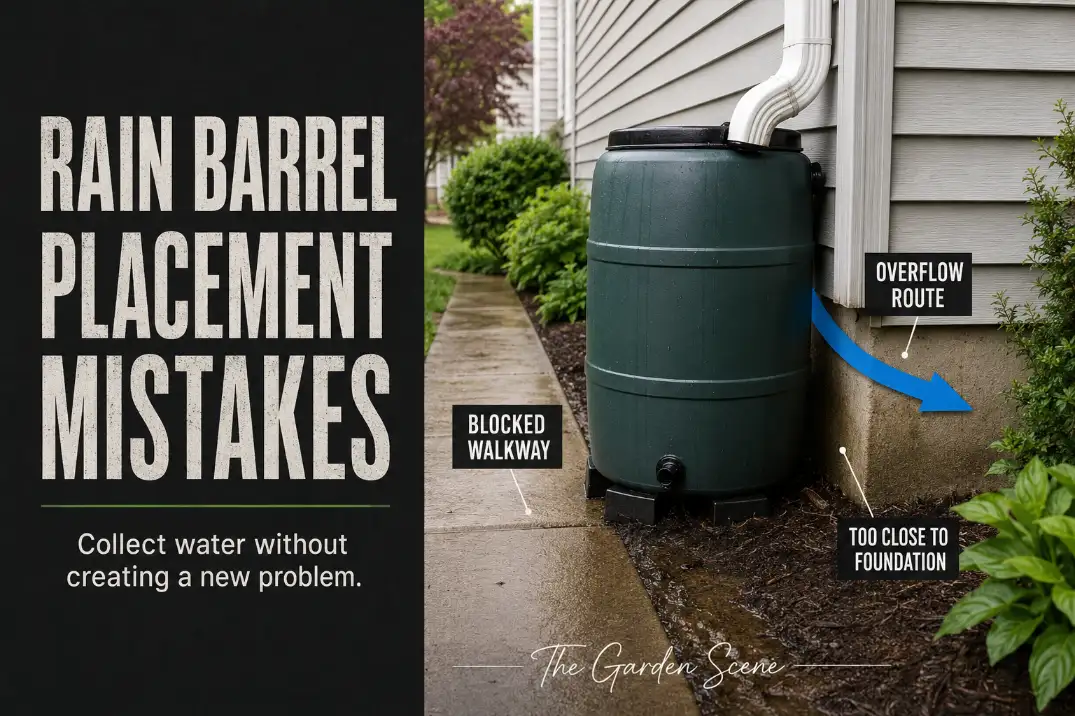
Rain barrels usually fail as placement decisions before they fail as containers. A downspout may fill the barrel, but that does not mean the barrel is safe, reachable, stable, or useful.
The first checks are simple: leave about 30 to 36 inches of walking clearance, give overflow a route away from the house, and set the barrel on a base that can hold several hundred pounds when full.
The bigger mistake is treating the barrel like a gutter accessory instead of a small water system. One inch of rain on 1,000 square feet of roof can produce more than 600 gallons of runoff, while a common residential barrel may hold only 40 to 60 gallons.
That means the barrel can turn from “storage” into “overflow device” during one strong storm. Placement has to work after the barrel is full, not just while it is filling.
The Downspout Is Not Enough
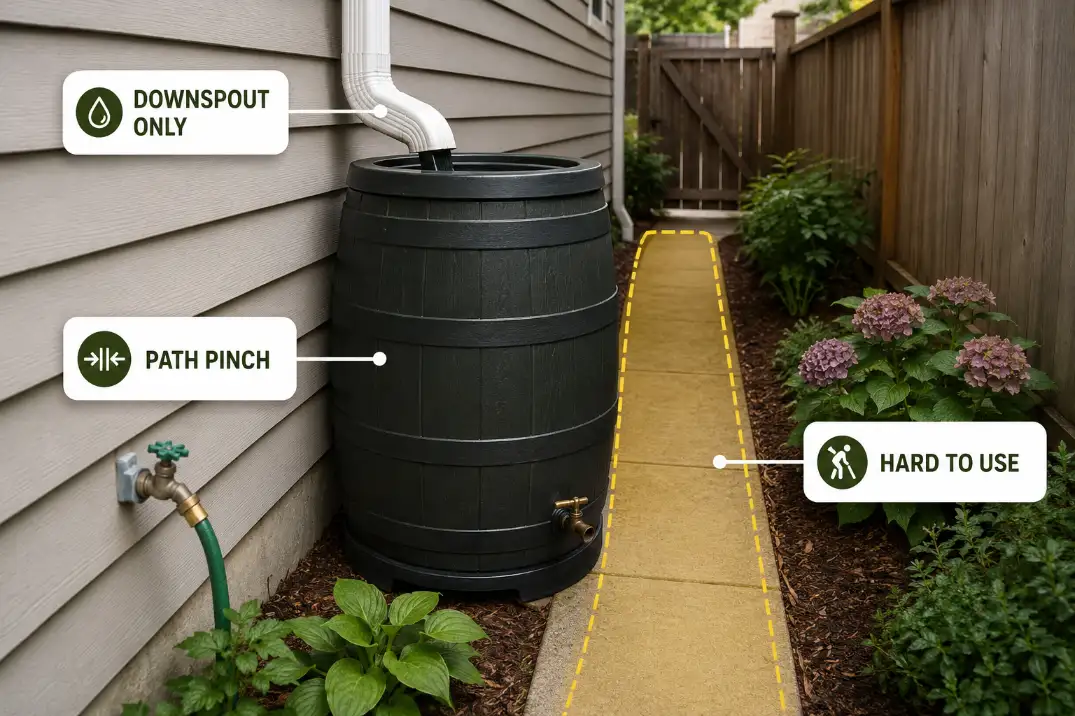
The right rain barrel location is not automatically the downspout that looks easiest to connect. The better location is the one that gives the barrel three things at once: a clean fill point, a usable watering route, and a safe overflow path.
The fill point is not the use point
A barrel tucked behind shrubs, squeezed beside a gate, or placed in a narrow side yard can collect water perfectly and still be a poor setup. If using it means stepping around bins, HVAC equipment, mud, or a tight corner, the barrel becomes an object you avoid instead of a tool you use.
A useful barrel should sit close enough to the planting area that filling a watering can feels easier than turning on the hose. If the main garden bed is 40 feet away and the path is awkward, the barrel may look sustainable while quietly becoming unused.
That is why drainage and access should be judged together. A downspout that already sends water across a walk may need a layout correction before a barrel is added.
The same failure pattern appears in Front Yard Drainage Downspout and Walkway Problems, where the visible puddle is less important than the route water takes to get there.
Bigger is not always better
A taller or larger barrel does not fix a poor location. It may block a window, raise the center of gravity, make the spigot harder to reach, or increase the weight on a weak base.
A 50-gallon barrel holds about 415 pounds of water before counting the barrel, stand, fittings, or blocks. If the location is already cramped or soft, upsizing the barrel simply adds more stress to a bad spot.
Pro Tip: Choose the working location first, then choose the barrel size. A smaller barrel in the right service spot usually performs better than a larger barrel jammed into the only downspout corner available.
Walkways Get Blocked Fast
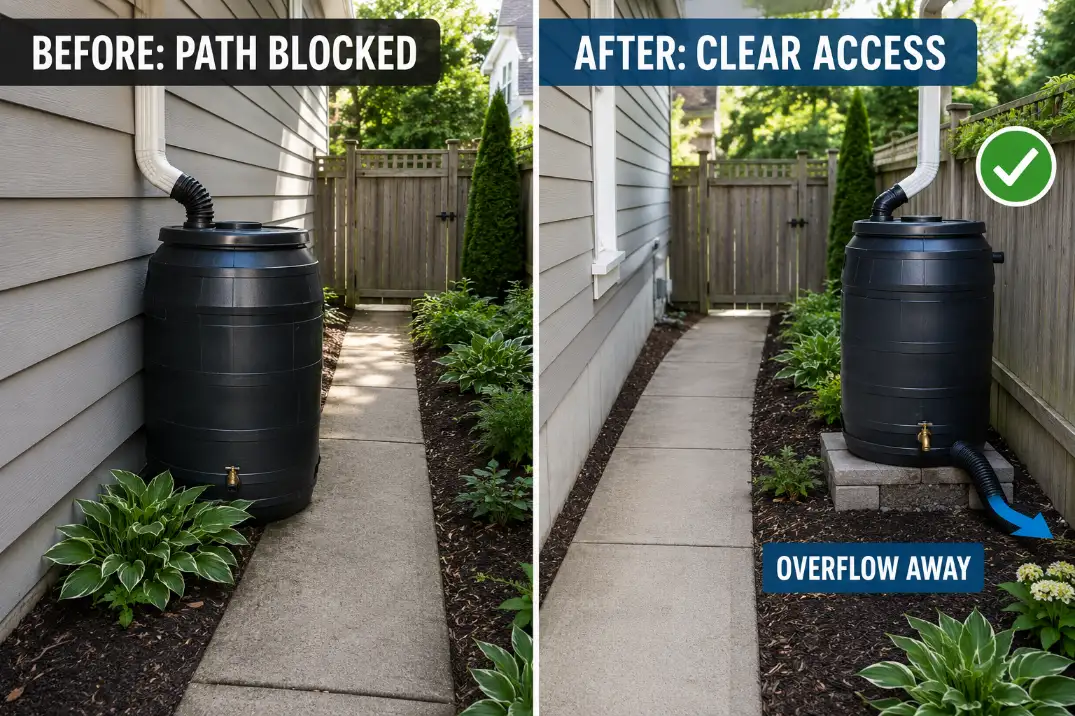
If a rain barrel reduces a primary path below about 36 inches, the placement is already failing before the first storm. The barrel itself may fit, but the working space around it often does not.
Dry clearance is not real clearance
A 24-inch-wide barrel may need another 12 to 18 inches in front for the spigot, hose connection, watering can, and hand movement. A walkway that feels passable when the barrel is empty can become awkward once the ground is wet, a hose is attached, or leaves collect around the base.
For a main route from a back door, side gate, or patio, aim for about 36 inches of clear walking space. A secondary service route can sometimes work closer to 30 inches, but less than that usually turns into a shoulder-turning squeeze.
This is where homeowners often overestimate the value of “it technically fits.” Fitting against the wall is not the same as staying usable through a rainy season.
The symptom is clutter; the mechanism is route friction
A blocked walkway often gets described as clutter, but the real problem is route friction. Every time someone has to step around the barrel, place a watering can at an odd angle, or avoid a damp hose, the system becomes less likely to be used.
That friction matters more than appearance. A neat barrel in the wrong path is still a wrong barrel. The same access logic applies near patio doors and everyday outdoor routes; Keep Patio Entry Clear explains why even a small obstruction near an entry can feel much larger during daily use.
Overflow Needs a Safe Route
Overflow is the part of rain barrel placement that gets underestimated most. A barrel does not store all roof runoff. It only delays part of it. Once it fills, every extra gallon must go somewhere.
A full barrel becomes a bypass point
A typical 40- to 60-gallon barrel can fill quickly during a strong storm, especially when connected to a large roof plane. After that, overflow behaves like a redirected downspout. If the outlet points toward the house, a low planting bed, a patio, or a walkway, the barrel has not solved drainage. It has moved the problem.
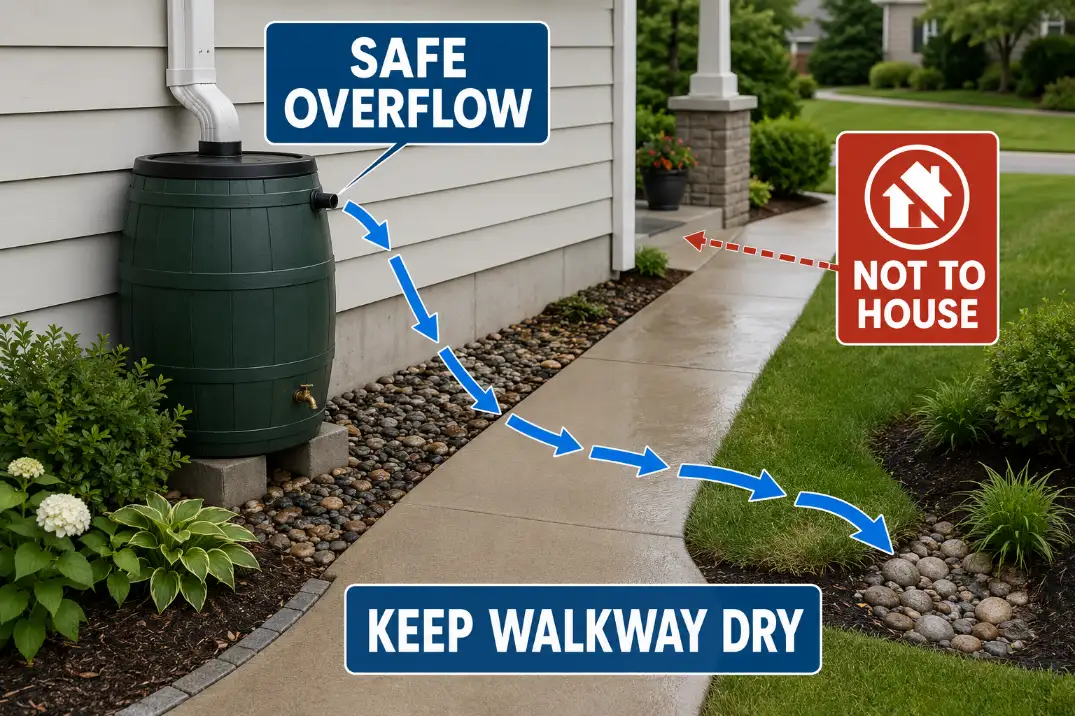
A safer rule is to send overflow at least 6 feet away from the house when possible. Ten feet is a better target where the soil is flat, clay-heavy, already damp near the wall, or prone to winter freezing.
Even a gentle 1-inch drop over 8 to 10 feet is more useful than a flat route that lets water linger beside the wall.
For yards where roof runoff already needs a controlled outlet, the decision may not be “barrel or no barrel.” It may be a barrel plus overflow hose, downspout extension, pop-up emitter, or dry well.
That comparison is easier to think through in Pop-Up Emitter, Downspout Extension, or Dry Well.
Overflow should not cross the walkway
Overflow across a walkway is a small mistake that becomes obvious fast. In warm weather, it can leave algae, soil splash, and slippery damp spots. In northern states, the same route can freeze overnight and create an ice strip near the door.
A healthy overflow route disappears into lawn, gravel, a planted drainage area, or another safe receiving zone. A failing route leaves wet mulch, puddles that last more than 24 hours, or a dark damp strip along the wall.
Diverter, hose, or second barrel?
The overflow setup should match the site. A diverter can return excess water to the downspout when the barrel is full, which is useful when the original downspout discharge route is already safe.
An overflow hose is better when the barrel needs to send extra water to lawn, gravel, or a drainage bed. A second barrel can add storage, but it does not remove the need for a final overflow route.
A second barrel is often overestimated. If the roof area is large, two barrels can still fill during one storm. Storage helps only when the water is used between storms; it does not replace drainage planning.
Weight, Base, and Stability
A full rain barrel is not a light garden accessory. Water weighs about 8.3 pounds per gallon, so a 50-gallon barrel holds about 415 pounds of water. Add the barrel, stand, blocks, and fittings, and the total load can easily push beyond what soft mulch or loose soil can support.
The base matters more than the barrel style
Plastic barrels, decorative barrels, slim barrels, and repurposed barrels all need the same support: level, compact, and wide enough to prevent rocking. Setting a barrel directly on soft mulch is weak because mulch compresses, shifts, and hides sinking until the barrel is already leaning.
A better base is compacted gravel, concrete pavers, or a stable pad that is slightly wider than the barrel footprint. If the barrel must be raised for easier filling, keep the stand low and broad.
Raising the barrel 12 to 18 inches can help a watering can fit under the spigot, but stacking blocks too high adds tipping risk.
Re-leveling should not become the routine
A slight adjustment after installation is normal. Re-leveling the barrel twice in one season is a warning sign. At that point, the problem is usually the supporting soil, slope, or runoff moving under the base, not the paver itself.
This is the point where a routine fix stops making sense. Adding another block under one side may make the barrel look level for a few days, but it does not solve settling soil or water washing under the pad.
Keep Water Away From the House
Water near the house is the placement issue that outranks appearance, convenience, and even collection volume. A rain barrel should never become the reason water stays closer to the house than it did before.
Foundation moisture is not a cosmetic signal
Wet siding, dark mulch near the wall, and damp soil at the barrel base are not just messy details. They show where water is concentrating. If the soil beside the house is still damp 48 hours after a normal rain, the location needs correction before the barrel is treated as successful.
This is where small slopes get underestimated. A barrel can look level while the surrounding grade still sends overflow back toward the house.
If the yard already has pooling near the wall, adding a barrel without fixing the exit route may only delay the same water problem until the barrel fills.
For a broader diagnosis of water sitting against exterior walls, Patio Water Pooling Against the House is a useful companion because the same basic rule applies: water needs somewhere lower and safer to go.
A planting bed is not automatically a rain garden
Sending overflow into plants can work, but only if the planting area is built to receive water. A low bed beside the foundation is not automatically a rain garden.
If overflow is directed into soil that stays saturated, the plants may suffer and the house still gets the moisture risk.
A better receiving area is lower than the barrel, away from the house, and able to absorb water without sending it back across hard surfaces.
Near patios and walks, this matters even more because the wrong receiving zone can create mud, slick paving, or erosion.
Rain Garden Placement Near Patios and Walkways shows why the receiving area matters as much as the collection point.
Make the Rain Barrel Useful Without Looking Awkward
The best-looking rain barrel is usually the one treated like a small service station: flat base, open front, clean overflow line, and light side screening. It does not need to disappear. It needs to look intentional and remain easy to use.
Screen the barrel without trapping the access
A small side screen, low planting, or clean gravel pad can make a barrel feel planned. The mistake is hiding it so well that the spigot, lid, overflow line, and shutoff point become difficult to reach.
Leave the front working face open. The spigot should be visible, the lid should be reachable for cleaning, and the overflow route should be easy to inspect after a storm. If the barrel has to be buried behind shrubs to look acceptable, it is probably in the wrong spot.
Maintenance access is part of placement
A rain barrel also needs seasonal attention. The screen or lid should be reachable so leaves, sediment, and mosquito entry points can be managed.
In freezing climates, the barrel may need to be drained, disconnected, or bypassed before winter. That is much harder when the barrel is wedged behind planting or blocked by stored items.
Placement should make the routine obvious: check the screen after storms, confirm the overflow hose is still aimed correctly, drain or disconnect before freeze risk, and inspect the base after heavy rain.
Quick Placement Check
| Placement Check | Safe Sign | Problem Sign | Better Decision |
|---|---|---|---|
| Walkway clearance | 30–36 inches open | Less than 30 inches | Move barrel out of the route |
| Overflow direction | Away from house | Toward foundation or steps | Add hose, diverter, or safe outlet |
| Base support | Level after storms | Tilting, sinking, rocking | Rebuild base wider and firmer |
| Use distance | Near regular planting area | Long awkward carry | Choose a more useful downspout |
| Drying time | Area dries within 24 hours | Damp after 24–48 hours | Correct drainage before keeping barrel there |
What to check after the first storm
The first real test is not installation day. It is the first heavy rain after installation.
Check these signs within 24 hours:
- Water is not running back toward the house.
- The walkway is still open and not slippery.
- The base has not tilted, sunk, or rocked.
- Overflow reaches the intended area.
- The spigot can fill a watering can without awkward lifting.
- The surrounding soil is not still saturated after 48 hours.
If two or more of those fail, do not keep adjusting the same barrel in place. Move the system, change the overflow route, or choose a different downspout.
Questions People Usually Ask
How close can a rain barrel be to the house?
The barrel can sit near the wall if the base is stable and the overflow moves away from the foundation. The risky part is not the barrel’s physical closeness to the house.
The risky part is leakage, overflow, or splashback soaking the soil beside the wall.
How big should a rain barrel be?
For most home gardens, a 40- to 60-gallon barrel is useful only if it is easy to use between storms. Bigger is not automatically better because roof runoff can exceed barrel capacity quickly.
If the barrel is full most of the time, improve the overflow route before adding more storage.
Is a rain barrel worth it for a small garden?
Yes, if the barrel is close to the plants you water most often. For a small garden, a modest barrel in the right working spot can be more useful than a larger barrel placed farther away.
Should a rain barrel go in the front yard?
It can, but front yard placement needs stricter attention to appearance, walkway clearance, and overflow. If it blocks the entry route or looks like a utility object dropped into the foundation bed, move it to a side wall or screen it lightly while keeping the working face open.
For installation guidance on keeping overflow away from foundations, see Rutgers Cooperative Extension’s Rain Barrels Part II: Installation and Use.