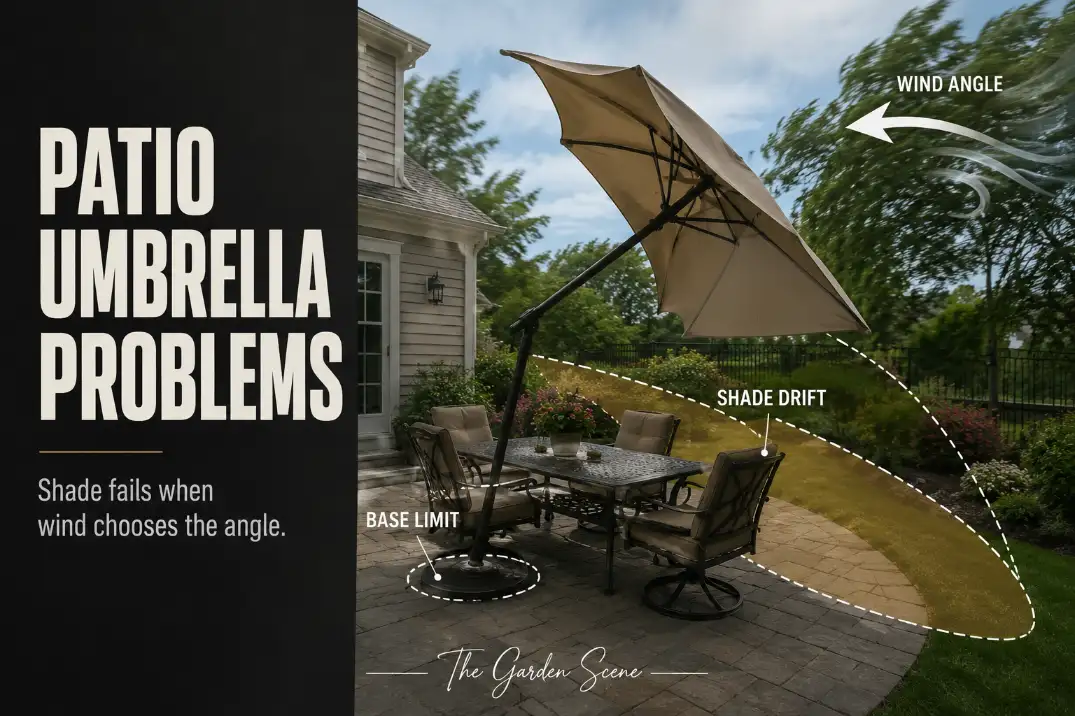
Most patio umbrella problems in windy yards come from side wind hitting the canopy, not simply from a light base. Check the wind angle, shade position, and base behavior before buying another umbrella.
If the canopy rocks, spins, or lifts during ordinary 13–18 mph breezes, the umbrella is already working outside easy comfort. If it becomes difficult to use around 19–24 mph, the issue is no longer cosmetic wobble.
At 25 mph and above, leaving most patio umbrellas open is usually a risk, not normal shade use.
The quick fix is not always a heavier base. Move the table out of the wind lane first if shade keeps missing the seats. Add base weight only when the base slides or tips.
Change the shade type when the canopy keeps lifting, twisting, or forcing you to close it during the exact hours the patio should be usable.
The Umbrella Is Not the Whole Shade Plan
A patio umbrella is best as adjustable shade for a defined sitting or dining zone. It is weaker when it becomes the entire shade strategy for a patio that also has side wind, afternoon sun, and exposed seating.
What the Umbrella Can Actually Solve
A good umbrella can block direct overhead or angled sun for a few chairs. It can make a dining table usable for lunch or soften late-day glare when the pole and canopy line up with the seats. That is the job it is built for.
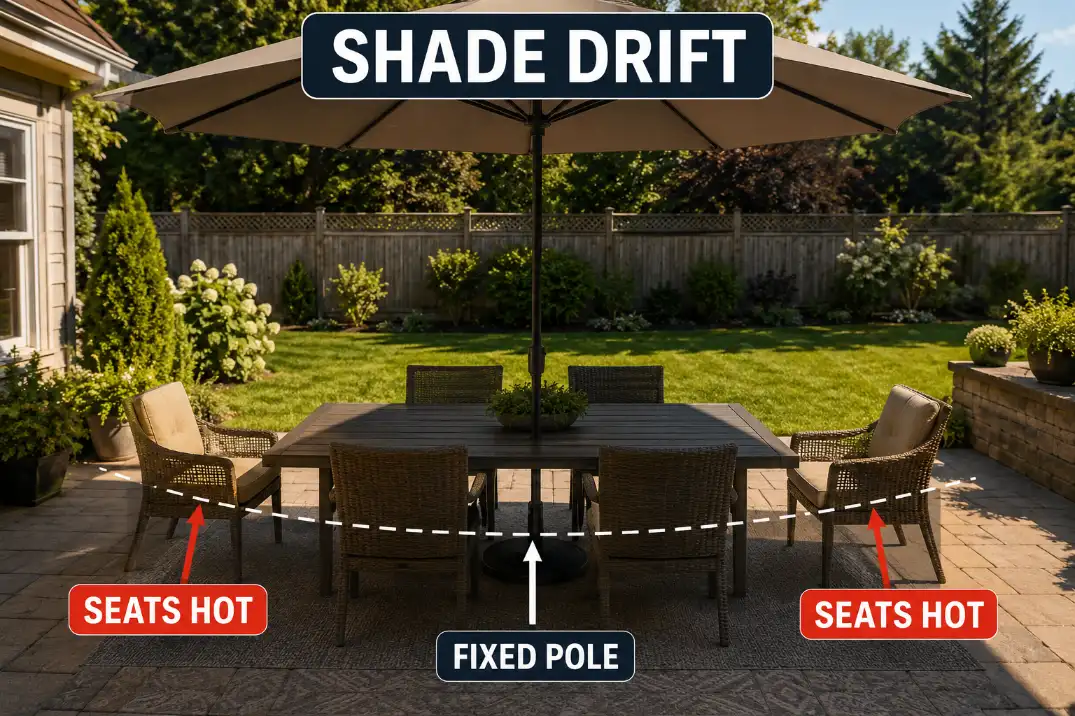
It cannot fix a patio that is placed in the strongest wind corridor. It also cannot keep shade on every chair all day when the sun angle moves 2–4 feet across the patio over the afternoon.
If your patio already has a broader shade pattern problem, the diagnosis in Patio Shade Problems in Outdoor Spaces is often more useful than comparing umbrella fabrics.
The First Sign It Is the Wrong Tool
The clearest warning sign is daily adjustment. If you open the umbrella, rotate it, move chairs, close it during gusts, and then repeat the same routine within 30–60 minutes, the umbrella is not supporting the patio plan. It is compensating for a bad shade and wind setup.
That does not mean an umbrella is useless. It means it should be one part of the shade plan, not the whole plan.
Wind Finds the Weak Angle
Wind rarely pushes a patio umbrella straight down or evenly from all sides. It usually enters from one exposed edge, catches the canopy underside, and turns the umbrella into a lever.
Lift Is the Real Warning Sign
Homeowners often watch for the base to tip. The earlier and more useful warning is canopy lift. If the fabric jumps upward, chatters, or twists before the base moves, the wind is getting under the canopy.
That is a different problem from simple wobble. Wobble may come from a loose collar, thin pole, or light base. Lift means the canopy is catching air. Tightening the knob may quiet the movement for a few minutes, but it does not change the pressure path.
Use Wind Speed as a Decision Line
A mild breeze should not make the umbrella feel like a fight. If problems start around 13–18 mph, first suspect layout, exposure, tilt, or base fit. If the umbrella becomes difficult to use around 19–24 mph, the canopy is probably catching too much side pressure for normal comfort.
At 25 mph or more, most patio umbrellas should be closed unless the manufacturer specifically rates the model and anchoring for that condition.
The mistake is assuming the umbrella failed because it is cheap. A stronger umbrella can still be wrong if it sits directly in the wind lane. If the gusts always arrive from the same open side of the yard, the patio layout needs to answer that wind path before the umbrella can behave.
For that broader setup issue, Windy Patio Layout Ideas gives a better next step than simply buying a heavier canopy.
Pro Tip: Test the umbrella closed first. If the closed umbrella still rocks in its stand during the normal problem hour, the open canopy will not become stable just because the fabric is wider or newer.
Base Weight Is Not Everything
A heavier base can help, but only when the base is the weak point. Wind pressure happens high at the canopy. Base weight works low at the patio surface. That distance is why a base can be technically heavy and still feel wrong in a windy yard.
Weight, Footprint, and Surface Grip Are Different
Base weight resists tipping. Base footprint resists leverage. Surface grip keeps the base from sliding across concrete, pavers, or smooth decking.
Those three things are often treated as one issue, but they are not the same. A narrow 75-pound base can still feel twitchy under a large canopy because the weight is stacked close to the pole. A wider base spreads resistance farther out. A base on slick pavers may slide even when it is heavy enough not to tip.
This is where people commonly overestimate weight and underestimate surface behavior. Another 25 pounds may help a sliding base, but it will not stop wind from lifting the canopy edge.
When More Weight Makes Sense
More weight is worth considering when the base creeps, rotates, or lifts slightly while the canopy itself is not jumping. In sheltered patios, many 7.5- to 9-foot table umbrellas can work with a properly matched heavy base.
Freestanding and cantilever umbrellas need more support because the canopy sits away from the base and creates a longer lever.
The practical threshold is movement. If the pole wobbles mildly but the canopy stays calm, improve the connection and base fit. If the base slides, increase grip or weight. If the canopy lifts, close the umbrella or change the wind exposure.
When More Weight Wastes Money
More weight often wastes money when wind is catching the underside of the canopy. At that point, the umbrella is acting like a sail. You may make the base harder to move, but you have not made the sitting area calmer or the canopy safer.
| What You See | What It Usually Means | Better First Move |
|---|---|---|
| Canopy spins but base stays still | Wind hitting canopy edge | Reduce tilt or change orientation |
| Base slides on pavers | Low grip or poor base match | Add grip or use a wider/heavier base |
| Canopy lifts upward | Wind caught underneath | Close umbrella or change shade type |
| Shade misses seats within 1 hour | Wrong pole or table position | Move the table or use offset shade |
| Umbrella feels risky above 20 mph | Exposure exceeds umbrella role | Shift layout or use fixed shade |
Table Placement Matters
The table often decides whether the umbrella works. A center-pole umbrella can only shade and stabilize well if the table sits in the right place for both sun and wind.
Centered Can Still Be Wrong
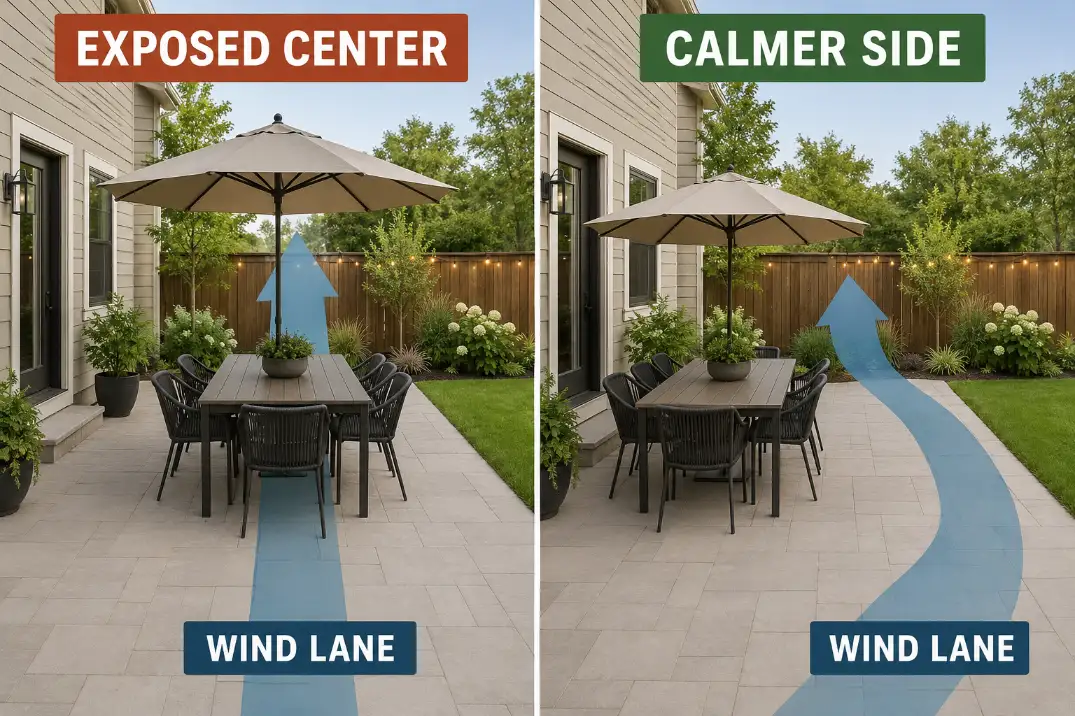
A dining table centered on the patio may look balanced but perform poorly. It might sit directly in the wind lane between a house corner and fence gap. It might also place the umbrella pole where the shade looks good at noon but misses the chairs by late afternoon.
Moving the table 2–3 feet toward the calmer side of the patio can change the whole behavior of the umbrella. The base may stop creeping, the canopy may stop twisting, and the shade may stay over the chairs longer.
That small shift often does more than upgrading from one similar umbrella to another.
For compact patios, table shape matters too. A round or narrow rectangular table may keep the umbrella usable while preserving chair clearance, while a bulky dining set can trap the pole in the worst possible place.
The same layout tradeoff appears in Best Patio Table Shapes for Small Spaces, where the table is not just furniture but a control point for movement and comfort.
Do Not Fix Wind by Blocking Flow
A calmer table position still has to work as a patio. Keep about 30–36 inches behind dining chairs where people need to walk. If moving the table protects the umbrella but blocks the back door, grill route, or main walkway, the fix will fail in daily use.
The right move is usually a slight shift, not a corner trap. You want the umbrella out of the worst wind angle while keeping the patio easy to use.
When Shade Sails Work Better
A shade sail becomes a better choice when the shaded area is fixed, the umbrella is closed too often, and the patio has reliable anchor points. It is not automatically better in wind.
A Sail Solves a Different Problem
An umbrella shades from one movable pole. A shade sail shades a fixed zone from overhead. That makes a sail useful when the same dining corner, lounge zone, or afternoon sun patch needs coverage every day.
If you close the umbrella most afternoons between 2 p.m. and 6 p.m., the umbrella is failing during the most valuable shade window. At that point, a fixed shade plan may make more sense than a stronger portable setup.
A sail can also remove the pole from the middle of the table. That helps when the umbrella keeps forcing awkward chair placement or making the patio feel crowded.
If the next step is product-level comparison, Best Shade Sails and Outdoor Canopies for Hot Patios fits the point where umbrella shade is no longer enough.
A Sail Only Works If It Is Tensioned Correctly
The sail must be tight, properly anchored, and set with enough height variation to shed rain. A loose, flat sail can flap, sag, hold water, and become a larger wind surface than the umbrella it replaced.
This is the limit many people miss. A sail can be calmer than an umbrella when the structure is right. It can be worse when it is mounted casually to weak posts, low fascia, or poorly spaced anchors.
Shade Still Is Not Wind Protection
A shade sail blocks sun from above. It does not stop side gusts at chair height. If the real comfort problem is wind crossing people’s backs, a low screen, planting layer, or furniture shift may be needed along with overhead shade.
Shade Without the Daily Fight
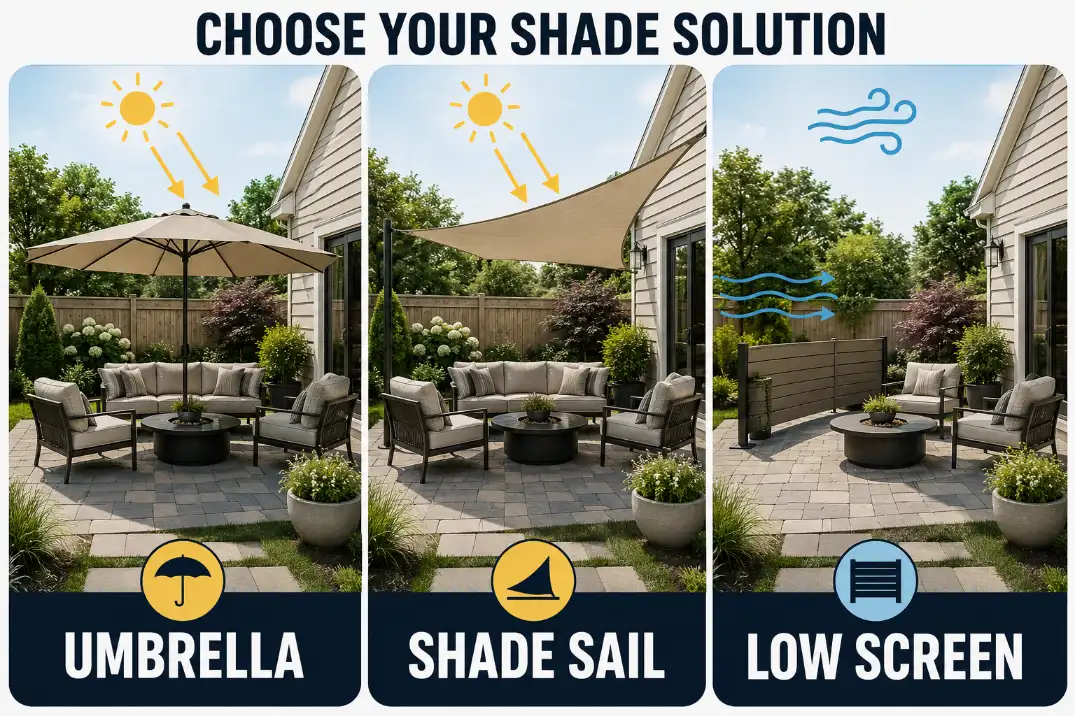
The best solution is usually a calmer shade system, not one heroic umbrella. The patio should place seating where wind is less aggressive, use the umbrella only where it can stay useful, and switch to fixed or semi-fixed shade when daily adjustment becomes the main routine.
Keep, Move, Add, or Replace
Keep the umbrella if the problem is mild shade drift, occasional wobble, or a table position you can improve. Move the table if the shade misses chairs within an hour or the canopy sits directly in a known wind lane.
Add base weight or grip only when the base itself slides, tips, or rotates. Replace the shade approach when the canopy lifts repeatedly, the umbrella has to stay closed during the hottest hours, or the patio still feels exposed after the table is moved.
If the whole patio feels hot, windy, and awkward at once, the umbrella is probably only revealing a larger layout problem. The planning logic in Backyard Layout Shade, Seating, and Airflow is a stronger starting point when shade, wind, seating, and movement all compete.
Quick Diagnostic Checklist
- If the shade misses the seats within 30–60 minutes, fix placement first.
- If the canopy lifts, treat wind angle as the main problem.
- If the base slides, improve grip, footprint, or weight.
- If the umbrella feels difficult around 19–24 mph, close it and rethink exposure.
- If the umbrella stays closed most afternoons, consider fixed shade.
- If moving the table blocks 30–36 inches of chair clearance, solve layout before shade.
Questions People Usually Ask
Should I leave a patio umbrella open in wind?
No. If gusts make the canopy lift, twist, or snap, close it. Flutter is one thing; repeated lift means the wind is getting under the canopy.
Will a heavier base stop an umbrella from spinning?
Not always. A heavier base helps when the base moves. Spinning often comes from wind hitting the canopy edge or from a loose pole connection.
Is a shade sail better than an umbrella in windy yards?
Only when it is properly tensioned, strongly anchored, and solving a fixed shade problem. A loose or flat shade sail can flap badly and create its own wind problem.
For broader official wind-speed context when judging breezy versus difficult patio conditions, see the National Weather Service Beaufort Wind Scale.