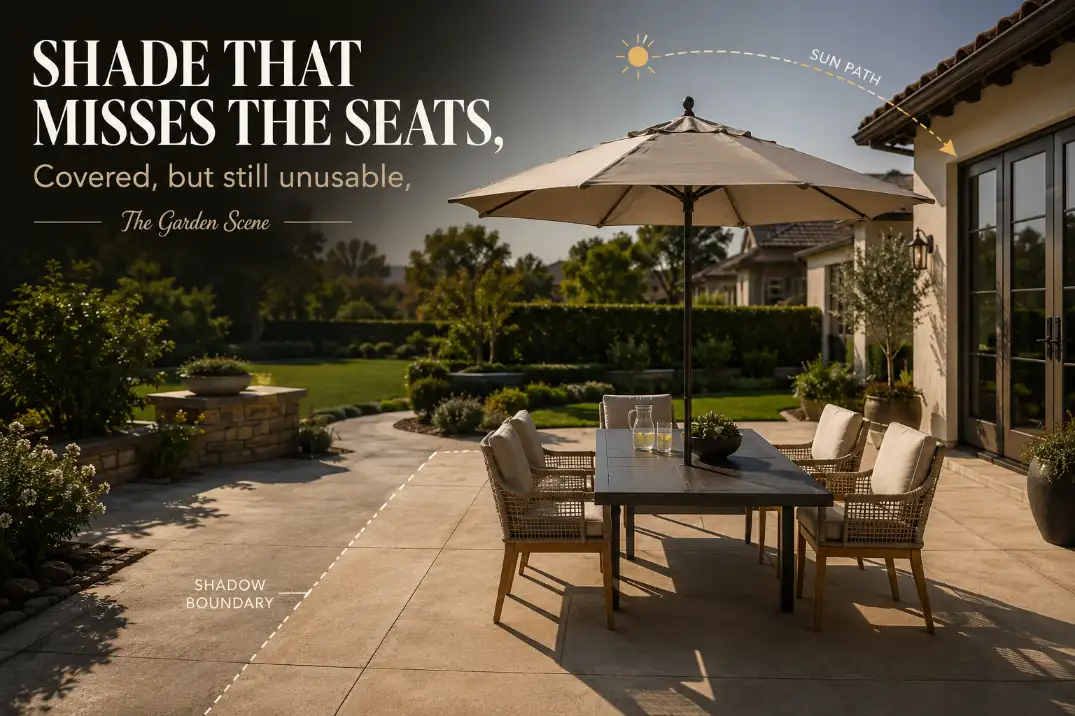
A patio usually becomes hard to use when the shade solves the wrong problem. The failure is not simply “not enough shade.” More often, the shade lands in the wrong place, works at noon but fails by 4 p.m., blocks airflow, or arrives after the patio surface has already stored hours of heat.
The first checks are practical: where the shade falls between 3 p.m. and 7 p.m., whether it covers seated bodies instead of just furniture, and whether the patio still radiates heat 30–60 minutes after direct sun is gone.
If the seating area slips out of shade within 30–45 minutes, the issue is usually placement, not canopy size.
This is different from a patio that only needs a bigger umbrella. A wider canopy may improve overhead shade, but it will not fix low western sun, reflected glare, a hot slab, or a covered patio that traps warm air.
The fastest way to diagnose the real shade problem
Watch how people use the patio. A shade problem usually shows up before anyone explains it. Guests avoid one chair, pull seats out of alignment, keep sunglasses on, or leave after 15 minutes even though the patio technically has shade.
The shade covers the table, not the people
The most common failure is table-only shade. The umbrella or canopy looks centered, the tabletop is protected, and the setup seems correct from a distance. But the chair backs, shoulders, and faces are still in sun.
For dining patios, useful shade should extend at least 18–24 inches beyond the chair backs during the main use window. If the shadow stops at the table edge, it is visual shade, not comfort shade.
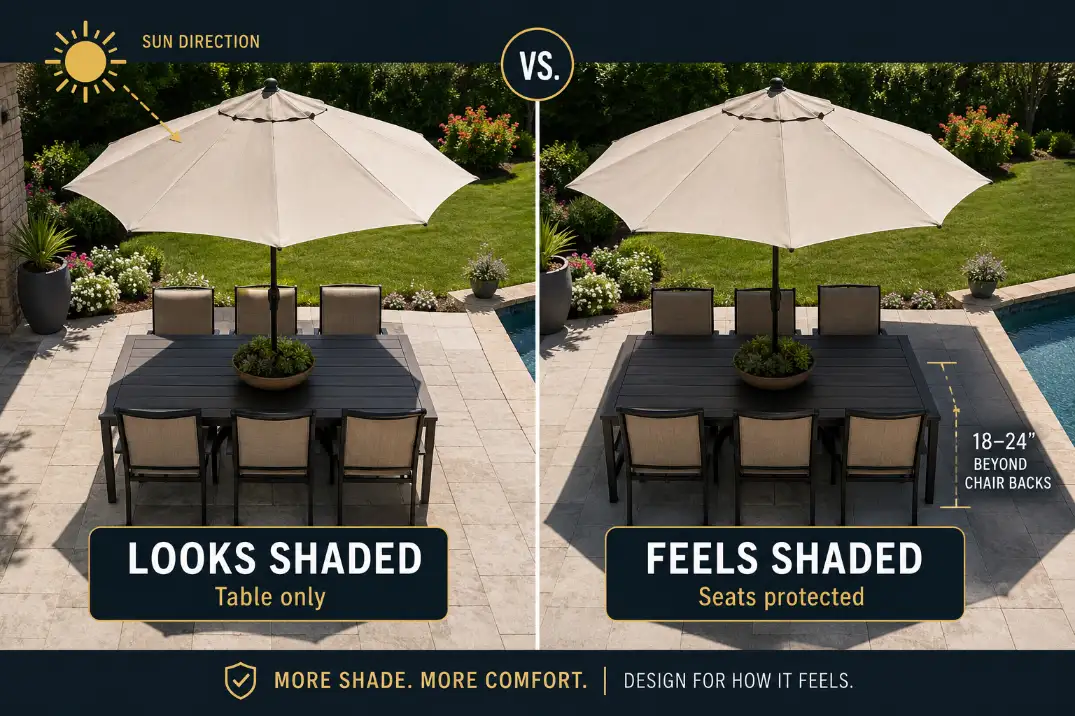
This is where many homeowners buy a larger centered umbrella when the better answer is an offset shade source. A cantilever umbrella, wall-mounted shade, or slightly shifted canopy may protect the seating zone better than simply increasing diameter.
For small patios, the base can become part of the problem. If the umbrella blocks chair movement or narrows the walking path, the patio may feel shaded but harder to use.
The strongest options in Best Patio Umbrellas for Shade in Small Backyards are useful because they focus on usable shadow, not just canopy width.
The patio passes the noon test but fails later
Noon shade is often misleading. Many patios look comfortable when the sun is high, then become nearly unusable when low afternoon sun slides under the shade edge.
If direct sun hits faces, chair backs, or the main lounging position for 2 or more hours in late afternoon, overhead shade is no longer the main fix. The patio needs side control.
That is why west-facing patios are so frustrating. A 9-foot umbrella can feel generous at lunch and useless at dinner. The product did not necessarily fail. The sun angle changed the job.
What people usually misread first
Visible floor shade is not the same as outdoor comfort. People sit higher than the slab, and their upper bodies may still be exposed to glare, side sun, or reflected heat.
The symptom is “too hot,” but the mechanism may be different
A hot patio can come from at least four different mechanisms: direct sun, low-angle side sun, stored surface heat, or trapped air. Treating all four with “more shade” is where many fixes disappoint.
If the patio still feels hot 45–60 minutes after it moves into shade, the slab, pavers, walls, or nearby hardscape are probably releasing stored heat. If the air feels still under a roof for 10–15 minutes, airflow is part of the problem. If people keep squinting in the shade, glare is the issue.
The mistake is treating every discomfort signal as a coverage problem. Coverage matters, but it is only one part of patio usability.
Glare can feel like heat
Glare is often underestimated because it looks less serious than direct sun. But a pale fence, white wall, pool deck, or bright concrete slab can bounce light into a shaded seating area.
A simple test works: sit in the main chair for 5 minutes without sunglasses. If you need to turn your head, squint, or move the chair, the patio has a glare problem.
A deeper overhead canopy may help slightly, but a side screen, trellis, outdoor curtain, or planting layer usually changes the experience more.
When shade needs to solve glare without blocking movement, the better strategy is often selective side protection rather than more overhead material.
That is the same logic behind Add Patio Shade Without Blocking Walkways, where the path through the patio matters as much as the shade itself.
Match the fix to the failure pattern
The right shade fix becomes much clearer when the problem is named correctly. The goal is not maximum shade. The goal is shade that protects the right zone at the right time without making the patio feel smaller, hotter, or harder to move through.
| What makes the patio hard to use | What it usually means | Best first fix | Fix to avoid |
|---|---|---|---|
| Table is shaded but chairs are hot | Shade footprint is misplaced | Offset shade or extend coverage 18–24 inches past chairs | Larger centered umbrella only |
| Late-day sun hits faces | Low side sun is bypassing overhead shade | Vertical screen, curtain, trellis, or side planting | Overhead-only pergola |
| Patio feels hot after shade arrives | Surface heat is stored in slab, pavers, or walls | Earlier shade plus surface cooling | More canopy fabric alone |
| Covered patio feels heavy and still | Airflow is blocked or heat is trapped | Open breeze path, fan, higher clearance | More side curtains |
| Shade makes patio feel cramped | Posts, bases, or panels interrupt circulation | Wall-mounted, cantilevered, or perimeter shade | Freestanding shade in the walking path |
| Shade needs constant adjustment | Product type does not match sun angle | Fixed directional shade or side control | Re-tilting every 20–30 minutes |
Low-angle sun needs a vertical answer
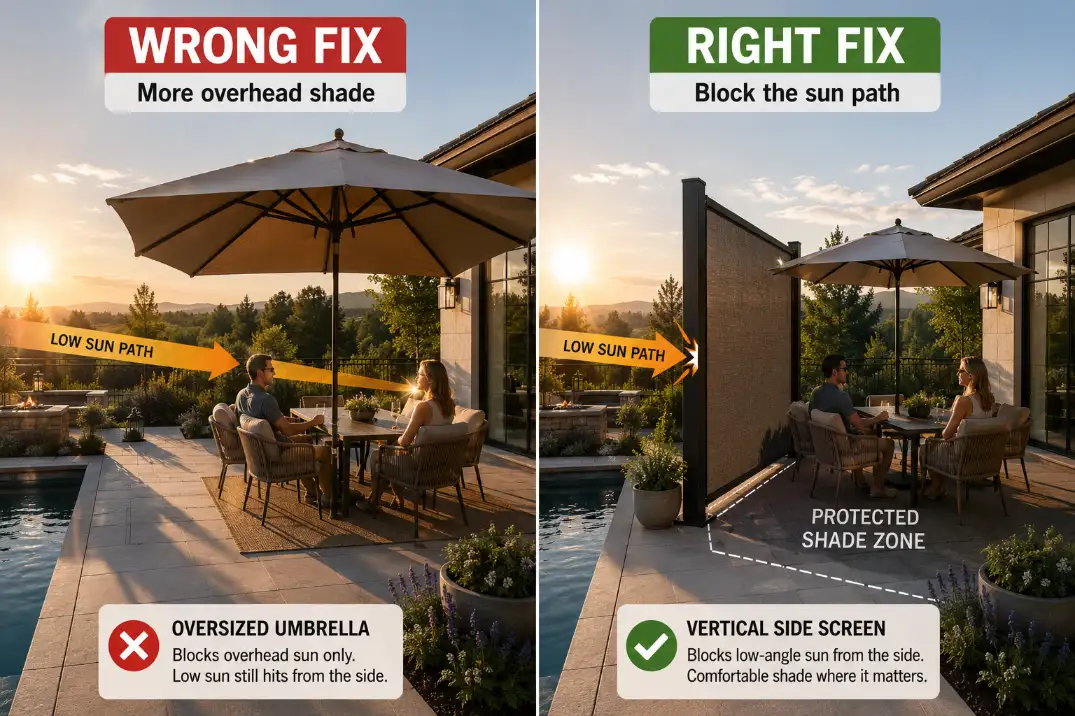
Low-angle sun is one of the most important patio shade problems because it defeats otherwise good products. When the sun comes from the side, a wider roof or canopy may still leave seated people exposed.
The fix is interception, not just coverage. A vertical screen, outdoor curtain, vine panel, lattice, or strategically placed tall planter can outperform a larger overhead structure because it blocks the path the sun is actually taking.
Pro Tip: Test side shade with a movable object before building anything permanent. A temporary screen or even a tall piece of cardboard at 5 p.m. can reveal whether the patio needs vertical shade or a different overhead layout.
For patios where afternoon sun is the dominant problem, Best Patio Shade Solutions for Afternoon Sun is the more targeted decision path than a general shade upgrade.
Stored heat needs earlier shade and cooler surfaces
Concrete, stone, brick, dark pavers, and stucco walls can keep radiating heat after direct sun has moved away. After 5–7 hours of exposure, a shaded patio may still feel uncomfortable because the hardscape is releasing warmth around your legs and feet.
This is especially noticeable in dry, hot climates where surfaces can heat aggressively through the afternoon. In humid regions, the stored heat may combine with still air and make the patio feel heavy rather than sharply hot.
The key distinction is timing. Shade that reaches the patio only after the surface has already peaked will not feel as effective as shade that arrives earlier. If the surface is still noticeably warm 60 minutes after it is shaded, the patio needs surface strategy, not just a larger canopy.
Covered shade can still trap heat
A roof, pergola cover, or canopy can reduce direct sun while making the air below feel stagnant. This is why some covered patios look comfortable but feel worse than an open shaded area with better airflow.
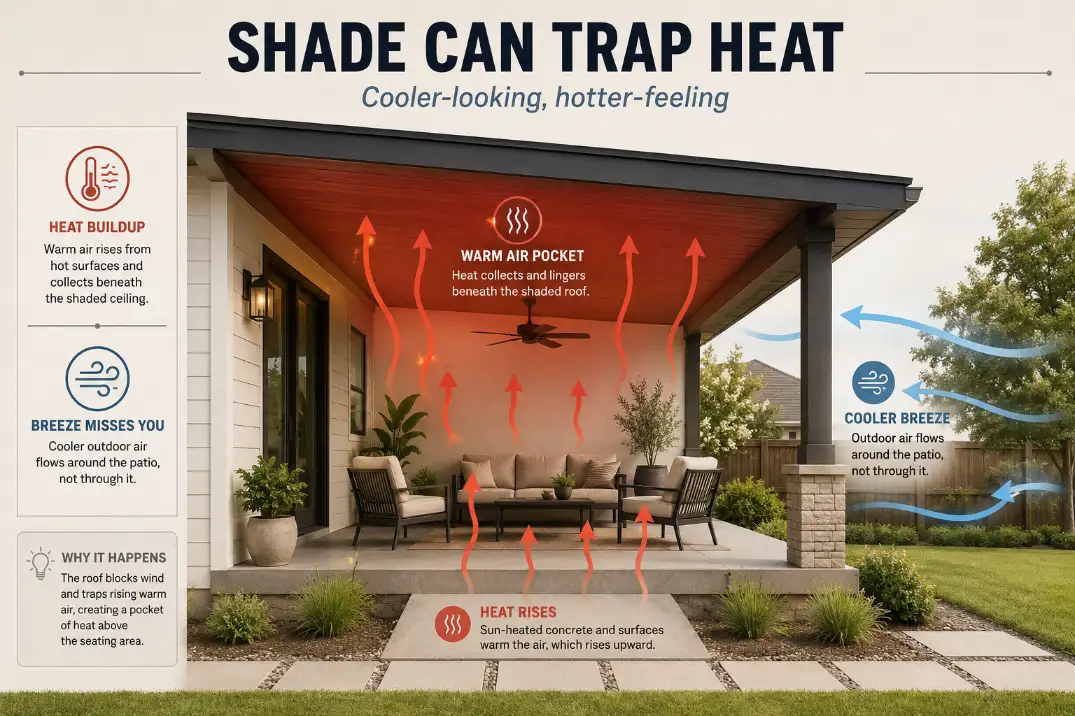
Airflow is not a decorative comfort detail
If the patio has a low roof, two enclosed sides, and little cross-breeze, adding curtains or privacy panels can make the space worse. The shade improves visually while comfort declines.
A useful threshold is simple: if the air feels still for more than 10–15 minutes while nearby open areas feel better, airflow is part of the failure.
In humid climates like Florida or the Gulf Coast, blocking breeze can matter as much as blocking sun because evaporation is already slow.
The better fix may be a ceiling fan, a more open side, a raised shade edge, or fewer enclosed panels. If the patio is already covered but still feels hot, Covered Patio Traps Heat is a more accurate frame than adding another layer of overhead shade.
If this is your problem, start here
This is the quickest way to keep the diagnosis from turning into another random shade purchase.
| Your patio problem | Start with this shade type | Upgrade only if |
|---|---|---|
| Chairs are sunny while the table is shaded | Offset umbrella, cantilever umbrella, or shifted canopy | The seating zone still loses shade in under 45 minutes |
| Low afternoon sun hits faces | Side screen, outdoor curtain, trellis, or tall planter | The same exposure lasts 2+ hours on most clear days |
| Patio feels hot after shade arrives | Earlier overhead shade plus surface cooling | The slab still radiates heat after 60 minutes |
| Covered patio feels still | Fan, open side, or raised shade edge | Air remains stagnant after airflow improves |
| Shade makes the patio feel smaller | Wall-mounted or perimeter shade | The main path still falls below 30–36 inches |
| Shade changes every time you sit down | Movable umbrella or temporary screen first | You adjust the same setup every 20–30 minutes |
The most important rule is simple: use a temporary fix when the problem moves, and a fixed solution when the same zone fails repeatedly.
Choose the shade type by the failure pattern
A patio shade product should be chosen by what it is good at solving, not by how much shade it appears to create in a product photo.
Umbrellas work best for movable overhead shade
Umbrellas are useful for small dining areas, compact lounge zones, and patios where the seating position changes. They are weaker when the problem is low side sun, a wide seating group, wind exposure, or a tight walking path.
A routine umbrella fix stops making sense when the canopy needs to be tilted every 20–30 minutes or the base forces people to squeeze around chairs. At that point, the patio needs better geometry, not more adjusting.
Shade sails and canopies work best for larger overhead zones
Shade sails and outdoor canopies are better for larger open patios, hot slabs, and seating zones that need broader coverage. But they are not forgiving if the anchor points are wrong.
A sail installed too flat can hold rain. A sail installed too low can make the patio feel compressed. Weak anchor points can also prevent the sail from holding proper tension, which makes the shade look messy and perform poorly.
As a practical rule, a noticeable slope of about 15–20 degrees is often more useful than a perfectly flat sail because it helps shed rain and keeps the fabric from sagging.
Clearance matters too. If the lowest edge makes people duck, visually caps the seating area, or cuts across the view from indoors, the sail may technically provide shade while making the patio feel worse.
When the main issue is a hot open patio rather than a small dining zone, Best Shade Sails and Outdoor Canopies for Hot Patios gives that choice a more specific product path.
Curtains, screens, and trellises work best for side sun
Vertical shade is the correct tool when the sun comes from the side. Outdoor curtains, roll-down shades, trellises, vine panels, privacy screens, and tall planters can all solve problems that overhead shade cannot.
This does not mean every patio should be enclosed. Too much side coverage can block breeze and make the patio feel smaller. The goal is to interrupt the sun path while keeping at least one clean airflow route.
Pergolas and awnings work best when the problem repeats daily
Permanent or semi-permanent shade makes more sense when the discomfort happens in the same place at the same time for most of the season. If a patio is unusable every clear afternoon from 4 p.m. to 7 p.m., a fixed solution may be more rational than moving umbrellas around all summer.
Retractable awnings, pergola covers, fixed screens, and properly anchored sails can all work, but only if they match the actual failure pattern. A pergola without side control may still fail against low western sun.
Think about commitment before you build
Not every patio shade problem deserves a permanent structure. The level of commitment should match how predictable the problem is.
A standard umbrella or temporary screen is a low-commitment way to test the sun path before changing the patio. A pop-up canopy can solve occasional gatherings, but it usually feels temporary because it must be set up, weighted, and stored.
A shade sail sits in the middle: it can look clean and cover a larger area, but it needs solid anchor points, proper tension, and enough slope to work well.
Awnings, pergolas, fixed screens, and built structures are higher-commitment choices. They make the most sense when the patio fails in the same place, at the same time, for much of the season.
Planting and trellises are slower, but they can become the most natural-looking long-term correction when glare, reflected heat, or privacy are part of the problem.
Fabric can solve glare but create heat
Shade material changes comfort. It is not just a color choice.
Dense, darker fabric can reduce glare and make a seating area feel visually calmer, but it may also feel warmer if airflow is poor. Breathable shade fabric can be better over hot patios because it allows some air movement, though it may not block glare as completely.
Waterproof canopy material helps with rain but can feel heavier in hot weather because it sheds water and air differently than breathable fabric.
This matters most when a patio already has limited airflow. In that situation, adding a dense side curtain or waterproof panel may improve shade while making the air feel trapped.
The better choice may be a breathable screen or partial vertical shade that blocks the worst sun without sealing the patio.
Pro Tip: Do not judge shade fabric only at noon. Check it during the hottest use window, especially after the patio surface has been in sun for several hours.
When temporary shade is enough — and when it is not
Temporary shade is useful when the problem moves. Permanent shade makes more sense when the failure is predictable.
If the uncomfortable spot changes by season, furniture layout, or time of day, a movable umbrella, temporary screen, or pop-up canopy can be the smarter first step. If the same chairs get hit by sun every afternoon, or the same wall reflects glare into the same seating zone, the patio is asking for a more fixed correction.
Natural shade belongs in this longer-term category. A tree, vine-covered trellis, or planted screen will not rescue this weekend’s dinner, but it can reduce glare, soften reflected heat, and make the patio feel less exposed over time.
In northern states, deciduous trees can be especially useful because they provide summer shade while allowing more winter sun.
The key is patience and placement. A tree planted too far from the western exposure may look good but barely affect the seating zone.
A trellis or planted screen near the actual sun path often delivers more useful comfort sooner than a decorative tree placed where it frames the yard.
Quick diagnostic checklist
Use this before buying another shade product:
- Does the shadow protect seated bodies, not just the table?
- Does the patio stay comfortable for at least 60–90 minutes during the main use window?
- Does low sun hit faces or shoulders after 3 p.m.?
- Does the patio surface still radiate heat 30–60 minutes after shade arrives?
- Does the shade solution preserve a 30–36 inch walking path?
- Does added side shade improve comfort or make the air feel still?
- Does the setup need adjustment every 20–30 minutes to keep working?
The final decision rule
Judge patio shade by seated comfort, not floor shadow. A patio can look shaded in a photo and still fail in real use if the sun reaches people from the side, the slab releases heat, or the shade structure blocks movement.
The strongest patios usually combine three things: overhead protection for high sun, side control for low sun, and enough open space for airflow and circulation. They do not always need more shade.
They need shade that works where people actually sit.
For compact patios, this is especially important because every post, base, and panel affects movement.
A small patio often becomes more usable with selective shade around the edges than with one large object in the middle, which is why Best Shade Options for Small Patios That Stay Open is a better next step when openness is part of the comfort problem.
If the fix creates a new obstacle, needs constant adjustment, or only improves the patio at noon, it is probably solving the wrong part of the problem.
The better question is not “How do I add more shade?” It is “Which path of sun, heat, or airflow is making this patio hard to use?”
For official context on how trees and vegetation reduce surface and air temperatures around built areas, see the U.S. Environmental Protection Agency.