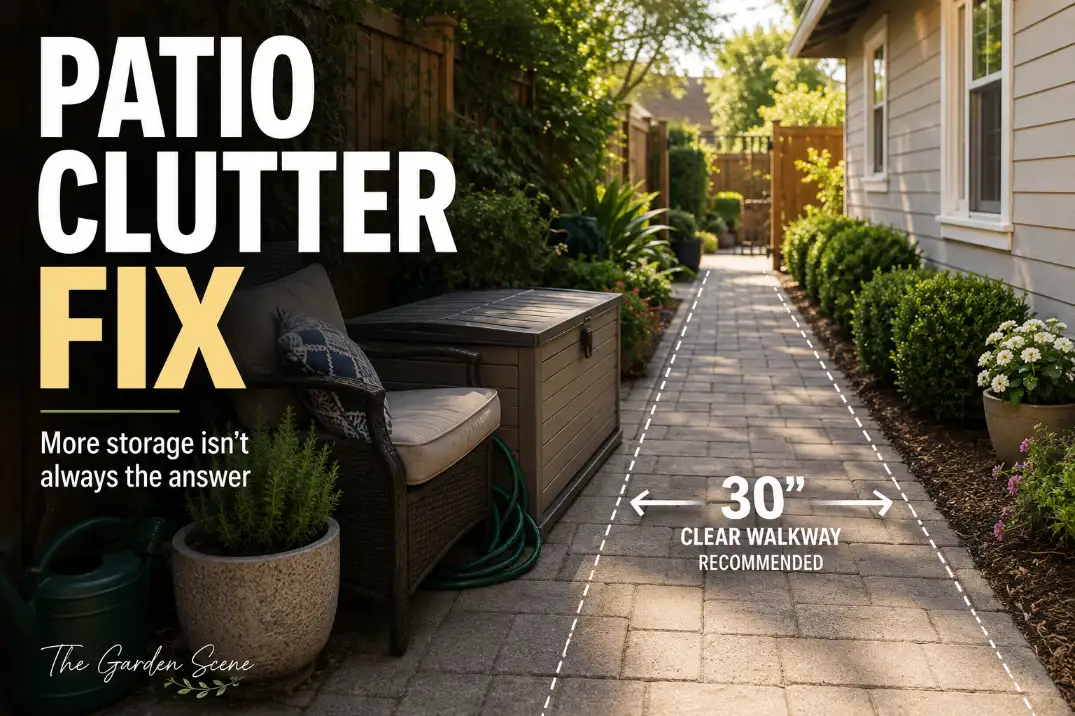
Most patio clutter is not a storage shortage. It is a flow problem. Useful items end up on chairs, tables, steps, and walkways because they are stored too far from where they are used, buried too deeply, or mixed with items that do not belong on the patio at all.
Start with three checks: keep a clear 30–36 inch walking path, remove anything used less than once every 30 days from the patio surface, and notice what gets moved more than twice before someone can sit down.
That last signal matters. A patio that needs a 10-minute reset before use does not have a mess problem; it has a system problem.
The goal is not to make the patio empty. The goal is to keep the things that support sitting, cooking, watering, or relaxing without letting those things take over the space.
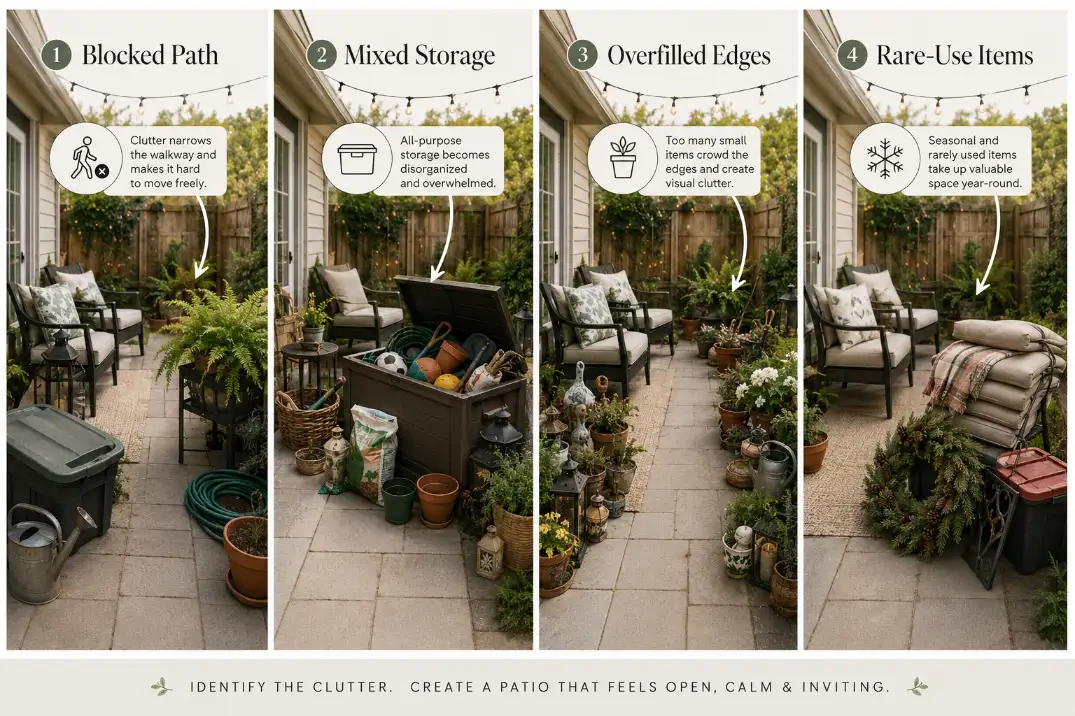
Before You Buy More Storage, Identify the Clutter Type
Buying another box is the obvious fix, but it is often the wrong first move. Storage only helps when it solves the actual clutter pattern. If the patio is already tight, a new bench, cabinet, or deck box can become another obstacle.
Flow clutter blocks movement
Flow clutter is anything that narrows the route from the door to the seating area, grill, steps, or yard. It may be useful: a hose, toy bin, cushion box, planter, or grill cart. But if people have to turn sideways to pass it, it is hurting the patio more than it helps.
For everyday use, 30 inches is the minimum workable path. A 36-inch path feels much better when people carry plates, cushions, drinks, or grilling tools.
Frequency clutter belongs nearby, not always on the patio
Some items are outdoor items, but not patio items. Potting soil, backup cushions, seasonal covers, extra lanterns, rarely used tools, and spare planters usually do not deserve prime patio space.
Use a simple rule: if it is used every 7 days during patio season, it can stay near the action. If it is used every 30 days, it should move to a nearby cabinet, side yard, garage, shed, or off-patio storage zone. If it is used only a few times per season, the patio is too valuable for it.
Category clutter hides inside “organized” boxes
A large deck box can look tidy from the outside and still fail. Cushions, toys, grill tools, plant supplies, cords, and seasonal decor all thrown into one container create a patio junk drawer. The mess disappears visually, but the friction remains.
That is why some patios look organized yet still feel hard to use. The storage exists, but the categories are wrong.
Choose Storage That Protects the Patio, Not Just Hides Stuff
Good patio storage has one job and sits close to the point of use. Bad patio storage has too many jobs and sits wherever there was leftover space.
The most common mistake is overestimating storage capacity and underestimating access. A 120-gallon deck box sounds helpful, but if it becomes deep mixed storage, people stop using it properly within a few weeks.
A smaller 50–70 gallon box near the seating area can work better if it holds only cushions and throws.
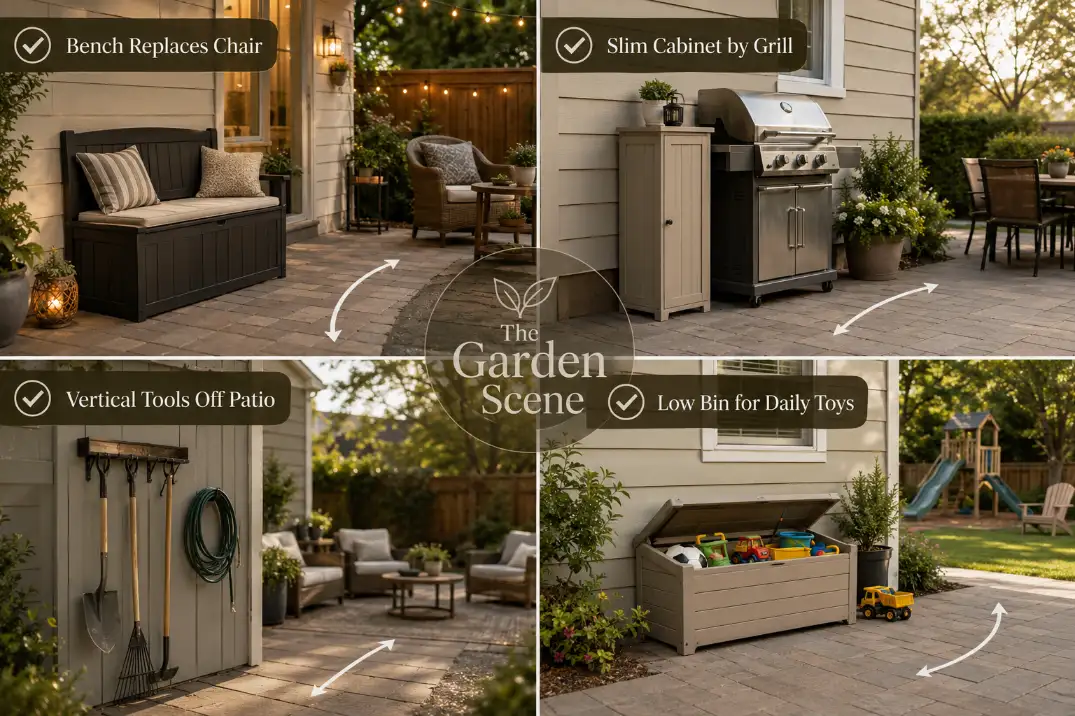
Match the fix to the repeated problem
| Patio problem | Better fix | Avoid this |
|---|---|---|
| Cushions stay on chairs | Storage bench near seating | Deep mixed box across the yard |
| Grill table gets covered | Slim cabinet near grill | Using the dining table as storage |
| Tools lean against walls | Vertical organizer off the patio | Wide floor bin that spreads handles |
| Toys scatter daily | Low open bin or small lidded box | Deep container kids cannot reset |
| Seasonal items pile up | Garage, shed, or side-yard cabinet | Patio bench used as overflow |
This is where a storage bench can be excellent, but only when it replaces something. If it adds seating and hides cushions, it earns its footprint. If it simply joins the chairs, planters, and side tables already crowding the edge, it becomes clutter with a lid.
For patios where cushions are the item that keeps returning to chairs, the decision is no longer general organization.
It becomes a seating-and-storage problem, which is where Outdoor Storage Benches for Patio Problems makes more sense than another loose container.
Keep storage shallow enough to use
Storage that requires digging, lifting, or unstacking usually fails in daily life. A good reset should take less than 5 minutes. If putting the patio back together takes 15 minutes, the system is too complicated.
Pro Tip: Store items at the height and shape they naturally use. Cushions need low, wide storage. Grill tools need upright or hanging storage. Small toys need easy drop-in storage, not a deep box.
Keep the Walking Path Ruthless
A patio can hold more than it seems if the path stays clear. It can hold far less than expected if every movement is interrupted.
The most important route is usually from the back door to the main seat. The second is from seating to the grill, steps, or yard. These paths decide whether the patio feels usable. A tidy storage box in the wrong place is still a problem if it interrupts either route.
The 30–36 inch rule is not decorative
A 30-inch path is the practical minimum. A 36-inch path is better for real use, especially when people are carrying food, moving cushions, or walking around dining chairs.
Dining areas need more space than they appear to need when chairs are pushed in. If people must pull chairs back and pass behind them, allow about 36 inches behind the chair. Lounge furniture is even more demanding because a deep chair can consume 34–40 inches before anyone sits down.
If the patio still feels tight after storage is added, the issue may be layout rather than clutter. The flow logic in Backyard Storage Mistakes That Hurt Patio Flow is especially relevant when the patio looks organized but still feels awkward.
Edge clutter makes patios feel smaller
People usually notice the center of the patio first, but the edges often cause the visual clutter. Too many small planters, lanterns, baskets, folding chairs, side tables, and loose bins make the patio feel squeezed from the outside in.
This matters most on patios under about 120 square feet. A clean center helps, but if every edge is busy, the patio still feels crowded. Three larger, intentional pieces usually feel calmer than nine small objects scattered around the border.
The useful distinction is simple: a patio edge should either support seating, storage, shade, privacy, or movement. If an object does none of those, it needs a stronger reason to stay.
Use the Patio for Active Items Only
The patio is not the storage room for the whole backyard. It is the highest-value outdoor surface because it supports sitting, eating, cooking, and daily use.
That means some useful items still need to leave.
Soil bags, extra hose parts, backup planters, broken decor, winter covers in summer, rarely used garden tools, and duplicate outdoor accessories should not live on the patio. These items are not bad. They are just in the wrong zone.
The best clutter fix may be off-patio storage
For many homes, the sharpest improvement comes from moving bulky or low-frequency items just off the patio. A slim cabinet along a side wall, a small shed zone, or a vertical organizer near the yard can free the patio without making outdoor tasks harder.
This is especially important in humid climates where cushions and soft goods need airflow, in northern states where seasonal covers pile up after winter, and in dry regions where dusty tools and supplies can make a clean patio feel dirty quickly.
If the patio keeps absorbing tools, toys, and supplies that belong somewhere nearby but not on the surface, What to Store Off the Patio to Free Up Space is the better next step than buying another deck box.
When Storage Becomes Clutter
Storage stops helping when the storage piece needs more space, effort, or rearranging than the items it holds.
This usually happens quietly. First, one deck box goes near the seating area. Then a cabinet goes beside the grill. Then a toy bin, plant shelf, hose pot, and cushion bag fill the remaining edges. Everything has a home, but the patio no longer has breathing room.
Watch for these failure points
If a small patio has more than two storage pieces, each one needs to justify its footprint. If a lid needs 18–24 inches of clearance but the box sits against a wall, it will be annoying to use.
If stored items are stacked more than two layers deep, the bottom layer will probably be forgotten.
The biggest warning sign is a storage piece blocking the primary route. Once storage narrows the door-to-seat path, it is no longer solving clutter. It is relocating it.
For truly small spaces, storage has to be chosen around circulation first. Best Small Patio Storage Solutions is most useful when the storage choice is based on what the patio can spare, not what the patio can technically fit.
Do not confuse hidden with solved
A patio can look cleaner after everything goes into boxes, but if no one wants to open those boxes, the clutter will return. The real test is behavior after two weeks. Are cushions still going back into the bench? Are grill tools staying near the grill? Are toys landing in the bin without adult rearranging?
If not, the system is too demanding.
Pro Tip: Keep one patio surface intentionally empty. A clear table, side table, or grill shelf gives temporary items somewhere to land without becoming permanent clutter.
Build a 5-Minute Reset
The best patio clutter system is not the one that looks perfect in a photo. It is the one that can recover quickly after real use.
A strong reset has three parts: visible homes for daily items, fewer categories per storage piece, and one clear path that never becomes storage.
Make the homes obvious
Cushions go in the bench. Grill tools go in the slim cabinet. Toys go in the low bin. Watering gear goes near the planting area. Seasonal items go somewhere else.
Avoid systems that require perfect behavior. Tight lids, stacked bins, hidden shelves, and deep mixed boxes are better for long-term storage than daily patio use.
Keep function visible
Some visible items are fine. A watering can beside planters can be functional. A grill brush near the grill makes sense. A folded throw on a chair may belong there during cool evenings.
The problem is not visibility. The problem is when visible items interrupt movement, seating, cleaning, or quick use. That is the difference between a lived-in patio and a cluttered one.
A patio is working when people can walk out, sit down, cook, water plants, or clean up without moving a pile first. If it can return to usable shape in under 5 minutes, the clutter system is probably strong enough.
Questions People Usually Ask
Should I remove furniture to reduce patio clutter?
Only if the furniture blocks movement or duplicates another function. On patios under 100 square feet, removing one oversized chair can help more than adding storage. If every seat is used weekly, fix storage placement first.
Are deck boxes good for small patios?
Yes, but only when they do one job and stay out of the main path. A large mixed deck box can make a small patio look cleaner while making it harder to use.
What should not be stored on the patio?
Avoid storing soil bags, chemicals, wet cushions without airflow, cardboard packaging, broken planters, duplicate decor, and rarely used tools on the patio. They consume high-value space without improving daily use.
How much open space should a patio keep?
Keep at least one 30–36 inch route clear at all times. Storage and loose accessories should not dominate the patio surface; if they do, the space is functioning more like a shed than a patio.
For broader official guidance on reducing household waste and keeping useful items out of disposal cycles, see the U.S. Environmental Protection Agency.