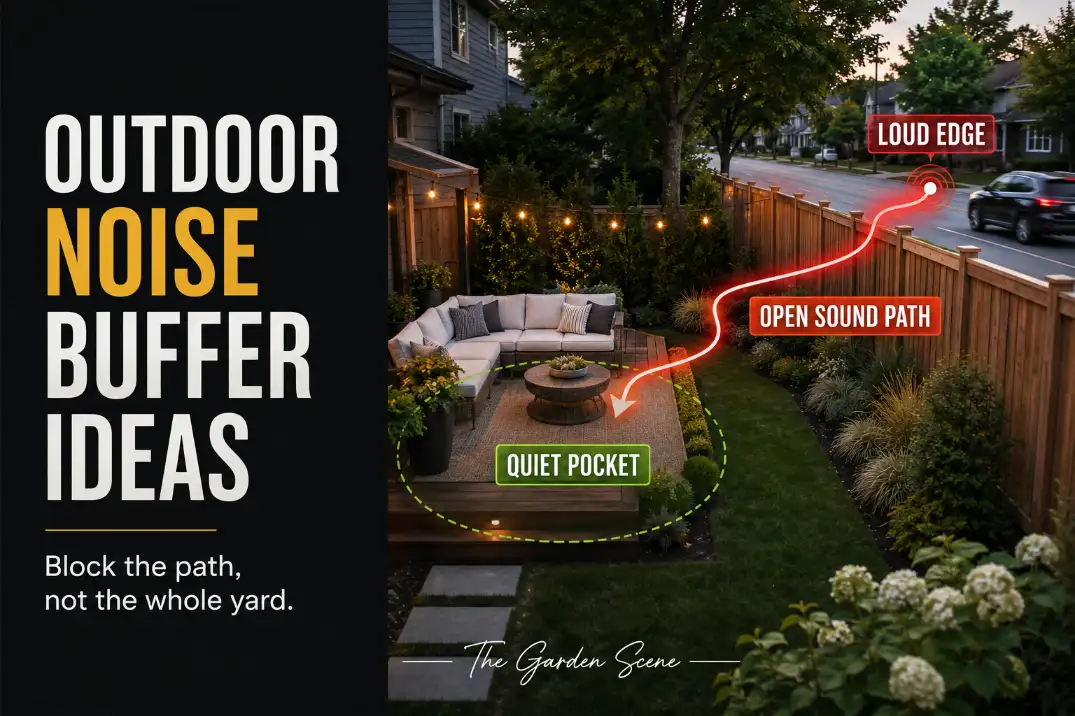
Outdoor noise buffer ideas work best when they interrupt the sound path instead of trying to silence the entire yard. Start with three checks: where the noise enters, where people sit, and whether moving the seating area 10–20 feet changes the feeling.
If one spot is consistently 5–10 dB quieter than another, layout is probably the first fix. If every useful spot feels equally exposed, the loud edge needs a stronger barrier strategy.
An outdoor noise buffer is not one product. It is the combination of barrier position, planting depth, surface softness, and seating placement that reduces how strongly unwanted sound reaches the main outdoor living area.
The strongest outdoor noise buffer ideas usually combine one solid interruption, one soft planting layer, and one smarter seating move rather than relying on plants alone.
This is different from visual privacy. A hedge can hide traffic and still do very little for tire noise. A fence can look solid but fail if sound slips under it, around it, or over the seated listening line.
The goal is not a silent yard. The goal is a calmer seating pocket where the loudest edge no longer controls the whole space.
Noise Changes How a Yard Feels
Noise does not affect a yard evenly. A patio near a road, driveway, alley, neighbor deck, pool pump, dog run, or side gate can feel harsh while another corner of the same yard feels usable.
That is why the first question should not be “How do I soundproof my backyard?” It should be “Where is the loudest path, and am I sitting inside it?”
The symptom is discomfort, not just volume
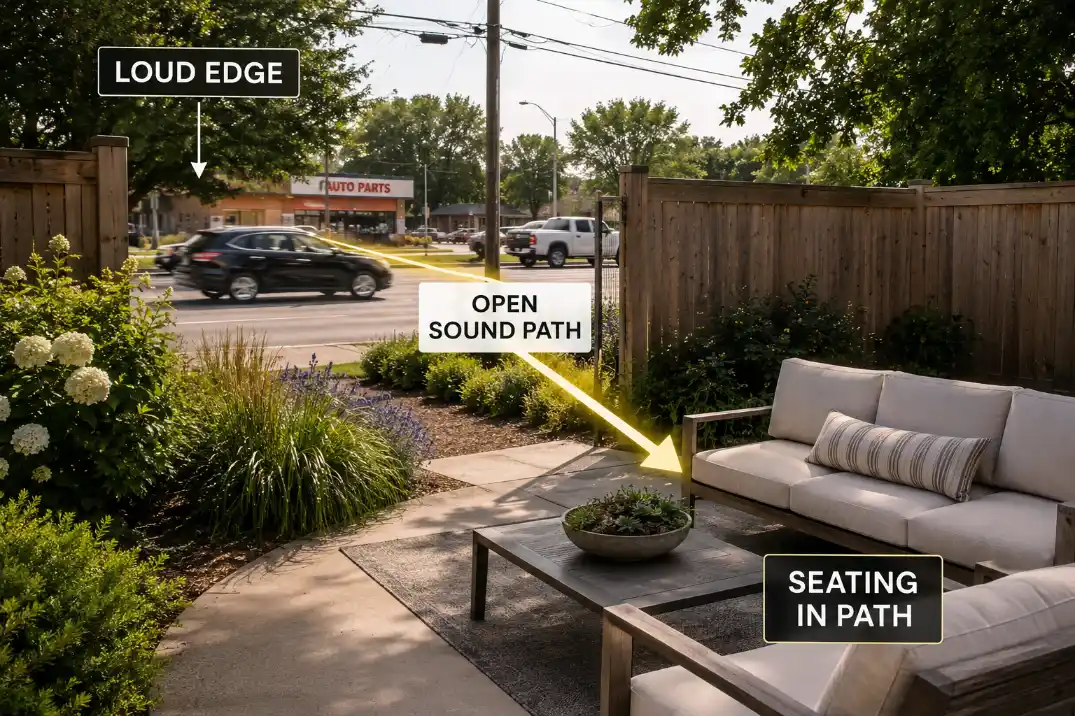
The symptom is that the yard feels tense, exposed, or hard to relax in. The mechanism is usually an open line between the sound source and the listener.
If you can sit down and see the moving cars, neighbor deck, AC condenser, alley opening, or outdoor work area, sound is often traveling along the same route.
This is why some fixes disappoint. A decorative screen may block the view while leaving a 12-inch gap at the bottom.
A hedge may soften the scene but leave the sound path untouched. A tall fence may help one angle but do little if the seating area still faces the open side.
The useful test is comparison
Stand at the loudest edge for 10–15 minutes during the actual noisy period. Then sit where people normally gather. Then test the quietest usable corner.
Do this during the real problem window: morning school traffic, 5–7 p.m. commuting, weekend lawn equipment, or evening neighbor activity.
A phone sound app is not a professional sound meter, but it can help compare locations. If the current patio reads 5–10 dB higher than a corner 15 feet away, the yard is giving you a layout clue.
If you need to raise your voice to talk at 3 feet, the seating area is probably too exposed for comfort during that window.
Street Noise vs Neighbor Noise
Street noise and neighbor noise need different buffers. Treating them the same is one of the fastest ways to spend money without changing the yard much.
Street noise is broad and steady
Street noise usually spreads across a wide edge. Tire hum, delivery trucks, motorcycles, buses, and stop-and-go traffic create a background wash with sharper spikes.
If the road is only 15–25 feet from the seating area, a few shrubs or one decorative panel should not be expected to carry the whole job.
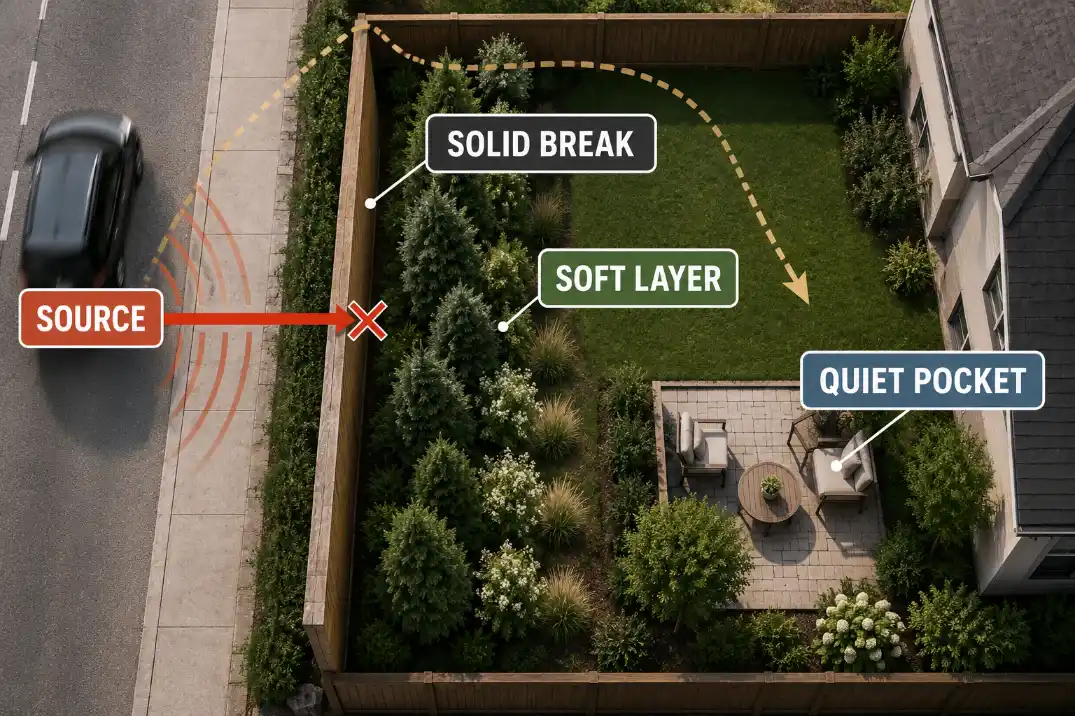
For traffic, the stronger move is usually layered: a solid interruption, planting that makes the edge feel less exposed, and seating placed behind the protected side.
This is where ideas used to block a busy road view from the front yard with no fence can support the same diagnosis, but sound needs fewer gaps than view control.
Neighbor noise is more directional
Neighbor noise is usually more targeted. It may come from a deck, patio table, hot tub, basketball hoop, side gate, garage workspace, dog area, or pool equipment. Because the source is smaller, a focused screen can work better than a full-yard enclosure.
A 6–8 foot solid or semi-solid screen placed between the source and the seating area often does more than a low hedge spread along the whole property line.
The test is seated height. If the source is still visible from the chair, the sound path is probably still too open.
Equipment noise needs distance and airflow
AC units, pool pumps, generators, and outdoor appliances are not just “neighbor noise.” They are fixed mechanical sources, often with vibration and airflow needs. Do not box equipment tightly just to quiet it.
Many outdoor units need at least 12–24 inches of working clearance around the sides and a clear discharge area where air leaves the unit.
A screen can hide equipment and soften the sound path, but airflow and service access come first. If the equipment itself is failing, rattling, or vibrating, a landscape buffer may hide the symptom without fixing the source.
Find the Loudest Edge Before Choosing a Fix
A good outdoor noise buffer starts with mapping, not shopping. Most yards have one or two pressure points that matter more than everything else.
Use a three-position listening test
Test the loud edge, the current seating area, and the quietest usable corner. Stay in each spot for at least 3–5 minutes. Short sounds can mislead you if you only listen for a few seconds.
Look for these signals:
- Conversation becomes difficult at 3 feet.
- One side of the yard feels sharper than the rest.
- Moving a chair 10–20 feet changes comfort more than adding a small plant would.
- The loudest noise arrives through one visible opening, corner, or fence line.
- The yard is only unpleasant during a specific 60–90 minute window.
That last point matters. A yard with short noisy windows may need a seating shift and partial screen. A yard with constant traffic exposure may need a stronger edge.
Watch for hard-surface echo
Some yards feel louder because hard surfaces bounce sound around. Concrete patios, stucco walls, vinyl fences, blank garage walls, narrow side yards, and bare paved courtyards can make voices, traffic, gates, and equipment sound sharper. These surfaces are not always the source, but they can amplify the harshness.
This is one reason a “cleaner” patio can feel worse after improvement. More paving, fewer planted beds, and a tall reflective fence may look finished while making the space feel less forgiving.
In tight outdoor rooms, the same layout thinking used for patio privacy ideas for secluded seating can help reduce both exposure and reflected sound.
Pro Tip: Test noise while seated, not just standing. A barrier that looks tall enough when you stand may fail at the actual listening height.
Soft Barriers and Hard Barriers Do Different Jobs
The best noise buffer choice depends on the source. Use this comparison to match the fix to the sound path, not just to the option that looks best in the yard.
The most common overestimate is expecting plants to act like acoustic walls. The most common underestimate is how much a solid interruption can help when it is placed in the right line.
Plants soften the edge
Plants can reduce the feeling of outdoor noise, but most small residential hedges do not block strong traffic noise by themselves. Plants help most when they are dense, layered, evergreen where needed, and close to the sound path.
A 2-foot-wide row of shrubs may improve the view and make the yard feel less exposed, but it usually will not create a major sound reduction by itself.
In many residential yards, even 20–30 feet of dense layered planting is a lot of space, and thinner planting should be treated as visual softening rather than a primary sound barrier. That does not make planting useless. It reduces the hard, exposed feeling, softens reflected sound, adds movement, and helps a solid barrier feel less severe.
Solid barriers interrupt the direct path
Solid barriers help outdoor noise problems most when they block the direct line between the sound source and the listener. A fence, wall, storage structure, raised planter wall, masonry edge, or solid screen can help when it is solid, continuous, and correctly placed.
Decorative lattice, widely spaced slats, open metal panels, and loose plant screens are privacy cues, not true sound breaks. A 6-foot barrier with a bottom gap, side opening, or weak corner can perform worse than expected because sound follows the openings.
For traffic or strong neighbor noise, the barrier should reach low enough, high enough, and wide enough to protect the actual seating area.
Berms help only when the yard has room
Berms can help outdoor noise buffers because soil has mass, but a small decorative mound is not the same as a real sound interruption. A 12–18 inch planting mound may make the edge look softer, yet it will not do much if the direct sound path still clears the top.
Berms work best when the yard has enough depth for a gradual slope, stable planting, drainage, and safe maintenance. Sunken seating can also feel calmer because the listener sits below part of the surrounding edge, but it brings its own issues: steps, drainage, water pooling after storms, and accessibility.
In rainy Midwest regions or clay-heavy yards, a lowered seating area should be planned with drainage first, not as a quick noise trick.
| Noise buffer fix | Best use | Common misread | When it stops making sense |
|---|---|---|---|
| Dense shrubs | Visual softness and mild edge comfort | Expecting a thin hedge to block traffic noise | When the noise is close, steady, and dominant |
| Solid fence or wall | Direct street or neighbor sound path | Choosing decorative gaps for a sound problem | When openings still expose seated ear height |
| Tall planters | Flexible patio or front-yard shielding | Treating planters as acoustic walls | When they are too low or too scattered |
| Berm or raised earth | Yards with depth and drainage room | Expecting a small mound to change much | When slope, runoff, or access becomes worse |
| Water feature | Light masking near seating | Using louder sound to fight loud sound | When people raise their voices over it |
| Seating relocation | Yards with one loud side | Assuming materials matter before layout | When every usable spot is equally exposed |
Seating Away From Sound Often Beats Bigger Barriers
The cheapest noise buffer is sometimes moving the place where people sit. It sounds too simple, so it is often skipped.
Move the listener out of the path
Moving seating away from the loudest edge is often the best first outdoor noise buffer idea when one part of the yard is clearly quieter than another. If the patio is built against the loud edge, every screen has to work harder.
Moving seating 10–20 feet behind a garage corner, planting bed, pergola post line, storage wall, or side return can noticeably change the yard. It may not make the space quiet, but it can make conversation easier.
This is especially important in small backyards, where a full enclosure can feel heavy. A seating area tucked behind an offset screen may feel better than one pressed against a tall fence.
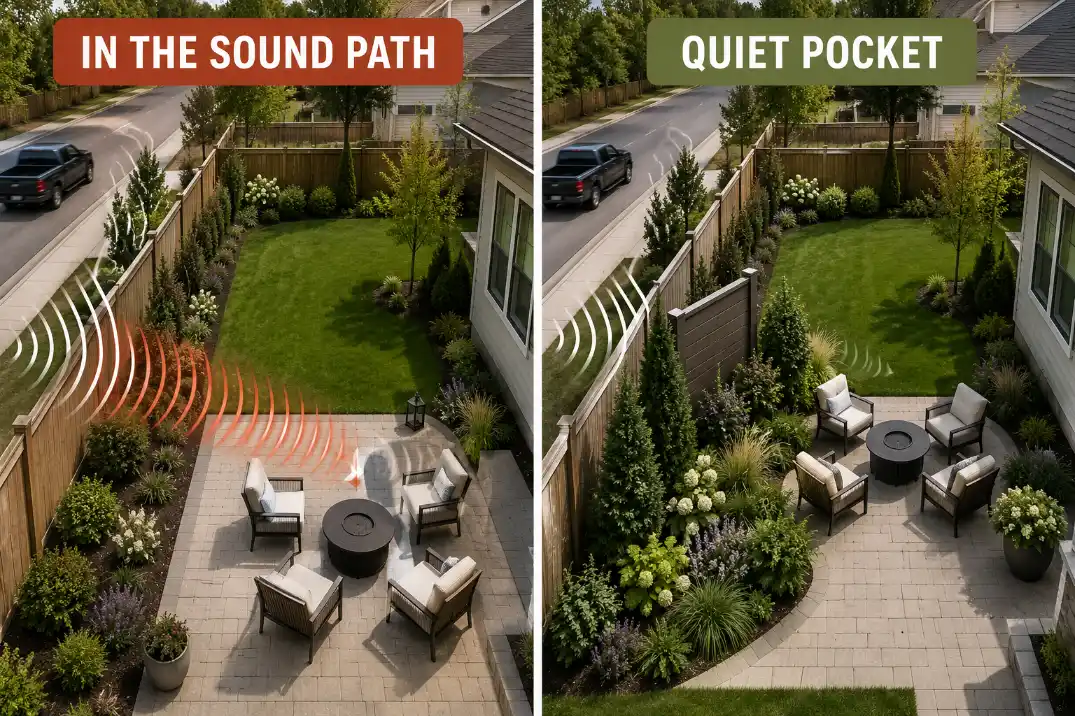
The screen does not have to wrap the entire patio. It only has to interrupt the worst angle. When the yard needs softness as well as privacy, backyard privacy ideas without a fence can help shape that enclosure without turning the yard into a box.
Turn the seating, not just the fence
Chair direction matters. People feel noise more when they face the source directly. Turning the main seating 30–45 degrees away from traffic, an alley, or a neighbor deck can reduce the feeling of exposure even when the measured sound level changes only slightly.
This is not acoustic magic. It is comfort design. The eye, ear, and body stop treating the loud edge as the center of the space.
Use water only for light masking
Water features can make a noisy yard feel calmer when they mask light background noise, but they do not block sound. That difference matters.
A small fountain 3–6 feet from seating can make light background noise feel less obvious, especially when the sound is steady and gentle. But a loud fountain used to fight traffic usually becomes another fatigue source. If people raise their voices over the water, it is not improving the seating area.
Outdoor speakers have the same risk. Adding music to cover road noise can make the yard feel busier, especially in close neighborhoods where the sound carries back to other homes.
Quieter Without Feeling Closed In
A calmer yard does not need to become a sealed outdoor room. In many cases, the best solution is selective interruption: close the loud angle, keep the quiet side open.
Use partial screens where sound enters
Partial screens work best when they sit where the noise enters the seating area. Many yards need one strong screen, not four weak ones. A side screen beside a patio, a taller planter wall near a neighbor deck, or a solid panel at the road-facing corner can do more than scattered planting around the whole perimeter.
This is where privacy planters for front yards and patios are useful. They are not magic sound blockers, but they can thicken a weak edge, shield seated areas, and make a hard panel look intentional when fences are limited by HOA rules or front-yard codes.
Keep openings where quiet already exists
Do not close the quietest view just because you can. If one side of the yard faces trees, lawn, sky, or a low-activity neighbor wall, leave that side visually open. Close the loud angle instead.
A uniform privacy wall can look complete while creating new problems. It can trap heat, reduce airflow, make a small yard feel tight, and create more hard surfaces for sound to reflect from. In hot climates, especially on patios with afternoon sun, full enclosure can trade one comfort problem for another.
Know when the standard fix stops working
A light planting strip stops making sense when the source is close, constant, and clearly dominant. If traffic noise forces raised voices at 3 feet during the time you want to use the yard, a decorative hedge alone is not the right first fix. If the loud edge is consistently 10 dB higher than the quiet corner, start with seating relocation, a solid interruption, or both.
For larger suburban lots, creating a privacy buffer in a suburban yard can help combine view control, planting depth, and outdoor-room placement. For small yards, the same idea has to be compressed: fewer layers, better position, and no wasted barriers where they do not affect the listening area.
Quick Noise Buffer Checklist
- Listen during the real noisy window, not during the calmest part of the day.
- Compare the loud edge, current seating area, and quietest corner for at least 3–5 minutes each.
- Treat a consistent 5–10 dB difference between spots as a layout clue.
- Block the direct sound path at seated ear height before adding decorative planting.
- Use plants to soften and layer, not as the only fix for strong traffic noise.
- Move seating 10–20 feet when the yard gives you a naturally quieter pocket.
- Avoid full enclosure if it creates heat, poor airflow, or harsh sound reflections.
Questions People Usually Ask
Do hedges really reduce outdoor noise?
Hedges can reduce the feeling of outdoor noise, but most small residential hedges do not block strong traffic noise by themselves. A narrow hedge is usually better for privacy and visual calm than serious noise reduction.
For a stronger buffer, planting needs depth, density, and often a solid element behind or within it.
Will a fence help if it does not block the view of the source?
A fence usually will not help enough if the sound source is still visible from seated height. If the road, neighbor deck, equipment opening, or alley is still visible from the chair, the sound path is probably still open. A fence or screen helps most when it interrupts the direct line between the source and the listener.
Is a taller fence always better for noise?
A taller fence is not always better if it is in the wrong place or has gaps. A 6-foot solid barrier placed directly between the source and seating can outperform a taller but poorly placed screen with open lattice, bottom gaps, or a weak side return.
Can a water feature make a noisy yard feel calmer?
A water feature can make a yard feel calmer by masking light background noise, but it does not block traffic or neighbor sound. Keep the water sound soft and close to the seating area. A loud fountain used to fight loud traffic usually adds fatigue instead of comfort.
Because a calmer yard is usually about reducing interference rather than chasing silence, the EPA’s outdoor noise guidance is a useful reference for understanding where everyday sound starts to affect normal outdoor use.