
Yard drainage problems usually come from one of three mechanisms: soil that will not absorb water, slope that moves water too fast, or a surface that blocks the water’s exit. The puddle is only the symptom.
First decide whether water is arriving from above, sitting because the soil is sealed, or backing up because it has nowhere safe to leave. Water that disappears within 6 to 12 hours after heavy rain may be normal.
Water that remains for 24 to 48 hours, crosses a walkway, sits near a foundation, or returns after every storm is more serious.
The mistake is diagnosing from the wettest spot alone. A 2-inch puddle at the bottom of the yard may matter less than a thin sheet of runoff crossing a patio edge every time it rains.
Read the Water First
Surface water, saturated soil, or blocked outlet?
The first useful clue is movement. Standing water tells you where water ended up. Moving water tells you why it got there.
Watch the yard during rain if you can do it safely. The most useful window is often the first 10 to 20 minutes of visible flow, before the whole yard looks wet. If water runs in a narrow route, the problem is probably surface runoff.
If the area darkens evenly and stays soft underfoot after the storm, soil saturation or compaction is more likely. If water stops along concrete, pavers, edging, a fence base, or a raised planting bed, the outlet may be blocked.
There is also a fourth clue that gets missed: water appearing near the bottom of a slope after the upper yard is already saturated.
That can look like a simple low spot, but it may be a slope-and-soil problem where water is moving through or across the grade before showing up at the base.
The quick diagnostic checklist
- Water disappears within 6 to 12 hours: often normal unless it crosses a walkway, patio, or foundation first.
- Water remains for 24 to 48 hours: suspect slow soil, compaction, low grade, or a blocked outlet.
- Water appears during the storm in a visible route: prioritize surface runoff and slope.
- Water appears after every irrigation cycle: check watering schedule and sprinkler direction before installing drainage.
- Water follows a patio, driveway, walkway, or edging line: suspect hardscape redirection.
- Water carries mulch, gravel, or soil: erosion is part of the drainage problem.
- Water sits within the first 5 to 10 feet of the house: treat foundation direction as a priority, not a lawn-only issue.

Soil That Holds Water
Clay is often blamed correctly, but fixed incorrectly
Clay soil can hold water long enough to make a lawn soft, sticky, and slow to recover. In parts of the Midwest and Southeast, clay-heavy yards may stay saturated long after sandy or loamy soil nearby has dried. But clay is not automatically a drain-installation problem.
Sometimes the better first move is reducing compaction, improving organic matter, or giving water a controlled surface route.
A simple infiltration check helps separate slow soil from blocked surface flow. Dig a small hole about 6 inches deep, fill it with water, let it drain once, then fill it again and time the second drain.
If water is still sitting after 24 hours, absorption-based fixes need caution. A rain garden, dry well, or soakaway area only makes sense if the soil can actually empty between storms.
For broader fix selection, a general guide like Yard Drainage Solution Guide is useful after you know which mechanism you are dealing with, not before.
Compaction can mimic bad soil
Compaction is easier to underestimate than clay. A yard can have decent soil below and still shed water because the top 2 to 4 inches are sealed by foot traffic, mower passes, pets, construction work, or repeated wet-season use.
The signal is usually a slick, shiny surface during rain and shallow puddles that appear before the soil has any chance to absorb water.
Aeration, compost topdressing, and traffic control can help when the issue is shallow compaction. But if the yard sits in a bowl and has no lower outlet, soil improvement alone will not create a destination for excess water.
Pro Tip: Test the wet area and a nearby dry area on the same day. The comparison matters more than one isolated hole.
Slope That Moves Water
A slight grade can still create a serious flow path
Homeowners often overestimate steepness and underestimate continuity. A yard does not need to look steep to move water. Even a 2% slope, or about 2 feet of fall across 100 feet, can send roof runoff, lawn runoff, and neighbor runoff toward the same low edge.
The warning sign is repeated direction. If water takes the same route during several storms, the slope is not a background detail; it is the drainage system. That does not always mean the yard needs full regrading. It may mean the runoff path needs to be intercepted, slowed, spread, or carried to a safer outlet.
Where erosion is already cutting through mulch or soil, sequence matters. Stabilizing bare soil before controlling the water route often fails because the next storm removes the repair.
For sloped yards, Fix Slope Drainage and Erosion in the Right Order is the more useful decision path than simply filling the low spot.
When slope is the cause, the puddle is downstream evidence
A low spot at the bottom of a slope is rarely the whole problem. Filling it with soil may only raise the water line and push runoff sideways. Adding gravel may hide mud for a season while the same flow keeps arriving.
A better question is whether the water can be slowed before it reaches the problem area. Shallow swales, planted flow paths, dry creek beds, and catch points can work when they are placed across the actual water line. They disappoint when installed as decoration beside the flow.
Surface That Blocks Water
The blocked exit is often smaller than the wet area
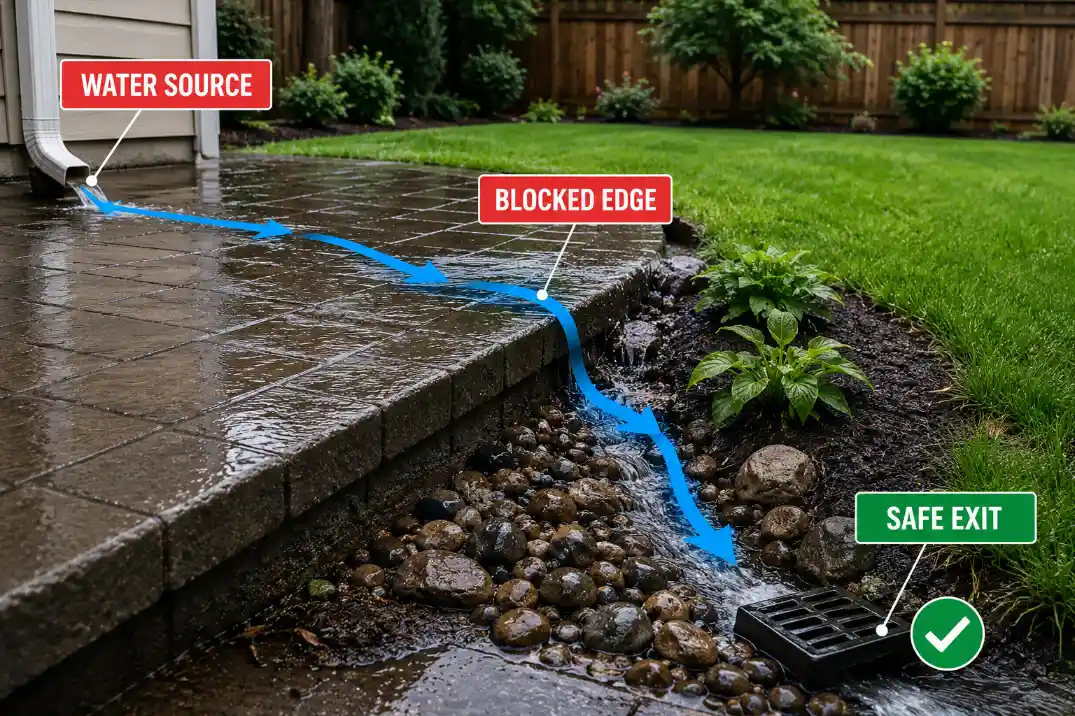
Some drainage problems are not caused by too much water. They are caused by water losing its exit. Edging, compacted gravel, raised planting beds, dense turf lips, settled pavers, and fence bases can hold back water just enough to create ponding.
A 1-inch raised edge can matter if the surrounding grade is nearly flat. That small lip may stop shallow sheet flow from reaching a lawn, swale, or lower discharge area.
In freezing northern states, trapped water near hardscape can also become a winter safety issue because it freezes, thaws, and refreezes along walking surfaces.
Drains only help when they match the water shape
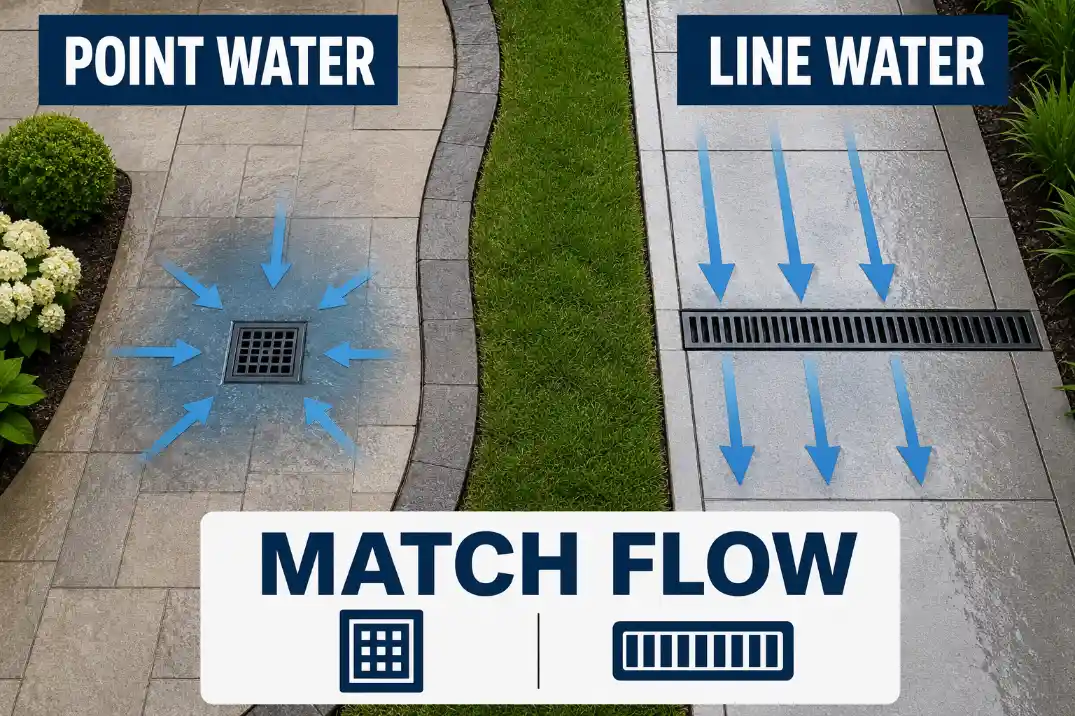
A catch basin is not a universal answer. It works best where water collects at a point. A channel drain works better where water crosses as a line, such as across a patio edge, driveway apron, or walkway. Installing a square basin beside sheet flow is one of the most common wasted fixes because the water simply passes by it.
| Drainage clue | More likely cause | Better first response |
|---|---|---|
| Water sits evenly across soft lawn | Slow soil or compaction | Test infiltration and reduce surface sealing |
| Water cuts the same route during rain | Slope-driven runoff | Intercept or redirect the flow path |
| Water pools against patio or walkway edge | Blocked surface exit | Lower, notch, drain, or reroute the hard edge |
| Water crosses a long hardscape edge | Line flow | Use a drain or swale that crosses the flow |
| Water collects in one low pocket | Point collection | Use a basin only if it has a real outlet |
| Water returns toward the house | Bad discharge direction | Move outlet away from foundation and traffic paths |
If water is crossing a hard edge as a long sheet, the difference between a point drain and a line drain becomes more than a product choice.
The placement logic in Catch Basin vs Channel Drain for Runoff is useful when the water shape is visible but the right inlet is not obvious.
Hardscape That Redirects Water
Patios and walkways can create new drainage paths
Hardscape rarely behaves like the old lawn it replaced. A patio, driveway, walkway, or compacted gravel path can collect rainfall faster, shed it in a sharper direction, and block water that used to spread through soil.
This is why drainage problems often show up after a landscape upgrade. The yard did not suddenly become wetter. The water became more organized.
A patio that falls 1/4 inch per foot in the wrong direction can send water toward a bed, walkway, basement wall, or lawn low point. A driveway can add a large sheet of runoff to a side yard that was only designed to handle rain falling directly on soil.
If roof water is part of the pattern, the outlet matters as much as the extension length. A downspout that moves water 6 feet away but releases it onto a surface that slopes back toward the house has not solved the cause.
For that specific decision, Pop-Up Emitter, Downspout Extension, or Dry Well? is a better fit than guessing from the puddle alone.
Near the house, drainage has a stricter standard
A wet lawn low spot and water near the foundation are not equal problems. Near the house, the key question is whether the grade, outlet, and hardscape slope move water away from the structure.
As a practical target, the soil and surface should clearly fall away from the foundation rather than flattening or dipping back toward it.
If water sits near the house after ordinary rain, do not start with decorative rock, mulch, or plants. First check whether the discharge point, patio pitch, walkway edge, or settled soil is sending water back.
A pretty planting bed can hide the symptom while the mechanism keeps working.
When the Standard Fix Stops Working
Soil improvement stops when there is no outlet
Aeration, compost, and topdressing can improve shallow compaction, but they cannot solve a trapped basin. If the surrounding grade blocks water on all sides, better soil only helps the yard absorb small storms more gracefully. It does not create a safe overflow route for larger storms.
Gravel stops when water is still arriving
Gravel is often used because it makes mud look cleaner. That is not the same as solving drainage. If water continues to arrive from a slope, driveway, downspout, or patio edge, gravel may sink, clog with sediment, spread into the lawn, or simply become a wet stone strip.
Absorption fixes stop when soil drains too slowly
Rain gardens, dry wells, and soak-in basins need soil that can recover between storms. If a test hole still holds water after 24 to 48 hours, an absorption feature may stay wet too long or overflow in the wrong direction.
In humid climates such as Florida or coastal parts of the Southeast, that recovery window matters because storms can arrive close together. In drier parts of Arizona, the same rule still matters because short, intense storms can overwhelm a decorative basin quickly.
Rain gardens and dry creek beds only work when they meet the real water path. A beautiful stone line that sits 12 inches away from the runoff is still the wrong drain. For that failure pattern, Dry Creek Bed Drainage Mistakes is worth using when the feature looks right but runoff keeps bypassing it.
DIY stops when water has legal, structural, or neighbor impact
Routine homeowner fixes stop making sense when water is moving toward a foundation, entering a basement, crossing a public sidewalk, damaging a retaining wall, or being discharged toward a neighbor’s property.
Those are not just wet-lawn problems. They involve grade, outlet rights, structural risk, or local stormwater rules.
Fix the Cause, Not the Puddle
Use the 3-part decision rule
Before choosing a fix, answer three questions in order.
First, where does the water enter the problem area? This may be roof runoff, uphill lawn flow, driveway sheet flow, irrigation overspray, or water from a neighboring grade.
Second, what stops it from leaving? The answer may be clay, compaction, low grade, a raised edge, a patio slope, or no lower outlet.
Third, where can it safely go? A good destination is lower than the problem area, away from the foundation, away from walkways, and not aimed at a neighbor’s yard. Water discharged within the first 5 to 10 feet of a foundation deserves extra suspicion unless the grade clearly continues away.
Pro Tip: Mark the water path with flags or temporary chalk during rain. After the yard dries, those marks are often more useful than memory.
The best fix changes the mechanism
A good drainage fix changes at least one of three things: where water enters, how fast it moves, or where it exits. If a fix does not change any of those, it is probably cosmetic.
That is why the right answer may be smaller than expected. A shallow notch through a raised edge may solve what gravel could not. A downspout outlet moved to a lower lawn may outperform a buried dry well in slow soil.
A channel across the flow may work better than a basin beside it. The goal is not to buy the most serious-looking drainage product. The goal is to interrupt the actual failure pattern.
Questions People Usually Ask
Can soil improvement fix every yard drainage problem?
No. Soil improvement helps when the problem is shallow compaction or slow absorption. It does not solve active runoff from a slope, driveway, patio, or downspout. It also does not fix a yard with no safe outlet.
Is a French drain the right fix for surface runoff?
Not usually. A French drain is more useful for subsurface moisture or saturated soil than for visible sheet flow crossing hardscape. If water is moving across the surface, interception, grading, or a surface drain may matter more.
What if the yard only floods during big storms?
Occasional flooding during unusually heavy storms may not require a major system if water drains safely and does not threaten structures, walkways, or neighboring property.
But if big storms send water toward the house, across access routes, or through the same erosive channel, the overflow path needs to be planned.
For a more technical look at how soil, grading, slope, and runoff combine in landscape drainage problems, see Oklahoma State Extension’s guide to drainage issues in urban landscapes.