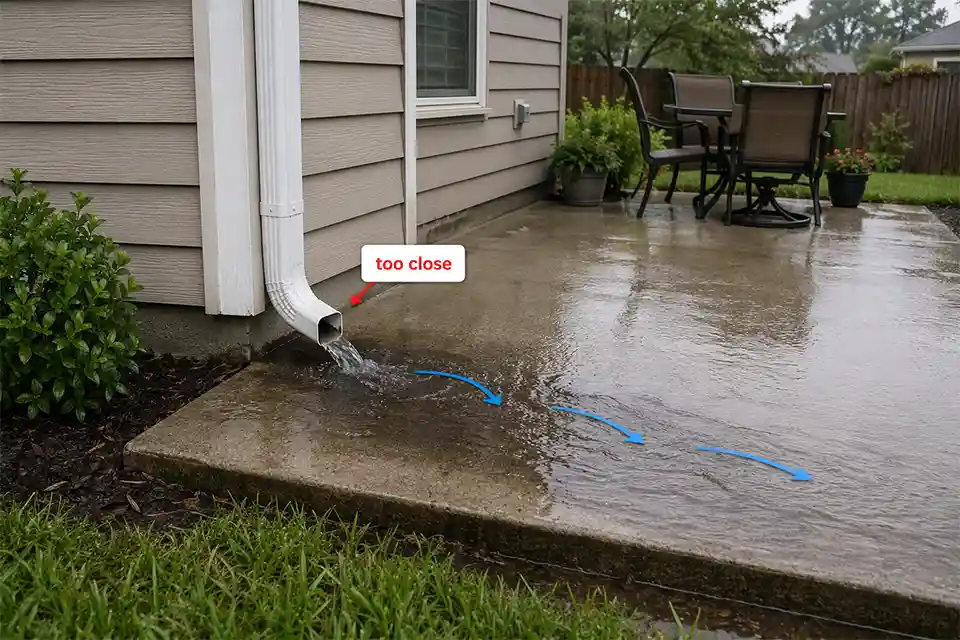
If runoff is cutting across the patio, the patio is usually where the problem shows up, not where it starts. In most yards, this issue falls into 1 of 3 fix paths: a narrow runoff line needs interception, a nearby downspout is adding too much volume, or water is entering through one corner or low spot.
The fastest checks are simple: does water reach the patio within 5 to 15 minutes of rain, does it arrive as one visible path or one entry point, and does the same strip stay wet more than 24 hours later? A wet patio is normal. A patio acting like a drainage route is not.
That distinction saves time. Many homeowners re-sand joints, seal pavers, or keep cleaning the same muddy strip. But if the runoff path begins uphill, the durable fix is usually to intercept, redirect, or reduce that flow before it reaches the hardscape.
What type of patio runoff problem do you actually have?
Start with the runoff pattern, not the product. That is the quickest way to choose a fix that actually matches the problem.
A narrow runoff line crossing the patio
This is the clearest pattern. Water reaches the patio in one repeatable lane, often diagonally, and leaves behind the same silt line, debris trail, or darker wet strip after each storm. That usually means runoff has already concentrated uphill and is now crossing hardscape in a visible path.
This is the strongest match for a channel drain because the problem is linear. It is much less convincing when water is spreading across the whole patio as broad sheet flow.
| BEST DRAIN FOR A RUNOFF CROSSING |
|---|
| Channel Drain Kit |
| Best for patios where runoff enters in one narrow, repeatable path and needs to be intercepted at the hardscape edge. |
| This category fits when the slope sends water across the patio instead of letting it spread out and slow down earlier. |
| Look for a low-profile kit with removable grates, enough linear length for the runoff path, and debris handling that makes sense for outdoor use. |
| 🔴 SHOP channel drain kit |
A channel drain is strongest when the path is visible and repeatable. If the water is arriving from several directions at once, this is usually not the lead fix.
A downspout making the slope wetter before water reaches the patio
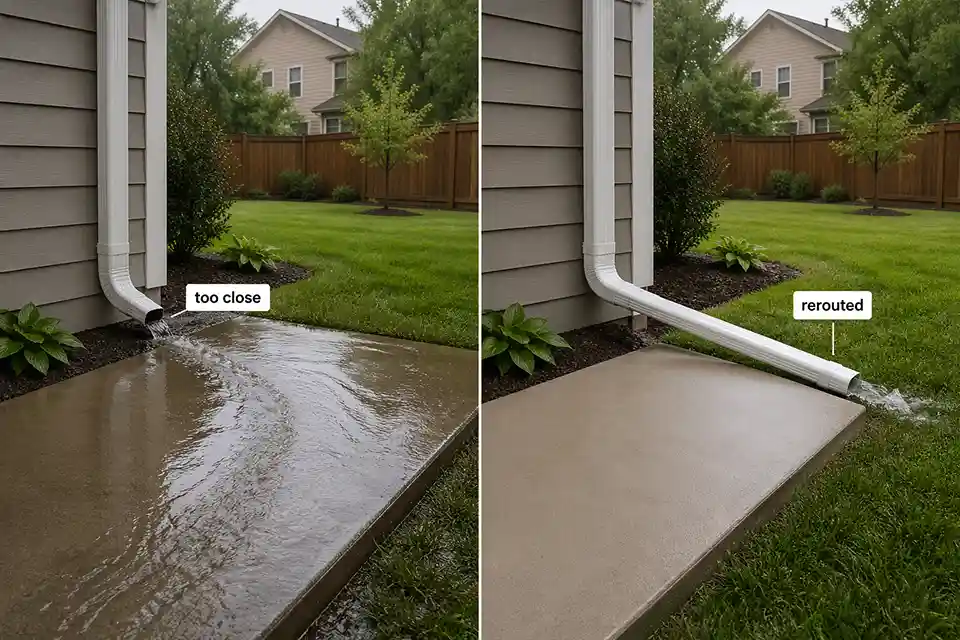
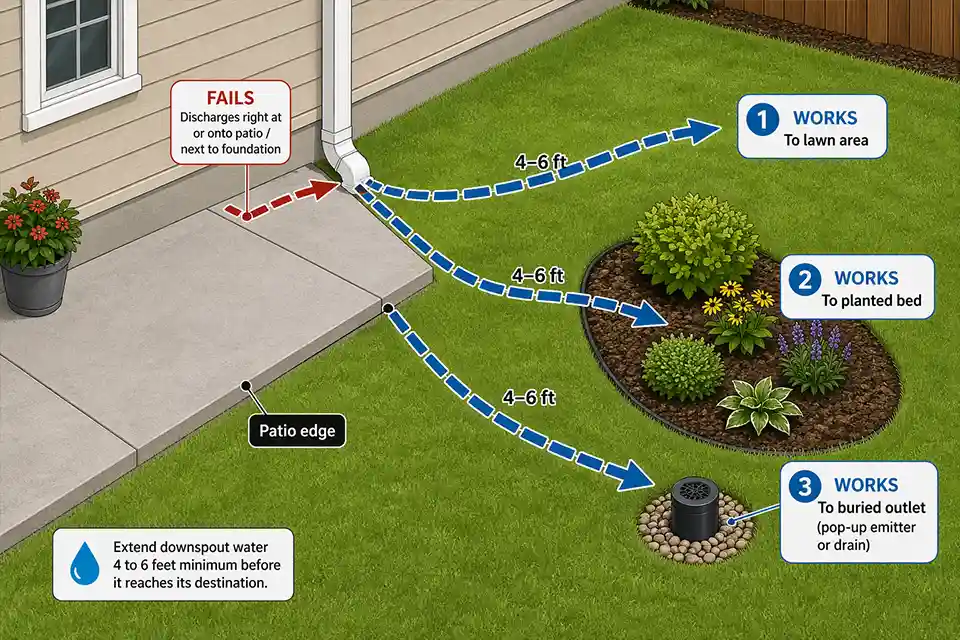
Sometimes the slope is only part of the story. A downspout outlet 10 to 20 feet uphill can add enough extra volume to turn a manageable yard into a repeat runoff problem.
This is especially common when the outlet lands near compacted soil, a side approach, or a bed edge that quietly steers water toward the patio.
If one outlet is clearly adding volume, this is often the fastest low-effort fix to try first.
| BEST FIX FOR DOWNSPOUT-FED RUNOFF |
|---|
| Downspout Extension Kit |
| Best for setups where a nearby downspout is adding concentrated water to the slope above the patio. |
| This category fits when the patio is not the source problem, but the runoff volume is being amplified before it gets there. |
| Look for an extension that gives enough reach, connects cleanly to the existing downspout, and helps move discharge away from the patio approach. |
| 🔴 SHOP downspout extension kit |
This works best when one discharge point is clearly feeding the problem. It is not a substitute for correcting larger grading failures, but it is often the simplest high-value correction when runoff volume is the trigger.
Water entering through one corner or low spot
Some patios do not get crossed by a long runoff line. Instead, water funnels into one corner, one low edge, or one concentrated entry point before it spreads. In that case, the goal is often collection at the entry point, not interception across a longer edge.
This is a narrower use case than the other two. If the water is moving across a long visible strip, a catch basin is usually not the better first match.
| BEST FIX FOR A RUNOFF ENTRY POINT |
|---|
| Catch Basin Drain Kit |
| Best for patios where runoff funnels into one corner, edge, or low spot before spreading across the surface. |
| This category fits when the water is not coming across the whole patio evenly, but entering through one concentrated point. |
| Look for a kit that handles outdoor debris, connects cleanly to drain pipe, and suits the amount of runoff your slope is sending down. |
| 🔴 SHOP catch basin drain kit |
Why people misread the patio first
The patio is where the mess appears, so it gets blamed first. But the visible symptom and the useful mechanism are often different things.
Symptom versus mechanism
A patio can be pitched reasonably well, around 1/8 to 1/4 inch per foot, and still perform poorly if too much water arrives from uphill in one concentrated path. The surface can be acceptable while the surrounding drainage pattern is not.
The fix that often wastes time
Re-sanding joints, sealing pavers, patching one visible low spot, or repeatedly pressure washing the runoff line may improve appearance for a while. None of those changes the route water takes. They are finish-layer fixes to an upstream routing problem.
What gets underestimated
Repeated low-grade runoff is usually underestimated because it does not always look dramatic. But a shallow crossing path that reappears storm after storm can strip joint sand, stain concrete, keep pavers slick, and slowly soften patio edges. Over one season, that kind of repeat movement often matters more than one messy storm.
Pro Tip: If you can point to the exact place where runoff first steps onto the patio, that entry point usually matters more than most of the wet area below it.
What is most likely feeding the runoff
Once you stop treating this as a patio-only issue, the source usually becomes easier to read.
Compacted or thinning uphill ground
In many yards, the upper slope sheds water too fast because the top 2 to 4 inches of soil are compacted, worn, or partly bare. Turf may still look acceptable from a distance, but once the surface stops absorbing well, rain starts moving across it. On clay-heavy ground, even moderate rain can trigger visible flow quickly.
That same slope-driven drainage logic also sits behind Sloped Backyard Problems: Drainage, Erosion, and Safety, where the issue is not just steepness but unmanaged water movement.
Beds and edging that quietly redirect water
Softscape does not always absorb the way people think it should. A mulch bed can act like a channel if the edging behaves like a curb or the bed surface sheds water toward one side.
A raised edge of just 2 to 3 inches can be enough to shift runoff sideways until it finds one weak entry point at the patio.
If mulch keeps slipping downslope, that is already a clue that water momentum is not being broken up early enough. The same pattern shows up in Stop Mulch Sliding on a Sloped Planting Bed, where the visible mulch movement is really a runoff warning sign.
Adjacent work that changed the drainage path
Patio problems often start after nearby changes: a new bed, a different edging line, minor regrading, or even a downspout relocation. In those cases, the patio itself may be fine, but the surrounding yard now feeds it differently.
That broader surrounding-grade failure is also common in Backyard Drainage Problems After Adding a Patio or Walkway.
The repair hierarchy that usually works best
The strongest fix is usually not to make the patio shed water faster. It is to stop the patio from being the route.
First priority: intercept or reshape the flow path
If there is one obvious runoff lane and at least a few feet of soil space above the patio, interception uphill is usually the best first move.
That might mean a shallow swale, a capture strip, or a regraded transition that spreads water before it reaches the hardscape. Even a swale just 4 to 8 inches deep and 18 to 36 inches wide can redirect manageable runoff if it has a true outlet.
Second priority: reduce what is feeding the runoff
If the upper slope is bare, shedding fines, or receiving extra water from a discharge point, interception alone may not hold. The contributing area needs to calm down first. Otherwise the patio fix becomes a maintenance trap.
Third priority: add patio-edge drainage only when the site demands it
A channel drain makes more sense when the patio sits directly below the slope, soil buffer is limited, or hardscape on both sides leaves no room for a swale.
A catch basin makes more sense when the runoff is truly entering through one corner or one low point. Both become weak answers when water is still arriving as broad sheet flow from several directions.
| Runoff pattern | Best first move | Secondary move if needed | What often wastes time |
|---|---|---|---|
| One narrow fast lane from uphill | Swale or interceptor upslope | Small channel drain at edge | Re-sanding or sealing the patio |
| Broad sheet flow over a wide area | Regrade upper yard to spread and redirect | Add capture only after reshaping | Installing one isolated drain |
| Downspout-fed surge near patio side | Extend or reroute discharge | Rebuild local grade near outlet | Reworking the whole patio first |
| Water entering at one corner or low point | Catch basin at the entry point | Improve outlet routing | Installing a long drain without need |
| Wet strip stays damp beyond 24 hours | Check outlet path and edge moisture | Inspect patio base and surrounding grade | Surface-only cleanup |
When this stops being a patio fix
This is where many drainage articles get too optimistic. Some sites are no longer dealing with a patio-edge problem at all.
Signs the bigger slope is now the real problem
If you are seeing runoff channels more than about 1 inch deep uphill, repeated soil washout, exposed roots, or settlement along the patio edge, the issue has moved into slope stabilization and erosion control. At that point, another patio-focused fix usually disappoints because the contributing ground is still failing.
That is where the broader failure pattern starts to look more like Stop Erosion in a Sloped Backyard, where the source area needs to be stabilized before the runoff symptom will settle down.
When infiltration-based fixes are realistic
Rain gardens, amended soil zones, and permeable areas can help, but only under the right conditions. They work better when runoff can be spread out before it arrives, when the soil can actually absorb water, and when there is enough room between the slope and the patio to hold and infiltrate flow.
As a rule, they are more realistic when the area between the slope and the patio has a gentle usable grade and enough space to spread runoff out, not when compacted clay is sending a fast narrow stream straight downhill.
Site constraints that decide the outcome
Three constraints matter more than people think: whether there is a safe place to send the water, whether there is enough distance above the patio to intercept it, and whether nearby structures, utilities, or septic areas limit your options. A swale without a real outlet is just a holding groove. A drain with nowhere to daylight is often just buried maintenance.
A short diagnostic checklist that is actually useful
Use this during the next solid rain or with a hose test lasting 10 to 15 minutes:
- Does water hit the patio as one narrow line, one corner entry, or broad sheet flow?
- Does runoff show up within 5 to 15 minutes of rain starting?
- Is the path carrying mulch, soil, or joint sand?
- Does the same strip stay wet for more than 24 hours?
- Is there an uphill bed edge, worn lane, or discharge point feeding it?
Those answers usually tell you whether the first move should be interception, rerouting, collection, or a larger slope correction.
The risk ladder that matters most
A muddy line, surface staining, and slick algae are the nuisance stage. Joint washout, edge softening, and recurring debris trails are the moderate stage. Paver settlement, slab undermining, and runoff moving toward the house are the serious stage.
That last category is the line people often wait too long to respect.
If the crossing path is sending water toward the foundation side of the patio or collecting against the house, it stops being just an outdoor comfort problem and starts overlapping with the broader moisture-routing issue covered in Patio Water Pooling Against the House.
For broader official guidance, see the University of Minnesota Extension rain garden guidance.