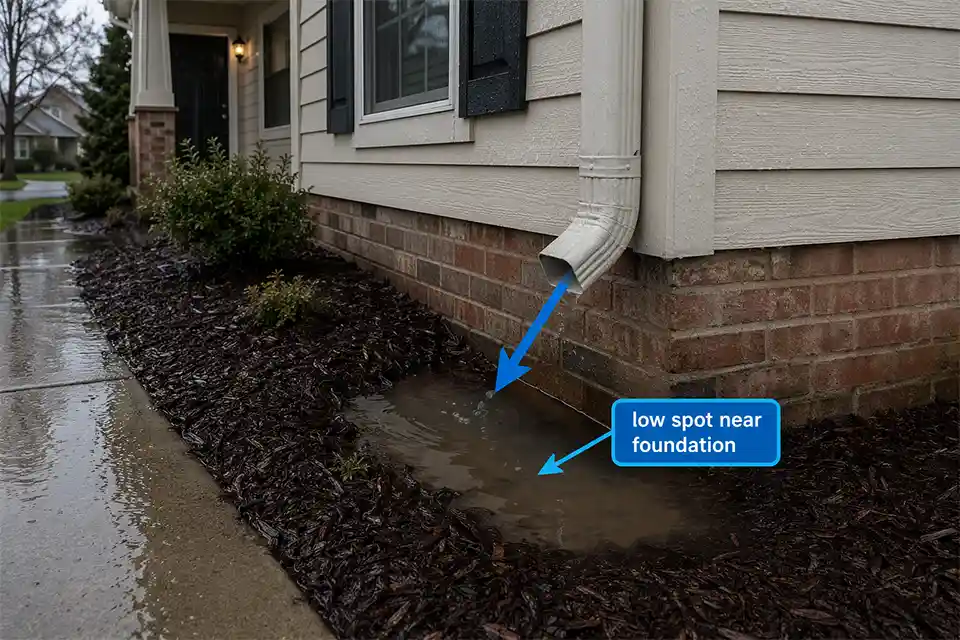
Water pooling near the house in a front yard usually comes from a short list of causes, and they are not equally likely. The first thing to suspect is bad grading beside the foundation.
The next is roof water being discharged too close to the house, either from a short downspout extension or a gutter overflow point.
After that, look at compacted or clay-heavy soil that cannot absorb water fast enough. Broader site drainage problems do happen, but they are not the first place to start unless the whole front yard stays wet.
That order matters. Water sitting in the middle of the lawn is one kind of drainage problem. Water collecting within the first 3 to 6 feet of the house is a more specific and more important one because the structure is now part of the drainage pattern.
If the puddle forms during ordinary rain, keeps returning in the same spot, or is still there 24 hours later, treat it as a real drainage failure, not just a soggy patch.
What usually causes it first
Settled grading beside the house
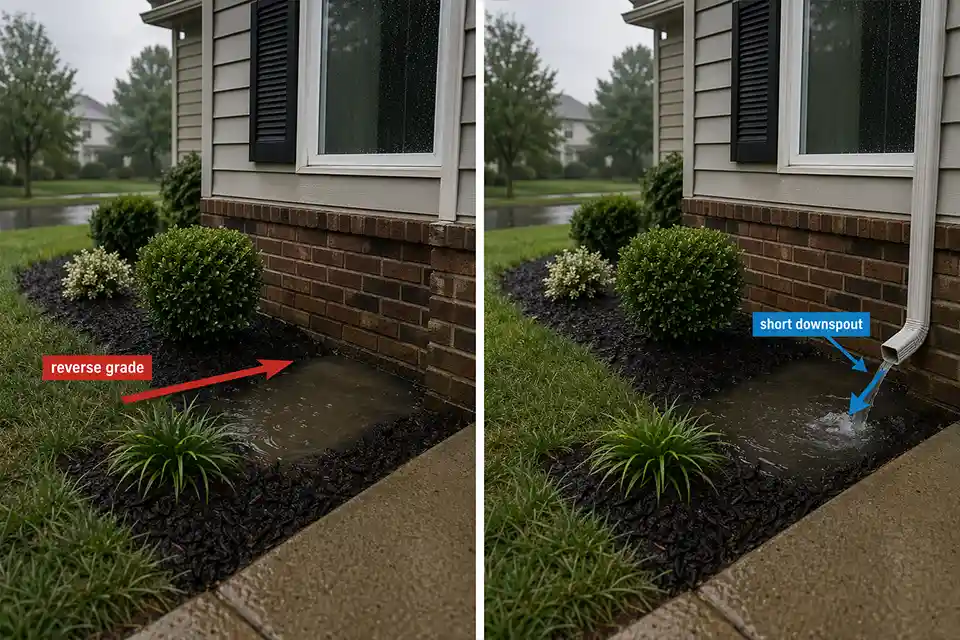
This is the most common cause, especially in homes that were built or reworked in the last several years. Soil placed around a foundation often settles. When that happens, the surface near the house can flatten out or tilt back toward the wall instead of away from it.
A healthy surface should shed water away from the foundation, not pause it there. Formal guidance often points to at least 0.5 inch of fall per foot for the first 10 feet on permeable ground.
In the field, many contractors use a rough rule of thumb of about 6 inches of fall over the first 10 feet. The exact geometry varies in tight front yards, but the principle does not: the first few feet beside the house should not be the low point.
This is the issue people often underestimate. They see a wet mulch bed and assume the mulch or soil is the problem. More often, the bed is just revealing that the grade at the foundation edge has sunk.
Downspouts or gutter overflow points too close to the house
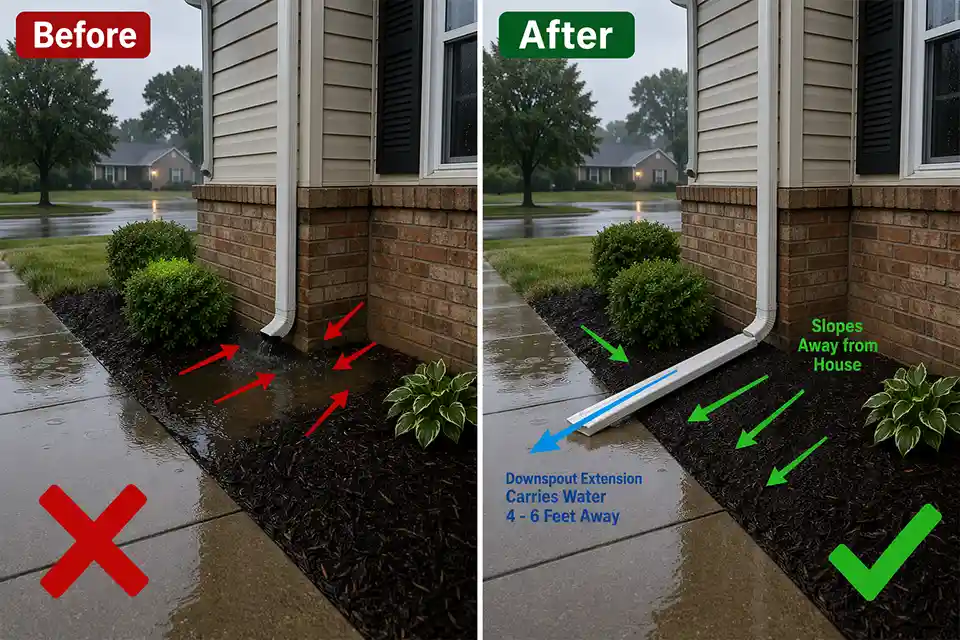
The second likely cause is concentrated roof runoff. A short extension that dumps water 1 to 2 feet from the wall can overwhelm even decent soil. The same is true when a gutter overflows at one front corner, or a downspout connection leaks and sends water into the bed instead of away from it.
If pooling begins only during active rainfall, a clogged or overflowing gutter is a strong suspect. If it keeps forming at the same discharge point once rain is underway, the issue is more often where the downspout is depositing water.
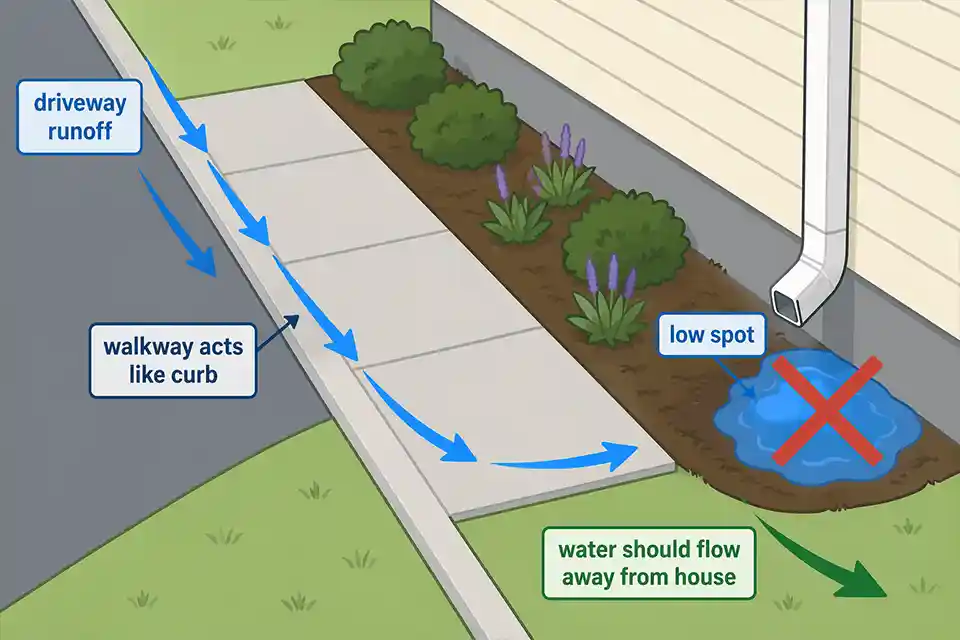
In many cases, extending discharge to at least 4 to 6 feet away makes a bigger difference than doing anything to the bed itself. The problem gets worse when runoff lands beside the house and nearby paving keeps it boxed in, which is common in front-yard drainage setups where downspouts and walkways push water into the same trouble spot.
Slow infiltration from compacted or clay-heavy soil
Clay soil is real, but it gets blamed too early. It is often the amplifier, not the original trigger. If runoff is being dropped beside the house and the grade is already shallow, slow soil infiltration makes the puddle last longer. It does not necessarily explain why the puddle forms there in the first place.
A compacted upper layer is often more important than people think. In front yards, the top 4 to 8 inches can become dense from foot traffic, edging work, repeated wet-dry cycles, or construction compaction. When that top layer seals quickly, water starts moving sideways instead of soaking in.
This is not the same as a generally soggy yard
Near-house pooling has a tighter cause pattern
A soggy lawn is often a landscape problem. Recurring water within 3 to 6 feet of the foundation is often a building-adjacent drainage problem. That is why broad wet-yard advice can miss the point.
If the whole lawn stays wet after every rain, you may be dealing with a low lot, poor site drainage, or water coming from uphill ground. But when the wet area hugs the house or repeats at one front corner, the cause pattern is usually narrower: bad grade, roof discharge, or a hardscape-controlled trap.
After drainage is solved, tall planters for driveway privacy can be a practical next step for the exposed edge.
Use timing to narrow it down
A quick timing check helps:
- If water appears within minutes of rainfall under one roof edge, suspect gutter or downspout discharge first.
- If the area fills more gradually and forms a shallow strip beside the house, suspect settled grade.
- If the source has been corrected and water still lingers past 24 hours, move soil infiltration and compaction higher on the list.
- If multiple low areas stay wet across the front yard and the problem seems to flow back toward the house, it may be behaving more like a low front lot that keeps collecting runoff from higher ground.
What people usually misread
The puddle is the symptom, not the mechanism
This is the biggest diagnostic mistake. People focus on the water they can see, then throw stone, mulch, or a drain at that exact spot. But the real mechanism is usually one of these:
- runoff delivered too close to the house
- surface grade that lets water pause at the wall
- a walkway or driveway edge that traps water in the wrong zone
If the cause is upstream, spot-fixing the puddle will disappoint.
Clay gets overestimated
People often assume clay is the whole story because the area feels slick and stays wet. But clay alone does not explain why one front corner fails more than the rest of the yard. When the wettest spot lines up with a downspout, porch corner, or walkway edge, start there.
Once you have ruled out misdirected runoff and bad grading, it becomes more useful to look at how clay-heavy front yards hold water and why they drain slowly.
Pro Tip: If one area near the house is repeatedly wet but the lawn 10 feet away is mostly fine, do not start by diagnosing the whole yard. Start by tracing the water path into that one failing zone.
Why the obvious fix often fails
More mulch or gravel does not solve drainage
This is one of the most common time-wasting fixes. Mulch can hide a shallow depression for a while. Gravel can reduce splash. Neither one changes the grade, the runoff source, or the trapped flow path. If the same area keeps washing out, floating mulch, or turning soft after normal rain, surface cover was never the real fix.
Aerating first is often backward
Aeration can help a compacted yard, but it is not the first move when roof water is being dropped beside the foundation or the grade beside the house is wrong. That is backward sequencing. Fix the source and the slope first. Then decide whether the soil still needs help.
A French drain is not always the first answer
People often overestimate how quickly they need to jump to buried drainage. A drain starts to make more sense when basic corrections have already been made and the site still traps water with nowhere practical to send it.
That is more common when driveways, stoops, or walkways lock the surface into a bad pattern. In those cases, the issue often looks less like a simple wet bed and more like driveway runoff that keeps feeding the wrong part of the front yard or a tighter sloped front-yard drainage pattern that keeps pushing water back toward the house.
Quick diagnostic checklist
- Water collects within the first 3 to 6 feet of the house
- The same front corner or wall section gets wet repeatedly
- A downspout, gutter overflow point, or roof edge lines up with the puddle
- The puddle remains longer than 24 hours
- Mulch floats, washes, or thins in the same zone
- The surface feels hard when dry and slick when wet
- A walkway, stoop, or driveway edge seems to hold water near the wall
When it stops being a simple yard fix
A standard surface correction starts to make less sense when the basic cause pattern has already been addressed and the water still has no path out. That is the pivot point.
If you have already redirected roof runoff and corrected the obvious grade beside the house but pooling still returns after ordinary rain, not just heavy storms, the issue may be bigger than a simple front-bed adjustment.
The same is true when the low spot is boxed in by concrete so regrading alone cannot create a real exit path, when the front lot clearly receives water from uphill areas, or when water problems are also showing up at a crawlspace, basement wall, or interior edge.
At that point, the drainage logic starts to look more like a larger front-yard slope problem where surface water keeps finding its way back downhill, not just a small bed correction.
Less common causes do exist, including irrigation leaks or hidden plumbing issues, but they are usually worth checking only when the timing does not fit a rain event. If pooling appears in dry weather or persists without any recent rainfall, those causes move up the list.
What to prioritize before anything else
| What you notice | Most likely cause | Best first move | What usually wastes time |
|---|---|---|---|
| Water starts fast at one roof edge | Short downspout or gutter overflow | Redirect discharge farther away | Adding gravel at the puddle |
| Water sits in a strip along the house | Settled grade | Regrade the first foundation-adjacent zone | Aerating first |
| Water lingers after source correction | Compaction or clay-heavy soil | Test infiltration and upper-soil density | Re-mulching again |
| Water is trapped by walkway or driveway | Hardscape-controlled flow path | Correct routing before adding drains | Treating the bed alone |
| Multiple front areas stay wet | Larger site drainage problem forcing water back toward the house | Trace broader slope and inflow pattern | Assuming one corner fix solves it |
The sharpest way to read this problem is simple: bad grading near the foundation is usually the first suspect, roof-water discharge is the next, and soil limitations are often the reason the problem gets worse, not the reason it began.
For broader official guidance, see the University of Minnesota Extension page on moisture around foundations.