Last updated: July 5, 2026
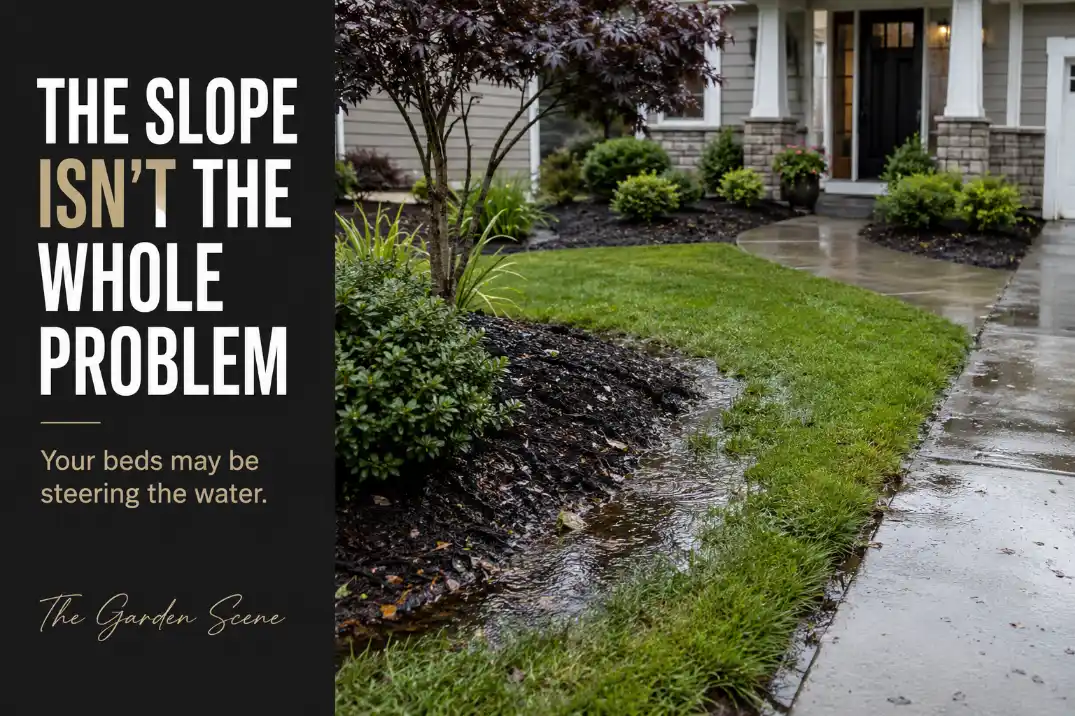
A sloped front yard usually gets blamed the moment mulch slides, grass stays wet, or water crosses the front walk. But the slope is often only the carrier. The real problem is what the landscaping makes that water do next.
A raised bed edge can hold water on the uphill side. Loose mulch can sit directly in a fast-water strip. A driveway edge can turn sheet flow into a narrow channel. A lower planting bed can become the receiving zone for water that started much higher in the yard.
That is why the useful question is not, “How do I landscape a slope?” It is, “Where does the water start, where does it gain speed, what does it hit, and where does the landscaping accidentally trap or concentrate it?”
Before adding more plants, more mulch, or a more decorative border, read the yard after rain. The final puddle is only the ending. The first failure point is usually uphill.
Why a Sloped Front Yard Turns Landscaping Into a Drainage Problem
A front yard does not need to feel steep to move water with force. Even a gentle grade can push rainwater faster than a flat lawn, especially when that water is fed by a driveway, walkway, downspout, curb edge, or compacted upper lawn.
That is where landscaping starts to matter. A curved bed edge may look finished, but if it sits across the downhill path, it can behave like a small dam. A clean mulch layer may look neat at installation, then collect at the lower corner after the next storm.
A narrow lawn strip beside a driveway may look like leftover green space, but during rain it may be the main route water uses to reach the sidewalk or front bed.
The most misleading clue is the final wet spot. Water often appears at the lowest or slowest area, but that does not prove the low spot caused the problem. A soggy bed base may simply be where water finally loses speed. The trigger may be several feet uphill, where a hard edge turned broad flow into a narrow line.
That is the core soil, slope, and runoff relationship in a front yard: grade moves the water, but landscaping decides whether that movement stays broad and manageable or becomes concentrated and damaging.
A sloped front yard usually fails in one of four ways. Water gets blocked. Water gets narrowed. Water gets accelerated. Or water is delivered into a planting area that was designed to look good, not receive flow. Once you know which pattern is happening, the fix becomes smaller and more accurate.
Read the Water Path Before You Change the Planting
The first test is simple: inspect the yard while the evidence is still fresh. Dry soil can hide the route. After rain, the yard leaves clues in darker grass, sediment lines, mulch trails, muddy edges, shiny low spots, and the area that dries last.
Start at the upper side of the slope, not at the puddle. Look for the first place water enters the landscaped area. It may come from the roof, a downspout, the upper driveway edge, a walkway, or a small hardscape transition near the porch. Then follow the line downhill.
The important question is not only “Where is it wet?” It is “Where did the water change behavior?” A wide, shallow sheet of water is usually less damaging. A narrow line along a border, step edge, driveway lip, or bed curve is more likely to move mulch, expose soil, or stress roots.

Use this compact field check before changing plants or materials:
- Find the first arrival point, not just the final puddle.
- Look for a visible flow line in grass, mulch, or sediment.
- Check where water turns along a walkway, driveway, curb, or bed edge.
- Note where mulch has moved, thinned, or piled up.
- Compare the first area to dry with the last area to dry several hours later.
- Mark any spot where water crosses the entry walk or sits near the house side of the yard.
Roof water can confuse the diagnosis because it may land near one feature, then use the slope to create a problem somewhere else.
If the wet line begins near a downspout, porch bed, or hard edge beside the entry, diagnose that source separately from the slope itself; downspout and walkway drainage problems often look like a sloped-yard issue only after the water starts moving downhill.
A clean diagnostic order is: observe after rain, trace the source, note where water gains speed, inspect the edges it touches, then choose the fix direction. Skipping that order is how homeowners end up replacing plants in a bed that was never the real cause.
Where Landscaping Usually Makes the Slope Worse
The landscaping feature that looks most “finished” is often the feature changing the drainage. On a slope, a border, mulch layer, lawn strip, or lower bed can quietly become part of the water system.
A raised bed edge is one of the easiest problems to miss. It may be only a few inches high, but if it sits across the natural downhill route, it can hold water on the uphill side or turn flow sideways. When the edge shifts or tilts, one part becomes a dam and another becomes a spill point. The border is no longer just a border.
If the edge is no longer holding its line, the next decision may be about stabilizing a shifting landscape edge rather than adding more mulch or reshaping the whole bed.
Loose mulch is another common failure point. Mulch can protect soil where water moves slowly, but it does not behave well in a repeated fast-water strip. On a slope, lightweight mulch often migrates to the lower edge, leaving bare soil above and a thick pile below. The homeowner sees a messy bed; the diagnostic clue is concentrated water.
| Landscaping feature | Drainage effect on a slope | What to check first |
|---|---|---|
| Raised bed edge | Traps water uphill or redirects it sideways | Look for a wet strip above the border |
| Loose mulch | Moves through fast-water zones and exposes soil | Follow the mulch trail uphill |
| Thin turf or bare soil | Lets water gain speed instead of slowing down | Check for a narrow muddy line |
| Walkway or driveway edge | Turns sheet flow into a channel | Look for water running along the hard edge |
| Lower planting bed | Receives water from above without relief | Check if it is the last area to dry |
Thin turf matters because grass is not just decoration on a slope. A dense surface slows water and protects soil. A thin strip gives water a smoother route downhill. Once soil opens, water tends to reuse that line, and the mark becomes clearer after each storm.

A lower front bed is not automatically wrong. It becomes a problem when it is designed like a dry decorative border but used by the yard as a receiving basin. Plants in that zone may yellow, lean, rot at the base, or fail to root deeply because the bed alternates between moving water and soggy soil.
Avoid the quick cosmetic fix here. Adding more mulch hides the symptom for one storm. Adding more plants gives water more stems to hit. Adding a taller border may make trapped water worse. The useful question is: what is this landscape feature making the water do?
When the repeated clue is mulch movement, the issue deserves its own diagnosis. A sloped bed where mulch that keeps washing out returns every season is usually telling you the water has not been slowed, spread, or released before it reaches loose material.
Separate Slope Problems From Source Problems
Do not judge the slope until you know what is feeding it. In a front yard, extra water commonly enters from a downspout, driveway, walkway, porch roof edge, compacted upper lawn, or hardscape transition that was regraded without enough attention to runoff.
Think of the slope as the carrier and the source as the feeder. If the feeder is too strong, the best planting design downhill will still struggle.
A downspout discharging onto a sloped bed can send roof water across mulch and into the lawn. A driveway that tilts slightly toward the yard can deliver fast sheet flow to a narrow grass strip. A walkway edge can collect water on one side, then release it into a lower bed. In each case, the visible symptom may be downhill, but the first correction belongs uphill.
Field Check:
Do not judge a planting bed until the incoming water has been identified. A bed that looks poorly designed may simply be receiving more water than a landscape bed should handle.
Driveways deserve special attention because their water can arrive fast and clean-looking. There may be no dramatic washout at first, just a wet edge, a thin strip of turf, or sediment where pavement meets grass.
If the first arrival point is along pavement, treat driveway runoff into the front yard as a source issue before blaming the slope or the plants below it.
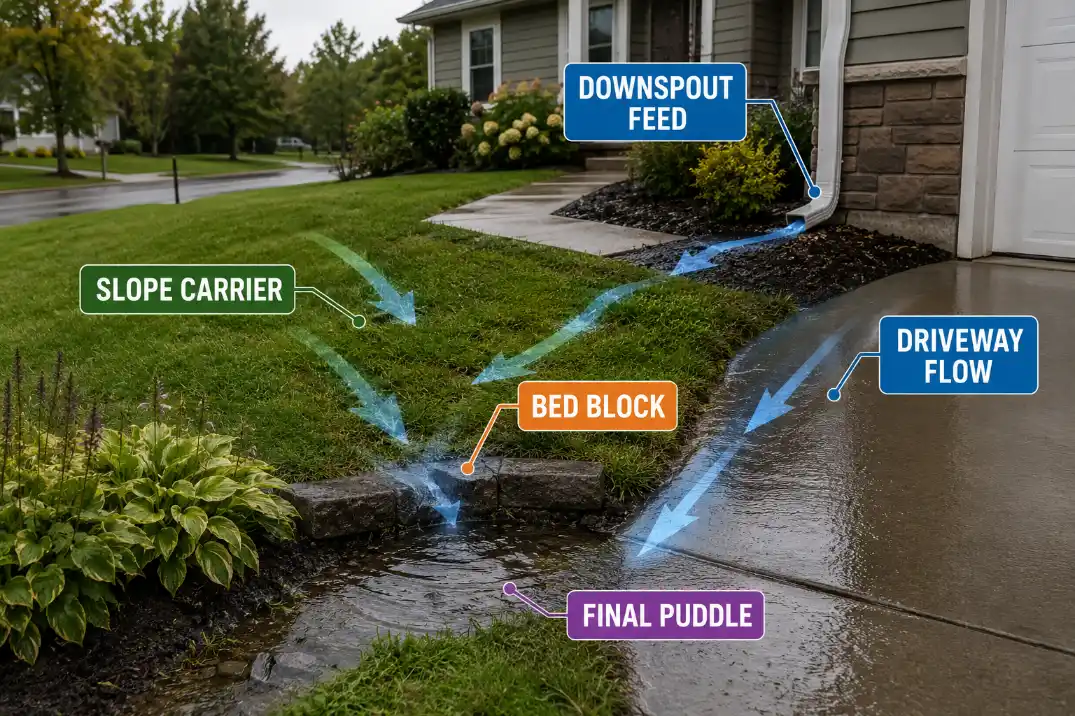
This split protects the fix from becoming expensive guesswork. If the source is still feeding the problem, changing the lower bed may only move the symptom. The water will still arrive, still gain speed, and still look for the lowest or easiest route.
Planting on a Slope Only Works After the Flow Pattern Is Clear
Plants can support a sloped front yard, but they cannot correct a bad water path by themselves. This is where many designs become frustrating: the planting plan is asked to perform drainage work that should have been handled by edge shaping, surface coverage, grading adjustment, or water routing.
Dense ground-level coverage is more useful on a slope than widely spaced decorative plants. Bare gaps between shrubs or perennials can become small flow lanes. Once water finds those lanes, it can cut between plants instead of slowing across the bed. The planting may look full from the street but fail at soil level.
Roots need stable conditions. If water repeatedly cuts through the same strip, young plants may struggle even if they are technically suited to the sun and soil. If the bottom of the bed stays wet after the upper slope dries, the plants in that lower area need to be chosen for the receiving condition, not the average yard condition.
This does not mean every sloped front yard needs a specialized plant palette. It means plant selection should come after flow diagnosis. Once the water behavior is clear, front yard plant choices can match the actual exposure: fast-draining upper slope, moving-water strip, damp receiving edge, or hot pavement-adjacent zone.
A common mistake is planting delicate flowers in the final receiving area because that lower bed is the most visible from the sidewalk. If water collects there first, the bed needs to function before it decorates.
Choose the Fix Path by Where Water Gains Speed
The right fix belongs where water changes behavior, not automatically where the yard looks worst. If you only fix the final puddle, you may miss the point where water gained speed. If you only replant the exposed strip, you may ignore the edge that turned water into a channel. If you only replace mulch, you may be resetting the same failure.
On a sloped front yard, useful fixes usually do one of five jobs: slow water high, spread flow wider, open a blocking edge, hold soil in place, or route excess water away from the wrong area.
| Observed behavior | Likely issue | Fix direction |
|---|---|---|
| Water races down from the upper yard | Flow gains speed too early | Slow high before it reaches beds |
| Water follows one narrow line | Flow has become concentrated | Spread flow wider or interrupt the channel |
| Water sits above a border | Edge is blocking movement | Open, lower, or reshape the edge |
| Soil or mulch moves repeatedly | Surface is not protected in a fast zone | Hold soil and reduce water speed |
| Lower bed stays wet longest | Area is receiving too much flow | Design a receiving zone or route excess |
If water is fast near the top, the lower yard should not be the first place you fix. The upper slope needs a way to slow and spread water before it reaches loose mulch, a walkway edge, or a planting bed. That might mean changing surface cover, softening a hard edge, or giving water a broader path.
If the problem begins where water meets a border, the edge matters more than the plants behind it. A taller border is not always better. Sometimes the smarter move is to lower a small section, create a controlled release point, or reshape the bed so water does not build pressure along one side.
If the lower yard is the natural receiving area, treat it honestly. A receiving zone should not be built like a dry decorative strip. It needs plants and surface materials that tolerate occasional wetness, and it needs a way to release excess water when ordinary rain becomes heavy rain.
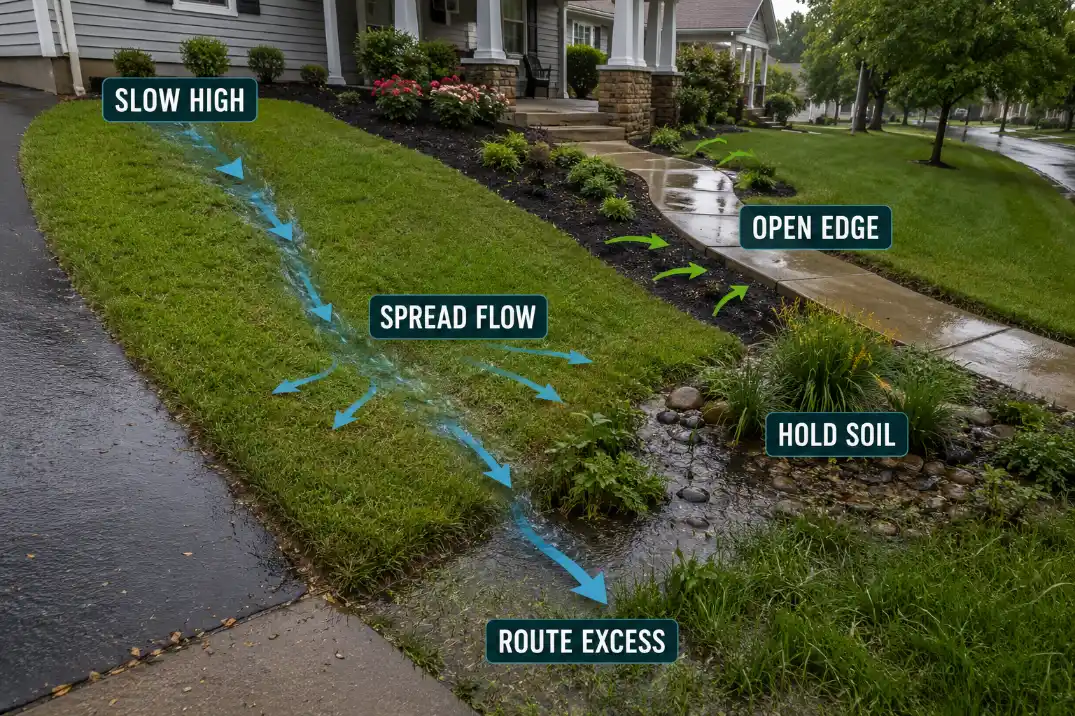
The fix does not need to be dramatic to be correct. In many front yards, the highest-value move is a small change at the first failure point: stop a hard edge from channeling flow, interrupt a narrow runoff line, protect exposed soil, or change the lower bed from a decorative stop into a planned receiving area.
When This Is No Longer a Landscaping Problem
Some sloped front yard drainage issues cross the line from landscape adjustment into drainage, grading, or structural concern. If water is moving toward the foundation, collecting against the house side of the yard, or staying near steps, porch supports, or basement-adjacent areas, do not treat it as a planting problem.
Soil loss is another boundary. Exposed roots, undermined sidewalk edges, visible utility exposure, or washing near porch and step bases deserve more caution than ordinary mulch movement. The same is true when water crosses a public sidewalk in a way that creates a slick surface or recurring sediment deposit.
Wall movement, leaning walls, failing structural edges, or major grade changes sit outside this article. Those conditions should not be solved with more plants, extra mulch, or a taller border.
Fix Boundary:
If the water path threatens the house, public walking surface, structural grade, or a built wall, treat the landscaping symptom as evidence rather than the repair plan. The next step should be drainage, grading, or local professional guidance, not another cosmetic landscape layer.
The point is not to make every wet sloped yard sound dangerous. Most front yard slope problems are manageable once the water path is understood. But a slope that sends water toward structures or repeatedly removes soil has crossed out of simple landscaping judgment.
A Sloped Front Yard Should Move Water on Purpose
A sloped front yard does not need to be flattened to work. It needs to move water on purpose.
That is the difference between a yard that keeps losing mulch and a yard that still looks intentional after rain. Beds placed across flow, raised edges with no release, loose material in fast-water zones, and lower planting areas with no receiving plan all make the slope harder to manage.
Before changing the planting, watch the yard after rain. Find where water first arrives. Follow where it gains speed. Identify the edge, strip, or bed that changes the flow. Then choose the smallest fix that addresses that first failure point.
For additional homeowner stormwater guidance, see the Massachusetts stormwater fact sheet on preventing erosion around the home.