
Last updated: July 5, 2026
A front yard at the bottom of a hill should not be diagnosed from the puddle first. The puddle only shows where the water stopped. The real drainage problem usually starts higher up, then reveals itself in the lowest visible place.
That is why these yards can feel unfair. The rain may not be extreme, but the lawn stays soft, mulch keeps moving, the walkway gets muddy, or water creeps toward the house. The front yard is not just handling the rain that falls on it. It may be receiving water from the slope above it, the driveway, the street edge, a side yard, a downspout, or several of those at once.
The useful diagnosis is a water-path diagnosis: where the water enters, how it concentrates, where it slows, what holds it, and whether it stays in the lawn or starts moving toward the house. Until that path is clear, adding soil, replacing mulch, or choosing a drainage feature can fix the symptom while leaving the source untouched.
Why the Bottom of a Hill Changes the Drainage Problem
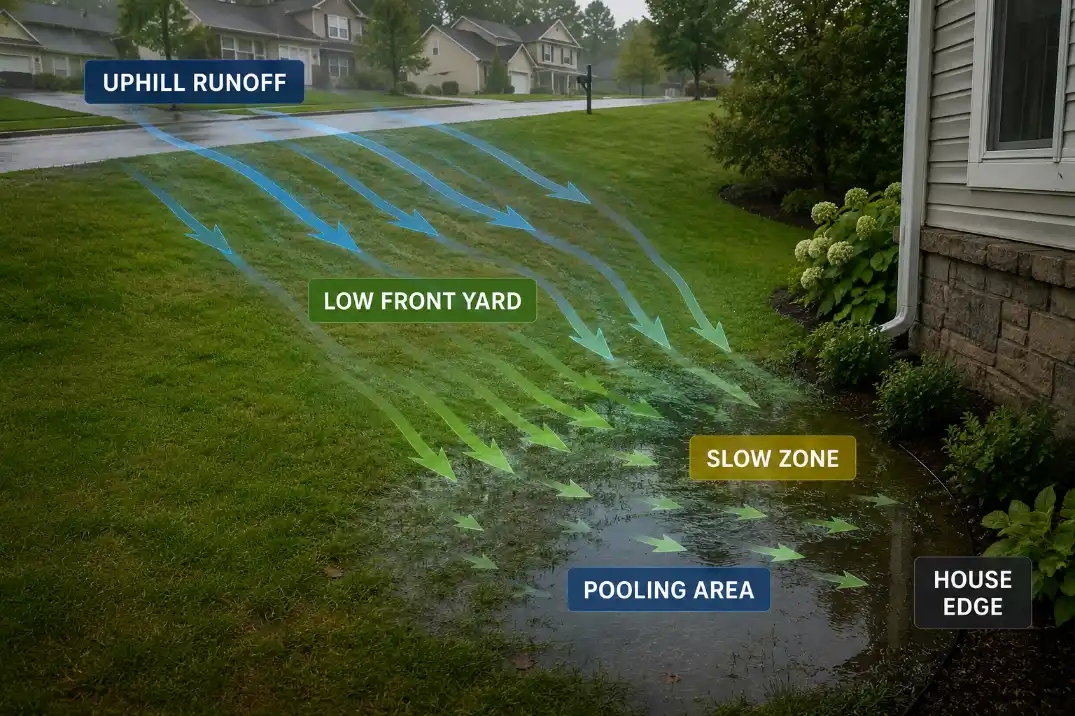
A low front yard has a different job than a flat yard. It is not only a surface that gets rained on. It is a receiving area for water already moving downhill.
On the slope, water can gain speed across turf, mulch, bare soil, street edges, or pavement. At the bottom, that movement slows. When fast-moving runoff reaches flatter ground, it spreads, stalls, drops sediment, pushes mulch, or settles into the lowest lawn pocket.
That is why an ordinary rain can produce a wet area that seems larger than the storm itself. The front yard may be collecting runoff from a bigger uphill area than the homeowner realizes. The lowest patch is just where the extra volume becomes visible.
This is where broad drainage advice can mislead the diagnosis. A low front yard may have a grading problem, a soil problem, a downspout problem, a driveway problem, or a layered version of all four.
A broader look at yard drainage problems tied to soil, slope, and runoff can help with the larger category, but this page is about the hill-bottom pattern: water arriving low, concentrating, and failing to leave cleanly.
Common Mistake Box
- Fixing only the puddle without tracing the water source.
- Adding soil to the low spot while incoming runoff still cuts across the same path.
- Treating every wet lawn area as a soil problem.
- Choosing a drainage system before watching where water first enters the front yard.
The Wet Spot Is Usually the End of the Water Path
The wettest area deserves attention, but it should not automatically get blamed. In a hill-bottom front yard, the wet spot is often the last stop in a longer path.
A puddle beside the sidewalk may be fed by street-side sheet flow. A muddy strip near the driveway may come from the driveway slope. A soggy foundation bed may begin with water entering from farther uphill, then becoming noticeable only when it reaches the planting edge. A low lawn hollow may simply be the meeting point for several small flows.
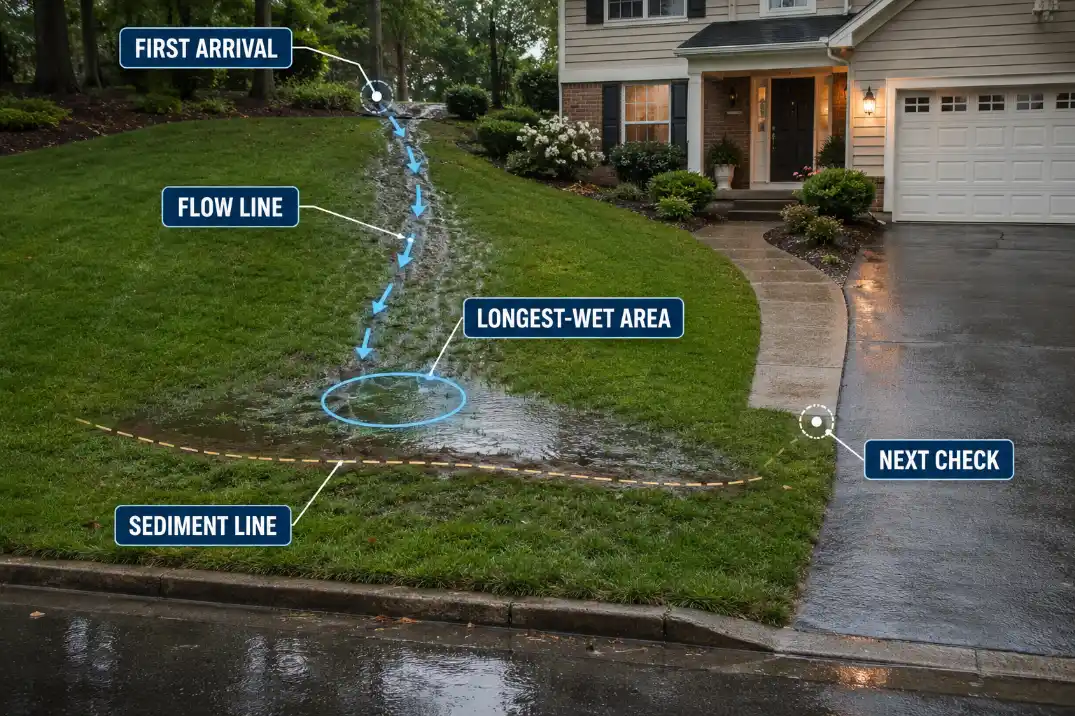
The field clue is direction. Look for the shape of the damage, not just the deepest water. A round puddle suggests water is settling. A narrow washed strip suggests movement. Mulch pushed in one direction, flattened grass, sediment lines, and clean-washed soil all tell you water had a route before it stopped.
Filling only the low spot can fail because it treats the stopping point as the cause. If uphill water keeps arriving, the water will either return to the same place or find a new low edge beside it. That is when a “fixed” yard starts showing a second wet strip, a new mulch washout, or water crossing the walkway after the next storm.
Where the Extra Water Comes From
The first repair-relevant question is source. If the yard receives extra water from more than one direction, the visible puddle may be a combined failure, not a single flaw in the lawn.
Uphill sheet flow is the broadest version. Water moves across lawn or street-facing grade as a thin layer instead of a single stream. It may not look dramatic while rain is falling, but it can load the lower lawn with more water than the soil can release.
Side-yard or neighbor-side runoff is narrower. It often appears along a property edge, fence line, hedge line, or side walkway before turning into the front yard. This pattern is easy to miss because the pooling may be in front of the house while the entry point is off to one side.
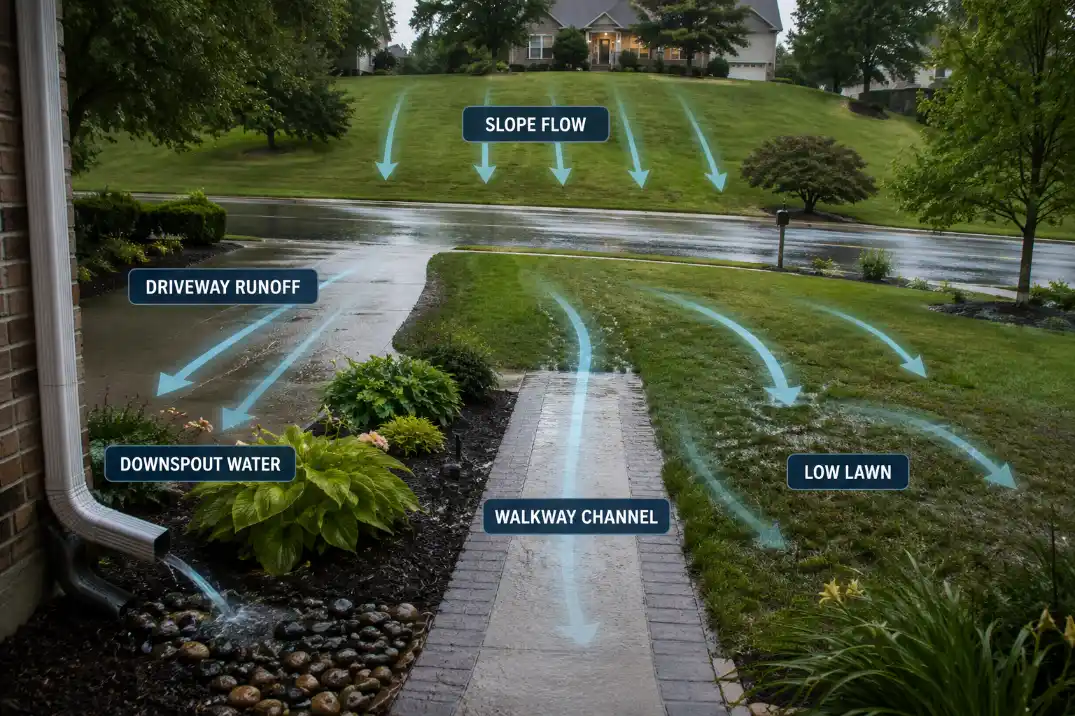
Driveway runoff is more concentrated. A sloped driveway can collect water from the upper lot, garage approach, roof edge, or street apron, then send it across the front lawn or toward the entry.
When the wet area follows a hard edge or cuts diagonally across turf, driveway runoff across the front yard becomes a stronger suspect than general poor drainage.
Roof water adds another layer. A downspout that discharges into a low bed or beside a walkway may not cause trouble on a higher lot. At the bottom of a hill, that same downspout can overload a zone that is already receiving surface runoff.
Walkways and sidewalks can also guide water without looking like drainage features. A walkway edge can trap water on one side, send it toward a step, or create a narrow channel between concrete and planting soil. Regraded beds, edging, and hardscape borders can do the same thing at a smaller scale.
| Visible symptom | Likely hill-bottom cause | First thing to check |
|---|---|---|
| Water appears after moderate rain, not just storms | Yard receives runoff from uphill area | Watch where water first enters the front yard during rain |
| Mulch or soil moves downhill into one bed | Concentrated surface flow | Look for a narrow flow line or sediment trail |
| Lawn stays wet into the next day | Slow absorption, clay, compaction, or saturation | Compare wet lawn to higher, better-drained areas |
| Mud forms near driveway or walkway edge | Hardscape channeling | Check whether water follows the concrete edge |
| Water collects near foundation bed or entry | Low house-edge grade or overloaded planting zone | Check whether water is moving toward the house, not just sitting in lawn |
| Wet area expands after each storm | Multiple sources joining in one low zone | Trace roof water, slope flow, and hardscape flow separately |
Why the Yard Holds Water After It Arrives
Incoming water explains why the low yard gets loaded. Soil explains why the water does not leave fast enough.
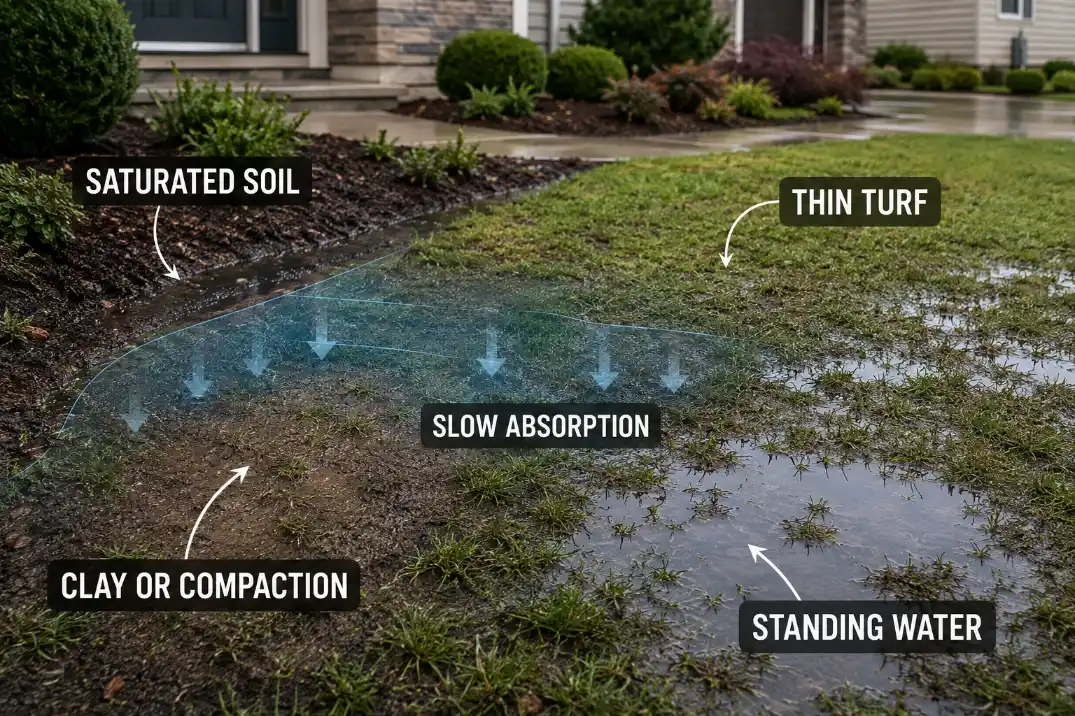
A bottom-of-hill front yard often has compacted soil because water, foot traffic, mower traffic, and repeated saturation all weaken the surface over time. Compacted soil has fewer open spaces for water to move through. Instead of soaking down evenly, water spreads sideways or sits near the surface.
Clay soil can make this worse. Clay is not automatically bad, but when it sits in a low collection area, it can drain slowly after repeated rain. The yard may look fine between storms, then become soft again because the deeper soil never fully reset.
Thin turf and bare soil are also part of the pattern. Turf slows water and protects the soil surface. When grass thins out in the wettest zone, rain and runoff hit exposed soil directly. That can create a sealed crust, shallow rills, or slick mud that absorbs water even more slowly.
The diagnosis should split here. A yard can be wet because too much water is arriving. It can also be wet because the soil cannot take in ordinary water fast enough. In bottom-of-hill yards, both often happen together.
If the wet area remains soft long after the visible runoff has stopped, clay soil drainage problems in front yards may be part of the next diagnosis.
How Driveways, Walkways, and Edges Make the Problem Worse
Hardscape does not just sit beside the drainage problem. On a low lot, it can aim the water.
A driveway may collect water from the upper side of the property, then release it at the lower edge. If the driveway leans slightly toward the lawn, runoff may cross the same turf strip every storm. The result is not a uniformly wet yard. It is a repeated channel, often visible as flattened grass, exposed soil, gravel movement, or a muddy corner near the driveway apron.
Walkways can create a quieter version of the same failure. A front walk may hold water on its uphill side, guide it toward the steps, or prevent water from spreading into the lawn. If the walkway is slightly raised, it can act like a small dam. If the soil beside it has settled, it can act like a trough.
Edges matter too. Landscape edging, mulch borders, stacked stone, and low retaining lips can all slow water in the wrong place. They may look neat when dry but hold runoff against a bed, sidewalk, or lawn hollow during rain.
The practical clue is repetition. If the same narrow line fails after every storm, the whole front yard may not be draining poorly. One hardscape edge may be steering water into the low zone.
When the Problem Moves Toward the House
Lawn wetness and house-edge water should not be treated with the same urgency. A soggy patch in the grass is a site-use problem. Water repeatedly moving toward the foundation bed, entry landing, front steps, basement wall, or crawlspace edge is a boundary problem.
The warning sign is not one shallow puddle after a heavy storm. It is a repeat pattern: mulch pushed against the house, soil settling next to the foundation, wet planting soil that stays damp, water crossing the entry route, or a low bed that receives runoff from the yard instead of shedding it away.
At that point, the issue should stop being framed as curb appeal. If bottom-of-hill flow is reaching the house edge, front yard water pooling near the house deserves its own focused check before surface fixes are chosen.
A professional assessment makes sense when water repeatedly reaches the foundation area, enters a basement or crawlspace, undermines steps, or keeps returning after grading changes. In those cases, the risk is not just a wet lawn. It is water pressure in the wrong place.
A Simple After-Rain Test for a Hill-Bottom Front Yard
The best test is not complicated, but the order matters: watch the water move before judging where it sits.
If it is safe, check the yard during rain, then again 30–60 minutes after rain stops. The first visit shows movement. The second visit shows what drains and what remains loaded.
Start uphill, not at the puddle. Look at the street edge, driveway, side yard, planting bed borders, and downspout outlets. Then follow the clean-washed strips, flattened grass, mulch movement, or sediment lines downhill until they meet the wet area.
If roof water is joining the same low zone, separate that from slope runoff. A downspout may be acceptable in one yard but wrong in a yard that is already collecting water from above. When the wet pattern follows both a roof discharge point and a walkway edge, downspout and walkway drainage problems may be part of the real cause.
After-Rain Field Check
- Watch where water first enters the front yard, not only where it pools.
- Recheck the yard 30–60 minutes after rain to see what drains and what stays wet.
- Look for sediment lines, moved mulch, flattened grass, or clean-washed soil.
- Note whether water crosses the driveway, walkway, steps, or visitor route.
- Compare the longest-wet area with higher lawn areas nearby.
- Mark whether water stays in the lawn or moves toward the house edge.
What the Pattern Tells You to Investigate Next
The pattern should choose the next investigation. Do not let the deepest puddle choose it by itself.
If water crosses the driveway before it reaches the lawn, the driveway is part of the drainage path. If roof water joins the same low bed, the downspout may be overloading a zone that already receives slope runoff. If water remains long after the surface flow stops, soil structure and compaction deserve more attention than another surface-level patch.
If water collects at the house edge, do not treat the issue as a lawn repair. That pattern needs a closer look at grade, planting bed height, entry drainage, and whether water is being directed away from the structure.
Only after that diagnosis does a broader yard drainage solution guide make sense. The stronger path is to identify the dominant cause first: incoming runoff, hardscape channeling, slow soil drainage, house-edge water pressure, or a layered combination.
For many bottom-of-hill yards, the answer is not one dramatic failure. It is a stack: uphill runoff enters broadly, a driveway or walkway concentrates it, compacted soil holds it, and the lowest bed shows the damage.
The wet spot is the evidence. The source is the diagnosis. Trace the water first, then choose the fix that matches the path.
For a neutral reference on grading and moisture near foundations, see the University of Minnesota Extension guidance on moisture in basements.