Quick Solution Summary
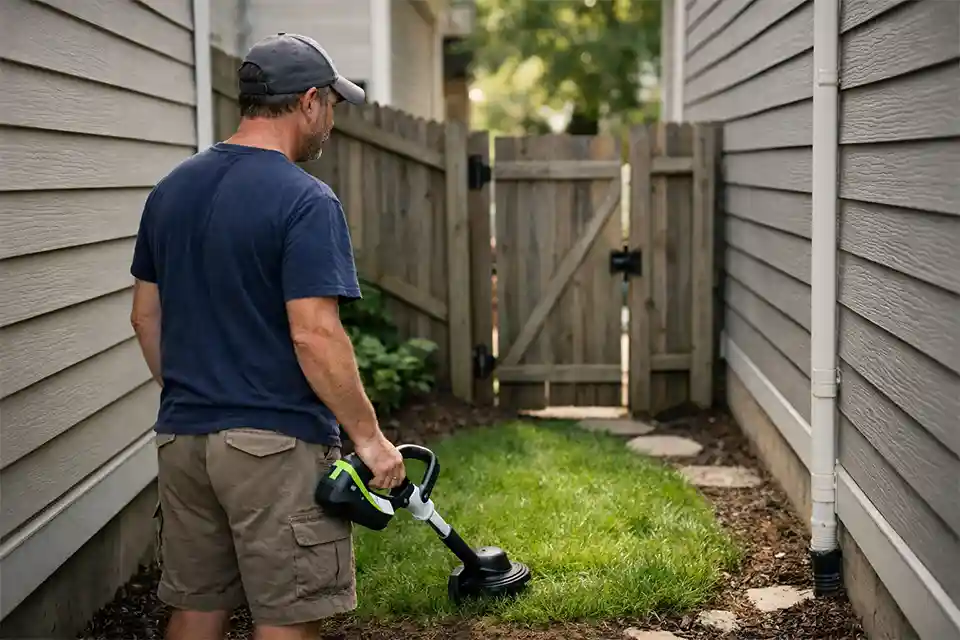
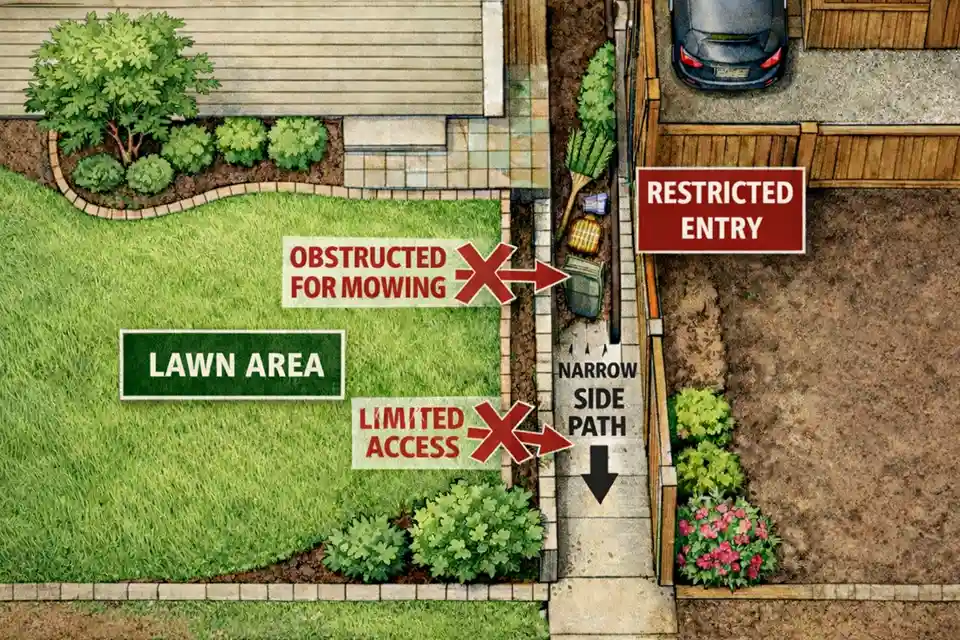
A front yard with no equipment access usually means there is less than about 30 inches of side clearance, preventing lawn mowers, aerators, wheelbarrows, or garden carts from reaching the lawn. When this happens, routine yard care becomes inefficient and maintenance often shifts toward manual tools or neglected tasks.
Small front yards in dense suburban neighborhoods frequently have 18–24 inch side passages, which are too narrow for most lawn equipment. Over time, this leads to uneven mowing, soil compaction from repeated foot traffic, and difficulty performing seasonal maintenance such as aeration or dethatching. In humid climates like Florida, this problem can also trap moisture around turf areas, increasing fungal disease risk. In colder northern states, compacted soil combined with freeze–thaw cycles can weaken grass roots during spring recovery.
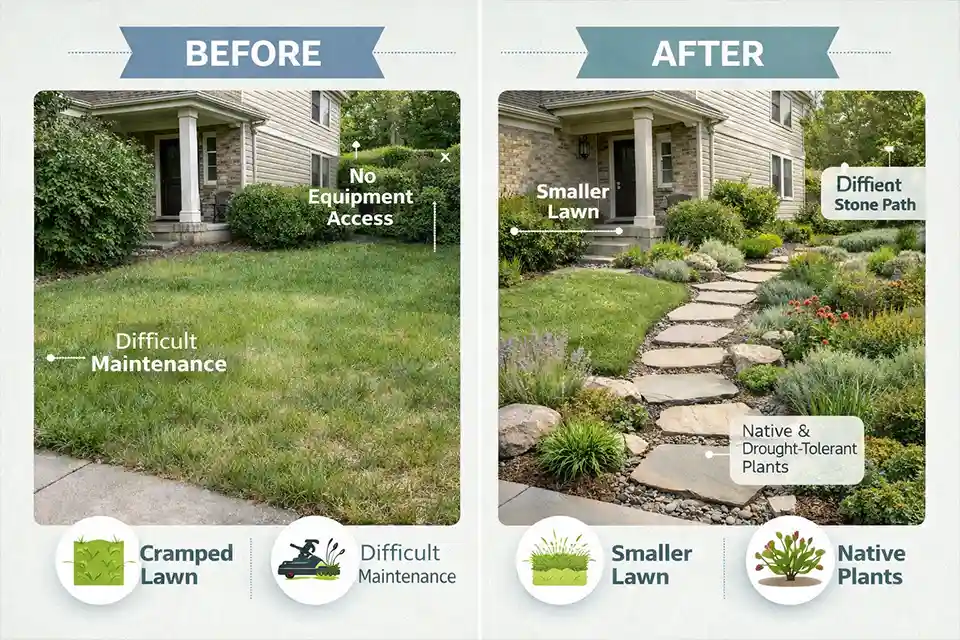
The most reliable solution is usually not forcing equipment access, but redesigning the yard to reduce equipment dependency. Compact electric tools, smaller lawn areas, and planting beds that require minimal trimming often solve the problem while improving curb appeal. In many cases, reducing lawn area by 25–40% dramatically simplifies maintenance in tight front yard spaces.
Why Small Front Yards Without Equipment Access Become Hard to Maintain
The difficulty is not the lawn size itself. The real issue is maintenance logistics.
Most landscaping tools are designed around standard suburban yard access:
| Equipment | Typical Width | Comfortable Access Needed |
|---|---|---|
| Push lawn mower | 20–22 inches | 30 inches |
| Wheelbarrow | 25–30 inches | 36 inches |
| Manual aerator | 24–28 inches | 36 inches |
| Garden cart | 24–30 inches | 36–40 inches |
When side passages are narrower than these ranges, equipment cannot enter the yard. Homeowners must either carry tools through the house, lift equipment over fences, or rely on smaller handheld devices.
In neighborhoods with narrow lots, these limitations often appear alongside other layout challenges discussed in Front Yard Design Problems on Narrow Lots. Tight spacing between homes frequently leaves little room for service paths or equipment gates.
Over time, maintenance routines become inconsistent simply because the yard is harder to access.
Quick Diagnostic Checklist
If equipment access is the main cause of maintenance problems, several patterns typically appear.
-
Lawn mower cannot pass through side gate
-
Wheelbarrow or garden cart cannot reach the front lawn
-
Fertilizer or soil must be carried manually in bags
-
Lawn aeration or dethatching is rarely performed
-
Grass near entry points becomes worn or compacted
-
Maintenance time increases by 30–50%
These issues are especially common in older suburban neighborhoods built before modern landscaping standards considered equipment access.
How Restricted Access Affects Lawn Health
Limited access changes how maintenance tasks are performed, which gradually affects soil structure and turf health.
Soil Compaction From Foot Traffic
When equipment cannot enter the yard, homeowners often walk across the same routes while mowing or trimming.
Soil bulk density may increase from 1.2 g/cm³ to 1.6 g/cm³, reducing air movement around grass roots. Compacted soil slows water infiltration and decreases oxygen availability in the root zone.
This often leads to shallow root systems that are more vulnerable to heat stress during summer months.
Irregular Mowing Patterns
Handheld trimmers and narrow electric mowers often create inconsistent cutting heights, especially during periods of rapid turf growth.
In Midwest regions where spring rainfall can reach 3–5 inches per month, grass growth may exceed 1 inch per week. Uneven mowing can quickly make a small front yard appear neglected.
Shade conditions can make this problem even worse, especially in yards where tree canopies slow turf growth as described in Front Yard Maintenance Problems When Large Shade Trees Keep Grass From Growing.
Skipped Seasonal Maintenance
Equipment access problems often lead homeowners to skip maintenance tasks entirely.
Commonly skipped tasks include:
-
lawn aeration
-
dethatching
-
soil amendment
-
topdressing
In clay-heavy soils common across parts of the Midwest, skipping aeration for several seasons can significantly reduce turf vigor and drainage performance.
Practical Maintenance Strategies for Small Yards Without Equipment Access
Instead of trying to force traditional lawn maintenance methods into a restricted space, it usually works better to adapt the yard design and maintenance approach.
Use Compact Battery-Powered Tools
Modern electric lawn equipment is significantly smaller than traditional gas-powered equipment.
Typical specifications:
| Tool | Typical Weight | Cutting Width |
|---|---|---|
| Compact electric mower | 20–30 lbs | 14–16 inches |
| Cordless trimmer | 5–7 lbs | 12–14 inches |
| Mini lawn edger | 6–8 lbs | 8–10 inches |
| Hand aerator | 8–12 lbs | manual |
These tools work best in lawns under 500–800 square feet, which is common for many urban and suburban front yards.
Reduce Lawn Area
Grass is often the most maintenance-intensive surface in a yard.
Reducing the lawn footprint by 25–40% can significantly lower mowing frequency and simplify trimming.
Homeowners often replace lawn sections with:
-
native perennial beds
-
drought-tolerant shrubs
-
gravel pathways
-
ground covers such as creeping thyme or sedges
Many homeowners initially attempt to design low-maintenance yards but unintentionally create complex planting layouts, a pattern discussed in Why Low Maintenance Front Yards Often Become High Maintenance.
Create a Narrow Maintenance Path
Even when full equipment access is impossible, a narrow path can improve yard usability.
A maintenance path 18–24 inches wide may allow:
-
fertilizer spreaders
-
handheld aerators
-
compact carts
Stepping stones or compact pavers also reduce soil compaction caused by repeated foot traffic.
Seasonal Maintenance Plan for Small Front Yards Without Equipment Access
A structured seasonal routine can prevent maintenance from becoming overwhelming.
| Season | Maintenance Focus | Typical Tasks |
|---|---|---|
| Spring | Soil recovery | light aeration, fertilization, overseeding |
| Summer | Growth control | weekly mowing, trimming, irrigation monitoring |
| Fall | Soil improvement | compost topdressing, leaf cleanup |
| Winter | Structural care | pruning shrubs, repairing paths |
In northern states where winter temperatures drop below 20°F, freeze–thaw cycles can compact soil further. Spring aeration becomes particularly important in these climates.
Weekly Maintenance Workflow Without Equipment Access
Maintaining a small yard without full equipment access works best with a consistent routine.
Typical weekly workflow:
-
Trim lawn using compact mower or trimmer
-
Edge along walkways and planting beds
-
Remove weeds manually or with a handheld hoe
-
Check soil moisture levels and irrigation
-
Sweep debris from paths and sidewalks
Most small front yards require 20–30 minutes per week when maintained consistently.
Without a routine, small maintenance issues accumulate quickly and the yard can become difficult to manage.
Design Adjustments That Prevent Long-Term Maintenance Frustration
Many equipment access problems originate from the initial yard layout.
Several design mistakes increase maintenance difficulty, particularly in tight landscapes. Some of these issues are discussed in Small Garden Design Mistakes That Increase Maintenance.
Key adjustments that improve long-term usability include:
| Design Factor | Impact | Recommended Adjustment |
|---|---|---|
| Narrow service path | Equipment cannot pass | Install wider gate if possible |
| Sharp lawn corners | Difficult mowing | Use curved planting beds |
| Overcrowded planting | Hard to trim | Increase spacing between plants |
| Large lawn area | Frequent mowing | Reduce turf footprint |
Even increasing gate width by 6–10 inches can significantly improve access for maintenance tools.
For homeowners planning long-term improvements, the design strategies explained in How to Design a Low Maintenance Front Yard often provide the best long-term results.
Climate Conditions That Influence Maintenance Difficulty
Climate can amplify equipment access problems.
Humid Southeast (Florida, Gulf Coast)
Humidity levels often reach 75–85% during summer, accelerating turf growth. Small lawns may require mowing twice per week, making equipment access particularly important.
Dry Southwest (Arizona, Nevada)
Temperatures above 95°F place significant stress on turf. Many homeowners in these climates transition to gravel landscaping or drought-tolerant planting designs.
Northern States (Minnesota, Michigan, New York)
Heavy winter freeze cycles and snow cover can damage turf. If aeration equipment cannot access the yard during spring recovery, lawns may struggle to regain density.
Frequently Asked Questions
Can a front yard function without equipment access?
Yes. Many small front yards are maintained using handheld electric tools. When lawn areas remain under 600 square feet, these tools can handle most maintenance tasks efficiently.
What is the minimum gate width for lawn equipment?
Most push mowers require 30 inches of clearance, while landscaping professionals often prefer 36 inches or more for comfortable equipment movement.
Are lawns always the best choice for very small front yards?
Not necessarily. Ground covers, ornamental grasses, and native plant beds often require less maintenance than turf and can improve biodiversity.
Do lawn alternatives affect property value?
Well-designed landscapes generally maintain curb appeal. Research from the University of California Agriculture and Natural Resources shows drought-tolerant landscapes can perform well aesthetically when properly designed.
Key Takeaways
Small front yards without equipment access often become difficult to maintain because most lawn tools require 30–36 inches of clearance. When access paths are narrower, homeowners must rely on manual tools, which increases maintenance time and can lead to soil compaction or skipped seasonal tasks. The most effective solution is usually redesigning the landscape to reduce equipment dependency by shrinking lawn areas, introducing planting beds, and using compact electric tools. With thoughtful planning, even the tightest suburban front yards can remain attractive and easy to maintain.