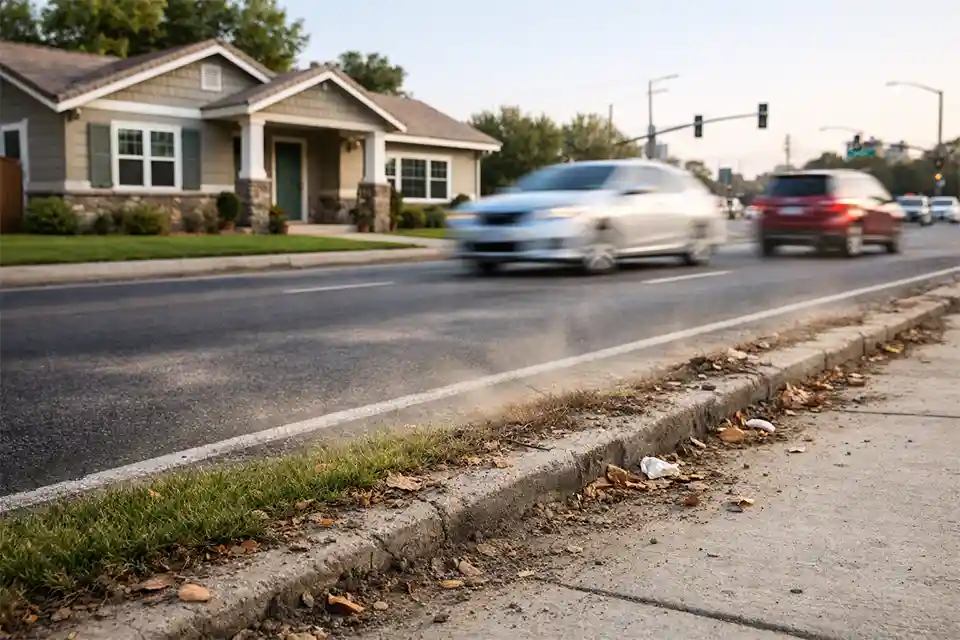
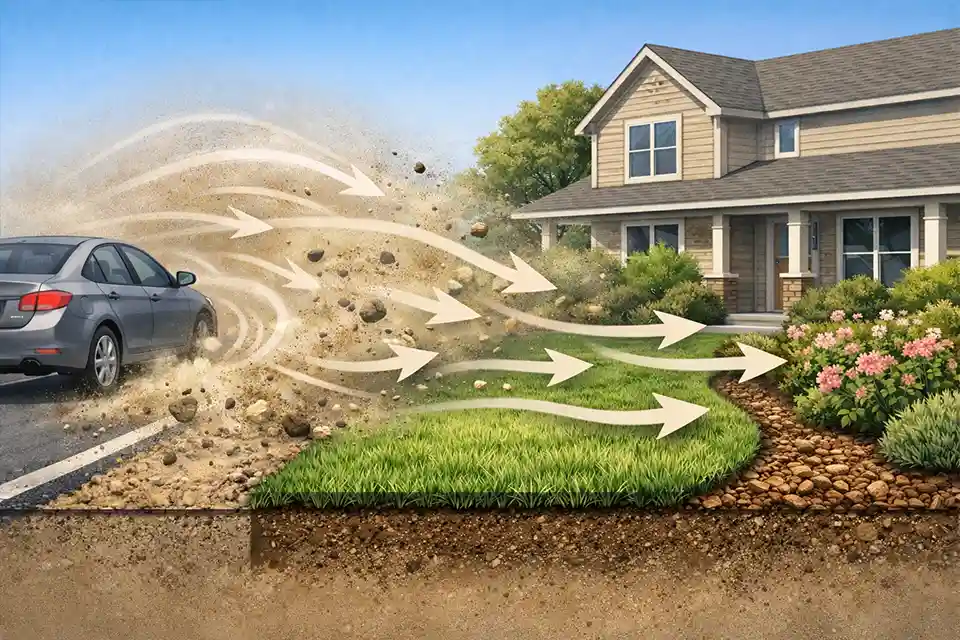
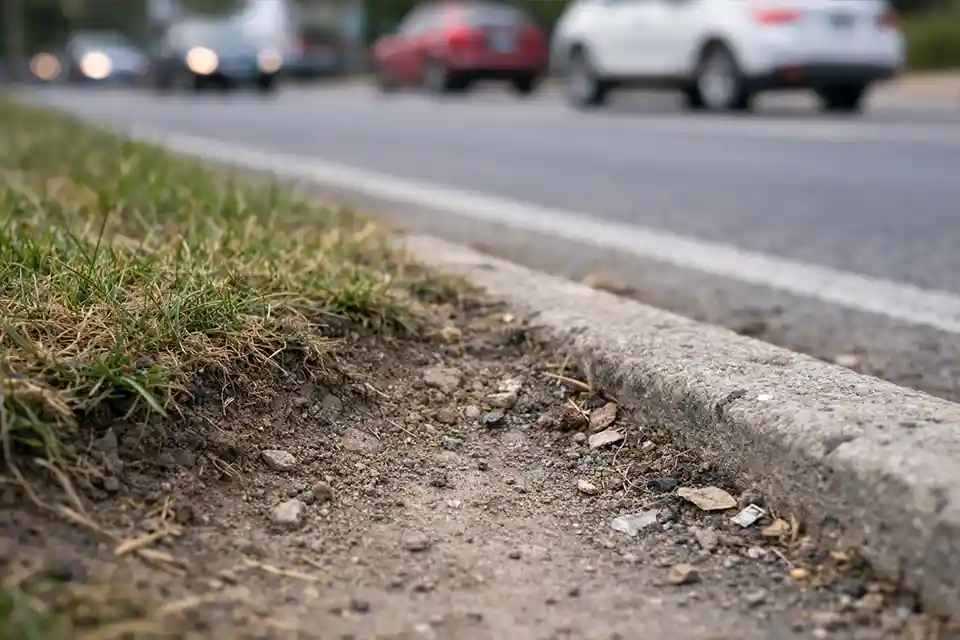
Front yards located next to busy roads often develop persistent maintenance problems because vehicle traffic constantly pushes dust and debris toward nearby properties. Cars traveling at typical neighborhood speeds of 30–45 mph create turbulent airflow that lifts fine particles from the road surface. These particles can include tire rubber fragments, brake dust, sand, soil, and organic debris.
Once airborne, many of these particles travel 15–30 feet from the roadway before settling on lawns, planting beds, and hardscape surfaces. Over time, this creates a repeating maintenance cycle: lawn edges become compacted and dusty, mulch beds fill with grit, and plant leaves collect a gray film that reduces photosynthesis.
The most effective solution is usually not a single fix but a combination of landscape strategies. Dense plant buffers, gravel transition zones, and layered vegetation can intercept airborne particles before they reach the main yard. When properly designed, these features can reduce dust accumulation by 40–60%, depending on traffic levels, wind direction, and climate conditions.
Why Busy Roads Push Dust and Debris Into Front Yards
Every vehicle disturbs the air around it as it moves. Even small passenger cars generate localized turbulence that lifts loose material from the road surface. Larger vehicles such as delivery trucks and buses move significantly more air, increasing the distance that debris can travel.
Common roadside particles include:
-
pulverized asphalt dust
-
microscopic tire rubber fragments
-
brake pad residue
-
roadside sand and soil
-
dried leaves and organic debris
Many of these materials fall within the PM10 particle range, meaning they measure less than 10 microns in diameter. These small particles can remain suspended in the air long enough to drift into nearby landscapes.
Heavier materials such as sand and gravel usually settle within the first few feet of the yard. That is why the first 3–6 feet of lawn near the curb often show the earliest signs of stress.
Traffic patterns also influence how much debris reaches a yard. Areas where vehicles frequently brake or accelerate—such as intersections or stop signs—often produce higher concentrations of airborne particles. Homes in these locations may experience environmental conditions similar to properties facing heavy traffic exposure, which is discussed in detail in Fix Front Yard Privacy Issues for Homes Facing Constant Traffic at a Stop Sign or Intersection.
Environmental Conditions That Increase Roadside Dust
Not every home near a busy road experiences the same level of debris accumulation. Several environmental variables influence how far particles travel and how quickly they settle.
| Environmental Factor | Impact on Dust Movement | Typical Likelihood | Possible Mitigation |
|---|---|---|---|
| Vehicle speeds above 40 mph | Stronger turbulence pushes particles farther | High | Plant shrub buffers |
| Dry roadside soil | Dust lifts easily into the air | High in desert climates | Gravel capture strip |
| Heavy truck traffic | Larger air displacement | Moderate to high | Multi-layer planting |
| Lawn sloping toward the road | Debris settles along curb | Moderate | Adjust grading |
| Lack of vegetation barriers | No interception of airborne particles | Moderate | Plant roadside shrubs |
Climate also plays a role. In dry regions such as Arizona or inland California, summer temperatures often exceed 95°F, drying roadside soil and making dust easier to lift into the air.
In contrast, humid regions like Florida or the Gulf Coast may experience less airborne dust during wet periods, but rainstorms can wash sand and organic debris from road surfaces into nearby yards.
Common Maintenance Problems in Front Yards Near Busy Roads
Over time roadside debris creates several recurring maintenance challenges. These problems usually appear first near the street and gradually affect larger areas of the yard.
Dusty Lawn Edges
The portion of lawn closest to the curb often collects the most debris. Fine particles settle on the soil surface and slowly fill air pockets within the soil structure.
When soil density increases beyond roughly 1.6 g/cm³, grass roots struggle to penetrate deeper layers. As a result, turf near the street often becomes thinner than the rest of the lawn.
If lawns already experience environmental stress—such as heavy shade from large trees—dust buildup can worsen the problem by blocking sunlight on grass blades. Situations like this are similar to the challenges described in Front Yard Shade Trees Grass Not Growing, where environmental conditions reduce turf growth.
Dirty Walkways and Hardscape Surfaces
Concrete sidewalks and driveways trap dust easily because their textured surfaces collect fine particles. Even after sweeping or rinsing, a gray film can return within 3–5 days during dry weather.
This constant buildup often surprises homeowners who expect outdoor surfaces to stay clean for longer periods.
Mulch Beds Filling With Grit
Mulch beds located near the street tend to collect airborne debris. Sand and small gravel gradually mix with organic mulch layers, causing them to compact over time.
Many homeowners notice that mulch near the curb begins to look dull or compacted after 12–18 months because mineral particles replace organic material.
Dust-Coated Plant Leaves
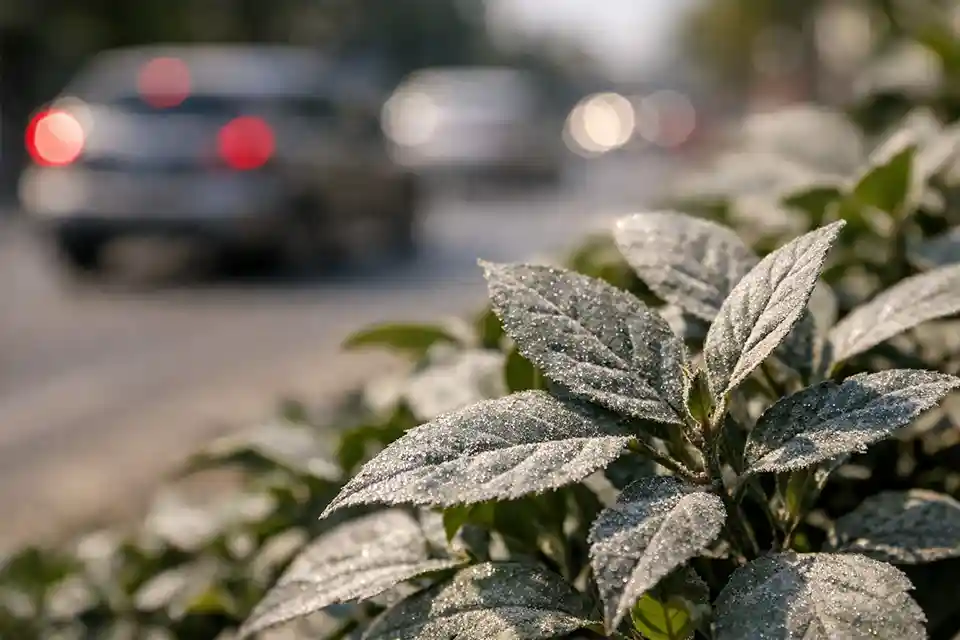
Dust accumulation on leaves can interfere with plant function. When particles cover leaf surfaces, they partially block sunlight and restrict gas exchange through small pores known as stomata.
Research suggests that heavy dust buildup can reduce photosynthesis rates by 10–25%, depending on plant species and particle density.
Plants with narrow leaves, such as ornamental grasses, usually shed dust more easily than broad-leaf plants.
How Much Extra Maintenance Busy Roads Create
One of the most noticeable differences between homes on quiet residential streets and those along busy roads is the frequency of maintenance tasks required to keep the yard clean.
Even well-maintained landscapes may need significantly more upkeep when they are exposed to constant roadside dust.
| Maintenance Task | Quiet Residential Street | Busy Road Location |
|---|---|---|
| Sweeping walkways | Every 2–3 weeks | Every 5–7 days |
| Rinsing plant leaves | Occasionally | Every 2–4 weeks |
| Lawn aeration | Every 2–3 years | Every 12–18 months |
| Mulch replacement | Every 2 years | Every 12–18 months |
| Lawn edge repair | Rare | Often yearly |
The first 6–10 feet of landscape closest to the road typically becomes the highest-maintenance portion of the yard. Without preventative design features, dust accumulation gradually increases soil compaction and cleaning frequency.
Quick Diagnostic Checklist
Use this checklist to determine whether roadside debris is causing your front yard maintenance problems.
✔ Lawn edges near the street appear dusty within a few days of cleaning
✔ Walkways collect dirt even without rainfall
✔ Plant leaves develop a gray film during dry weather
✔ Mulch beds contain sand or gravel particles
✔ Grass near the curb appears thinner than the rest of the lawn
✔ Soil near the road feels harder or compacted
If several of these symptoms occur regularly, traffic-generated debris is likely the primary cause of the maintenance issues.
How Dust Gradually Changes Soil and Yard Conditions
Roadside debris may initially seem like a cosmetic problem, but over time it can alter the physical structure of the soil.
Fine particles settle between soil grains, reducing natural air pockets that allow water and oxygen to move through the ground. Compacted soil also increases surface runoff during rainfall, which can carry debris deeper into the yard.
Landscapes that rely heavily on open lawn areas or bare soil tend to experience these changes more quickly. In contrast, yards designed with layered planting structures slow airflow and intercept airborne particles more effectively.
Plant layering is commonly used in residential landscape design to improve both aesthetics and environmental resilience, as explained in How to Layer Plants in Front Yard Landscaping.
Practical Landscaping Strategies That Reduce Dust
Reducing roadside debris usually requires intercepting particles before they spread across the yard.
Dense Shrub Buffers
Planting a dense hedge 5–10 feet from the curb can act as a natural dust filter. Thick foliage slows wind movement and traps airborne particles.
Common shrub choices include:
-
boxwood
-
dwarf holly
-
viburnum
-
native evergreen shrubs
Many homeowners choose native species for roadside plantings because they tolerate heat, dry soil, and environmental exposure better than ornamental imports. These advantages are highlighted in Front Yard Landscaping Ideas Using Native Plants.
Gravel Transition Zones
Installing a 2–4 foot gravel strip between the road and lawn creates a debris capture zone. Dust particles settle into the gravel layer instead of spreading across the yard.
Gravel sizes between ⅜ and ¾ inch usually work best because they trap particles effectively while still allowing water drainage.
Landscape Edging Barriers
Steel, stone, or concrete edging along planting beds helps prevent debris from migrating into garden areas during strong winds or heavy rainfall.
These barriers also help maintain soil structure by separating contaminated roadside material from planting areas.
Advanced Landscape Design Strategies for High-Traffic Roads
Basic solutions like shrub buffers and gravel strips help reduce some dust movement, but homes located along high-traffic corridors or arterial streets often need stronger landscape design strategies. When daily traffic volumes exceed 10,000–20,000 vehicles, airflow disturbance becomes nearly constant, which allows airborne particles to travel farther into nearby yards.
In these situations, effective landscaping focuses on slowing the airflow entering the property, which causes heavier particles to settle earlier before reaching lawns and planting beds.
Berm Landscaping Buffers
A landscape berm is a gently raised mound of soil placed between the road and the main yard. Berms are typically built 18–36 inches high and 4–8 feet wide, depending on available space.
When planted with shrubs or ornamental grasses, berms change the way wind moves across the landscape. Instead of flowing straight from the street into the yard, airflow lifts slightly and loses momentum as it moves over the berm.
This reduction in air speed encourages dust and sand particles to settle along the roadside planting zone rather than spreading across the entire yard.
Berms also improve visual separation from traffic, which is why many landscape designers use them to soften the appearance of homes located near busy streets. These design strategies often complement broader curb-appeal improvements discussed in Front Yard Landscaping Ideas Curb Appeal.
Multi-Layer Vegetation Buffers
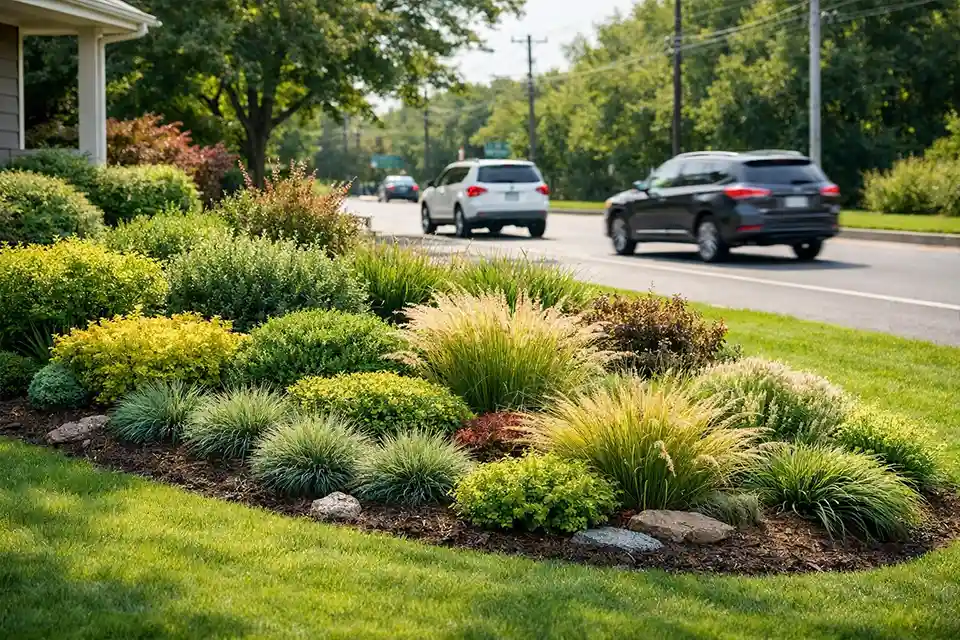
One of the most effective ways to control roadside debris is layered planting. Instead of relying on a single hedge, several layers of vegetation intercept airborne particles at different heights.
A typical roadside buffer may include:
-
small trees or tall shrubs (8–12 feet high)
-
medium shrubs (3–6 feet high)
-
ornamental grasses or dense groundcovers near the street
Each layer slows airflow slightly. As wind passes through multiple plant layers, dust particles gradually lose energy and settle before reaching the inner yard.
This layered approach not only improves dust control but also adds visual depth and seasonal texture to the landscape.
Landscape Design Mistakes That Increase Dust Problems
Some front yard layouts unintentionally allow roadside debris to move freely into the yard. These designs may look clean and simple at first but often lead to higher maintenance workloads over time.
| Design Mistake | Result | Long-Term Impact | Better Alternative |
|---|---|---|---|
| Lawn directly against curb | Dust settles directly on turf | Lawn thinning | Add shrub or gravel buffer |
| Bare soil planting beds | Soil traps airborne debris | Soil compaction | Use mulch layer |
| Decorative gravel without edging | Debris spreads across yard | Difficult cleanup | Install border edging |
| Sparse plant spacing | Wind flows freely through yard | Dust reaches inner yard | Layered vegetation |
| Flat lawn sloping toward road | Debris accumulates near curb | Drainage issues | Berm or slight grading |
These problems are particularly common in suburban developments where landscaping plans prioritize open lawns and minimal planting structures.
Homes located next to busy roads often benefit from slightly denser landscape designs that intercept airflow and protect the interior of the yard.
Maintenance Routine for Front Yards Near Busy Roads
Even well-designed landscapes cannot completely eliminate roadside dust. Homes near heavy traffic typically require a slightly different maintenance routine compared with homes on quiet residential streets.
Common maintenance practices include:
• sweeping sidewalks and driveways once per week during dry seasons
• rinsing plant foliage every 2–3 weeks to remove dust buildup
• aerating lawn edges once per year to reduce soil compaction
• refreshing mulch layers every 12–18 months
In colder northern states where roads are treated with sand and salt during winter storms, spring cleanup often includes removing mineral residue deposited along curbside lawn edges.
Over time these materials can affect soil chemistry if they accumulate repeatedly.
Some homeowners choose to convert the first 6–10 feet of roadside lawn into planted beds or shrub buffers. This change often reduces long-term maintenance because turf grass is typically more sensitive to dust and soil compaction.
When Roadside Lawn Areas Begin to Decline
The lawn strip closest to the street usually shows the earliest signs of stress. Dust accumulation gradually alters soil structure and reduces the ability of grass roots to grow deeply.
Several factors contribute to this pattern:
-
compacted soil restricts root penetration
-
dust blocks sunlight on grass blades
-
mineral particles change soil composition
-
repeated cleaning removes organic material
When turf repeatedly struggles near the curb, converting that section of the yard into a planting zone often produces better results.
Shrubs, ornamental grasses, and hardy groundcovers generally tolerate roadside conditions more effectively than turf grass.
How Regional Climate Influences Roadside Dust
Climate conditions significantly affect how severe roadside debris problems become.
In dry desert climates such as Arizona or Nevada, dust accumulation tends to be more noticeable because roadside soil dries quickly during hot weather. Summer temperatures above 95°F can turn loose soil into fine powder that vehicles easily lift into the air.
In contrast, humid coastal regions like Florida or the Gulf Coast may experience less airborne dust during wet seasons. However, heavy rainfall can wash sand and organic debris from road surfaces into nearby yards.
In many Midwestern states, roadside dust tends to increase during late-summer drought periods, then decrease when autumn rainfall returns.
Understanding these regional differences helps homeowners choose landscaping strategies that match local environmental conditions.
Questions Homeowners Often Ask
Does planting a hedge stop roadside dust completely?
No. Dense hedges reduce airborne debris but cannot eliminate it entirely. Depending on plant density and traffic levels, shrub buffers may reduce dust movement by 40–60%.
Why do plants near the road look dusty so quickly?
Fine particles settle on leaves during dry weather. Plants with broad leaves tend to collect more dust because their surfaces trap particles more easily.
Should plants be pressure-washed to remove dust?
No. High-pressure washing can damage foliage. A gentle garden hose spray usually removes dust effectively without harming plants.
Does mulch help reduce roadside debris?
Yes. Organic mulch layers 2–3 inches deep trap airborne particles before they reach the soil surface. However, mulch should be replaced periodically because dust gradually mixes into the material.
For further research on airborne particulate movement and environmental dust management, the University of California Agriculture and Natural Resources provides detailed studies on residential landscape dust mitigation.
Key Insights
Front yards located next to busy roads face a unique maintenance challenge caused by airborne debris, vehicle turbulence, and environmental exposure. Dust, sand, and organic material are continuously lifted from road surfaces and deposited onto nearby landscapes.
Over time this accumulation increases cleaning frequency, compacts soil, and can stress plants and lawns. However, thoughtful landscape design can significantly reduce these impacts.
Dense shrub buffers, gravel transition zones, berm landscaping, and layered vegetation slow airflow and capture airborne particles before they spread across the property. When combined with consistent maintenance routines, these strategies help homeowners maintain attractive and functional front yards even in high-traffic environments.