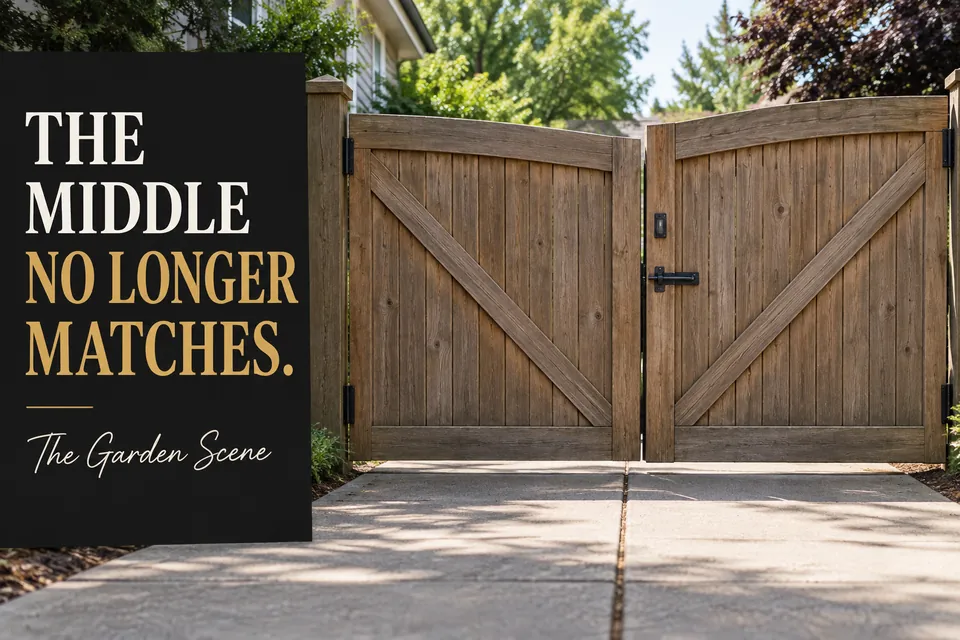
One driveway gate leaf reaches the center, but the other arrives lower, overlaps it, or stops before the latch can meet. Moving the latch may restore closure briefly while leaving the change that caused the mismatch unresolved.
Compare each leaf with its own support before using either leaf as the reference for the other. The center gap combines the behavior of two posts, two sets of hinges, and two frames. Where support wheels are fitted, the driveway surface also affects that relationship.
Start by distinguishing whether a leaf reaches the wrong position or something prevents it from reaching its normal position. The higher leaf is not automatically correct, and matching center heights can conceal sag on both sides. That distinction determines where the next useful check belongs.
What the Center Gap Says About Each Gate Leaf
Read the gap only after checking that both leaves have reached equivalent near-closed positions. Compare the spacing near the top, at latch height, and near the bottom without pulling them together through the latch. Keep fingers clear of the space between the leaves.
Use structural rails and the upright meeting edges as references. Decorative caps, curved tops, or uneven pickets can make sound frames look misaligned. An older photograph showing those same structural points may reveal whether the apparent difference is actually new.
A gap that widens toward one end shows that the meeting edges are no longer parallel. That tells you to investigate an angular difference, but it cannot identify a moving post, loose hinge, or distorted frame by itself. Several faults can create a similar wedge-shaped opening.
| Visible pattern | What it establishes | Next comparison |
|---|---|---|
| Gap wider at the top or bottom | Meeting edges have a relative angular difference | Each post’s vertical alignment and each frame’s shape |
| One meeting edge lower | The leaves arrive at different heights | Each inner corner against its own hinge end |
| Similar center heights, but both inner ends droop | Equal center height may conceal sag on both sides | Both structural frames independently |
| One leaf stops short of the closing plane | The leaves are not reaching equivalent positions | Bottom clearance and existing wheel contact |
Also separate sideways spacing from front-to-back offset. A leaf stopped slightly open may make the gap look too wide from the driveway entrance, even though its horizontal reach has not changed. View the relationship from a safe position outside the swing path before deciding that the leaves have become too short to meet.
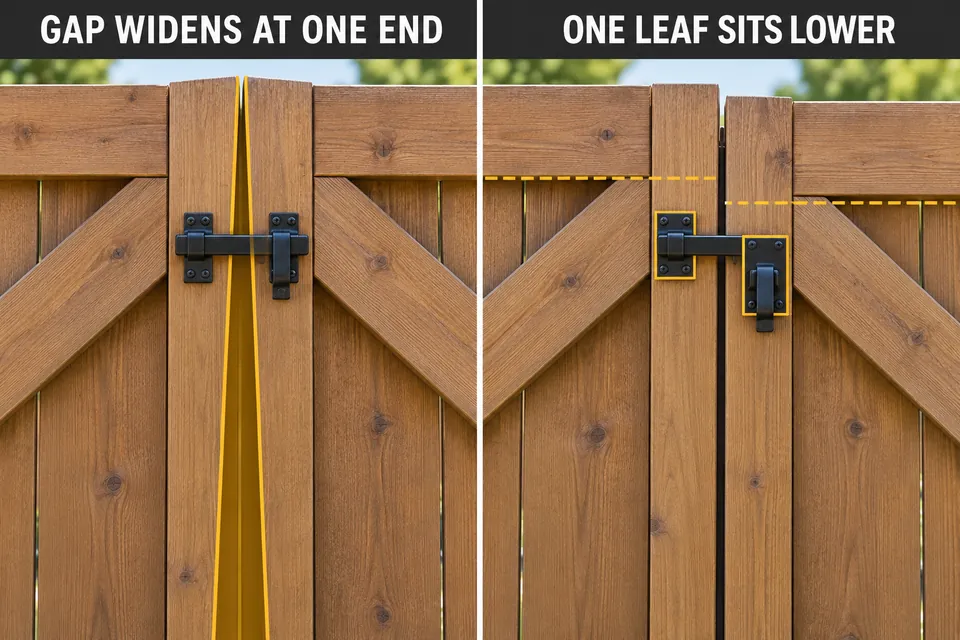
A roughly parallel gap deserves attention too. Both leaves could have shifted while retaining similar edge angles. Record the pattern as a starting observation, rather than treating any one shape as a diagnosis.
One Moving Post vs Two Sagging Frames
Check each post independently, then compare each frame with its own hinge end. Using the opposite leaf as the only reference can hide equal sag or make an unchanged side appear responsible.
Where the posts are safely accessible, a level against two perpendicular faces helps establish whether each post is vertical in both directions. Avoid leaning into the opening or holding a gate while checking. A tapered, rough, or warped wooden face can distort the reading, so use a straight structural reference rather than an irregular surface.
An out-of-plumb post identifies a geometric condition, not its history. It may have stood that way when the gates worked. An earlier photograph, a changed relationship to an adjacent fixed structure, or visible displacement at the base makes the finding more meaningful.
If a post visibly shifts during ordinary operation, the relevant investigation becomes gate post movement during opening. That movement can change the attached leaf’s height and horizontal reach together, making the center mismatch look like more than one fault.
Next, examine the relationship between each hinge end and inner corner. If the posts remain stable while a leaf’s inner corner drops relative to its hinge end, the evidence points toward sag within the leaf or its hinge attachments. Structural rails that descend toward the center, opening frame joints, or changed spacing around the hinge side can help locate that change.
Both inner corners may drop by similar amounts, leaving the latch halves close in height. The pair can still develop a tapered center gap or lose ground clearance. Compare each leaf’s current shape with its original geometry where possible; rails intentionally built to follow a slope should not be mistaken for new sag.
Conversely, one low inner corner does not prove that its frame has distorted. Hinge play can let an otherwise square leaf hang lower. Distinguishing hinge movement from frame deformation may require professional inspection; there is no need to loosen hardware to settle that question yourself.
The evidence may point to mixed causes. One leaf might sag while the opposite post leans. Keep observations attached to the side where they occur instead of forcing everything into a choice between one moving post and two sagging frames.
Stop ordinary-use comparisons if a post visibly moves, a hinge attachment separates, or a supporting member is damaged. Do not lift a heavy leaf, release its hinges, or pull the pair together with the latch to see whether the mismatch disappears.
Why Driveway Slope Changes the Closing Pattern
If one leaf stops before reaching the center, check where its clearance disappears. A rising driveway surface can interrupt the closing arc even when the leaf’s horizontal reach remains unchanged.
With ordinary fixed hinges arranged around a vertical axis, slope does not by itself make a rigid, unsupported leaf rise and fall. The gate follows its hinge geometry while the pavement rises or falls beneath it. Contact can stop one leaf short while the other completes its travel, leaving the latch components in different closing planes.
Look for a specific point where clearance disappears during normal, controlled use, provided the gate is stable. A scrape concentrated on a raised pavement edge is more informative than a general impression that the driveway slopes. Do not force the leaf across the contact point.
An existing support wheel adds another relationship. A wheel crossing a ridge may push upward against the leaf; a wheel above a depression may provide less support or lose contact. How much reaches the frame depends on the wheel assembly and its available movement. A spring-loaded wheel may accommodate some variation, so its presence does not establish the cause.
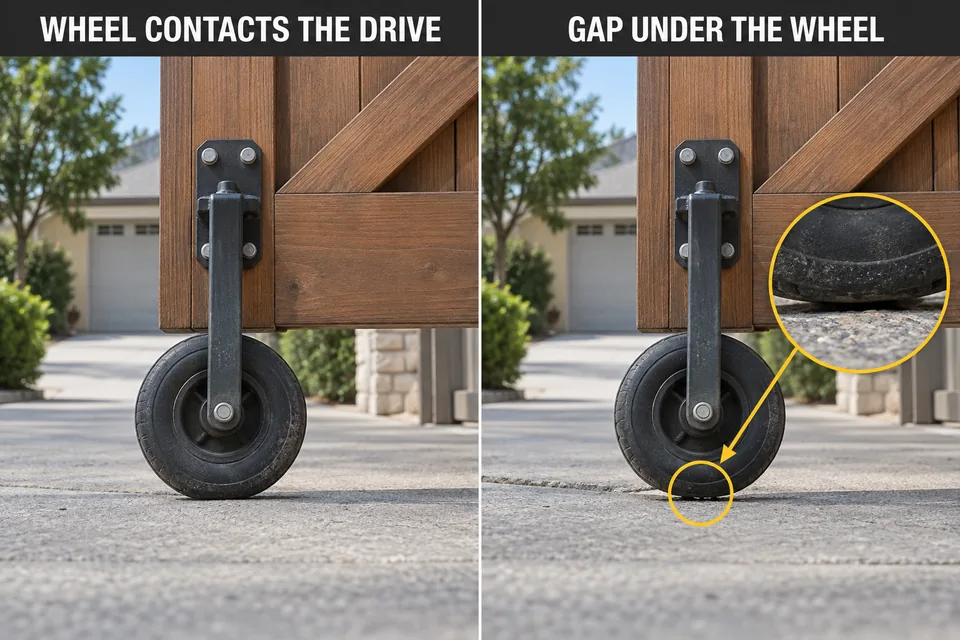
A driveway that has always sloped needs an additional change to explain a new failure. The leaf may have lost clearance through sag, the wheel may behave differently, or a pavement section may have moved. Compare wheel contact and bottom clearance at the location where closing changes. Treat the pavement itself as something to investigate, rather than automatically using it as a fixed reference.
How Seasonal Ground Movement Affects Alignment
If the mismatch varies with weather, record which reference changes before making a permanent latch adjustment. A note that “the gate sticks in winter” is less useful than knowing whether the right meeting edge rises, a post changes angle, or a wheel loses contact.
Use the same structural points and approximately the same near-closed positions each time. Photographs from different angles or leaves left at different opening positions can manufacture an apparent seasonal difference. Note prolonged rain, dry ground, freezing conditions, or thawed ground alongside the visible pattern.
In wooden gates, moisture can change member dimensions without moving the posts. If the leaves become tighter after rain while their structural reference heights and post positions remain consistent, that supports a different investigation from a post that changes angle. The distinction is developed further in gate alignment that changes after rain.
Ground movement needs corroborating clues. Moisture-sensitive soil may change volume, and freezing conditions can produce heave where local soil and water conditions allow it. Those possibilities become more relevant when a center-height change accompanies a pavement step, altered wheel contact, or a changed post reference. Weather alone does not prove footing failure.
Compare the gate again under different conditions only if it remains stable enough for ordinary use. A mismatch that partly reverses after drying or thawing suggests condition-dependent movement, but seasonal recovery does not show that the underlying support has repaired itself. Progressive change across several comparisons deserves particular attention, even if the latch occasionally works again.
When Re-Setting the Latch Is the Wrong Fix
Repositioning the latch makes sense only after the leaves consistently reach their intended closing positions. If the supports and frames remain stable, the ground does not interrupt travel, and the mismatch is confined to shifted or incorrectly positioned latch hardware, the latch may be the remaining adjustment point.
The boundary changes when the hardware must lift a dropped leaf, pull one sideways, or hold a distorted pair together. In those conditions, moving the catch can make closure possible while leaving the cause active.
Repeated latch relocation is especially revealing. If each adjustment works briefly before the center drops again, inspect what continues to change. For wooden leaves, recurring wooden gate sag is a separate mechanism worth investigating before creating another latch position.
Visible structural movement, damaged attachments, or heavy unstable leaves call for a gate professional to assess the support and alignment. Variable wheel support or pavement interference also needs to be resolved before the final meeting position can be trusted.
Judge the result before engaging the latch: both leaves should reach their intended center position consistently under their own support. The latch then secures that position. If it must create the alignment each time, the gate still needs attention elsewhere.
University of Minnesota Extension explains the underlying soil process in its guidance on frost heaving during freezing and thawing.