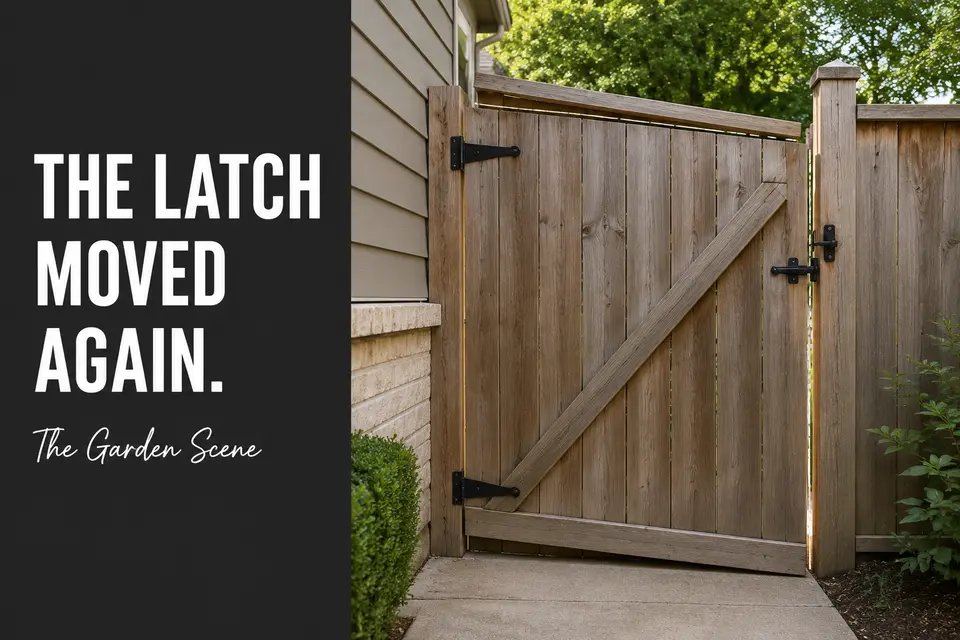
A wooden gate that has always hung slightly low may simply have been installed out of square. A gate that drops farther each year is different: one of its structural reference points is still moving.
The low latch corner is only the visible result. Raising the latch, trimming the bottom, or lifting the gate while closing it may restore clearance temporarily, but none of those actions reveals whether the post, hinge attachment, or gate frame is losing its original geometry.
The useful diagnostic rule is simple: start at the changing corner gap and trace the misalignment toward the hinges and supporting post. The first component that moves against a stable reference usually identifies the real repair zone.
What the Changing Corner Gap Reveals
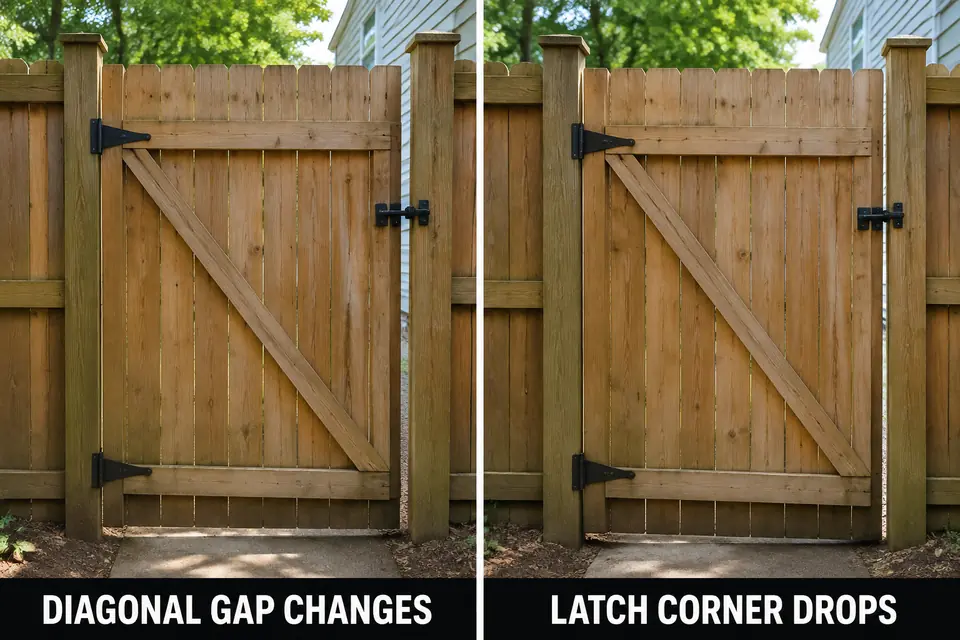
Read the gap as a diagonal pattern, not merely as less space beneath the latch corner.
A rectangular gate should retain approximately the same relationship between its four corners even when the opening itself is imperfect. When the frame racks, that rectangle gradually becomes a parallelogram. The latch corner drops, the upper latch-side gap widens, and the lower portion moves closer to the post or ground.
That pattern is more revealing than a uniformly narrow bottom gap. If the bottom rail remains reasonably parallel with the ground but the entire gate sits lower, both hinges or the supporting post may have shifted together. If one corner drops while the hinge-side corners retain their positions, distortion within the gate frame becomes more likely.
The latch provides another fixed reference. A latch that once entered the center of its strike but now meets below it confirms vertical displacement. If that mismatch becomes greater from one year to the next, the problem is not simply a gate that was hung low.
Wood absorbs and releases moisture, so a gate may tighten during humid or rainy periods and loosen after conditions dry. Normal seasonal movement tends to repeat within a similar range. It may alter clearance or make the latch temporarily stiff, but the gate should return near its earlier position.
Progressive sag establishes a different baseline: after each seasonal cycle, the latch corner remains slightly lower. Open joints, moving hinges, weakened attachment wood, frame racking, or post movement may then be accumulating rather than reversing.
Before moving the strike plate, note where the latch meets it and compare the upper and lower latch-side gaps. Adjusting the strike first can make the gate close, but it also removes useful evidence without correcting the movement.
Loose Post vs Out-of-Square Gate Frame
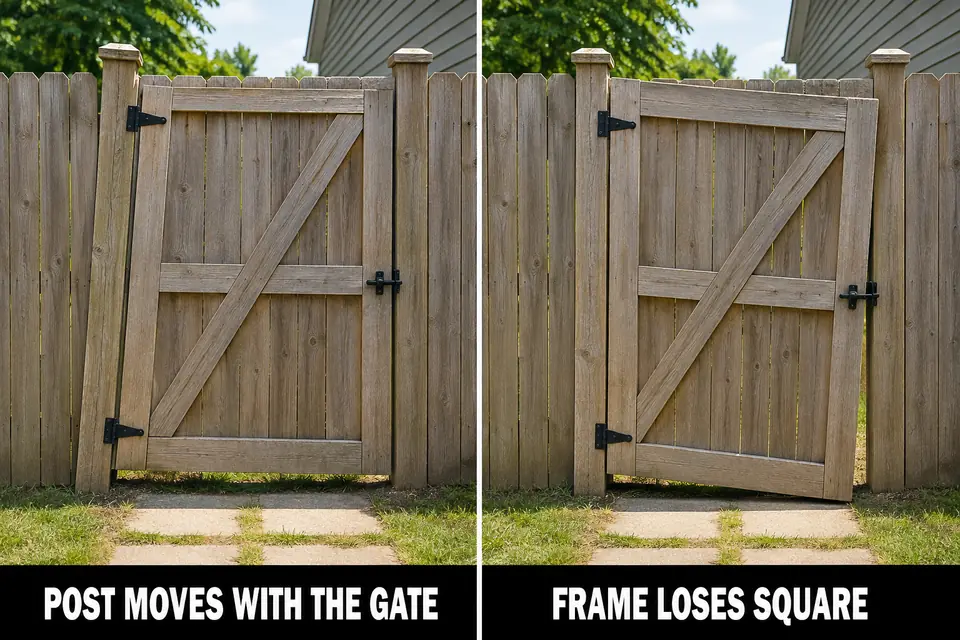
The deciding test is whether the post and gate shift together or the gate changes shape while its supporting post remains stable.
Stand far enough back to compare the hinge post with a nearby fence post, building corner, or another dependable vertical line. A hinge post leaning toward the opening carries both hinges out of position. The gate may remain comparatively square while its entire latch side moves downward and inward.
Next, inspect where the post enters the ground. A widening soil gap, disturbed ground, visible rocking, or separation around an old footing indicates that the support is no longer fixed. Wet soil, poor drainage, freeze-thaw movement, decay, and the leverage of a heavy gate can all contribute. The movement identifies the repair zone, although it does not prove which ground condition caused it.
A racked frame produces a different relationship. The hinge post may remain aligned with the fence while the top and bottom rails lose their original geometry. Joints may open at opposite corners, diagonal bracing may loosen, or the latch stile may no longer remain parallel with the hinge stile.
Move the gate gently by its handle while watching the post and frame. If the hinge post flexes or rocks under the gate’s weight, the supporting structure is involved. If the post remains still but frame joints shift or the gate visibly twists, the fault is within the gate.
Do not assume the two conditions are mutually exclusive. A leaning post can overload the frame, while a racked gate can add leverage to its hinges and post. Correcting only the most obvious gap in that situation usually produces another temporary alignment.
How Hinge Movement Changes the Diagnosis
Hinge movement matters only after you identify what is moving with it. A loose-looking hinge can be the fault itself, or it can be following a post or gate frame that has already shifted.
Both hinge leaves should sit firmly against sound wood. A visible gap behind a leaf, backed-out fastener heads, rust-colored movement marks, crushed fibers, or enlarged holes indicates movement at the attachment. Splitting or softness around the fasteners is more repair-relevant than minor surface rust.
The upper hinge deserves particular attention because the gate’s weight pulls outward at that point. When the upper attachment moves away from the post, the latch corner drops. That familiar pattern does not automatically mean the hinge is defective: the fastener may have lost its grip, the surrounding wood may be deteriorating, or the post may be flexing.
Compare the upper and lower hinges while moving the gate slowly. If the upper leaf separates from the wood while the lower attachment remains seated, the fault is concentrated near the upper connection. If both hinges remain tight but the post moves, tightening hardware will not stabilize the support. If the post and hinges remain still while the gate changes shape, attention returns to the frame.
Driving loose fasteners back into damaged holes can produce a convincing short-term improvement. It does not restore wood that can no longer hold the load, so the same corner may soon begin dropping again.
Which Checks Can Be Made Before Removing Hardware
Preserve the original movement pattern during the first inspection. Removing a hinge or lifting the gate into a new position can erase the evidence needed to distinguish the three fault zones.
Use this compact installed-gate check:
- Close the gate gently and compare the upper, lower, and latch-side gaps.
- Note where the latch meets the strike without lifting or forcing the gate.
- View the hinge post against a fixed vertical reference.
- Move the gate gently by its handle while watching both hinges.
- Look at the post’s ground line for rocking, separation, decay, or disturbed soil.
- Check frame joints for opening, splitting, or diagonal distortion.
Keep fingers and feet away from the space beneath the gate. A heavy or unstable gate can drop farther when its position changes.
Confirm that the structure is actually moving rather than encountering an outside obstruction. A stable gate affected by grade, vegetation, stored objects, or inadequate side-yard gate swing clearance may be difficult to operate without developing a changing diagonal gap.
If the condition varies with weather, record the reference points instead of adjusting immediately. Compare them again after a dry period. A gap that returns near its former position suggests seasonal movement; a latch corner that establishes a progressively lower baseline indicates lasting displacement.
When the Post or Frame Needs Professional Repair
Adjustment stops being a sensible repair when the material carrying the gate can no longer retain its position.
A post that visibly rocks, continues leaning, or separates at the ground line needs more than latch realignment. The soil, footing, drainage, post condition, and gate load may have to be evaluated together. Realigning the gate before stabilizing that support allows the same leverage to pull it out of position again.
Professional repair is also appropriate when hinge fasteners sit in split, soft, or decayed wood; structural joints continue opening; or the unsupported gate will not retain its shape. Those conditions can require post work, structural frame repair, or rebuilding rather than another adjustment.
Stop moving the gate if its weight is difficult to control, the post shifts noticeably during operation, or a hinge attachment is pulling free. Do not lift a heavy gate by its latch corner to test it.
The repair decision should follow the first reference point that moves. A moving post identifies a support problem. A stable post with shifting hinge leaves points to the attachment area. Stable posts and hinges paired with changing diagonal frame gaps point back to the gate itself.
A lasting correction restores the structure that is losing geometry. Moving the latch to meet a dropping corner only records the next stage of the failure.
For technical background on moisture-related dimensional changes in wood, consult the USDA Forest Products Laboratory’s Wood Handbook chapter on moisture and dimensional change.