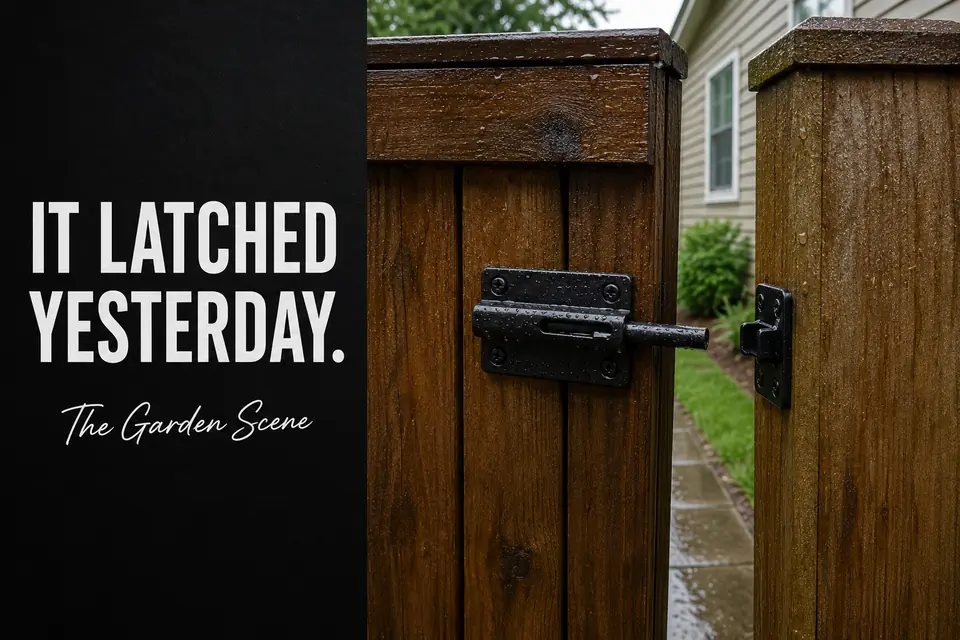
A gate that latched normally before a storm but will not close afterward has changed somewhere. The useful question is not simply whether rain caused the problem. It is whether moisture temporarily changed the size of the gate or whether the gate’s supporting geometry moved—and whether that change reverses after drying.
Begin with the reference points rather than the latch hardware. Look at where the latch bolt now lands, whether the hinge-side gap has changed, and whether the bottom corner has started touching the ground. Those clues show whether the gate became tighter inside the same opening or shifted as a complete assembly.
Do not trim the gate or move the receiver while everything is still saturated. A correction made to temporary wet-weather geometry can create a new alignment problem when the gate dries.
Why Rain Changes a Gate That Worked Yesterday
Rain can change either the gate’s dimensions or the structure holding it in position. Those mechanisms may produce the same refusal to latch, but they leave different evidence.
Wood does not absorb rainwater evenly. End grain, unfinished edges, joints, and the bottom rail may take on moisture faster than protected surfaces. As moisture content rises, wood changes dimension primarily across the grain. On a gate that already had limited closing clearance, a modest change can make the latch-side edge rub the post.
This type of expansion does not usually create a large change in latch height. The bolt may remain level with the receiver while the gate stops short of completing its swing. The hinge-side gap may also look much as it did before the storm.
Heavy rain can alter the support conditions instead. Saturated or eroded soil may let a marginal post move, while heaving soil, mud, or washed debris can reduce clearance beneath a gate that was already close to the ground.
Exposure is rarely equal across an outdoor structure. Water concentrated along one edge can produce a localized problem, much like other rain-edge problems around outdoor spaces develop where runoff repeatedly reaches the same boundary.
The timing narrows the diagnosis but does not settle it. A failure that begins after rain may involve swelling, changing ground support, or both at once.
Wood Swelling vs Post Movement
Start with the direction of the change. Lost sideways clearance favors swelling; altered height or a tapered hinge gap points more strongly toward movement.
Clues That Favor Temporary Swelling
Swelling is more likely when the gate stays at roughly the same height but loses horizontal clearance. The latch bolt may still line up vertically with the receiver yet stop beside it because the gate cannot travel its final fraction of an inch.
Look for fresh rubbing at the latch-side edge, a bottom rail that appears darker or wetter than the rest of the gate, and an otherwise even hinge-side gap. Several boards may feel tight within the frame without the free corner appearing noticeably lower.
A gate that becomes tight only after prolonged rain and consistently returns to normal during dry weather also supports this diagnosis.
Clues That Favor Support Movement
Post or frame movement changes the gate’s position rather than merely consuming edge clearance. The latch may land above or below the receiver, the hinge-side gap may become tapered, and the latch-side bottom corner may begin dragging.
A post does not need to look dramatically tilted to affect the latch. A small change at the hinge side becomes more visible at the far edge of a wide gate. Visible soil loss, softness beside the post, or runoff cutting near the footing makes erosion along the fence line more relevant than wood expansion alone.
Rain can also expose movement that was already developing. A gate that sat slightly low before the storm may stop closing only after saturated ground or new surface contact removes its remaining clearance.

Wet boards do not prove that swelling caused a lower corner, and a shifted latch does not automatically prove that the post moved. The useful diagnosis comes from combining the direction of misalignment with what happens after drying.
Reading the Latch Misalignment Pattern
Treat the latch as a position gauge, not as the failed part. Before loosening anything, close the gate gently and watch where the bolt or bar approaches the receiver.
The Latch Is Beside the Opening
A bolt that remains at the correct height but stops short or lands to one side usually indicates lost horizontal clearance. Check whether the gate contacts the closing post before the latch reaches its normal position.
Then observe the entire swing. Contact only during the final part of closing points toward a tight closing edge. Resistance earlier in the arc may instead involve reduced gate swing clearance, ground interference, or another obstruction away from the latch.
The Latch Is Above or Below the Opening
A definite height change is more consistent with altered gate geometry. A bolt landing below the receiver often accompanies a dropped latch-side corner, a tapered hinge gap, or new ground contact. A bolt landing above it indicates movement in a different direction rather than simple closing-edge expansion.
Gently lifting the latch-side edge may reveal whether vertical position is involved, but this is only an observational test. If lifting changes the alignment, do not assume the receiver needs to move. The gate or its support is changing position under load.

Read the surrounding gaps with the latch position. An even hinge gap with no new ground contact supports a width-related change. A tapered gap, altered latch height, and ground contact together make whole-gate movement more likely.
What to Test After the Gate Dries
The dry-weather comparison is the deciding test. Surface water disappearing is not enough; thick rails, end grain, and sheltered joints can retain moisture after the visible faces look dry.
Wait through a genuinely dry interval appropriate to the gate’s exposure. Then recheck the same reference points: where the latch lands, whether the hinge gap is even, how much closing-edge clearance remains, and whether the lower corner still contacts the ground. Photographs taken square to the latch and hinge gap can make small changes easier to compare.
If the gate returns close to its earlier position and closes without lifting or forcing, temporary swelling becomes the stronger explanation. If the edge clearance improves but the latch remains low, the storm may have produced both swelling and support movement.
Recurring saturation around the opening also matters. Persistent mud, runoff beside the post, or water sitting across the gate route can connect the symptom to wider side-yard drainage and access conditions rather than a one-time wet gate.
Mini Decision Matrix
- Wet pattern: Tight closing edge with little height change
After drying: Normal clearance returns
Likely interpretation: Temporary wood swelling is more likely. - Wet pattern: Latch lands lower and hinge gap becomes tapered
After drying: Misalignment remains
Likely interpretation: Post, hinge-side, or frame movement is more likely. - Wet pattern: Gate rubs the ground after rain
After drying: Ground contact disappears
Likely interpretation: A temporary ground condition or minor combined swelling may be involved. - Wet pattern: Several clearances change at once
After drying: Only some return
Likely interpretation: Swelling and structural movement may be occurring together.
One storm offers a comparison; repeated storms reveal a trend. A gate that fails by the same amount only while wet and reliably recovers favors moisture expansion. A gate left slightly lower after each storm is not returning to its previous geometry.
When Adjustment Will Not Solve the Underlying Problem
Adjustment becomes reasonable only after the gate’s position has stabilized. Moving the receiver while the gate is swollen may restore closure today and make the latch miss in the opposite direction during dry weather.
Latch adjustment is also unlikely to last when the gate remains low after drying, the hinge gap stays tapered, or the post visibly shifts during ordinary operation. Loose hinge attachment points, an out-of-square frame, recurring ground contact, and worsening alignment after successive storms all show that the latch is recording another failure rather than causing it.
Soil conditions create an especially clear boundary. Softness, washout, heaving, or persistent saturation beside the post cannot be corrected at the latch. Neither can a gate that must be lifted to close or has already required repeated receiver adjustments.
An unstable post, deteriorated frame, or hinge attachment pulling out of damaged wood moves the problem beyond routine adjustment. Keep the gate from being forced or slammed and have the support condition evaluated before changing the hardware again.
The strongest evidence is what remains after drying. Recovered clearance and restored latch alignment favor temporary swelling. Retained height change, a persistent tapered gap, or continuing ground contact means the gate’s geometry moved—and moving the latch would only conceal it.
For technical background on moisture-related dimensional change, see the USDA Forest Products Laboratory’s Wood Handbook chapter on drying and moisture control.