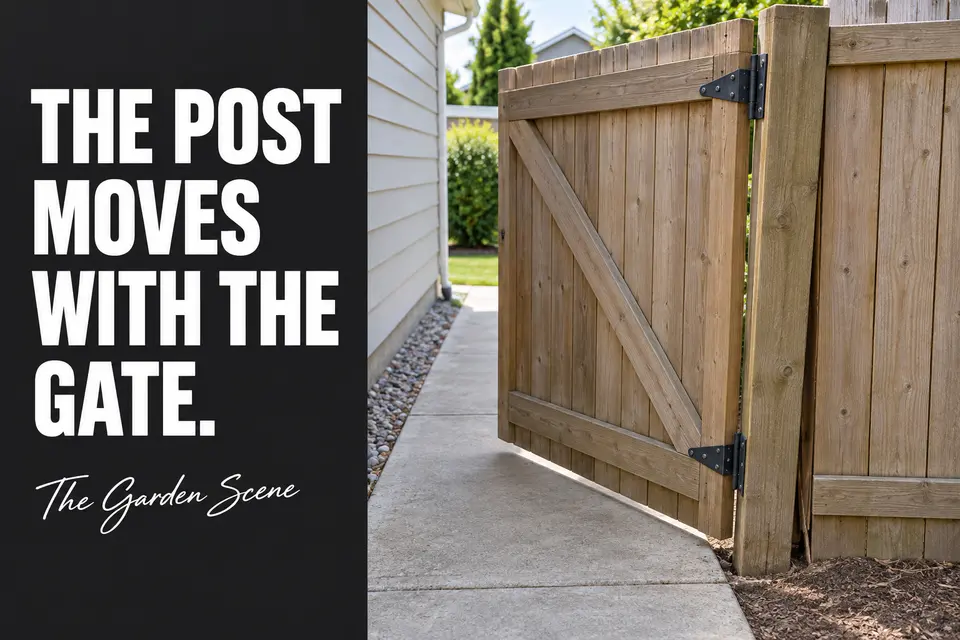
A gate post that shifts every time the gate opens is not mainly an alignment problem. It is a support problem: the gate’s load is changing the position of something meant to stay fixed. The useful question is where that movement begins—not how far the post top sways.
Watch the ground line rather than only the gate. If the base remains still while the upper post flexes slightly and returns exactly, the response may be elastic. If a soil gap opens, a concrete edge moves, weakened wood bends at ground level, or latch height changes during the swing, the support itself is moving.
Gate weight exposes these weaknesses but does not identify them. The hinges transfer the load into the post; the post, soil, and footing must resist it. Tracing that path separates surface response from repair-relevant failure.
What Movement at the Post Base Means
The post base is the diagnostic dividing line. Movement above it can be flex within the post or play at the hardware. Movement that reaches it means the problem involves the post’s structural section, its contact with the soil, or the footing intended to hold it.
Watch the boundary, not the top
Choose two fixed references visible from outside the swing and pinch zones: the line where the post enters soil or concrete and perhaps the gap to an adjacent fence panel. During one slow, normal opening, watch whether those lower points change.
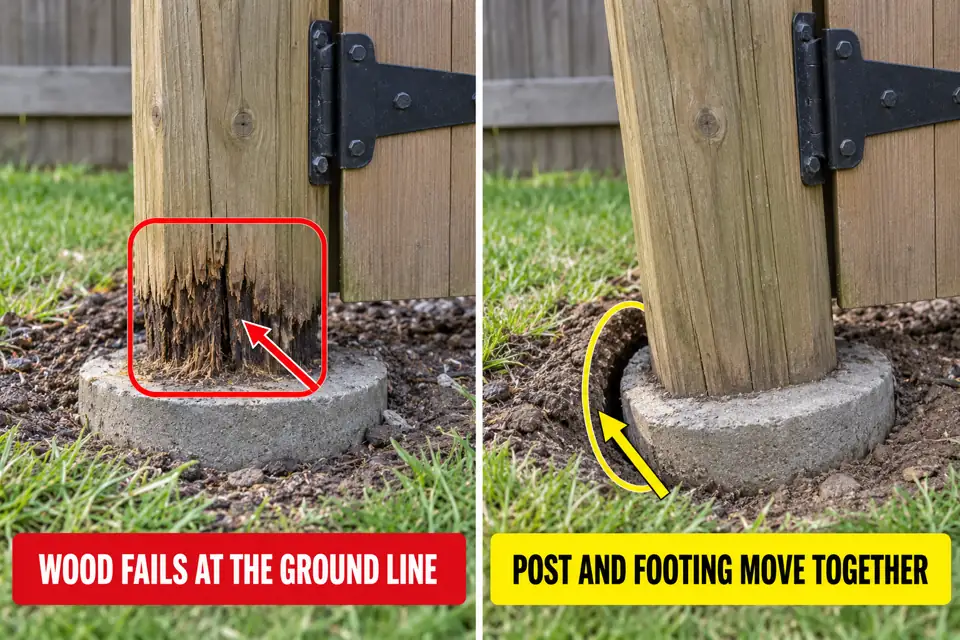
A crescent-shaped gap that opens beside the post is meaningful, as is soil that lifts, compresses, or cracks. If a visible concrete collar rotates with the post, both may be moving as a unit. A loose sleeve or trim collar can imitate this, so confirm that the structural post changes position.
Wood condition matters most near the ground line, where moisture can remain against the post. Dark staining alone does not prove decay, but softened fibers, a narrowed or hollowed section, splitting, crumbling wood, or fasteners losing their hold in that area are stronger clues. The upper post may look straight while the load concentrates bending at a weakened band close to the soil.
Latch movement is supporting evidence, not the diagnosis. If the latch rises, drops, or shifts sideways in the same opening cycle, the relationship between the hinge post and latch post is changing. The latch did not cause that change; it is showing that the gate’s support geometry no longer stays constant under load.
Gate Weight vs Soil or Footing Failure
Gate weight is the test load, not the diagnosis. Because that weight extends outward from the hinge line, opening the gate increases the pull and twist applied to the post. A wider or heavier gate makes an existing weakness easier to see, especially when partly or fully open. It may be exposing support that has already lost stiffness or restraint—not proving that weight alone caused the failure.
Compare the load path, not just the amount of sag. If the hinge post remains fixed at the ground while the gate’s free corner drops, the problem is more consistent with gate or hinge geometry. That distinction is covered more fully in the diagnosis of a gate leaf that keeps sagging while its post stays fixed. When the post base rocks in phase with the gate, however, adjusting the gate leaf does not address the part that is moving.
Soil can lose restraint without the post looking dramatically loose when the gate is closed. Saturated ground may soften; runoff may remove soil from one side; recently disturbed fill can settle; and drying soil can shrink away from the base. In these cases, the post may rotate slightly into the newly available space as hinge load increases.
A footing problem can produce a similar top movement but a different base pattern. If the post and a visible concrete edge shift together, the movement is deeper than a loose soil skin around the post. Cracking, separation, rotation, or loss of support beside the footing may be involved. Because most of the footing is concealed, observation can establish that deep movement exists without proving the precise underground defect.

How to Separate Surface Flex From Deep Movement
Compare the same gate fully closed and partly open. Do not shake, lift, or force it. If operation still appears controlled, one adult can move it slowly through one cycle while another watches from outside the swing and possible fall path.
Scan from bottom to top: the soil or concrete boundary, ground-line wood, hinge plates, and latch height. A nearby fence panel is useful only if that section remains stationary.
| Observed pattern | Where movement begins | What it suggests | Immediate response |
|---|---|---|---|
| Upper post flexes; base stays fixed | Above the ground line | Possible elastic response | Confirm exact return and no worsening |
| Hinge plate shifts; post stays still | At hinge fasteners | Connection play or weak fastener hold | Keep the base diagnosis separate |
| Wood bends or separates at a damaged band | At the ground line | Rot, splitting, or section loss | Stop loading the gate and assess the post |
| Soil gap opens or lifts beside the post | At the soil boundary | Lost restraint in the ground | Limit use; compare ground conditions |
| Post and concrete move together | At the footing boundary | Deep support movement | Stop use; arrange structural evaluation |
Weather can sharpen the distinction. After heavy rain, record the base rather than assuming the gate simply swelled. If movement is slight and observation remains safe, compare the same latch and hinge gaps again after the ground dries. A change with drying suggests a moisture-sensitive condition; it does not prove the footing is sound.
Return matters as much as displacement. Upper flex that returns to the same alignment, without a base gap, decay, or soil disturbance, differs from a post that settles into a new position. A latch that stays low or sideways shows that something failed to recover.
Location separates shallow from deep movement. A hinge leaf moving against stationary wood is local. A softened ground-line section bending inside a stable soil edge points to lost wood strength. An intact-looking post carrying its concrete edge with it points deeper. Concealed defects remain likely, not confirmed.
Site changes add evidence. A bare channel, exposed footing edge, downslope deposit, or widening void makes soil washing away along a sloped fence line relevant. Erosion may not be the only defect, but it shows that surrounding support is changing.
Judge the whole pattern. Small rotation at the base becomes a larger sweep at the top. A stable boundary, exact return, and no worsening may support limited monitoring. A moving boundary, permanent displacement, damaged wood, or expanding soil gap indicates a structural problem even when the sway looks modest.
Why Tightening the Hinges May Hide the Real Cause
Tightening the hinges answers only whether the hinge connection was loose; it does not test the post base. Watch the plate against the wood. If it shifts while the post-to-ground boundary stays fixed, the connection deserves attention. If the entire post rocks, the hinge is transferring load into support that cannot hold position.
Tightening a hinge can temporarily raise or pull the gate enough for the latch to meet again. That improved alignment does not stabilize loose soil, restore decayed wood, or stop a footing from rotating. It can hide the symptom at the latch while the base continues to move during every opening.
Repeatedly loosening fasteners are diagnostic evidence. A screw that no longer bites, sinks into crushed fibers, or sits in softened wood suggests that the material holding it has weakened. Adding a larger fastener or more hinge hardware as a quick test can redistribute the load and obscure the movement pattern without establishing that the post is sound.
Judge the connection and the support separately. The hinge may need attention, the post may need attention, or both may be involved. The key is that a hardware change cannot clear a base that was visibly moving before the adjustment.
The Point Where Continued Use Becomes Unsafe
The safe-use boundary is controlled by the base, not by whether the latch can still be persuaded to catch. Slight, repeatable flex above a stationary base may be monitored only when the post returns exactly, with no latch change, ground-line decay, widening soil gap, footing movement, or increasing lean.
Warning Sign: Stop normal use when the post base or footing visibly rocks, the post stays displaced, ground-line wood splits or crumbles, the hinge side separates, or the gate drops during its swing. Do not keep operating it to see whether the movement becomes worse.
Be more conservative when failure could put someone in the gate’s path. A heavy gate can fall or twist after a weakened section gives way. Driveways, public walkways, shared access, neighboring property, children, and pets leave little room for watchful waiting.
Pool-barrier gates demand particular caution because closing and latching are safety functions, not conveniences. If post movement changes self-closing, latch height, or the secure barrier line, take the gate out of normal service until the support condition is evaluated. Do not rely on manually repositioning the gate after every use.
If the gate must be immobilized, stay outside its swing and fall path and do not transfer the load to another weak fence section. Do not excavate around a loaded post merely to confirm what is underground. Visible base, rot, or footing movement already justifies qualified assessment.
Let the base deliver the verdict. If it remains fixed and every reference returns precisely with no damage or worsening, limited monitoring may be reasonable. Once movement enters the ground line, soil, or footing, hinge adjustment is no longer the answer and normal use should stop.
For background on the moisture conditions that permit wood decay, see the USDA Forest Products Laboratory’s Wood Handbook.