One fence bay knocks with each gust while the sections beside it seem quiet. Before tightening anything, identify which connection allows the movement. A board tapping against a rail, a rail shifting at a post, and a post carrying the whole section sideways call for different attention.
A bay is the section between two posts. Follow the movement through that section: board to rail, rail to post, then post to ground. The first place where connected parts change position relative to each other gives you a useful inspection target.
During strong wind, stay sheltered. Note the location only if you can do so safely from indoors; do not approach the fence to listen more closely or hold it steady. During a high-wind warning, prioritize shelter over observation. The useful inspection happens after conditions are calm, when you can compare connections without gusts moving them.
Where the Sound Usually Starts
Start with the smallest area you can identify: one board, an upper rail end, or the lower corner of a panel. “The back fence rattles” is too broad to guide an inspection. “The upper connection beside the corner post knocks” gives you somewhere specific to look afterward.
On a wooden fence, a board can tap against its supporting rail when an attachment allows play. Near a post, a rail end may knock as a gap opens and closes. A branch, hanging decoration, or nearby object can also strike the fence and make an intact section sound loose.
The sound’s character helps locate contact, but it does not establish the cause. A sharp click does not prove that a screw is loose. A deeper knock does not prove that a post has failed. Connected boards and rails can carry sound away from the point where it starts.
When the weather clears, look for evidence at the suspected contact point before assuming the whole panel needs attention. A fresh rubbed patch beside an attachment is more useful than loudness alone. If the sound location remains uncertain, compare the visible connections across that bay. Do not select a repair simply because one board looks older than the others.
Loose Fastener vs Flexible Panel Movement
Watch where the shape changes. Bending spread across the panel directs attention toward the span and its supports; a gap opening at one attachment directs attention toward that joint. Both can occur together, so visible flex does not rule out a loose connection.
Look at the joint, not just the panel face
If an individual board moves while the rail behind it stays in position, start with that board’s attachments. A withdrawn nail head, missing screw, or worn mark around the attachment can help explain the tapping. A fastener that remains visible may still have lost its hold in the wood.
If several boards and their rail move together, look farther along the connection path. Does the rail shift where it meets the post? Or does the post itself change position with the rail still attached? Tightening board fasteners would leave either supporting movement unresolved.
Broad bowing between posts is a different observation. The middle of a panel may deflect while its end connections remain seated. That does not establish that the movement is acceptable: construction, span, material condition, and the fence system all matter. There is no useful universal amount of “safe flex” for an unidentified residential fence.
| Observed movement | Possible source | Inspect next |
|---|---|---|
| One board taps against a rail | Play at the board attachment | Fastener presence, withdrawal, and surrounding wood |
| The panel bows broadly between posts | Deflection across the span | Rail condition and whether end connections remain seated |
| A rail end shifts against a post | Play or damage at the supporting joint | Attachment, bracket if present, and rail-end material |
| A post and connected rails move together | Movement involving the support | Post alignment, accessible base, and adjoining bays |
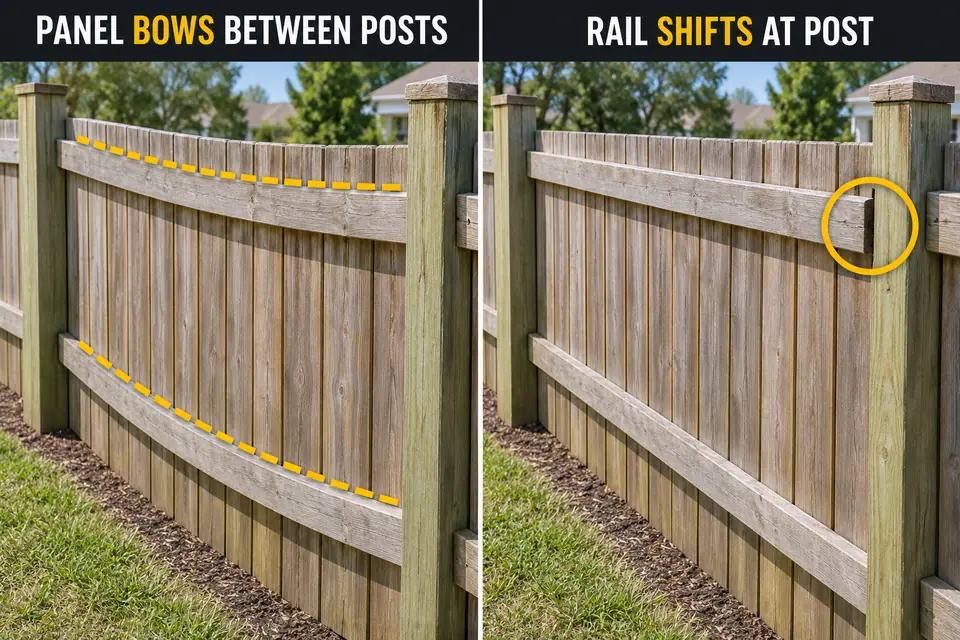
A panel returning to its previous shape after a gust does not clear the attachments of damage. A joint can open under load and close again afterward. Include that connection in the calm-weather inspection even when the panel looks straight again.
For vinyl or metal systems, use the actual connection design as the reference. Do not translate a wood-fence observation into an instruction to add screws or eliminate every gap. Identify the system before deciding that a particular opening or movement needs correction.
Why One Bay Moves More Than the Others
Choose a comparable neighboring bay before judging the noisy one. A longer section, different infill, previous repair, or exposed end position can change its response to wind. A quiet, sheltered section is a poor benchmark for a bay beside an opening.
Compare sections of similar height, span, and construction. Look for an attachment that is absent on the noisy section, a rail end sitting differently, or a repaired board that no longer follows the surrounding fastening pattern. These differences are more diagnostic than comparing noise levels alone.
Exposure can explain why the symptom concentrates in one place. A bay near an opening or corner may receive wind differently from the rest of the run. Where the fence borders a passage between buildings, wind channeling through a narrow side yard is relevant context for unequal exposure.
Then check whether the movement appears to involve one shared post. If the ends of two adjoining bays change position around that support, extend the inspection beyond either panel. That pattern directs attention toward the common post and its connections; it does not, by itself, prove a footing defect.
Also note what changed before the rattling began. Added screening or something attached to the fence may change how it responds to wind. Record that condition without assuming that another screen or more hardware will solve it. Exposure explains the load reaching the fence; the connection inspection shows where the assembly may be losing its hold.
What to Inspect After the Wind Stops
Check overall alignment before inspecting individual fasteners. A section that now leans, hangs from one connection, or has a partly detached rail already needs more than a close search for loose screws. View it from outside the area it could fall into and keep clear.
For a section without obvious instability, visually compare accessible attachments with equivalent ones nearby. Look at the relationship between parts, not just whether a screw or nail is present. A rail may still have hardware through it while the wood around that hardware has split.
Read the material around the attachment
A withdrawn fastener in intact wood presents a different repair problem from one surrounded by broken material. Distorted brackets, elongated openings, or a rail pulling away from its seated position also make “tighten it” an incomplete answer. The attachment needs material capable of holding it.
Fresh rubbing can help identify repeated contact. Look for a cleaner patch on weathered wood, worn paint at a joint, or matching marks on two touching surfaces. These clues help locate movement; they do not tell you how much holding strength remains.

Use this compact inspection order without pushing, pulling, or shaking the fence:
- Overall alignment: Look for a new lean, displaced corner, or rail line that no longer matches adjoining sections.
- Board attachments: Note missing or withdrawn fasteners and visible contact marks.
- Rail-to-post joints: Check for separation, shifted rail ends, or distorted brackets where fitted.
- Visible material damage: Look for splits, broken rail ends, or deteriorated wood at attachment points.
- Accessible ground line: Note fresh soil disturbance, exposed support, or washout without digging.
- Neighbor comparison: Photograph the suspect area and an equivalent nearby connection from safe positions.
A soil gap around a post needs context. It may predate the storm, and the gap alone does not establish that the footing moved. Fresh disturbance combined with changed post alignment is a more consequential observation.
Where runoff has visibly removed soil, erosion along the fence line becomes part of the underlying problem. Photograph the washout and its relationship to the support instead of treating the noisy panel as an isolated hardware issue.
The result should be a specific description: “one board attachment has withdrawn,” “the rail end has separated at split wood,” or “the shared post now leans.” Those descriptions support a repair decision far better than “the fence needs tightening.” If you cannot see the relevant joint safely, leave that part of the assessment to a fence professional.
When Rattling Points to Structural Weakness
A new persistent lean or an opened supporting connection changes the decision. A post that remains tilted after the wind, a partly detached rail, or a split through the fastening area warrants attention beyond individual board fasteners. Several connected components moving together also shifts the focus toward their shared support.
Repeated loosening at the same damaged location is another reason to stop treating the symptom as an adjustment. Drawing the parts together may silence the knock while leaving the attachment unable to hold as intended. The repair must address why the connection loses its hold.
A clearly localized board-attachment problem can remain a limited repair when the rail, post connection, and surrounding material are sound. Once the damage involves the rail support, an unstable post, or uncertain holding material, arrange professional assessment.
Keep people and pets away from a visibly unstable section. Do not hold it upright, add an improvised brace, or attach screening to restrain the movement. When requesting help, describe the affected bay, the visible damage, and whether neighboring sections share the movement.
After an appropriate repair, compare its visible condition in calm weather. Do not deliberately load the fence or go outside during another storm to test it. A local attachment repair should resolve a local attachment defect; movement at a rail support or post needs its own assessment, even if the knocking has stopped.
For shelter precautions during hazardous winds, follow the National Weather Service’s high-wind safety guidance.