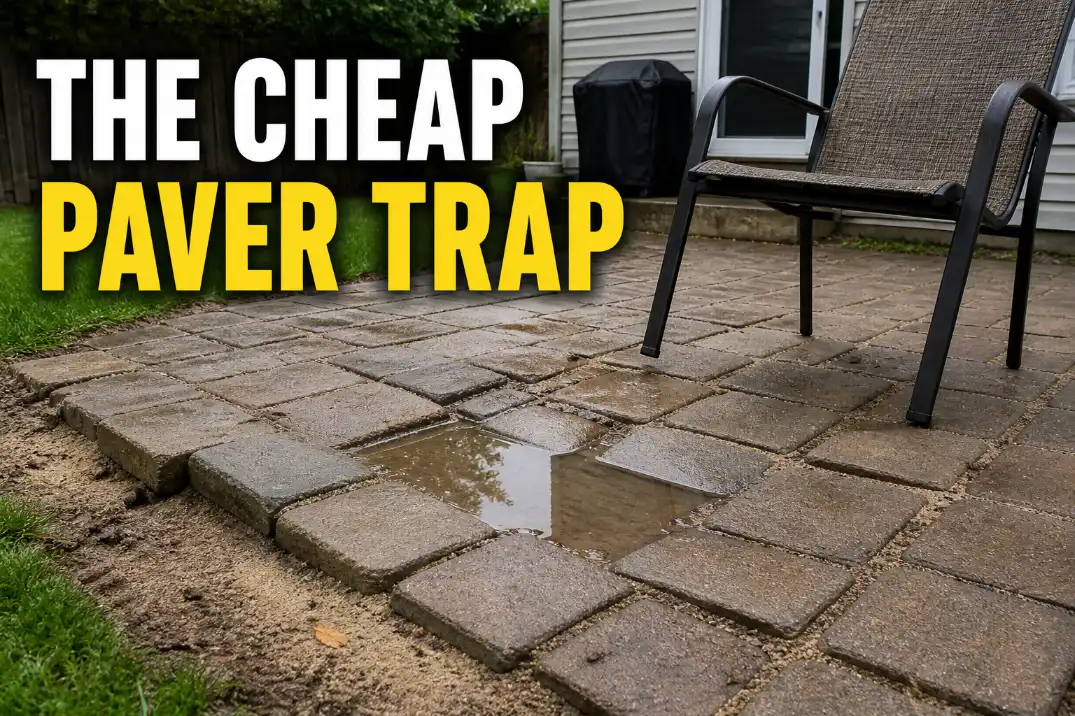
Cheap pavers stop being a smart backyard choice when the problem changes from cosmetic aging to repeat system failure. Mild fading, a few stains, or uneven color may be tolerable. Movement, pooling water, washed-out joints, spreading edges, and repeat repairs are different.
Those are signs that the patio is no longer just inexpensive; it is underbuilt for the yard.
Start with four checks: water that remains longer than 24 hours, joint gaps wider than 1/2 inch, trip edges around 1/4 inch or more, and repairs needed more than once in a year. Those thresholds matter more than the paver price.
A cheap paver surface can still be a bargain in a dry, lightly used corner. It stops making sense when it has to handle drainage, furniture load, slope, safety, or cleaning problems it was never built to solve.
Cheap Pavers or Cheap Installation?
Most cheap paver failures are not product failures first. They are underbuilt-system failures. The paver is the visible part, but the base, edge restraint, slope, and drainage decide whether the surface keeps working.
The surface gets blamed first
Thin or porous pavers can chip, stain, and fade faster than better products. But a thicker or more expensive paver will still shift if it sits on loose soil, a skim of sand, or a base that was never compacted properly.
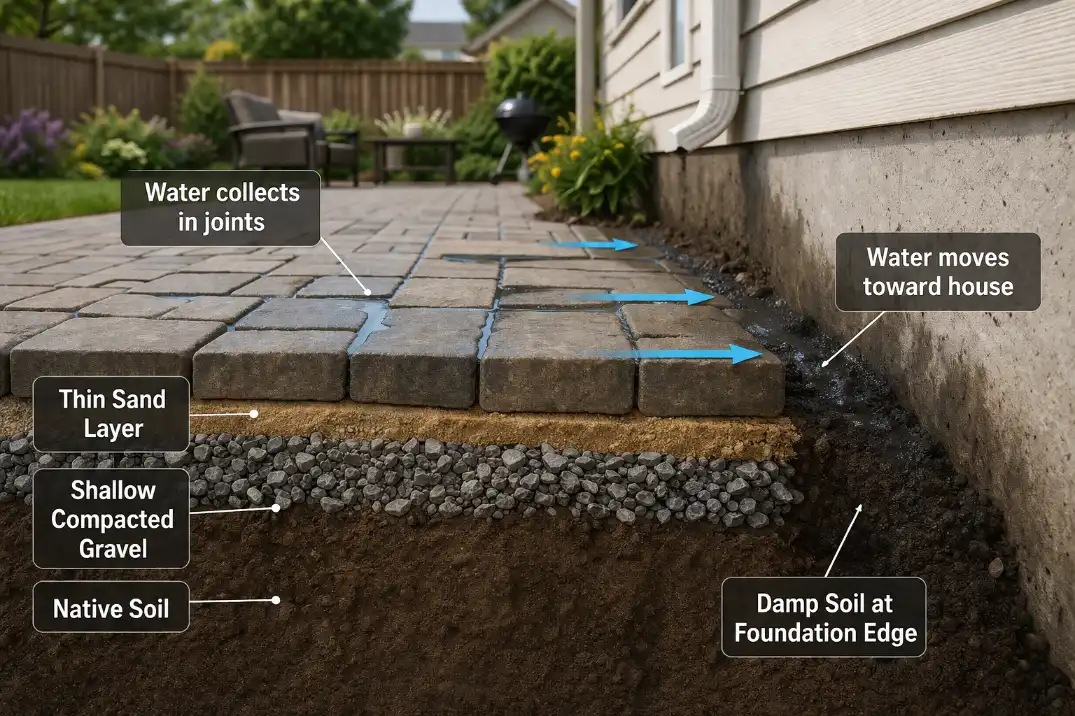
For many pedestrian patios, a compacted aggregate base around 4–6 inches deep is a more reliable starting point than 1–2 inches of loose sand. Wet clay, freeze-thaw climates, and high-runoff areas may need more preparation.
If the pavers looked good for a month and then settled after several storms, the base is the more likely culprit than the paver face.
Edges reveal the truth early
The outside edge usually tells the story before the center does. A patio with weak edge restraint starts to relax outward. You may see bowed borders, diagonal gaps, or pavers creeping toward the lawn. Once the edge moves, the joint sand loses support and the rest of the surface follows.
That is why a cheap paver patio can look acceptable in photos but feel wrong underfoot. Rocking blocks, widening joints, and chair legs catching between pavers matter more than whether the color still looks fresh.
If the main question is whether a different loose or hard surface would handle water better, Pavers vs Gravel for Backyard Drainage is a better comparison than judging pavers by appearance alone.
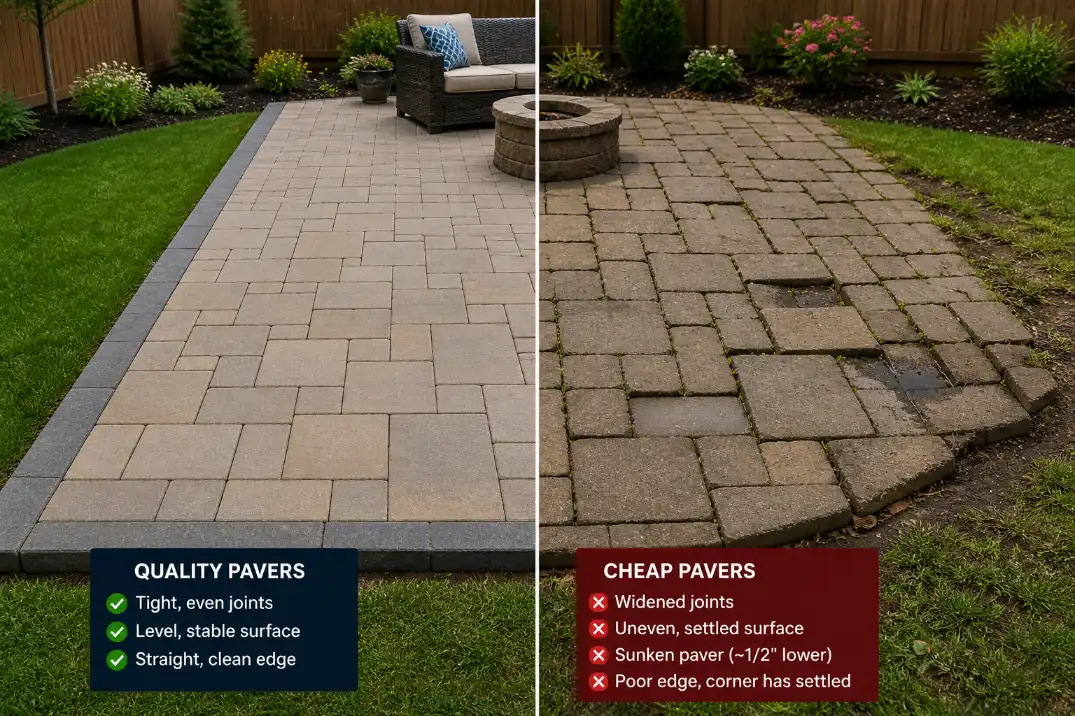
Quick Decision Checklist: Keep, Repair, or Replace
Use this as a decision filter, not a full inspection report.
- Water clears within 12–24 hours and the surface stays flat: keep and monitor.
- One isolated low spot appears after soil disturbance: repair that section.
- Joint gaps exceed 1/2 inch in several areas: suspect edge or base failure.
- Trip edges reach about 1/4 inch or more: treat it as a safety issue.
- The same area needs repair twice in one year: stop patching and reassess.
- Water moves toward the house: fix drainage before improving the surface.
- Rocking pavers, stains, and slow drying appear together: replacement may be more practical than rescue.
One mild issue can be normal aging. Three issues at once usually mean the low-cost choice is now costing you in labor, materials, or usability.
Once the same paver area needs sand, resetting, cleaning, or edge repair every season, the cheap choice is no longer saving money; it is spreading the real cost across weekends.
Where Cheap Pavers Still Make Sense
Cheap pavers are not automatically a mistake. They become a mistake when homeowners ask them to perform like a premium patio in a difficult site.
A small seating pad under 80–100 square feet, a side-yard stepping area, or a temporary backyard improvement can be a reasonable use for budget pavers. The risk stays lower when the area is flat, drains away from the house, and does not carry heavy furniture, a grill station, or daily foot traffic.
If the area sees only foot traffic and movable chairs, cheap pavers are easier to justify than in a dining area where concentrated weight and dragging furniture stress the joints every week.
They also make more sense when future change is expected. If a deck, larger patio, or landscape redesign may happen in 2–3 years, a modest paver area can be a practical placeholder.
The same pavers become a weaker choice beside a foundation, under a roofline with concentrated runoff, in a shaded wet corner, or anywhere chairs and tables move daily. A backyard does not need to be extreme for cheap pavers to struggle. Repeated wetting, furniture movement, and poor edge support are enough.
The more focused failure pattern in Why Cheap Backyard Pavers Shift and Stain is useful when the patio is already showing both movement and discoloration.
When the Obvious Fix Wastes Time
The first fix people reach for is usually not the fix that changes the outcome. Sand, sealer, and cleaner all have a place. None of them corrects a patio that is moving because the system underneath is weak.
More sand only helps minor joint loss
Sweeping in polymeric or regular joint sand can help when the pavers are still flat and the gaps are mostly from normal washout. It is not a cure for spreading edges or settled base material.
If the joint sand disappears after every heavy rain, the question is not “Which sand is better?” The better question is where the water is going and why it is carrying material with it.
Sealer protects stable pavers
Sealer can reduce staining and make some pavers easier to rinse. It cannot flatten a patio, improve slope, strengthen edges, or stop base movement. Sealing too soon can also make a damp patio more frustrating because the surface looks finished while the moisture problem remains.
Pro Tip: Do not seal a cheap paver patio until it has stayed flat and drained properly through several rains. Sealer should protect a stable surface, not hide an unstable one.
Cleaner solves grime, not structure
Cleaner is useful for surface dirt, algae film, leaf stains, and some grease marks. It is the wrong first step if the patio rocks, holds water, or keeps growing moss in the same wet joints.
If the patio only looks dirty, clean it before assuming it needs replacement. If it moves underfoot, repair structure before cleaning. If it stays wet, solve drainage before sealing. For cases where the surface is stable but slick or dirty, Best Non-Slip Cleaners and Treatments for Slippery Patios gives a more product-focused path.
The Drainage Threshold That Changes the Decision
Drainage is the line between “budget but workable” and “cheap in the worst way.” A patio should move water off the usable surface and away from the house. A common target is about 1/8 to 1/4 inch of fall per foot. Over a 10-foot run, that means roughly 1.25 to 2.5 inches of total drop.
If cheap pavers are too flat, water sits in the joints. If they slope toward the house, the problem becomes more serious than patio appearance. Damp soil against siding, foundation edges, basement windows, or low thresholds should be handled before any surface upgrade.
This is the condition homeowners often underestimate. A stained patio may be annoying. A patio feeding water toward the house can become expensive. When pooling appears near the foundation, Patio Water Pooling Against the House is the more urgent diagnostic path.
Best Surface Choice When Cheap Pavers Start Failing
The right next move is not always “buy better pavers.” Sometimes the answer is a better base, a different material, or a smaller hardscape area.
| Backyard Condition | Cheap Pavers | Better Pavers | Better Alternative |
|---|---|---|---|
| Dry, light-use corner | Usually acceptable | Nice but not essential | Gravel or compact seating pad |
| Wet clay backyard | Risky without deeper base | Better only with proper prep | Gravel with drainage plan or permeable system |
| Grill or dining area | Often stains and shifts | Better texture and thickness help | Concrete or larger-format stable patio surface |
| Shaded mildew-prone patio | Needs frequent cleaning | Helps only if drainage improves | Low-slip textured surface with better airflow |
| Area beside house | Poor choice if slope is wrong | Still risky without drainage correction | Correct drainage first, then use concrete or a properly built paver patio |
| Temporary project | Reasonable if expectations are low | Usually overkill | Simple gravel or removable paver pad |
The useful comparison is not cheap versus expensive. It is whether the surface matches the site. Freeze-thaw cycles punish thin bases in northern states, while humid shade can bring algae back within weeks. In dry regions, UV exposure and irrigation overspray can make low-quality pavers fade or loosen unevenly.
If the patio problem appeared after adding a walkway, changing grade, or redirecting runoff through the yard, Backyard Drainage After Adding a Patio or Walkway helps separate a surface problem from a routing problem.
When to Repair and When to Rebuild
Repair still makes sense when the failure is isolated. If one low spot developed near a downspout, one edge loosened after lawn work, or a small section settled where soil was disturbed, targeted repair may be enough. Lift the affected pavers, correct the base, compact in thin lifts, restore the bedding layer, and reinstall the pavers flush with the surrounding surface.
The repair should extend at least 12–18 inches beyond the visible settled area. Settlement rarely stops exactly where the eye first notices it.
Rebuild or replace the surface when the patio has widespread settlement, repeated joint washout, poor slope, and cleaning problems all at once. At that point, a new bag of sand or another weekend of scrubbing is not economy. It is delay.
Cheap pavers also stop making sense when the surface becomes slippery in a family backyard. If kids, older adults, pets, or frequent guests use the patio, slip resistance deserves more weight than bargain pricing. For that decision, Best Low-Slip Patio Surfaces for Family Backyards is more useful than trying to rescue every surface with coating or sealer.
Thicker pavers help, but they do not override poor water management. A 2 3/8-inch paver on a weak base can still move. The strongest rule is simple: fix drainage and base depth first, then choose the surface. Doing it backward creates patios that look finished before they are functionally ready.
The Bottom Line
Cheap pavers are still smart when the area is small, dry, lightly used, and easy to adjust. They stop being smart when the backyard asks them to handle daily furniture movement, recurring runoff, wet-weather slip risk, or drainage near the house.
A budget paver patio should stay boring: flat after storms, dry within a day, easy to sweep, and stable under chairs. Once it needs seasonal repair to remain usable, the savings have already started to disappear.
For a broader look at how pavement choices affect runoff and stormwater behavior, see the US EPA guide to permeable pavement.