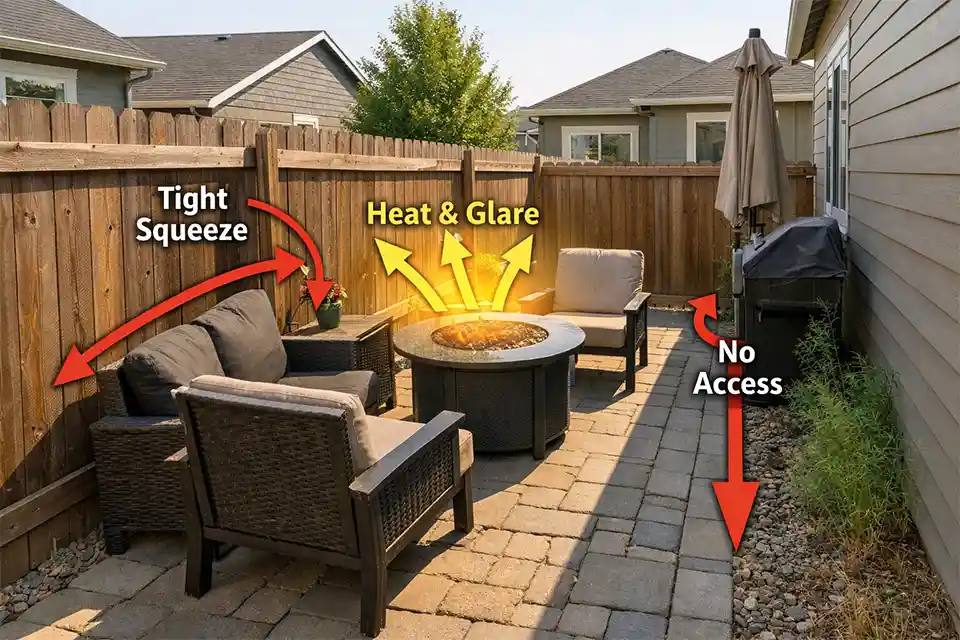
Shared-fence backyards usually fail for one reason before any other: too much pressure gets pushed onto the boundary line. The patio hugs the fence, the grill lands there too, storage slides into the same strip, privacy planting gets forced into a shallow bed, and the whole perimeter starts doing more work than it can handle.
The first checks are practical: is there at least 30 to 36 inches of clear fence-side access, is the main seating area sitting within about 4 feet of the fence, and does water stay soft or puddled near the edge for more than 24 hours after rain? If those signs show up together, the problem is rarely just privacy.
That distinction matters. This is not mainly a small-yard problem, and it is not automatically a narrow-yard problem either. A shared-fence yard fails differently because the boundary is not neutral.
It reflects heat, concentrates sightlines, amplifies glare, and turns a minor spacing mistake into a daily annoyance. In most cases, the right fix is not more stuff along the fence. It is less demand on the fence line.
The mistake pattern that causes most shared-fence yard problems
The most common failure is edge stacking. Instead of giving the yard a real center of use, the layout loads the shared boundary with too many jobs at once: seating, dining, screening, storage, planting, lighting, and circulation.
What gets overestimated
Fence height gets overestimated. A 6-foot fence can block a direct ground-level line of sight, but it does very little for reflected sound, hardscape heat, or the boxed-in feeling that shows up when furniture sits right against it.
What gets underestimated
Fence-side clearance gets underestimated. Once the working strip along the boundary drops below about 3 feet, regular upkeep becomes more annoying than most homeowners expect. Cleaning, staining, trimming, panel repair, drainage checks, and simple debris removal all get harder fast.
Symptom vs. mechanism
The symptom is “the backyard feels cramped.” The mechanism is different: the shared fence line is carrying too much of the layout. That is why a yard can look finished and still feel wrong.
Why shared-fence yards fail differently
An open backyard can absorb a mediocre layout for longer. A shared-fence yard usually cannot. The boundary acts like a pressure zone, not just a backdrop.
Boundary constraint is not the same as shape constraint
Some of the same compression issues show up in Backyard Design Problems in Long, Narrow Yards, but shared-fence yards usually fail for a different reason: they overload the boundary, not just the footprint.
Privacy symptoms can hide layout mistakes
People often assume the fence itself is the problem. Sometimes it is. More often, the layout is failing first. When the patio sits too close to the boundary, people do not just feel seen. They feel pinned to the edge.
Secondary problems arrive quickly
In shared-fence yards, the yard often starts feeling crowded during the first season. The secondary failures usually follow within 6 to 18 months: pruning stress, splash-back, dead air, clutter buildup, glare, and fence-access frustration.
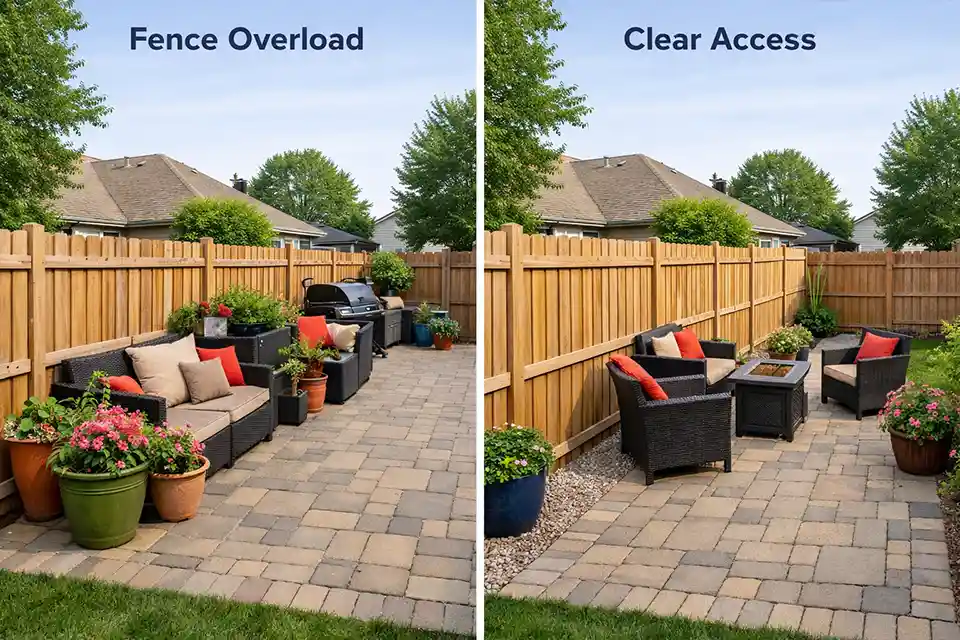
Signs the Fence Line Is Doing Too Much
If three or more of these are true, the layout is probably failing at the shared fence line:
- The main seating area sits less than 4 feet from the fence.
- There is under 30 to 36 inches of usable access along the boundary.
- Planting beds along the fence are narrower than 18 inches but expected to provide real privacy.
- Hardscape runs nearly all the way to the fence with little soft buffer.
- Lighting is aimed at the fence face instead of downward into paths or seating zones.
- Water lingers near the fence for more than 24 hours after rainfall.
- The yard feels private from one angle but exposed from upper-story neighbor windows.
What people usually misread first
People often blame the fence style or height before checking how the space is arranged. Sometimes the fence does need work, but poor zoning usually shows up first.
A quick test is to pull furniture inward by even 18 to 24 inches. If the yard immediately feels calmer and easier to move through, the fence was not the main problem.
That is also why so many Backyard Privacy Problems and Fixes That Fail disappoint: they add screening material without reducing pressure on the edge.
The second common misread is assuming more screening is always better. In a shared-fence yard, that often creates a wall in front of a wall. A thick hedge in a shallow bed may soften the view for a few months, but it usually steals usable width, blocks airflow, and turns simple maintenance into a recurring burden.
Why the obvious fix fails
The obvious fix is usually to add more along the fence. More shrubs. More trellis. More decorative panels. More planters. More lighting.
That often wastes time because the perimeter is already overloaded.
Why perimeter-only thinking breaks down
A perimeter-only strategy makes the center of the yard feel leftover. Better shared-fence layouts do the reverse. They protect the main use zone and let the edge support it.
That same logic runs through Backyard Zoning Mistakes That Hurt Outdoor Flow: a layout can look efficient on install day and still fail once real movement, comfort, and maintenance start mattering.
Where a standard privacy fix stops making sense
If the patio edge or seating edge is already within about 3 feet of the fence, adding more height or more plant mass usually makes the yard worse. At that point, the issue is no longer a shortage of privacy material. It is a spacing problem.
What people underestimate most
Upper-story overlook is often underestimated. A taller fence can block direct ground-level views, but it does almost nothing when the real exposure comes from second-story windows. That is an angle problem, not just a fence-height problem.
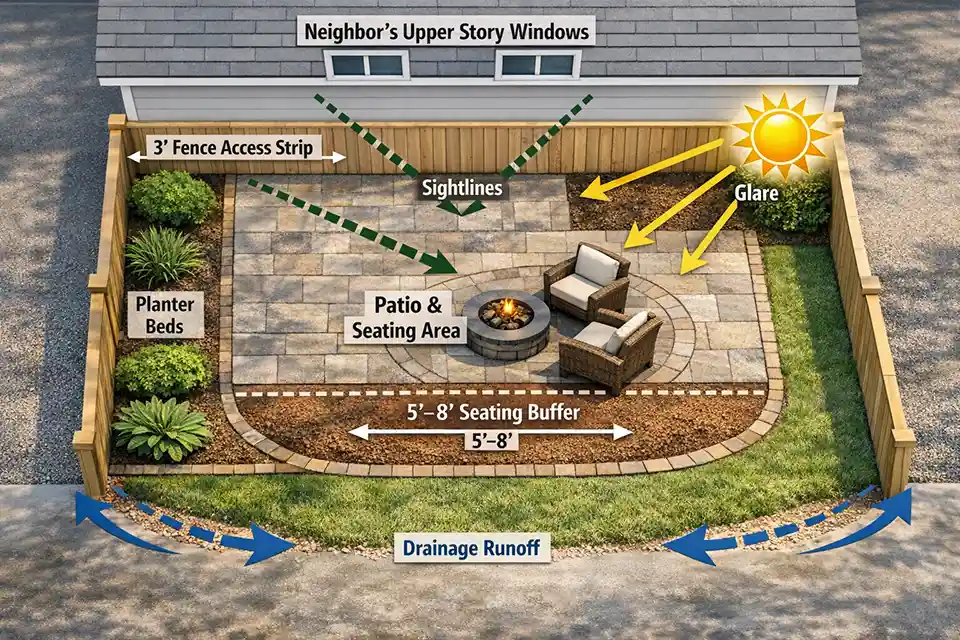
Smarter shared-fence layout ideas that do not create new problems
The better ideas here are not just attractive. They reduce boundary pressure without creating a new maintenance or privacy problem.
Pull-in patio layout
Pull the main seating or dining zone 5 to 8 feet inward when space allows, rather than building the social zone right against the fence.
Best when: the current seating area sits within 3 to 4 feet of the fence.
Avoid if: moving inward would eliminate the only usable center zone.
One quiet edge, one active edge
Do not make every boundary work equally hard. Let one fence line stay mostly functional, with access, drainage visibility, and lighter planting. Let another edge handle screening or decoration.
Best when: the yard has one side that already works better as a service strip.
Avoid if: all boundaries are equally exposed and still need the same level of screening.
Soft buffer, not a wall in front of a wall
A 24- to 36-inch planting strip with airy shrubs, upright grasses, or selective screening often works better than trying to cram a dense hedge into an 18-inch bed.
Best when: the edge feels harsh but the yard cannot afford a deep privacy mass.
Avoid if: the real exposure comes from upper-story views rather than eye-level sightlines.
Corner-anchor privacy
One stronger corner treatment can do more than an overloaded full perimeter. A small tree, loose-form shrub grouping, or screened bench zone can redirect attention and soften exposure.
Best when: one corner naturally draws the eye or captures the main sitting angle.
Avoid if: the yard’s biggest privacy problem is uniform exposure along the entire boundary.
Overlook fix, not just fence fix
If visibility comes from upper-story windows, think in terms of canopy, offset seating, or partial overhead screening instead of only adding more fence-adjacent material.
Best when: privacy feels inconsistent depending on standing versus sitting.
Avoid if: the real issue is glare, noise, or crowding at ground level.
This is also where a good Privacy Buffer in a Suburban Yard can outperform a heavier fence-side treatment. The goal is not to build a second wall. It is to calm the edge.
Pro Tip: In compact shared-fence backyards, one intentional privacy moment usually works better than trying to turn the entire fence line into a continuous barrier.
Comparison guide: what looks smart first but ages badly
| Layout choice | Looks smart at first | What it really does later | Better move |
|---|---|---|---|
| Patio tight to fence | Maximizes open center | Feels boxed in and makes fence upkeep harder | Pull seating 5–8 ft inward if possible |
| Deep hedge in a shallow bed | Promises instant privacy | Crowds the yard and creates pruning stress | Use lighter layered screening |
| Storage or benches on the access strip | Hides clutter | Blocks the service path | Keep one 30–36 in clear edge |
| Full hardscape to the boundary | Looks clean and low-maintenance | Increases heat, splash, and visual harshness | Break the edge with a soft buffer |
| Full-height screening everywhere | Feels private on day one | Shrinks light, air, and usable width | Screen only where exposure is real |
| Fence-mounted lights | Makes the perimeter look finished | Creates glare and neighbor-facing pressure | Light paths and seating instead |
Practical fixes, in the right order
Do not begin with stain color, decorative add-ons, or a new hedge shopping list. Start with the pieces that change how the yard works.
Reclaim a working edge first
Pick one fence run and restore a real maintenance strip. That usually means removing bulky planters, relocating storage, or shifting furniture. If the strip still does not reach 30 inches, the boundary is still doing too much.
Reposition the social zone before buying new privacy elements
Move the seating area inward by 18 to 36 inches before spending money. That single shift often tells you whether the yard truly needs more privacy treatment at all.
It is the same kind of high-value re-spacing that shows up in Backyard Layout Problems That Make Spaces Hard to Use: the fastest improvement often comes from layout correction, not product replacement.
Correct drainage before adding screening
If water remains soft or puddled near the fence more than a day after rain, do not bury that issue under mulch or new planting. Fix runoff direction, grade, or compaction first. Shared boundaries are especially unforgiving when drainage gets ignored because every extra layer makes future access harder.
Reduce edge pressure at night too
Fence-washing lights often look polished in inspiration photos, but in compact shared-fence yards they can create glare, hard contrast, and neighbor-facing pressure. Lower, inward-directed lighting usually performs better.
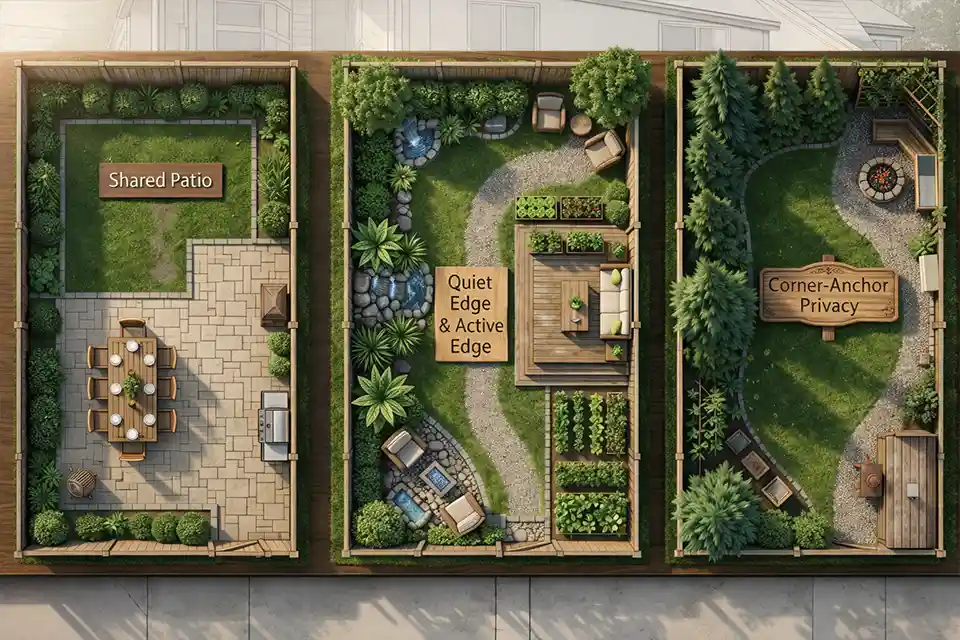
What not to add to a shared fence without checking first
A shared fence is not just visual background. It is a sensitive edge. That makes certain add-ons riskier than they look.
Mounted lights and speakers
Anything that points glare or sound toward the boundary tends to create more pressure than it solves. Even small fixtures can make the fence line feel active and exposed.
Heavy add-on screens or panels
Extra privacy layers attached right at the fence can seem like an easy fix, but they often add bulk exactly where the yard already lacks breathing room.
Irrigation spray aimed at the boundary
Overspray at the fence line is a quiet long-term mistake. It increases splash, can worsen fence wear, and usually signals that too much of the planting plan has been forced into the perimeter.
Vines that turn the boundary into a maintenance project
Vines can work, but they are often treated like a free privacy fix when they are really a maintenance multiplier. In shared-fence yards, that tradeoff matters sooner.
A strong shared-fence backyard is not the one with the most screening. It is the one that asks less of the fence line and gives the boundary enough breathing room to stay functional.
For boundary planning that supports better layout decisions before fence-side fixes start compounding, see the NC State Extension landscape design guide.