Last updated: June 19, 2026
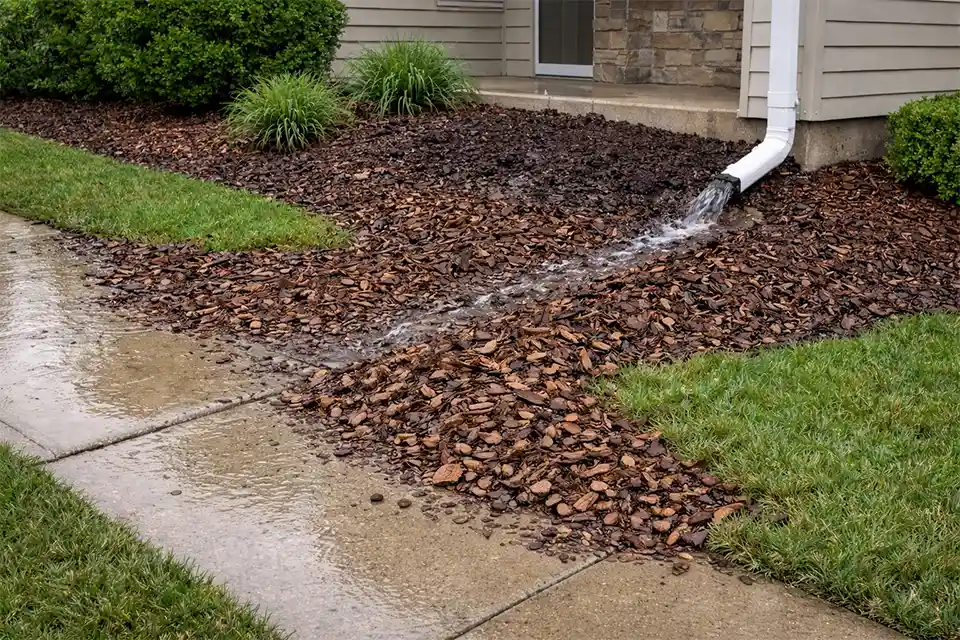
If your front yard mulch bed needs replacing every season, the problem is usually not the mulch. It is usually runoff entering too fast, crossing the bed too cleanly, and carrying the surface layer with it. Start with three checks: where water enters, whether the bed drops even a few inches from top to bottom, and how much mulch depth remains after an ordinary storm.
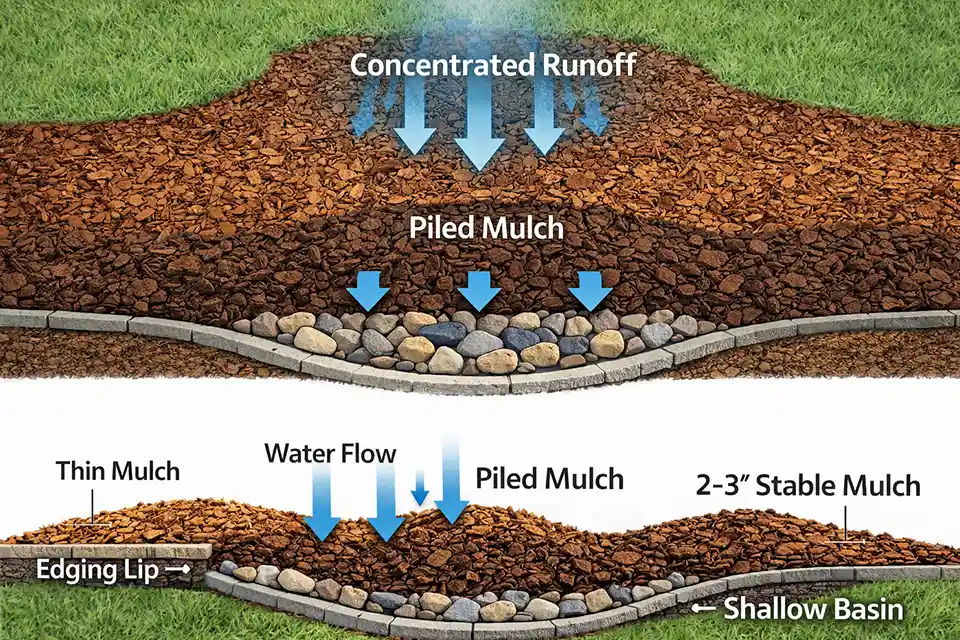
In a stable bed, mulch usually stays fairly even at about 2 to 3 inches deep. In a failing one, the upper section thins, the lower edge piles up, and exposed soil appears within 24 to 48 hours after rain. That is the useful distinction: settling happens gradually over 6 to 12 months, but washout shows up fast and leaves a clear direction of movement. If that pattern repeats after a routine 0.5- to 1-inch rain, treat it as a runoff-control problem first.
Quick Diagnostic Checklist
-
Mulch collects along the sidewalk, curb, or lawn edge after rain.
-
Soil is exposed in the upper half of the bed within 1 to 2 days of a storm.
-
A downspout, driveway edge, or walkway sends water into one concentrated point.
-
The bed carries runoff more than about 6 feet before it slows down.
-
Mulch depth falls below roughly 2 inches in the sections that fail first.
-
You keep topping it off, but the same edge breaks down after each heavy rain.
What People Usually Misread First
The visible problem is the mulch moving. The real problem is the water path.
That matters because people often spend money in the wrong order. They replace the bark, rake it smooth, and assume the bed is fixed because it looks full again. Then the next storm shifts everything back to the low edge. At that point, adding more material is not maintenance. It is repetition.
Wind gets blamed more than it deserves here. It can scatter very dry, lightweight mulch, but in front yards that fail over and over, water is the more likely cause. One downspout outlet, one driveway runoff line, or one shallow grade change usually does more damage than general exposure.
What also gets underestimated is bed shape. A mulch bed with no holding edge, no interruption point, and a smooth downhill exit behaves like a shallow channel. Once that happens, the mulch is simply showing you where the water wants to go.
Why the Obvious Fix Fails
The most common wasted fix is adding another inch of fine mulch every spring. That improves appearance, but it does not reduce water speed. In some beds it makes the surface less stable because finer material drifts more easily than coarser pieces.
Another weak fix is relying on edging alone. Edging helps hold mulch once flow is already under control, but it does not solve a bed that is taking direct runoff from a roof outlet or hardscape edge. If water enters with force, the bed will still scour from the top and overload the bottom.
This is why nearby site conditions matter more than people expect. In many yards, the mulch problem is tied directly to the same pattern behind driveway runoff that keeps overwhelming the front yard. The mulch is not the first thing failing. It is just the first thing you notice.
What Actually Changes the Outcome
The order of repair matters more than the mulch product.
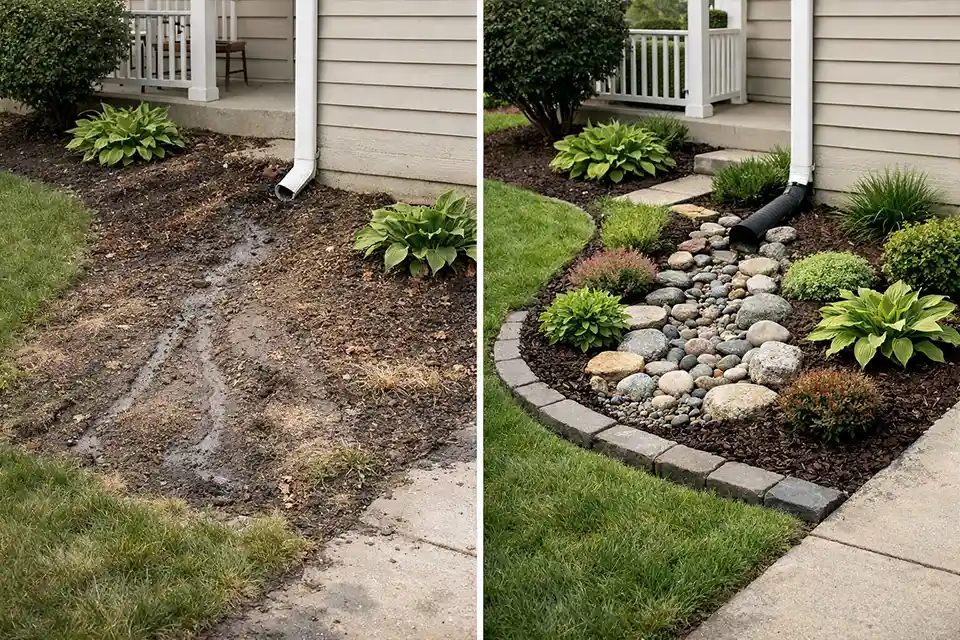
First, slow or redirect the inflow. If a downspout empties into the bed, move that outlet so water is not entering at one hard point. If runoff arrives from pavement, break it up before it reaches the mulch. A short gravel strip, a stone landing zone, or a small grade break usually does more good than replacing all the mulch in the bed.
Second, rebuild the bed so it can hold material instead of exporting it. On problem sites, a perfectly flat bed is often the wrong shape. A shallow basin profile, a subtle berm at the lower edge, or a defined lip of even 1 to 2 inches changes how long water stays in the bed and how quickly it exits. That same logic shows up in front yard drainage problems around downspouts and walkways because water control almost always beats surface replacement.
Third, match the mulch texture to the site. Fine shredded bark looks tidy, but it tends to move sooner on exposed slopes or in beds with concentrated inflow. Coarser shredded hardwood, larger bark pieces, or rough wood chips usually stay put better once the flow path is corrected. Material choice matters, but only after the bed stops acting like a runoff lane.
Pro Tip: Measure remaining mulch depth before reapplying anything. If one section is still close to 3 inches, full replacement there is waste. Spot correction is often enough.
Better Diagnosis Before Better Materials
A lot of front yard beds are not failing because they are under-mulched. They are failing because they sit in the wrong hydraulic path.
That is why slope matters even when it does not look dramatic. A bed does not need a steep hill to wash out. If the surface keeps carrying water across 6 to 10 feet without slowing, mulch movement becomes much more likely. This is where sloped front yard landscaping problems and drainage issues overlap with what seems like a simple mulch problem. Once flow gains direction, appearance-only fixes stop working.
It also helps to separate washout from normal breakdown. Organic mulch settles and decomposes over time. That is routine. But if more than about 20 percent of the bed surface shows exposed soil after ordinary rain, the bed has moved out of routine maintenance and into structural correction.
Practical Fixes by Failure Pattern
| Failure pattern | Most likely cause | Best next move | What usually wastes time |
|---|---|---|---|
| Mulch piles at the bottom edge | Water exits too fast downhill | Add a holding lip or slight berm and reshape the bed | Replacing mulch only |
| Soil shows at the top after rain | Concentrated inflow from above | Redirect runoff before it reaches the bed | Installing edging by itself |
| Mulch drifts onto lawn | Material is too fine for site exposure | Switch to coarser mulch after fixing flow path | Raking it back after each storm |
| Bed stays wet and still erodes | Compacted soil plus surface runoff | Reduce excess depth, improve the runoff path, and loosen the top layer where practical | Making mulch deeper than 4 inches |
| Same area fails every season | Bed sits in a repeating runoff line | Convert the inflow zone to stone or gravel transition | Rebuilding the whole bed the same way |
When the Standard Fix Stops Making Sense
There is a point where a traditional all-mulch bed is simply the wrong finish for the location.
If the bed sits below a roof valley, beside a descending driveway, or in a front yard that repeatedly channels stormwater to one edge, seasonal patching becomes a poor trade.
Once you have already redirected what you can and the same impact zone still keeps breaking down, it makes more sense to stop forcing mulch into that exact spot. A hybrid layout usually works better: stone or gravel where runoff enters, mulch around planting pockets, and a clear edge separating the two.
That is a better decision than endlessly testing new mulch products. Similar front-yard problems often show up under different names, especially in yards also dealing with clay soil drainage problems in front yards or homes at the bottom of a hill with front yard drainage problems. In both cases, the surface material keeps taking the blame for a water-path problem underneath it.
The Fix Order That Usually Works
-
Watch where water enters the bed during rain or immediately after.
-
Stop concentrated inflow first.
-
Reshape the bed so water slows instead of crossing straight through.
-
Check mulch depth in several spots.
-
Reapply only enough to restore an even 2 to 3 inches in most beds.
-
Use coarser mulch only after the flow path is under control.
That order is less dramatic than tearing everything out, but it is what usually ends the seasonal replacement cycle.
For university-backed guidance on applying mulch without creating new problems, see the Iowa State University Extension mulch guide.