Last updated: April 15, 2026
Quick Solution Summary
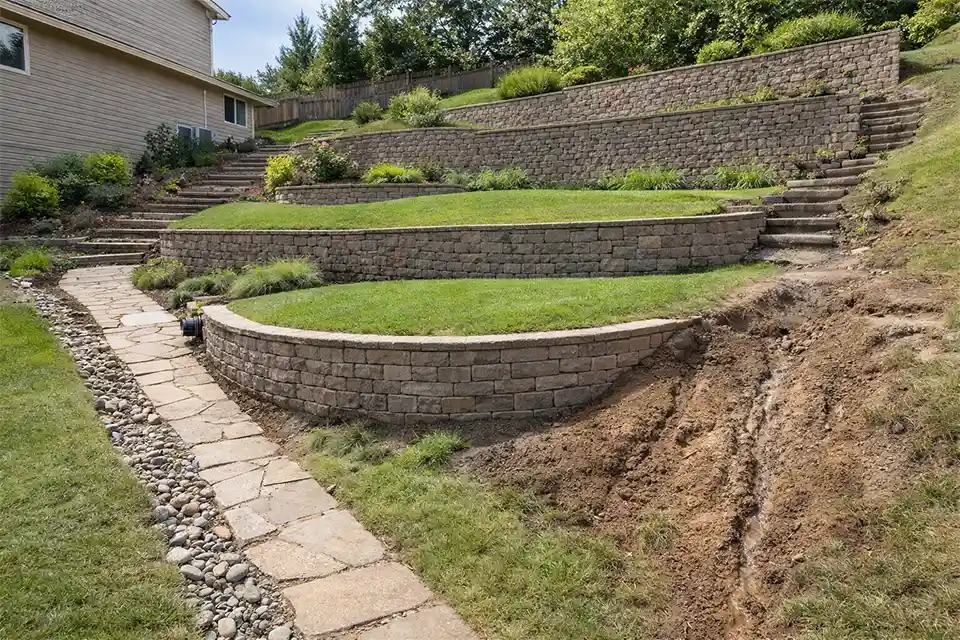
Sloped backyards create landscaping and safety challenges because gravity constantly pulls water and soil downhill. Over time, this natural movement can cause erosion, unstable patios, shifting retaining walls, and drainage problems that affect both the yard and nearby structures.
In many parts of the United States, climate conditions amplify these risks. Midwest storms may deliver 1–2 inches of rainfall in a few hours, rapidly increasing runoff velocity. In northern states, freeze–thaw cycles expand soil by up to 9% during winter, loosening hardscape foundations. Meanwhile, desert regions like Arizona experience long dry periods followed by sudden monsoon storms that destabilize slopes within minutes.
Most sloped yard problems originate from three factors: uncontrolled runoff, weak soil structure, and poor landscape design. Addressing these issues typically involves combining drainage systems, structural support such as retaining walls, and vegetation that stabilizes soil.
When slopes are managed correctly, erosion can be reduced by 60–80%, outdoor areas become safer to navigate, and long-term landscape maintenance becomes far easier.
This article will help you identify the real source of slope problems first, then show which solution types are worth considering when runoff, soil movement, or poor stability starts turning into a recurring repair issue.
Why Sloped Backyards Behave Differently Than Flat Landscapes
Flat yards distribute water, weight, and soil pressure evenly. Sloped yards do not.
Gravity accelerates surface runoff as water moves downhill. Even a moderate slope of about 10° can increase water flow speed by several times compared to flat ground. When rainfall hits soil at these angles, it carries fine particles downhill, gradually thinning the upper layers of soil.
Over several seasons, this process leads to common landscaping problems:
-
soil erosion on upper slopes
-
sediment buildup at the bottom of the yard
-
shifting patio foundations
-
unstable retaining walls
-
drainage concentration near structures
Many homeowners first notice these changes when patios or pathways begin to feel uneven. Movement under hardscape surfaces is often caused by shifting soil layers beneath the base material, which is explained further in Uneven or Sloped Ground: Here’s Why Your Patio Feels Unstable.
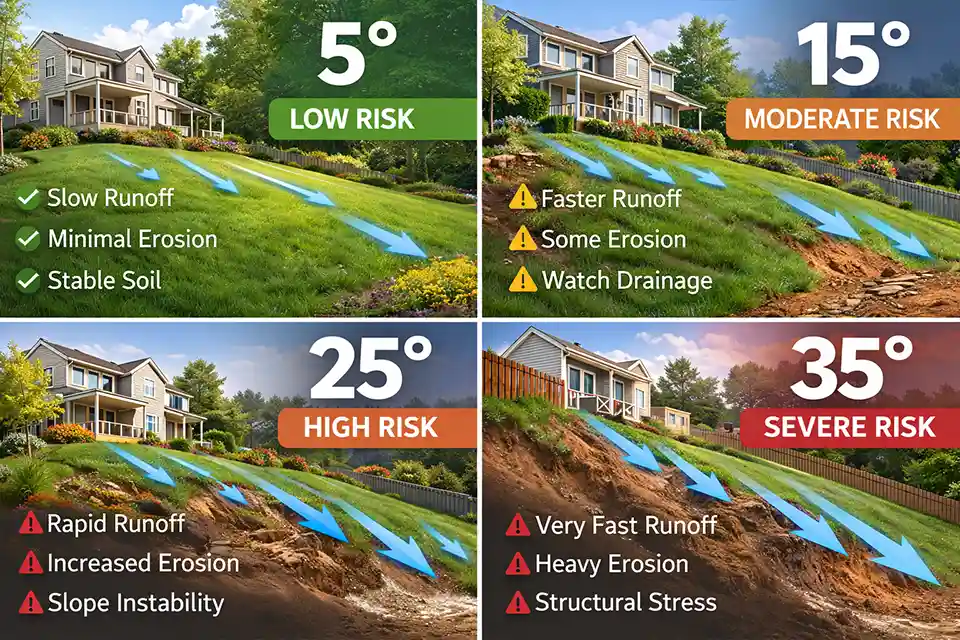
Slopes above roughly 15° create significantly higher stress on landscaping materials because runoff velocity increases and soil friction decreases.
Quick Diagnostic Checklist
If your backyard sits on a slope, these warning signs may indicate developing problems:
-
Soil washing downhill after heavy rain
-
Lawn thinning on upper areas of the yard
-
Pavers separating or shifting out of alignment
-
Mud collecting near patios or fences
-
Small cracks forming in retaining walls
-
Walkways becoming slippery or uneven
When multiple symptoms appear together, the underlying issue is often poor water management combined with weak soil stabilization.
If the problem keeps coming back, it is worth looking at the tools that are most useful for landscape edging that keeps shifting.
Slope Angle and Risk Level
The steepness of a slope plays a major role in how difficult the landscape is to maintain.
| Slope Angle | Difficulty Level | Typical Problems | Risk Level |
|---|---|---|---|
| 5°–10° | Low | Mild runoff, minor soil movement | Low |
| 10°–15° | Moderate | Lawn thinning, minor erosion | Medium |
| 15°–25° | High | Soil erosion, drainage concentration | High |
| 25°–35° | Very high | Retaining walls required, patio instability | Severe |
| 35°+ | Structural risk | Landslide potential, major erosion | Extreme |
Most residential yards fall between 10° and 25°. Within this range, landscaping requires thoughtful drainage planning and structural support to remain stable.
The Biggest Landscaping Problem: Water Runoff
Water runoff is the primary driver of most slope-related landscape failures.
When rain falls on sloped ground, gravity accelerates the movement of water across the surface. Depending on soil composition and slope angle, runoff may travel between 2 and 6 feet per second during heavy storms.
For a broader look at erosion-control products for sloped backyards, it helps to compare blankets, staples, and reinforcement grids based on how the slope is actually failing.
This movement strips away topsoil and concentrates moisture in lower parts of the yard.
Typical runoff problems include:
- erosion channels forming along the slope
- water pooling at the base of the yard
- oversaturated soil near patios or decks
- foundation moisture around the home
In clay-heavy soils common in Midwest states like Illinois or Ohio, water infiltration is slow. Instead of soaking into the ground, rainfall tends to move across the surface, dramatically increasing runoff pressure.
Poor drainage systems often cause homeowners to discover problems only after patios or outdoor seating areas become unstable.
Effective slope drainage typically combines several elements:
- French drains placed 12–18 inches below grade
- dry creek beds that slow water movement
- gravel drainage trenches
- graded channels directing runoff away from structures
For many sloped yards, the most useful starting materials are a perforated drain pipe that can collect subsurface water before it softens the slope and a geotextile drainage fabric that helps keep soil from clogging the system over time.
If the trench is likely to clog with migrating soil, the pipe alone is not enough. That is the point where filter separation becomes part of the fix, not an optional extra.
🔴 SHOP geotextile drainage fabric
If runoff is already washing out soil, softening the base of hardscape, or pushing water toward a lower patio edge, this is no longer just a grading concern. It is the point where a drainage category should move to the top of the shopping list.
| BEST CATEGORY FOR SLOPE RUNOFF |
|---|
| Perforated Drain Pipe |
| Best for sloped yards where water keeps moving through the soil instead of only sitting on the surface. |
| This category fits when runoff is softening lower sections, creating washout, or destabilizing nearby hardscape. |
| Look for durable pipe sized for residential drainage and pair it with filter fabric to help reduce clogging over time. |
| 🔴 SHOP perforated drain pipe |
In regions with heavy seasonal rainfall, these systems can reduce runoff pressure by 40–60%.
Soil Movement and “Soil Creep”
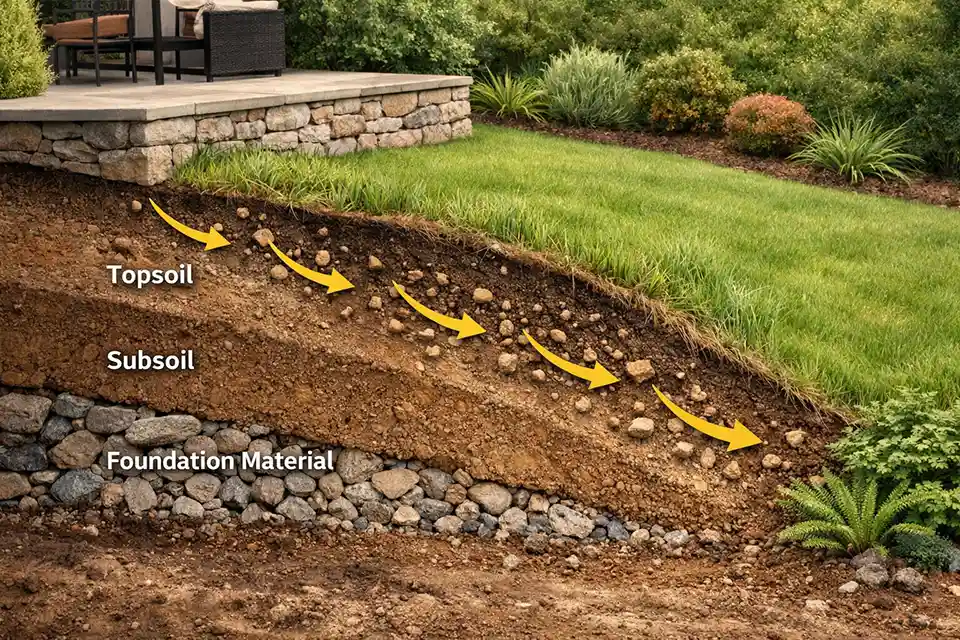
Another hidden issue on sloped yards is gradual soil movement known as soil creep.
Soil creep occurs when tiny particles slowly move downhill due to repeated cycles of moisture, gravity, and temperature changes. While the movement may be only fractions of an inch per year, over time it can shift landscaping structures noticeably.
Several factors accelerate soil creep:
-
repeated rainfall saturation
-
freeze–thaw expansion during winter
-
loose or sandy soil composition
-
landscaping fill that was not properly compacted
For example, in northern states where winter temperatures drop below 32°F, soil expands as water freezes. When temperatures rise again, the soil contracts but rarely returns to its original position. Over multiple seasons, this expansion and contraction slowly moves soil downhill.
This process explains why patios, garden walls, and steps sometimes shift even when they were originally installed correctly.
Yard usability problems can appear when slopes interfere with how outdoor spaces function. These design limitations are similar to the layout challenges discussed in Backyard Layout Problems That Make Outdoor Spaces Hard to Use.
Structural Stress on Retaining Walls
Retaining walls are one of the most common solutions for steep backyards, but they also introduce structural risks if designed incorrectly.
The main force affecting these structures is hydrostatic pressure, which builds up when water becomes trapped in soil behind the wall.
As soil becomes saturated, its weight increases dramatically. A cubic foot of dry soil may weigh around 75 pounds, but saturated soil can exceed 120 pounds. This additional load pushes outward on retaining walls and can cause:
-
wall cracking
-
tilting or bulging
-
drainage pipe failure
-
complete wall collapse
Many retaining wall failures occur because drainage gravel or perforated pipes were never installed behind the wall. Without a path for water to escape, pressure continues building after each rainstorm.
These structural stresses can become especially severe during heavy seasonal storms in humid regions like Florida or the Gulf Coast.
Improper landscape planning often contributes to these problems. Design mistakes that weaken outdoor structures are explored in Backyard Design Mistakes That Ruin Outdoor Spaces.
When a Sloped Backyard Becomes Dangerous
Not every slope is hazardous, but certain conditions significantly increase safety risks.
A backyard may become dangerous when:
-
slopes exceed roughly 25–30°
-
erosion exposes loose soil layers
-
retaining walls show visible movement
-
runoff creates slippery walking surfaces
-
drainage directs water toward the home
Safety hazards may include falls, unstable stairs, and collapsing landscape structures.
Children and pets are especially vulnerable to slippery grass surfaces after rain, particularly when slopes face north and receive limited sunlight, keeping the ground damp longer.
Steep yards can also make routine maintenance such as mowing difficult. Lawn equipment on slopes above 20° can lose traction, increasing the risk of slips or equipment tipping.
These safety considerations are often overlooked during initial landscaping design, yet they play a critical role in long-term usability.
Is Buying a House With a Sloped Backyard a Problem?
A sloped backyard is not automatically a problem, but it does require more careful evaluation before buying a home. Sloped properties often offer better views, improved natural drainage, and unique landscaping potential. However, they can also introduce additional maintenance and structural considerations.
The biggest concerns usually involve drainage control, soil stability, and retaining wall construction. If runoff is not managed properly, water may collect near the house foundation or erode soil around patios and garden beds.
In most residential neighborhoods, slopes between 10° and 20° are manageable with proper landscaping design. Steeper yards above 25° typically require terraces, reinforced retaining walls, or engineered drainage systems to remain stable.
Home buyers should inspect several features when evaluating a sloped backyard:
-
retaining wall condition and drainage outlets
-
visible erosion channels in soil
-
water flow direction during heavy rain
-
cracks in patios, stairs, or hardscape surfaces
-
vegetation coverage on steep areas
Many sloped yards perform well for decades when drainage systems and landscaping structures are properly designed. The key is ensuring the slope has already been stabilized or can be improved without major structural reconstruction.
Practical Solutions to Stabilize a Sloped Backyard
Once slope-related problems appear, the goal is not to eliminate the slope but to control water movement and reinforce soil stability. Effective solutions usually combine structural landscaping with vegetation that anchors soil.
Most professional landscape plans rely on three layers of defense:
-
Water management systems to control runoff
-
Structural reinforcement such as terraces or retaining walls
-
Deep-rooted plants that stabilize soil naturally
When these systems work together, erosion rates can drop dramatically and the landscape becomes safer and easier to maintain.
Terracing: The Most Effective Long-Term Solution
Terracing transforms a steep backyard into multiple flat sections separated by retaining walls or reinforced garden beds.
Instead of allowing water to accelerate down a single slope, terraces slow the movement of runoff by breaking the slope into smaller segments.
Typical residential terraces:
-
height between 2 and 4 feet per level
-
include drainage gravel behind retaining walls
-
use compacted base layers roughly 6–8 inches deep
This design reduces soil pressure and prevents long uninterrupted runoff paths.
Terraced yards also improve usability. Outdoor areas can include patios, seating spaces, or garden beds on each level instead of a single steep lawn.
Without careful layout planning, however, slopes can still create awkward outdoor spaces. Many homeowners experience these usability problems when landscaping doesn’t match the yard’s shape, a challenge similar to those discussed in Backyard Design Problems in Long Narrow Yards.
Retaining Wall Engineering Basics
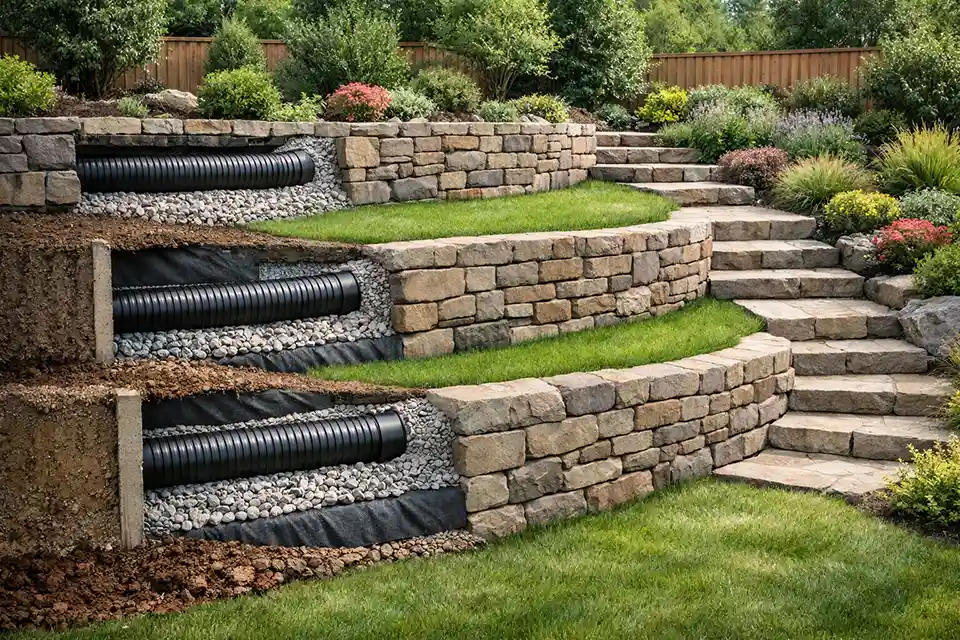
Retaining walls must withstand both soil pressure and water pressure. When these forces exceed the wall’s strength, structural failure becomes likely.
Three structural components are critical:
1. Proper Base Foundation
A stable retaining wall typically sits on a compacted gravel base about 6–12 inches thick. This base distributes the load evenly and prevents settling.
2. Drainage Layer Behind the Wall
A drainage layer made of crushed gravel allows water to escape rather than building pressure behind the structure.
Perforated pipes placed along the base of the wall often carry water away from the slope.
3. Geotextile Fabric
Geotextile fabric separates soil from drainage gravel and prevents fine particles from clogging drainage systems.
Without this barrier, sediment slowly blocks drainage pipes and hydrostatic pressure builds again.
These structural details are frequently overlooked during DIY landscaping projects, which is why improperly installed retaining walls often begin tilting within 2–5 years.
Best Plants for Stabilizing Sloped Soil
Vegetation is one of the most effective natural tools for preventing erosion.
Plant roots create a network within the soil that binds particles together and improves water absorption. On steep slopes, this root network may extend 12–36 inches below the surface, dramatically increasing soil stability.
Plants commonly used for slope stabilization include:
- creeping juniper
- switchgrass
- ornamental grasses
- native prairie plants
- groundcover sedums
For larger areas, the real goal is not ornamental variety first. It is broad root coverage that can hold soil more consistently across the slope. That is why erosion-control blankets can make more sense than treating the bank like a decorative planting bed from the start.
When the slope is patchy, newly seeded, or still too exposed to hold moisture and soil in place, this is usually the category worth checking first. In that situation, individual decorative plants do not solve the immediate problem because the surface still needs short-term protection while roots establish.
If the slope is washing out, losing seed, or staying too exposed between planting zones, this is the point where surface stabilization becomes the more practical buying decision.
| BEST STABILIZATION CATEGORY FOR THIS SLOPE |
|---|
| Erosion Control Blanket |
| Best for sloped areas that need short-term surface protection while seed or new planting gets established. |
| This category fits when erosion is active, bare soil keeps washing out, or newly seeded sections are not holding in place. |
| Look for blankets meant for slope use, with enough coverage, anchoring compatibility, and a material type that matches how temporary or durable the hold needs to be. |
| 🔴 SHOP erosion control blankets |
In dry climates like Arizona or New Mexico, drought-tolerant plants such as agave and desert grasses perform well because they stabilize soil while requiring minimal irrigation.
Meanwhile, in humid climates such as Florida, fast-growing groundcovers can reduce runoff by absorbing excess moisture during frequent rainstorms.
Advanced Drainage Systems for Sloped Yards
Drainage systems on slopes must move water efficiently without allowing soil to wash away.
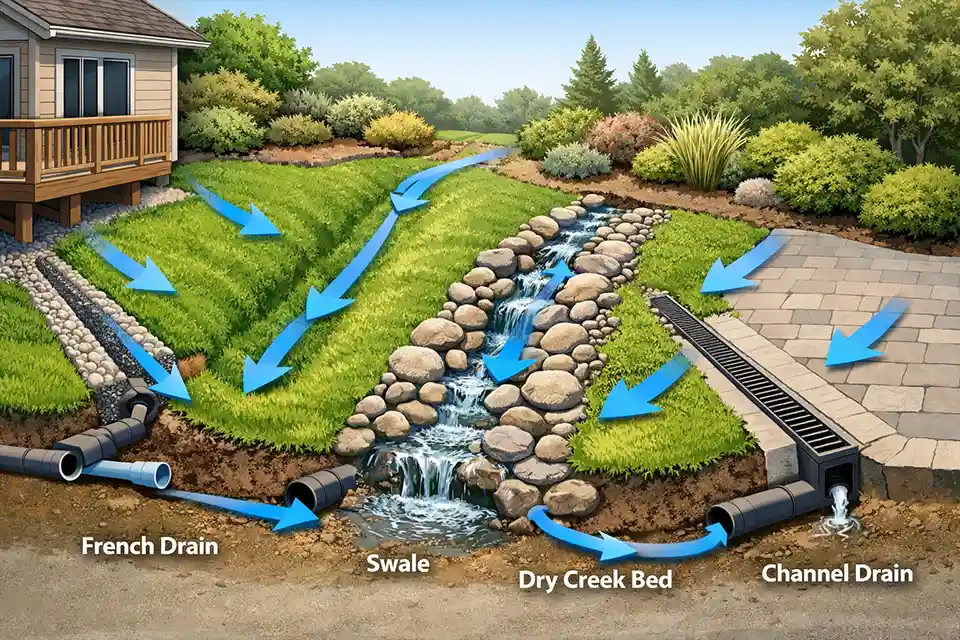
The most common drainage systems include:
| System | How It Works | Best Use Case |
|---|---|---|
| French drain | Underground perforated pipe collects water | Managing runoff on mid-slope areas |
| Dry creek bed | Rock channel slows surface runoff | Decorative erosion control |
| Channel drains | Surface grate drains capture water | Patios or walkways |
| Swales | Shallow grass channels redirect water | Large yards with gradual slopes |
| Catch basins | Collect heavy runoff and redirect water | Areas with stormwater concentration |
For hardscape edges and low spots where water collects quickly, a channel drain kit is often the most direct category-level solution. By contrast, swales usually depend more on grading and layout than on buying a single product.
That distinction matters because many homeowners try to solve concentrated patio runoff with broad drainage ideas when the real need is a surface collection point at the exact edge where water is building up.
If water is repeatedly crossing the same hardscape edge, spreading out across the patio, or collecting near a threshold, this is usually the point where a channel-based solution becomes the smarter category to shop first.
In regions with intense rainfall, drainage capacity must be designed carefully. A system handling 1–2 inches of rainfall per hour is often sufficient for many U.S. residential landscapes, but local climate conditions may require larger drainage capacity.
Environmental Factors That Affect Sloped Landscapes
Sloped yards behave differently depending on regional climate conditions.
| Environmental Factor | Impact on Sloped Yards | Common U.S. Regions | Typical Solution |
|---|---|---|---|
| Heavy rainfall | Rapid erosion and runoff | Midwest, Southeast | Drainage channels |
| Freeze–thaw cycles | Soil expansion and shifting | Northern states | Flexible retaining walls |
| Drought conditions | Soil shrinkage and cracking | Southwest | Mulch and drought plants |
| Coastal moisture | Persistent soil saturation | California coast | Subsurface drainage |
| Clay soil | Slow infiltration and pooling | Midwest | Soil amendment and grading |
Understanding these environmental conditions helps homeowners design landscapes that remain stable through seasonal changes.
The U.S. Department of Agriculture Natural Resources Conservation Service provides additional guidance on soil erosion control and slope stabilization strategies:
https://www.nrcs.usda.gov
Long-Term Maintenance for Sloped Backyards
Even well-designed landscapes require periodic inspection.
Homeowners should check sloped yards at least once or twice per year, especially after heavy storms or seasonal temperature changes.
Maintenance tasks often include:
- clearing debris from drainage channels
- inspecting retaining walls for cracks
- checking soil levels around terraces
- replanting areas where vegetation has thinned
- monitoring erosion after large storms
A simple soil moisture meter can be useful on sloped yards because it helps reveal wet zones that stay hidden below the surface long before those areas turn into visible drainage or stability problems.
That is especially helpful when the slope looks dry on top but keeps staying soft underneath, or when one section of the yard never seems to firm up after rain. If you cannot tell whether the problem is active moisture or just surface appearance, this is one of the easiest tools to buy before you waste time guessing.
When the same section keeps staying damp, drains slowly, or causes repeat plant failure, that is usually the point where a moisture check tool becomes worth buying instead of continuing to monitor by eye.
| BEST TOOL FOR EARLY TROUBLE SPOTS |
|---|
| Soil Moisture Meter |
| Best for homeowners trying to spot persistently wet slope sections before they turn into bigger runoff or stability issues. |
| This category fits when one part of the yard stays soft, drains slowly, or keeps causing repeat plant or soil problems. |
| Look for a simple outdoor-use meter that is easy to move between upper and lower sections of the slope for quick comparisons. |
| 🔴 SHOP soil moisture meters |
Early detection of small issues prevents larger structural problems later.
Frequently Asked Questions
Are sloped backyards harder to maintain?
Yes. Sloped landscapes often require additional drainage systems, erosion control measures, and structural reinforcement. Maintenance tasks such as mowing or planting may also be more challenging.
Can a steep backyard cause foundation problems?
It can if runoff is directed toward the house. Water accumulating near the foundation increases hydrostatic pressure against basement walls, which may eventually lead to moisture intrusion.
What slope is considered unsafe for landscaping?
Slopes above 25–30 degrees typically require engineered solutions such as retaining walls or terracing to remain stable and safe.
Is grass suitable for steep slopes?
Grass works well on gentle slopes but struggles on steep grades where runoff removes nutrients. Deep-rooted plants and groundcovers usually provide better long-term stability.
Key Takeaways
Sloped backyards present unique landscaping challenges because gravity constantly moves water and soil downhill. Without careful planning, this natural process leads to erosion, unstable hardscape structures, and drainage problems that affect both safety and property value.
The most successful slope landscapes combine structural support, vegetation, and effective drainage systems. Terracing slows runoff, retaining walls stabilize soil, and deep-root plants reinforce the ground naturally.
With thoughtful design and regular maintenance, even steep yards can become safe, attractive outdoor spaces that function well throughout changing seasons.