
Last updated: July 5, 2026
The wettest part of a front yard is often the last place water arrived, not the place the drainage problem began. That matters with driveway runoff, because a driveway can collect rain, speed it up, and release it into one narrow lawn edge or planting bed before the homeowner ever notices a puddle.
The useful diagnosis is not “Why is this spot wet?” It is “Where did water first leave the driveway?”
Driveway runoff changes front yard drainage because pavement does not slow water the way turf, mulch, or soil does. Once runoff reaches a low driveway edge, apron, seam, or walkway connection, it can enter the yard as a concentrated flow instead of scattered rainfall.
This article stays on that drainage question. It is not about driveway design, privacy, parking, access, or curb appeal. The goal is to trace how driveway water affects the front yard so you can tell whether the driveway is the source, the amplifier, or only one contributor.
Why Driveway Runoff Changes Front Yard Drainage
The driveway matters because it changes both the speed and the delivery point of rainwater. A lawn may absorb rain unevenly, but it still slows water down. A concrete or asphalt driveway sheds water across the surface and sends it toward the lowest available edge.
That edge is where many front yard drainage problems begin.
A slight driveway pitch, a settled slab corner, a low apron, or a raised border can send water toward the same lawn strip every time it rains. The slope does not have to look dramatic. A small grade difference can decide whether runoff moves toward the street, spills into a planting bed, follows a walkway, or drifts toward the house side of the yard.
The main distinction is simple: water may appear in one place while starting somewhere else.
When driveway water crosses into turf or mulch, it often arrives with more speed and volume than normal rainfall. Instead of soaking in where it lands, it may cut a shallow line, push mulch aside, seal the soil surface, or keep feeding a low spot until that area stays wet after the rest of the yard dries.
That is why driveway runoff problems can disguise themselves as lawn failure, mulch failure, or poor soil. The yard shows the damage, but the driveway may be delivering the water.
Signs the Driveway Is Feeding the Wet Area
A driveway runoff pattern usually leaves a trail. Look for an edge, line, or first-impact area rather than judging only by the deepest puddle.
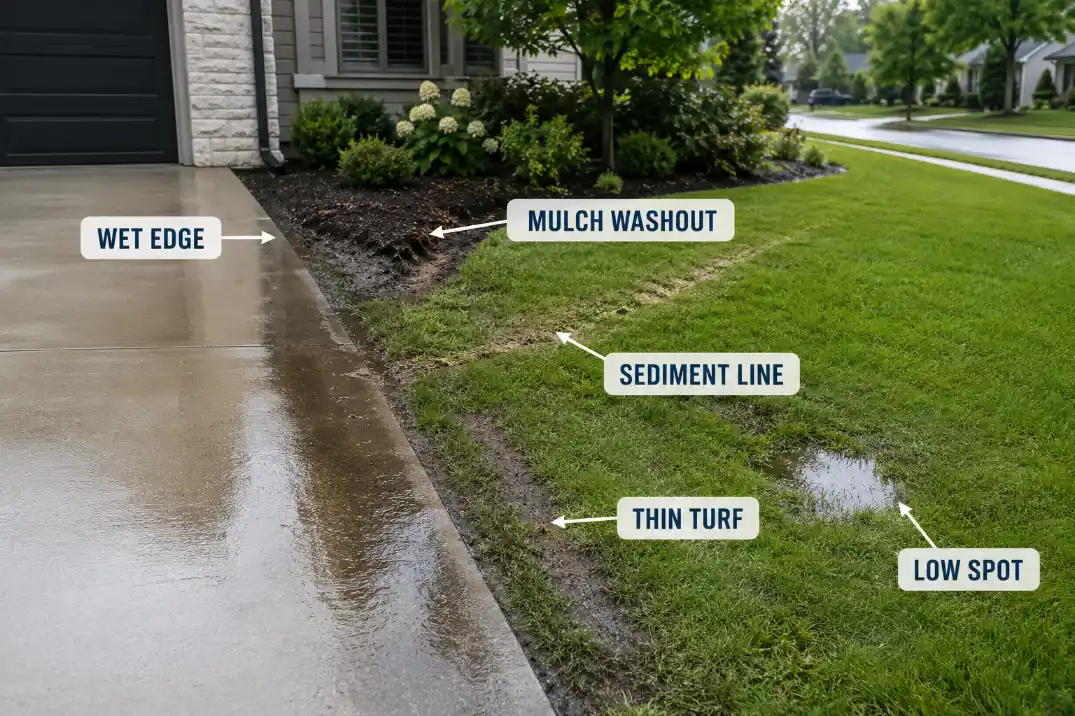
A wet strip beside the driveway is one of the clearest clues. If the lawn edge or planting bed next to the driveway is wetter than similar areas farther away, water may be crossing from pavement into soil. This is especially likely when the wet strip starts at a low driveway corner or continues toward a low lawn pocket.
Mulch movement is another strong signal. Mulch rarely washes away evenly across a bed. It shifts where water enters with force. If the thinnest mulch is beside the driveway edge, especially with exposed soil underneath, the driveway deserves attention before the planting bed does.
A sediment line matters too. Grit, leaves, fine soil, or dark residue can mark the path water took from pavement into the yard. These marks are often easier to see shortly after a storm than the next day.
| Driveway-side symptom | What it suggests | What to check next |
|---|---|---|
| Wet strip along the driveway edge | Water is crossing from pavement into the yard | Find the first low point where pavement drains sideways |
| Mulch washed away beside the drive | Runoff is entering the bed with force | Look for a narrow flow line through the mulch |
| Grit, leaves, or sediment in a line | Water carried debris from hard surface | Trace the line back toward the driveway edge |
| Thin grass or muddy turf near pavement | Repeated flow is weakening the lawn edge | Compare that strip with grass farther from the driveway |
| Pooling near a walkway or bed after rain | Driveway water may be slowing in a low area | Check whether the pool fills from the driveway side first |
These signs do not prove the driveway is the only cause. They tell you where to begin. If the same edge is wet after every storm and the damage follows the same path, the driveway is probably affecting the drainage pattern.
Where Driveway Water Usually Enters the Front Yard
The fix point is usually closer to the driveway edge than to the final puddle. That is why the first entry point matters more than the largest wet area.
The most common entry point is the lower side edge of the driveway, where pavement meets lawn or a planting bed. If that edge sits even slightly lower than the opposite side, water can sheet across the drive and spill into the yard.
The driveway apron can also mislead you. Water may move toward the street, curl along the apron or curb, and re-enter the front yard where the grade dips. That can make the problem look like street runoff when the driveway is actually part of the path.
Seams and cracks can guide water in a narrower line. A control joint, settled slab edge, asphalt depression, or gap between driveway and walkway can behave like a small channel. Instead of spreading evenly, the water follows the line and enters the lawn at one concentrated point.
Walkway intersections are easy to misread. When a front walk meets the driveway, runoff can jump from driveway to walkway, then use the walkway edge as a channel into the planting bed or lawn. In that case, the wet spot may appear beside the walk even though the water started on the driveway.
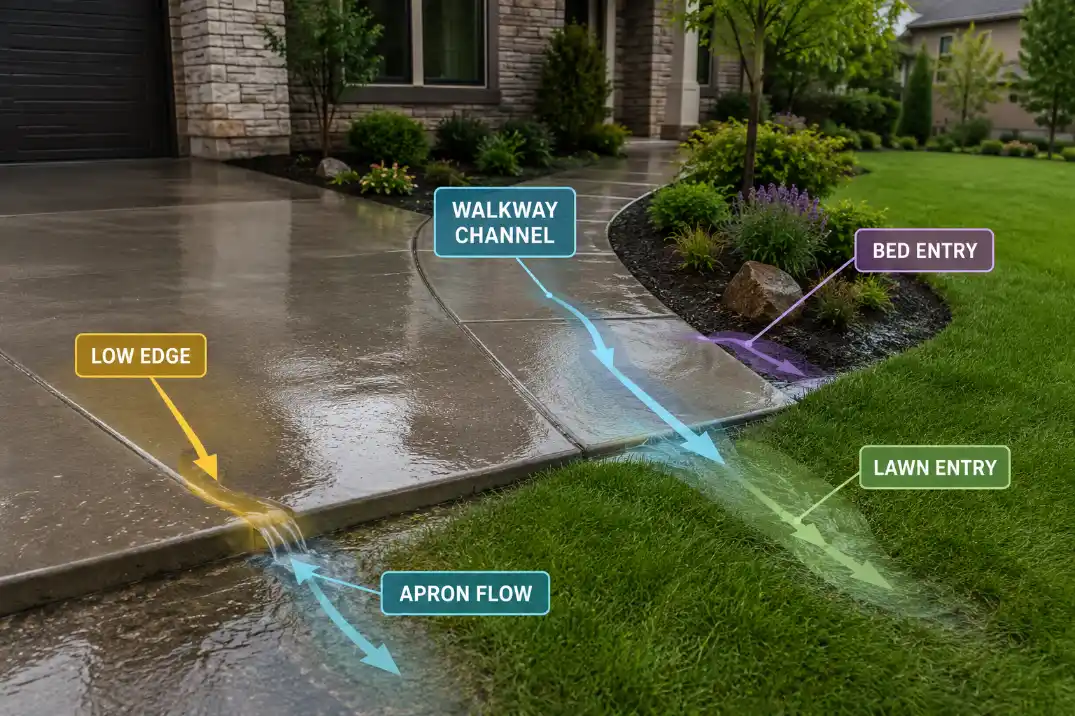
Planting bed edges are another first landing zone. Mulch, loose soil, and edging can slow water briefly, but they can also hide the exact point where runoff enters. If the bed looks disturbed near the driveway and cleaner farther away, diagnose the driveway edge before changing the planting.
The wrong move is to start with the deepest puddle. Start where water leaves pavement. The entry point tells you more about the repair direction than the final wet area does.
What Runoff Does After It Leaves the Driveway Edge
The damage pattern tells you whether the problem is force, saturation, or both. Fast driveway runoff moves material first; slow drainage holds water afterward.
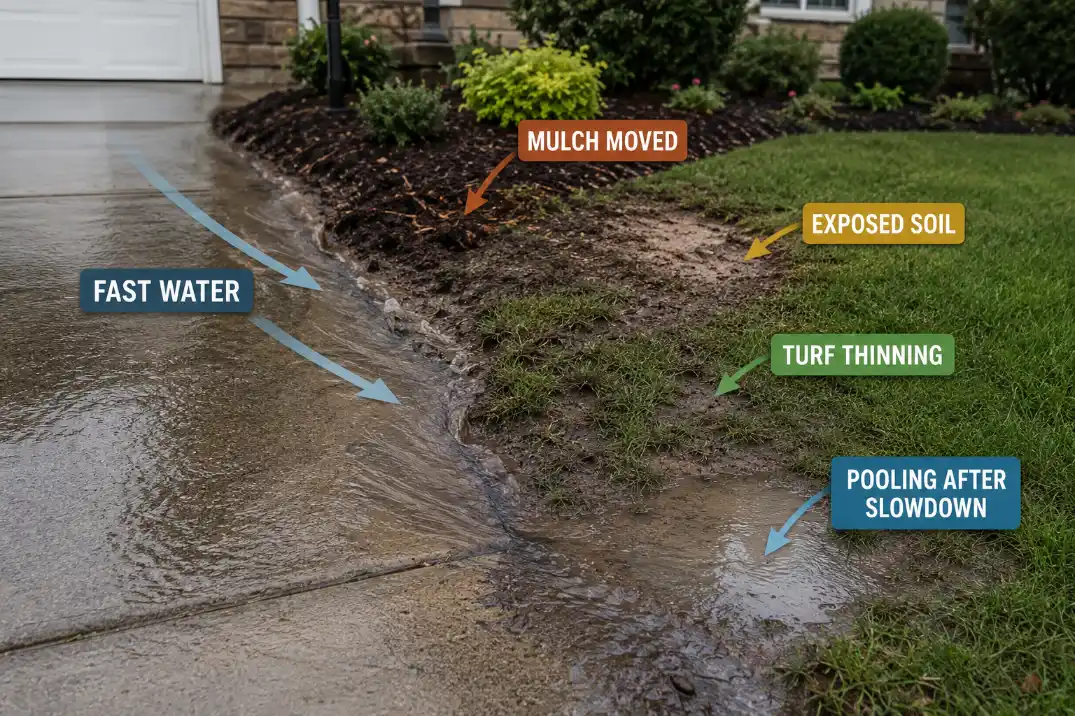
Fast water usually shows up as displacement. Mulch moves, fine soil disappears, exposed soil appears, and a shallow groove may form through turf or a planting bed. This is not just messy mulch. It is a sign that water is entering with enough force to move the surface.
Slower water shows up as saturation. The lawn may stay soft, muddy, or thin where runoff spreads and stalls. If the soil is compacted, the water may sit near the surface instead of soaking in. Over time, the grass weakens because the area alternates between wet, sealed, and worn.
A common pattern is fast water at the driveway edge and pooling farther inside the yard. The driveway delivers the water quickly. The lawn or bed slows it down. Then the low spot holds it.
That pattern matters because fixing only the pool may not stop the damage. If water keeps crossing the driveway edge in the same place, the puddle can return even after soil is amended or mulch is replaced.
In beds, repeated runoff often creates a first-impact zone. That is the spot where mulch is thinnest, soil looks polished or compacted, and small channels start to form. If this keeps happening every season, the issue may be mulch washout near the driveway edge, not simple bed maintenance.
Water moving toward the house edge is a repair boundary, not a cosmetic nuisance. This article is not a foundation drainage guide, but repeated runoff toward the house side of the front yard deserves more caution than a washed mulch strip.
How to Trace the Runoff Path After Rain
The best test is a short walk after rain, not a dry-yard guess. Check shortly after rain stops, when the path is still visible and the yard is safe to walk.
Do not begin at the deepest lawn puddle. Begin at the highest wet pavement point that appears to feed it. Then follow the water downhill or sideways until it leaves the driveway.
Use this sequence:
- Find the first wet driveway area that drains toward the yard.
- Follow the flow line to the driveway edge, apron, seam, or walkway joint.
- Look for the first soft landing point in lawn, mulch, or soil.
- Trace any sediment line, leaf line, grit trail, or shallow channel.
- Compare the final pool with the longest-wet area the next morning.
Then use a compact field check before deciding what to fix:
- Check whether the driveway edge is wetter than nearby lawn edges.
- Look for mulch pushed away from the pavement side of the bed.
- Look for a narrow muddy strip where water repeatedly crosses turf.
- Compare the first wet spot after rain with the area that stays wet longest.
- Note whether downspout water or walkway runoff joins the same path.
- Avoid testing during active storms, standing floodwater, or unsafe conditions.
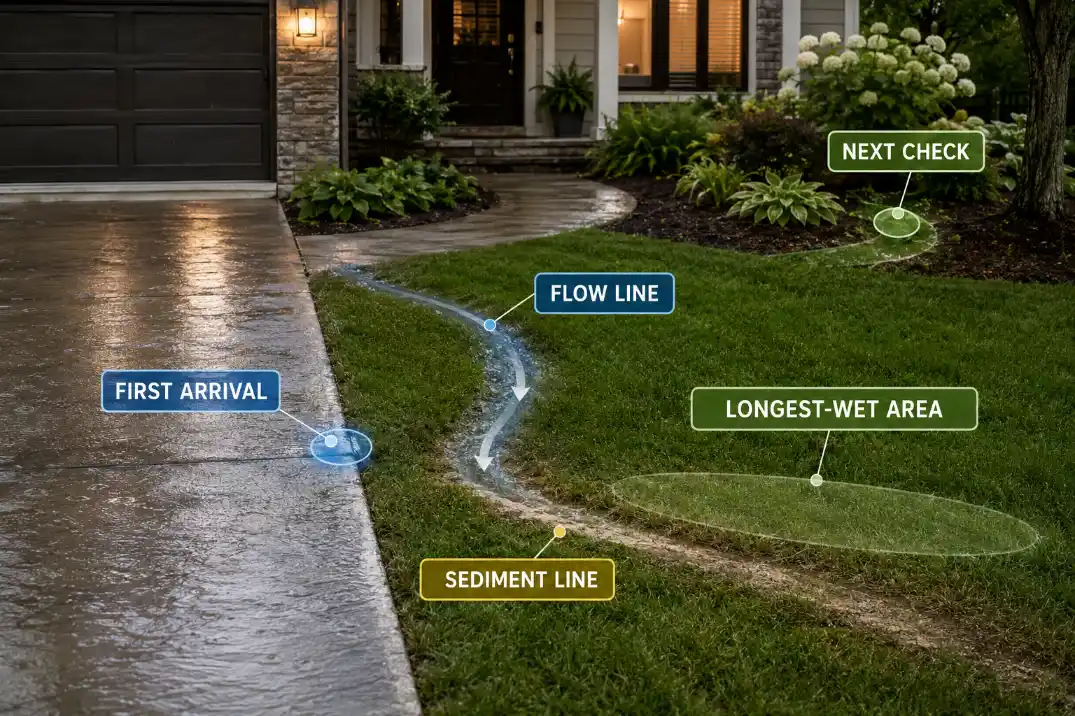
This test separates delivery from storage. The driveway may deliver the water, while the lawn, soil, or bed simply holds it. If the runoff path is unclear after one rain, repeat the check after the next heavier storm instead of guessing from a dry yard.
When the same driveway edge feeds the same wet area more than once, broaden the diagnosis to include soil, slope, and runoff patterns before choosing a fix. The driveway may explain the path, but the soil and grade decide how long the water stays.
When the Driveway Is Not the Only Cause
The driveway is not always the whole problem. It may be the surface that collects water, the path that moves it, or the place where another source joins the front yard drainage pattern.
A downspout may discharge near the driveway, cross the pavement, and join the same low lawn area. In that case, the driveway is not creating all the water. It is acting as a transfer surface that carries roof water into the yard.
A walkway can do something similar. If the walkway edge is slightly lower than the lawn or planting bed beside it, water from the driveway may move along the walk before spilling into the yard. That makes downspout and walkway drainage problems worth separating from the driveway runoff itself.
Clay or compacted soil can make the driveway look guiltier than it is. If water leaves the driveway in a mild sheet but then sits for a long time, the runoff path is only half the diagnosis. The receiving soil may be too slow to absorb water, especially where foot traffic, mowing, or repeated wetness has sealed the surface.
A low front yard can collect water from more than one direction. Driveway runoff may enter from one side while street grade, neighboring grade, or uphill lawn flow adds pressure from another. If your house sits below the surrounding grade, the driveway may be only one feeder in a larger pattern affecting homes at the bottom of a hill with front yard drainage problems.
The practical question is not “Is the driveway involved?” It is “Is the driveway the main source, a delivery path, or one contributor?” That answer changes what kind of fix makes sense.
What Fix Path Makes Sense After You Confirm the Source
Once you know where driveway runoff leaves pavement, the fix direction becomes narrower. The first move is not automatically a drain; it is matching the fix to the way water enters the yard.
If runoff is mild and spread out, the first fix path is usually to slow and spread it before it cuts a channel. A stronger receiving edge, healthier turf strip, or better landing area may be enough when the water is shallow sheet flow and not moving toward the house.
If runoff hits one small bed or lawn strip with force, protect the first soft landing point. That is where repeated damage starts. A fix placed only at the final puddle can leave the impact zone exposed.
If runoff is concentrated, interception becomes more important. A narrow stream crossing the same driveway edge after every storm behaves differently from a damp edge. Concentrated flow may need to be caught before it reaches the lawn or bed, especially if it is cutting a visible path.
For that kind of pattern, the next decision may involve catch basin vs. channel drain runoff decisions, but only after the source path is confirmed. A drain placed at the wrong point can miss the first-arrival line and leave the yard problem mostly unchanged.
Redirecting water only makes sense when there is a safe discharge path. Moving water away from one soggy bed and into another low area is not a fix. It is just relocating the symptom. The same caution applies to sending water toward a sidewalk, neighbor, foundation side, or area that already drains poorly.
Improving soil absorption can help when water arrives gently and stalls because the soil is compacted or slow. It is less useful when the driveway is sending a narrow, fast stream into one spot. In that case, the receiving area may fail again unless the flow is slowed or intercepted first.
Keep Driveway Runoff From Recreating the Same Front Yard Problem
After any adjustment, recheck the yard after the next heavy rain. Do not only look at the old puddle. Watch the first arrival point, the driveway edge, the flow line, and the area that stays wet longest the next morning.
Keep mulch, soil, and edging from forming new channels. A raised edge can block water in one storm and redirect it badly in the next. A low mulch pocket can become the new entry point. A repaired lawn strip can thin again if concentrated runoff still crosses it every time it rains.
Also keep nearby downspouts from joining the driveway path. If roof water, walkway flow, and driveway runoff all meet in the same low front yard area, fixing only one source may reduce the problem without ending it.
The strongest takeaway is simple: treat the puddle as evidence, not the diagnosis. Driveway runoff affects front yard drainage by moving water faster, concentrating it at weak edges, and sending it into places that were not meant to receive that much flow. Trace the first-arrival line before choosing the fix, and the next step becomes much easier to judge.
For a neutral stormwater reference, the U.S. EPA explains how runoff moves over impervious surfaces instead of soaking into the ground: Urbanization and Stormwater Runoff.