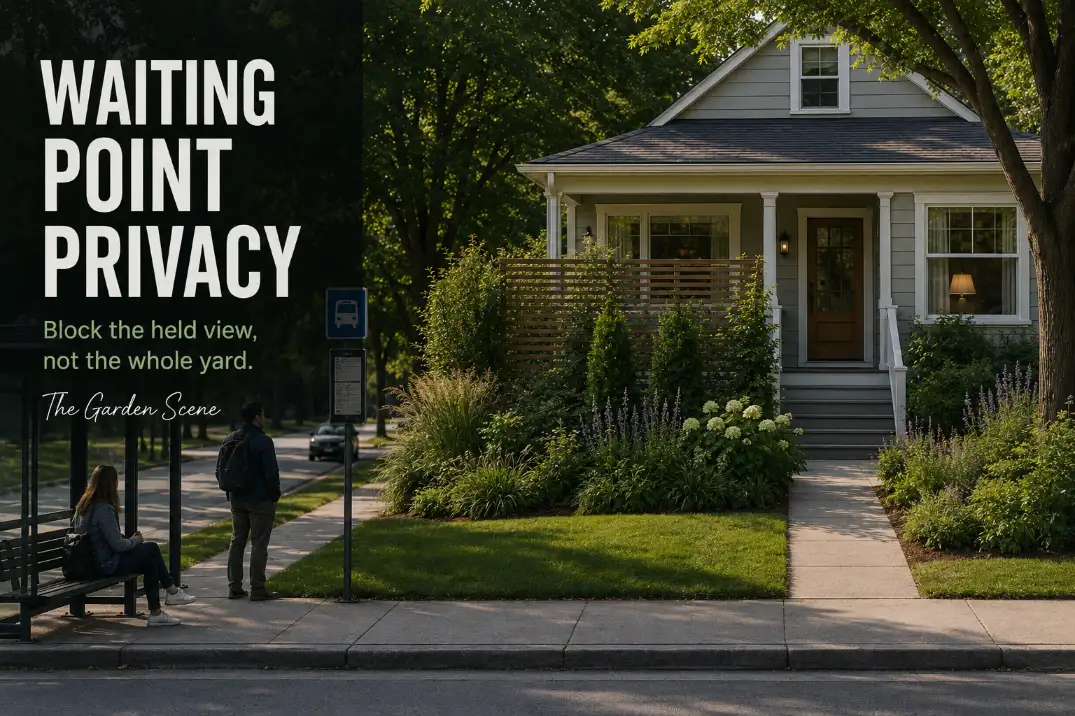
Last updated: June 29, 2026
The mistake is treating a school route, park edge, or bus stop like ordinary sidewalk traffic.
A person walking past your house may glance toward a window for a second. A person waiting near the curb, sitting on a park bench, standing at a bus stop, or lingering during school pickup has a different kind of exposure.
They have time to face the house, look around, notice movement, and return to the same visual position day after day.
That changes the privacy fix.
The real decision is not “How do I block everyone from seeing my front yard?” It is “Where does the repeated waiting view come from, and what exact part of the house does it reach?” Once you answer that, the best privacy move is usually smaller, more targeted, and less defensive than a full hedge or solid barrier across the front.
Why Waiting Exposure Is Different From Passing Traffic
Passing traffic creates a moving view. The angle changes quickly. The person is gone before they can study the porch, front window, side entry, or daily routine. That does not mean it feels pleasant, but it usually calls for lighter privacy: layered planting, a partial view break, or a softened edge.
Waiting exposure is slower. Someone may be standing in the same spot for several minutes, facing the same general direction, with nothing urgent to do. That makes the front yard feel more exposed even if the number of people is not huge.
This is why a yard near a bus stop can feel less private than a yard on a busier street. The street may have more people. The stop has more attention.
The same thing happens near school pickup zones, crosswalk corners, park benches, playground edges, trail entrances, and curbside waiting areas. The issue is not that the public space exists. The issue is that the public space creates a repeated viewing position aimed toward your home.
What most guides miss:
A front yard privacy problem is not always measured by traffic volume. Duration matters. If people pause long enough to scan the house, notice lights turning on, or register porch movement from the same spot, you are solving a held-view problem, not a pass-by problem.
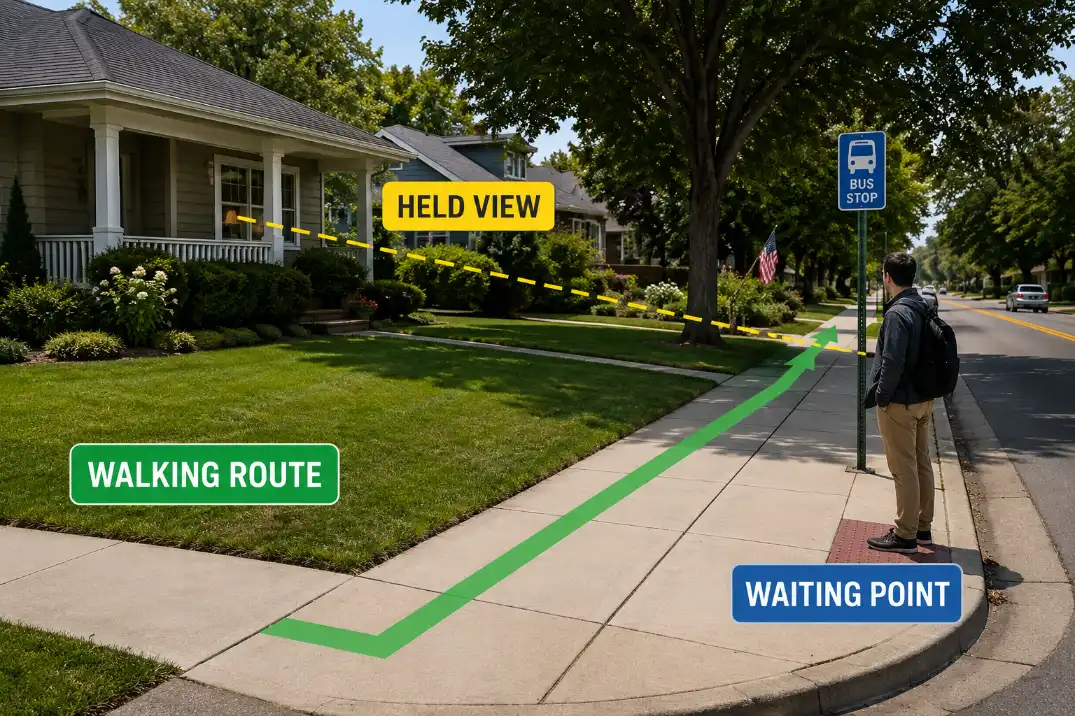
Find the Waiting Point Before You Choose the Privacy Fix
Do not start by shopping for shrubs or deciding where a fence could go. Start by finding the public point that creates the exposure.
Stand inside the room, porch, or entry area that feels most exposed. Look outward toward the school route, park edge, bus stop, curb, crosswalk, bench, or pickup area. The useful question is simple: from where can someone pause and keep seeing this exact spot?
Use the inside-out test
The inside-out test works because privacy is felt from the place being watched, not from the property line.
From the exposed window or porch seat, look toward the public area at eye level. Mark the point where the view seems to originate. That may be the bus sign, the curb by a stop, the shaded spot where people wait, a park bench, a trail opening, or the corner where parents gather before school lets out.
Then step outside and stand near that public-facing line from your side of the property. You are not trying to control the public space. You are checking which part of your yard could interrupt that line before it reaches the window or porch.
For homes where the sidewalk sits close to the house, the same inside-out logic also applies to front yard privacy when the sidewalk runs only a few feet from your windows. The difference here is that the viewer may be waiting, not just passing.
Check timing, not just location
A school route may be quiet most of the day and intense twice a day. A park edge may matter most on weekends, after dinner, or during warm evenings. A bus stop may create short but repeated waiting windows every weekday.
That timing changes the fix. A front room that feels fine at noon may feel exposed at 7 a.m. when interior lights are on and people are waiting at the curb. An evening test from inside the house can reveal more than a daytime walk around the lawn.
Block the Held View, Not the Whole Front Yard
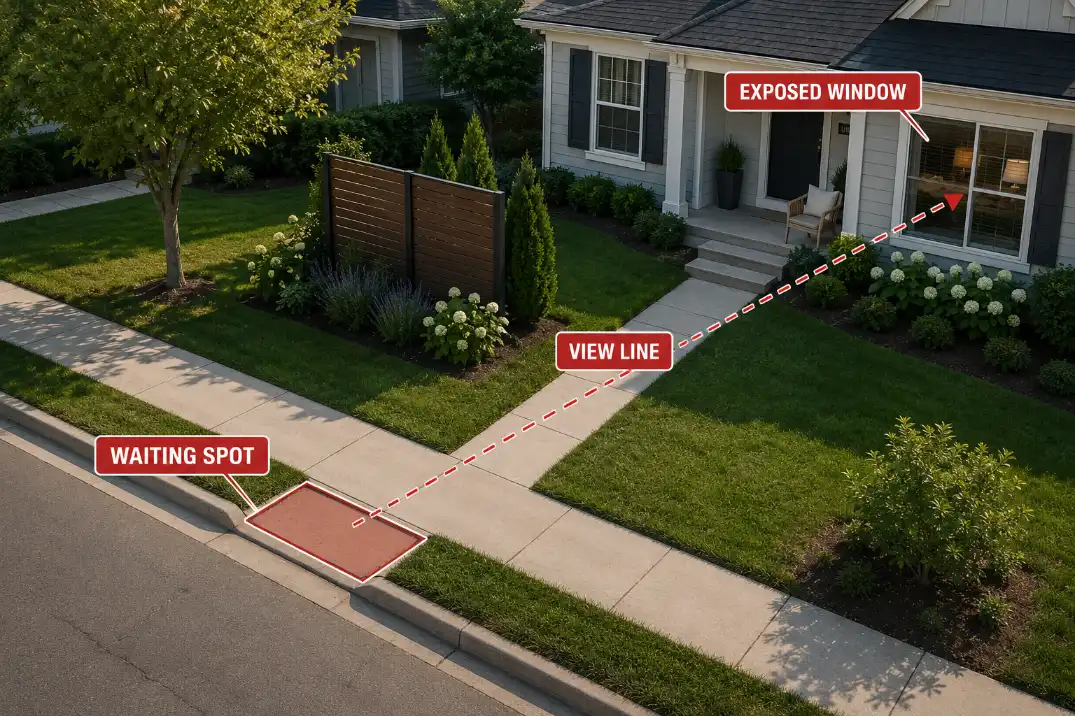
Once you know the waiting point, the fix becomes more precise. You are not trying to erase the public view of your entire front yard. You are interrupting one repeated line of sight before it lands on the exposed target.
That target might be a low front window, a porch chair, a glass front door, a side entry, a package area, or the part of the front room where family movement is visible. Each target asks for a different interruption.
A partial screen near the porch may work better than a tall hedge at the sidewalk. A mid-height planting offset from the property line may break the eye-level view without making the house look closed. A layered bed may soften the lower view while a narrow vertical element interrupts the direct line toward a window.
The weak version of front yard privacy advice says, “Put screening along the front.” The better filter is, “Place the interruption where the viewer’s eye travels.”
That is also why full-width hedges often disappoint in this situation. They may look private from the street, but if they sit too low, too far forward, or too evenly across the frontage, they can leave the porch or window exposed.
For broader route-based exposure, use a separate framework for front yard privacy on a busy walking route, because moving pedestrians behave differently than people who stop.
Passing Traffic vs. Waiting Exposure
This comparison matters because the same privacy feature can be enough for one condition and too weak for the other.
PASSING TRAFFIC
Brief glance. Moving angle. Broad but shallow exposure. A lighter interruption often works because the viewer is already leaving.
WAITING EXPOSURE
Fixed position. Longer attention. Repeated view toward the same window, porch, or entry. A targeted interruption matters more because the viewer is not moving away.
A passing view often needs a buffer. A waiting view needs a target.
That is the main reason this article should not turn into a list of plants, panels, fences, and screens. Those options only make sense after the exposure type is clear.
Keep the Entry Open While You Interrupt the Sightline
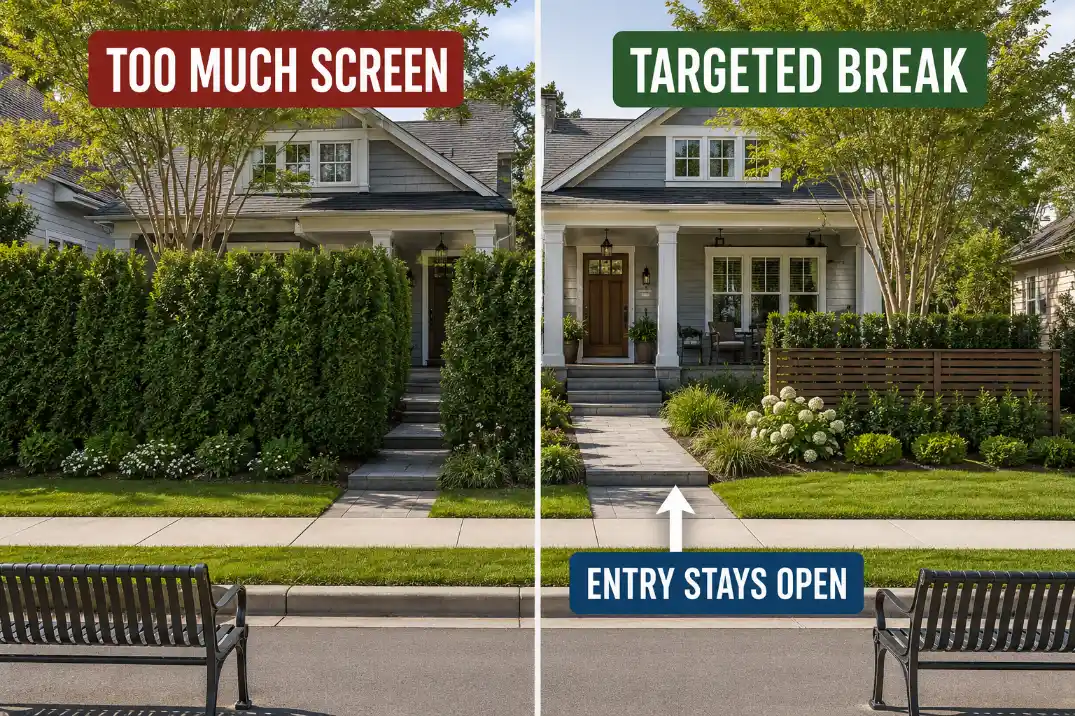
The most common overcorrection is making the whole front yard look closed because one window or porch seat feels exposed.
That can create a different problem. If the front door disappears behind dense screening, the house may feel less welcoming. If the walkway feels squeezed, visitors may hesitate. If the screen sits too close to the sidewalk, it can look like a wall against the street instead of part of the yard.
A better fix usually preserves three things: a readable front walk, a visible entry sequence, and a normal street-facing appearance. The screen can sit off the boundary. The planting can be layered instead of solid. The view break can protect the porch corner without hiding the entire home.
Entry clarity matters
A front yard can be private and still easy to understand. Delivery drivers, guests, and neighbors should still see where to walk. The front door does not need to be fully exposed, but it should not feel hidden behind a defensive barrier.
If your privacy plan starts to make the entry feel confusing, look for a narrower interruption. Move the screen closer to the exposed window, angle the planting bed, or use a mid-height element that blocks the waiting view while keeping the route to the door obvious.
This is especially important if you are trying to keep front yard privacy looking welcoming rather than sealed off.
Avoid the full-frontage reflex
A full-width screen across the front looks decisive, but it often solves the wrong problem. Waiting exposure usually comes from one or two public positions, not every inch of the street.
A more selective design can feel calmer: one offset screen, one layered planting pocket, one porch-side view break, or one narrow vertical interruption aligned with the actual line of sight.
Match the Fix to the Kind of Waiting
A school route, park edge, and bus stop can all create waiting exposure, but they do not behave the same way. The pattern of waiting should guide the privacy move.
School route or pickup edge
School-related exposure is often predictable. It may happen before and after school, with small clusters of people moving, stopping, turning, and waiting near corners or pickup areas.
The privacy issue is usually repetition. The same window, porch, or front door is exposed at the same time of day, several days a week. A fix here should focus on the repeated angle, not the whole street. A partial view break that protects the exposed room during pickup windows may matter more than a broad decorative hedge.
Do not frame the people as the problem. The design issue is that your home and a public waiting rhythm overlap.
Park edge or bench area
A park edge creates a wider kind of attention. People may sit longer, turn in different directions, pause after walking a dog, or gather near a path entrance. The view is less scheduled than a school route, but it can last longer.
Here, a single narrow screen may not be enough if the viewing angle is wide. Layering becomes more useful: a low foreground edge, a mid-height interruption, and a protected porch or window zone. The goal is not to block the park. It is to reduce the direct view into the part of the home that feels watched.
Bus stop or curb wait
A bus stop is often the clearest waiting-point problem. People stand in a fairly fixed area, face the street or approach direction, and wait long enough for the surrounding houses to become part of the view.
A bus stop fix usually benefits from precision. Identify the standing position, the likely facing direction, and the exposed target. Then interrupt that line with a mid-height screen, offset planting, porch-side panel, or window-focused layer. If there is a shelter, bench, or sign, the waiting position may be even more predictable.
Use a Small Decision Matrix Before Choosing Plants, Screens, or Fencing
Use the waiting source to choose the privacy move before choosing a material.
| Waiting source | What makes it different | Best privacy move | What to avoid |
|---|---|---|---|
| School route or pickup edge | Predictable timing, clusters, repeated daily view | Target the window, porch, or entry angle active during pickup times | Screening the whole frontage because the yard feels busy briefly |
| Park bench or path edge | Longer lingering, wider viewing angles, weekend or evening use | Layer the view with a low edge plus mid-height interruption | One narrow screen that leaves side angles open |
| Bus stop or curb wait | Fixed standing point, repeated forward-facing sightline | Place a precise view break between the stop and exposed target | A soft planting bed that looks nice but never interrupts eye-level view |
This matrix is not a buying guide. It is a way to avoid buying before diagnosing.
Once the source is clear, the solution family becomes easier to judge. If the issue is a single fixed view, a narrow targeted screen may beat a large planting plan.
If the issue is a park edge with multiple angles, layering usually matters more. If the issue is first-season exposure, a living-only fix may need support while plants fill in.
When Planting Alone Is Too Slow or Too Soft
Plants are often the best long-term privacy tool in a front yard because they can look natural from the street. The problem is timing.
A young shrub does not protect a low window just because it will eventually mature. A new planting bed may soften the yard in the first season while still leaving the held view open. Deciduous plants may help in summer and disappear visually in winter. Ornamental grasses may create movement and softness but fail to interrupt a direct eye-level view when they are cut back or dormant.
Decide whether you need immediate interruption
If the waiting view reaches a porch chair, a front room, or a glass entry every morning, “wait two or three years” may not be a realistic privacy plan. In that case, use planting as the long-term layer and add a faster view break where it is genuinely needed.
That does not mean a big fence. It may mean a small porch-side screen, a narrow trellis, a planter-based vertical element, or a mid-height structure set inside the yard. The key is to solve the held view now while letting the planting mature around it.
For plant-heavy approaches, keep the deeper plant-selection work separate from this article. A page on privacy plants and planters for front yard privacy can help with that next layer after the sightline decision is already made.
Plan for winter and interior light
Waiting exposure often feels worse when the house is brighter than the yard. Early mornings, winter afternoons, and evenings can reveal movement inside a front room that felt private during the day.
Before relying on planting alone, test the view when interior lights are on. If the same bus stop, bench, or pickup point can still see the room clearly, the fix needs more than seasonal softness.
How This Fits Into a Larger Front Yard Privacy Plan
This page owns one specific problem: privacy failure caused by waiting, pausing, and repeated stationary views near schools, parks, and bus stops.
It does not replace every other front yard privacy decision. If the house sits very close to the public edge, the bigger issue may be front yard privacy with no setback.
If the problem is mostly steady vehicle and pedestrian activity rather than waiting, a busy-street or walking-route framework may be a better match. If the front yard already feels closed and unwelcoming, the next decision may be how to keep privacy without losing entry clarity.
The order matters. Diagnose the exposure type first. Then use the more specific page for the condition that controls your yard.
That keeps the plan from becoming too broad. You do not need every privacy idea. You need the right privacy logic for the public view that actually reaches your home.
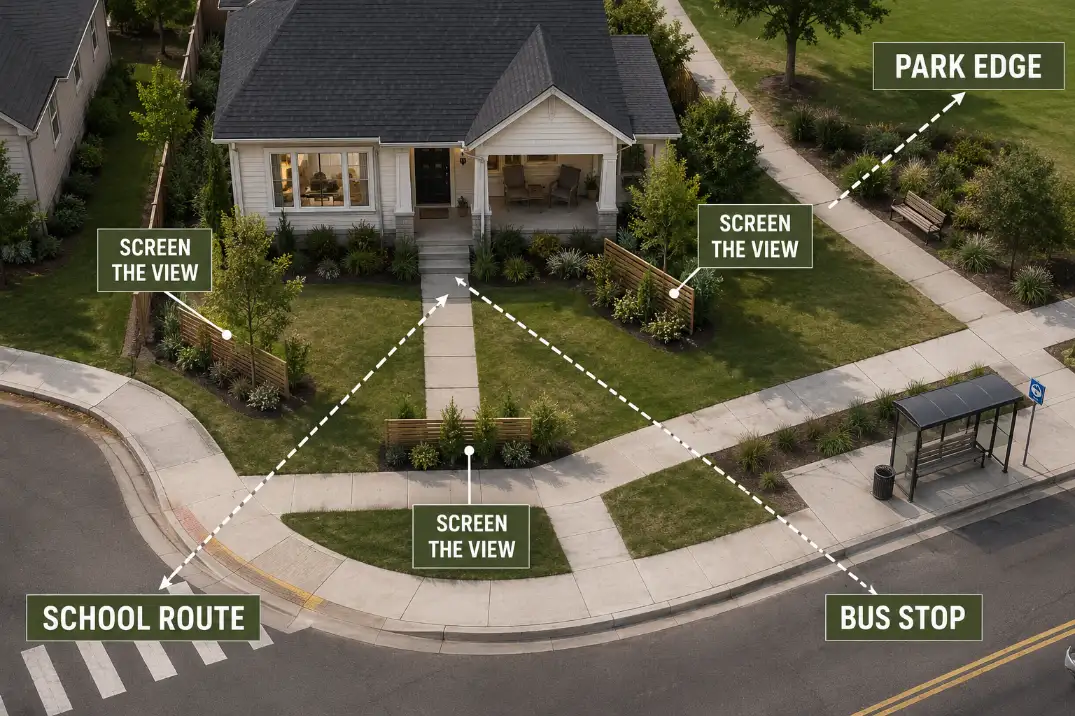
A Good Fix Should Feel Normal From the Street
The best front yard privacy fix near a school, park, or bus stop should not announce itself as a barrier. It should look like a normal part of the yard that happens to interrupt the one view that kept making the house feel exposed.
That is the standard to use before building, planting, or buying anything: does this reduce the repeated view into the exposed zone, keep the front entry understandable, avoid blocking the sidewalk, and still let the house feel like part of the street?
If the answer is yes, the solution is probably close. If the answer is no, the plan may be treating a waiting-point problem like a whole-yard problem.
For any screen, planting, or fence near the sidewalk or curb, check local rules first and keep public pedestrian access in mind; the U.S. Access Board’s Public Right-of-Way Accessibility Guidelines explain why clear pedestrian routes matter.