Last updated: June 28, 2026
When a house sits close to the sidewalk or street, front yard privacy has to work differently. The usual advice — plant layers, build depth, stagger shrubs, soften the whole frontage — assumes there is enough yard to work with.
In a no-setback front yard, there may only be a short walk, a narrow planting strip, a porch edge, and one exposed window before public space begins.
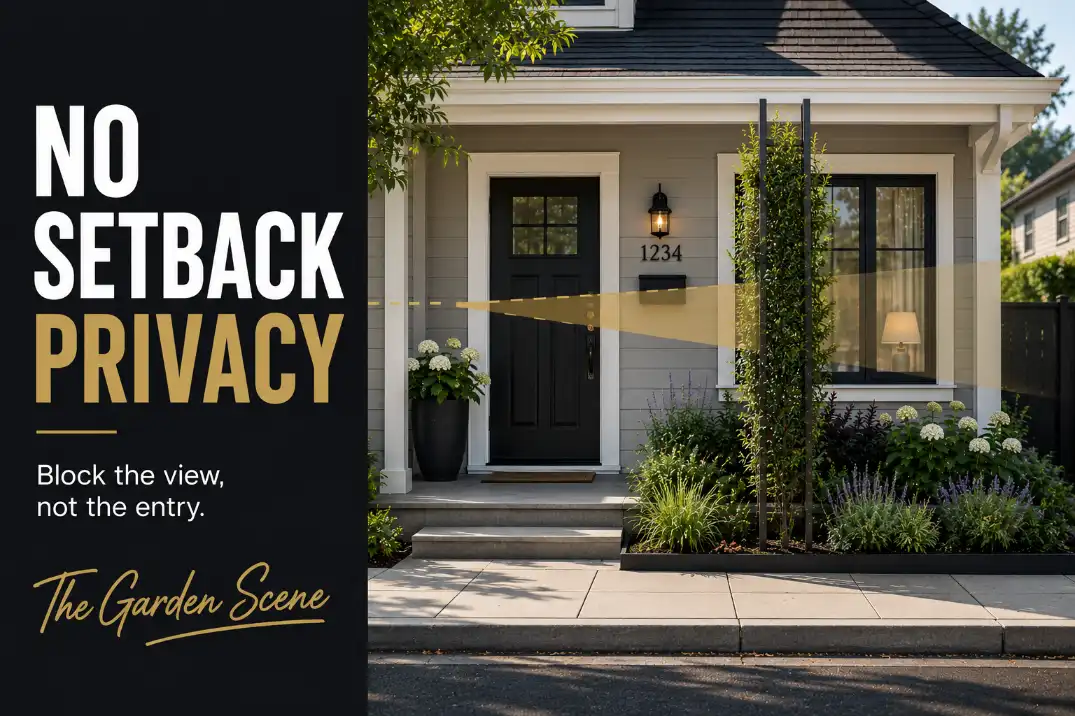
That changes the decision. You are not trying to screen the entire front yard. You are trying to interrupt the one view that makes the house feel exposed while keeping the front door, walkway, house number, and delivery route easy to read.
The best no-setback privacy plan is usually narrow, vertical, and specific. It blocks the view path, not the whole yard.
Why No Setback Changes the Privacy Problem
A no-setback front yard has little working distance between the house and the public edge. That edge might be a sidewalk, curb, busy street, shared driveway, or neighborhood walking route. Because the public view starts so close to the house, privacy problems show up faster: a front window feels exposed, a porch chair feels too visible, or the front door feels like it opens directly into the street.
This is not the same problem as a small front yard with some lawn depth. In a small yard, you may still have room to layer low plants, mid-height shrubs, and taller background pieces. In a no-setback condition, those layers often collapse into one crowded strip. The result can look heavy without actually blocking the view that matters.
That is why the first decision is not “what can I plant across the front?” It is “where does the public view enter the house or porch?” If the answer is one window, one porch corner, or one sidewalk angle, a narrow privacy break may do more than a wide planting bed.
This is also where no-setback privacy overlaps with broader front yard design for minimal setback space, but the privacy version has a sharper goal: reduce exposure without making the front entry feel blocked.
Find the View Line Before You Add Anything
Before adding a screen, planter, trellis, or planting strip, stand where the viewer actually stands. In no-setback yards, the problem is often not straight-on exposure from the curb. It may be a diagonal view from the sidewalk into a chair, a direct line from the street to a front window, or a side angle from the driveway.
A simple sightline test works better than guessing from the porch.
- Stand on the sidewalk and look toward the front window, porch chair, and door area.
- Move to the curb or street edge and check whether the exposure changes.
- Walk the normal front path and notice where privacy would block movement instead of helping.
The target is usually one or two view paths, not the entire frontage. If the sidewalk view catches the lower half of a living room window, the privacy break belongs near that window line. If the porch chair is exposed from a diagonal walking route, the break may belong at the porch side, not across the whole front yard.
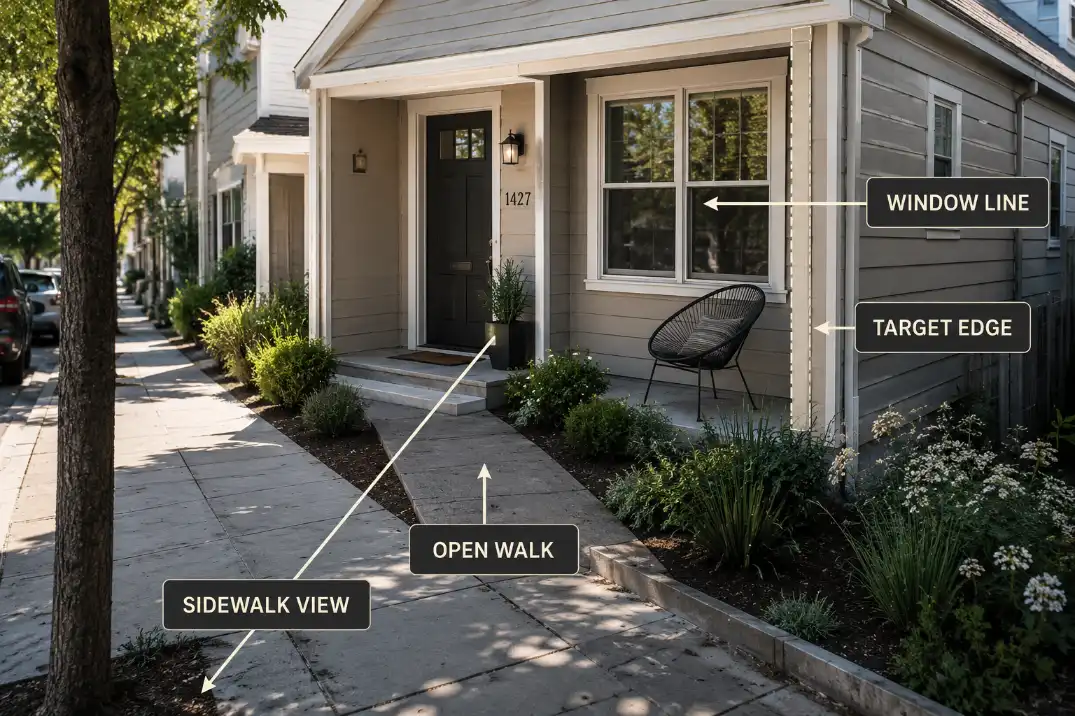
For window-heavy exposure, the same logic applies more tightly. A street-facing room may not need a whole yard screen; it may need a vertical interruption placed where the public eye meets the glass.
That is the difference between solving a privacy problem and simply adding more landscaping. For a window-specific version of this issue, a guide like fixing front yard privacy for windows facing a busy road can support the narrower window-line decision.
Use Vertical Interruption Instead of Horizontal Layers
In a normal-depth front yard, privacy can be built with distance. Low planting softens the public edge, mid-height shrubs slow the view, and taller structure sits closer to the house. That works because the eye passes through more than one layer before it reaches the porch or window.
In a no-setback yard, there is not enough room for that sequence. Trying to force it can create a dense strip that crowds the house but still leaves the main exposure open. The better move is vertical or edge interruption: place a narrow upright element directly where the view travels.
A slim trellis beside a window, a narrow screen at a porch corner, an upright planter near the front edge, or a tight planting mass beside the walk can work because it is placed on the view path. It does not need to cover the whole yard. It only needs to break the angle that makes the space feel exposed.
Comparison Box: Depth Layering vs Edge Interruption
Depth-based layering:
- Needs front-to-back room.
- Works best when planting beds can be staggered.
- Can feel cramped when squeezed into a shallow yard.
- Often screens the yard more than the actual exposure point.
Vertical or edge interruption:
- Works with little depth.
- Targets the window, porch, or sidewalk angle directly.
- Keeps more of the front walk and entry open.
- Filters the view without turning the frontage into a wall.
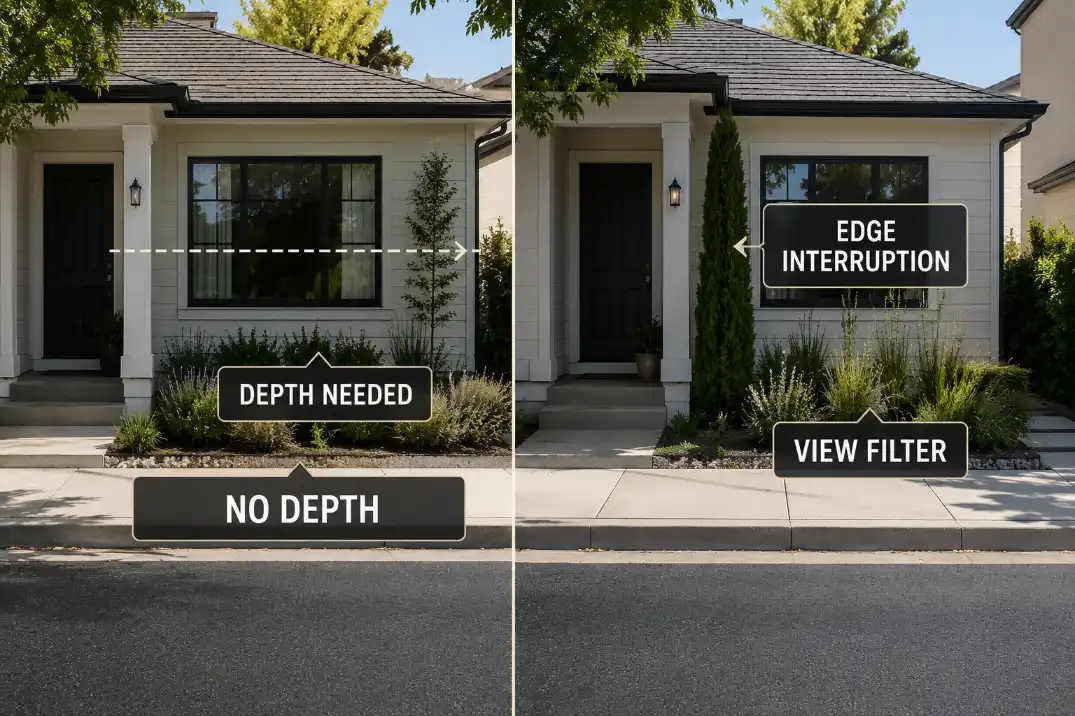
The key is not the object itself. A trellis in the wrong place is just decoration. A planter that sits beside the angle may do almost nothing. The privacy value comes from placing a vertical break between the public eye and the exposed use area.
Keep the Entry Visible While Filtering the View
No-setback privacy fails when the fix makes the front entry harder to use. A screen that hides the door may create privacy, but it also makes the house feel closed, less welcoming, and harder for guests or delivery drivers to read. In a tight front yard, that trade-off shows up immediately.
The front door should still be visible from the normal approach. The house number should not disappear behind foliage, a planter, a panel, or a tall seasonal container. The front walk should still feel direct enough that a visitor understands where to go without squeezing around a privacy object.
A good privacy break sits beside the route, not in the route. If the front walk is already narrow, avoid placing a heavy planter or screen where people naturally turn, pause, or carry packages. The package drop area also matters. A no-setback entry may only have one small landing or porch corner, so privacy should not consume the only usable delivery spot.
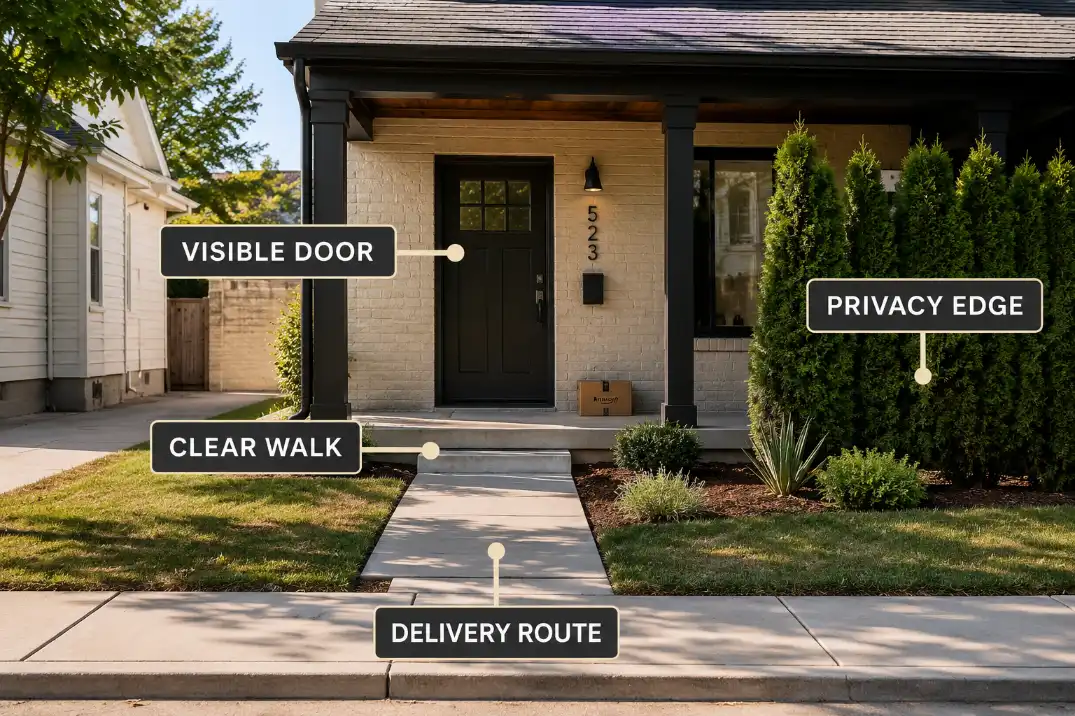
This is why privacy and entry usability have to be designed together. If address visibility is already weak, solve that before adding anything vertical near the entrance. A separate guide to front yard house number visibility is useful when the privacy move could hide the address or make the house harder to identify from the street.
Choose the Right Edge for the Privacy Break
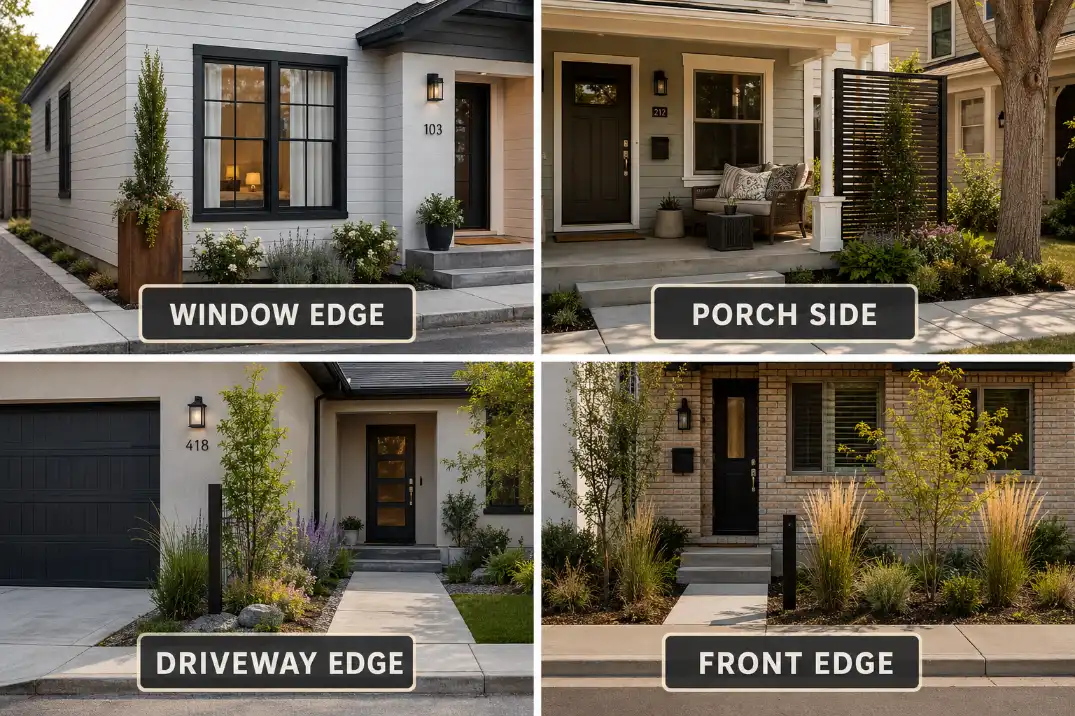
Once the exposure point is clear, the next decision is which edge should carry the privacy break. In a no-setback front yard, the “edge” might be the sidewalk side, porch side, window side, driveway side, or the narrow planting strip between the walk and the house.
A street-facing window usually needs the privacy break close to the window line or slightly forward of it. That may mean a narrow upright planting mass, a slim trellis, or a vertical planter that interrupts the line of sight without covering the full window. The goal is to soften the public view, not darken the room.
A porch chair or small sitting spot usually needs side privacy more than front privacy. If people walking by see directly into the seating angle, place the break at the porch side or front corner. Avoid closing the entire porch face unless the door and approach still remain obvious.
A narrow front walk needs more caution. If the walk is the only route from sidewalk to door, the privacy element should sit outside the walking line. Even a good-looking planter becomes a problem if it forces visitors to turn sideways, step into planting, or set packages in the path.
Driveway-side exposure is different again. If the open view comes from cars, neighbors, or a shared driveway, a driveway-edge privacy break may work better than a sidewalk-edge screen. The important part is leaving car doors, trash-bin movement, and daily access clear. For a driveway-specific version of that problem, front yard privacy when the driveway is open to the street gives that edge its own treatment.
Mini Decision Matrix: Match the Edge to the Exposure
Street-facing window:
Best privacy break: window-edge interruption.
Avoid: covering the whole window or darkening the room.
Porch chair or sitting spot:
Best privacy break: porch-side filter.
Avoid: closing the front door view.
Narrow walk beside the house:
Best privacy break: slim outside-edge filter.
Avoid: shrinking the walking route.
Driveway-side exposure:
Best privacy break: driveway-edge interruption.
Avoid: blocking car doors, bins, or daily access.
Very shallow curb-to-house distance:
Best privacy break: one precise vertical break.
Avoid: a continuous hedge or full-width screen.
If the exposure involves packages, visitor flow, or a small landing, the privacy edge should be checked against delivery behavior too. A guide to front yard package delivery zone ideas can help when the only good privacy location competes with the only practical drop zone.
Control Height, Width, and Density So It Does Not Become a Wall
The tighter the front yard, the easier it is to overcorrect. A tall, solid screen can technically block the view, but it may also make the house look boxed in. A continuous hedge can soften the street edge, but in a no-setback yard it can quickly feel like a barrier pressed against the house.
Height should follow the actual exposure. If the problem is a seated porch angle, a partial-height filter may be enough. If the problem is a standing sidewalk view into a window, the interruption may need to reach the eye line, but it still does not have to cover the full frontage.
Width matters just as much. A narrow privacy element that breaks the exact angle often feels better than a long solid run. Broken density also helps. Slatted panels, open trellises, upright grasses, narrow evergreen forms, or mixed vertical planting can interrupt the view while still letting the front yard breathe.
The mistake is treating no-setback privacy like fence replacement. A full barrier across a shallow frontage can make the house feel smaller, hide the entry, and draw more attention to the fact that the yard has no depth. A filter is usually stronger than a wall because it solves the specific exposure without making the whole front of the home feel defensive.
Where This Fits With Other Front Yard Privacy Fixes
This no-setback approach is for the tightest frontage problem: the house is close to public view, and there is not enough depth for normal layering. If there is even some usable front-yard depth, a broader front yard privacy plan for small yards without a fence may give you more room to combine low planting, mid-height screening, and open entry space.
If fences are not allowed, the route changes again. No-fence privacy can include planting, planters, trellises, grade changes, and porch-side filters, but the best choice still depends on where the view enters.
If the exposure is mainly a porch seating problem, the solution should stay closer to the sitting angle instead of spreading across the whole yard. If the exposure is mainly a window problem, the privacy break should be judged from inside and outside the window line. If the issue is the full front-yard plan, the no-setback decision should sit inside a larger privacy framework rather than replacing it.
The important boundary is depth. When the yard has room, layering can work. When the yard has almost no room, edge interruption becomes the main tool.
The Best No-Setback Privacy Plan Blocks the View, Not the Yard
A no-setback front yard does not need to be filled to feel more private. It needs one or two accurate interruptions placed where the sidewalk, street, driveway, or front walk view actually reaches the porch or window.
That is the standard to keep: the front door stays visible, the walk stays clear, the house number can still be read, deliveries still have a place to land, and the privacy element filters the exposed view instead of closing the whole frontage. When the yard has no depth, precision matters more than mass.
For the safety side of entry visibility, Oakland Park’s public safety guidance notes that address numbers should be visible from the street: Visible House Numbers Key to Public Safety Response Times.