
The real problem with acorns and seed pods is not simply how much falls. It is how difficult the surface below makes that debris to see, separate, and remove.
Leaves usually form a visible layer. Harder tree debris behaves differently: it rolls across paving, sinks below grass blades, mixes into mulch, and collects along edges. A lawn can therefore look clear in the morning and interfere with mowing again by afternoon.
That movement creates a functional drop zone larger than the canopy itself. It includes the area receiving direct fall, plus nearby slopes, paths, mower routes, and low points where debris travels or becomes trapped.
A cleaner yard starts with three judgments: map the true drop zone, protect the routes that cannot wait for seasonal cleanup, and choose a ground layer that releases debris instead of hiding it. The goal is not a debris-free yard. It is a drop zone that can be cleared without repeatedly disturbing the surface beneath it.
Why Seed Pods Create More Work Than Leaves
The first maintenance mistake is treating pods and acorns like a heavier version of leaf litter. Their shape changes the cleanup pattern.
Leaves tend to remain visible and move together. Pods and acorns bounce when they land, roll beyond the canopy, and settle between grass blades or pieces of mulch. A blower or rake may remove the lighter leaf layer while leaving the harder material behind.
The early sign is not always a large pile. It may be the same pieces appearing after each mowing pass, collecting against a curb, or returning to a walkway shortly after it was swept. That pattern shows that cleanup is reaching the obvious landing area but not the full drop zone.
Observe the area across several active-drop days rather than judging it after one cleanup. Look beyond the canopy outline. A slight grade may carry acorns toward a driveway, while shoes, mower wheels, runoff, and wind can move fragments in other directions.
The stronger maintenance move is to clear by consequence rather than trying to keep every part of the yard equally clean. Start with active walking routes, mower paths, and edges where hard debris repeatedly interferes with use. Less-used lawn areas can usually wait until enough material has accumulated to make collection efficient.
Where Acorns and Pods Become a Safety Problem
Tree debris becomes a priority when it crosses a route, not when the entire yard begins to look messy. A small number of acorns on the path between a door and driveway may matter more than a dense layer in an unused lawn corner.
Smooth walkways, steps, sloped paths, gates, driveway edges, and grass-to-paving transitions deserve the closest attention. Round acorns can move under a shoe instead of staying flat. Larger pods can create uneven footing or catch the front of a shoe, particularly when their color blends into the paving.
Wet conditions add a second problem: the surface may already offer less reliable footing while damp debris becomes harder to distinguish. Evening use can conceal isolated pieces even when the main accumulation remains visible beneath the tree.
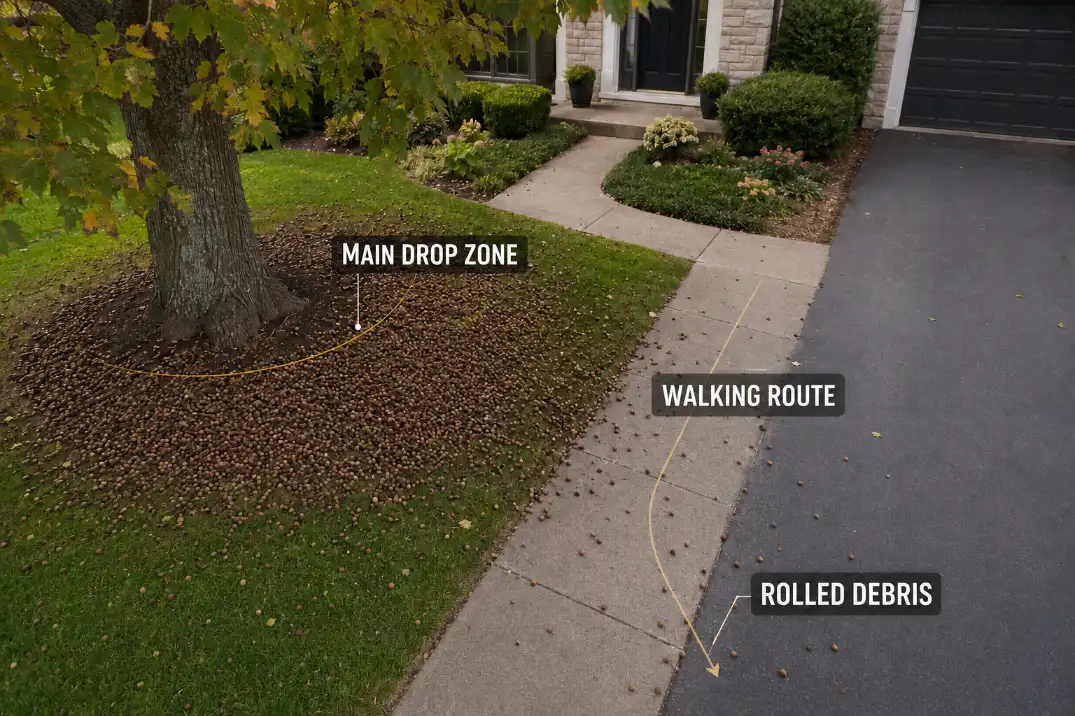
During active drop, clear the primary route before guests arrive, before using it after dark, and after weather carries debris back across it. There is usually no reason to sweep every paved area at the same frequency. Protect the route connecting doors, parking, bins, gates, and regularly used outdoor spaces first.
Layout Check: If debris returns to the same path shortly after removal, that path is part of the drop zone—not a separate cleanup area.
Tree debris may also reveal an existing route problem without causing it. Cracked, loose, lifted, or poorly lit paving requires a separate correction. More guidance on evaluating the route itself appears in this guide to front walkway safety for visitors and deliveries.
How They Damage Lawn, Mower Paths, and Walkway Edges
The practical lawn threshold is simple: when pods or acorns must be collected before most mowing passes, the mower route is working against the drop zone.
Hard debris can sit below the grass tips, become pressed into damp soil, break into fragments, and accumulate where the mower cannot complete a clean pass. Mower wheels may then push remaining pieces toward edging or carry fragments onto adjacent paving.
Narrow grass strips between a tree bed and walkway are particularly inefficient. There is little space to gather debris without moving it onto another surface, and each boundary creates another collection line.
Before mowing during an active drop, walk the main route and remove dense patches of hard debris. The University of Minnesota Extension’s mower safety guidance advises clearing objects such as rocks, wire, and sticks that could become dangerous projectiles. Although pods and acorns are different materials, the same pre-mowing inspection principle is sensible wherever hard debris is concentrated.
Signs that the drop zone is disrupting the mowing route include:
- Repeated stops to collect debris before a mower pass
- Shells or pod fragments appearing on adjacent paving
- Material packed against lawn edging after mowing
- Wheels pressing debris into damp or soft ground
- Narrow turf sections requiring separate hand cleanup
Lowering the mower or repeatedly scraping the turf is not a useful shortcut. It increases contact with concealed material without recovering what has settled at soil level. If the wider layout also creates awkward turns and trimming pockets, examine why backyard mowing and trimming become harder.
Visible thinning, ruts, or lasting bare patches are separate lawn-condition issues. The prevention move here is to keep concentrated hard debris out of the mower route before repeated interruption becomes part of every mowing cycle.
Why Bare Soil and Mulch Catch More Debris
A ground layer has failed the cleanup test when removing the debris also removes or rearranges the surface. Loose mulch and soft soil fail in different ways, but both can turn a visible drop into a separation problem.
Small pods, caps, shells, and acorns settle between individual pieces of mulch. Blowing may carry lightweight mulch with them, while aggressive raking can expose soil or drag the bed material across an adjacent walkway.
Bare soil eliminates that mixing but introduces another problem. Foot traffic, rain, and cleanup equipment can press debris into the surface. Mud may coat it, while broken pieces become difficult to distinguish from the surrounding soil.
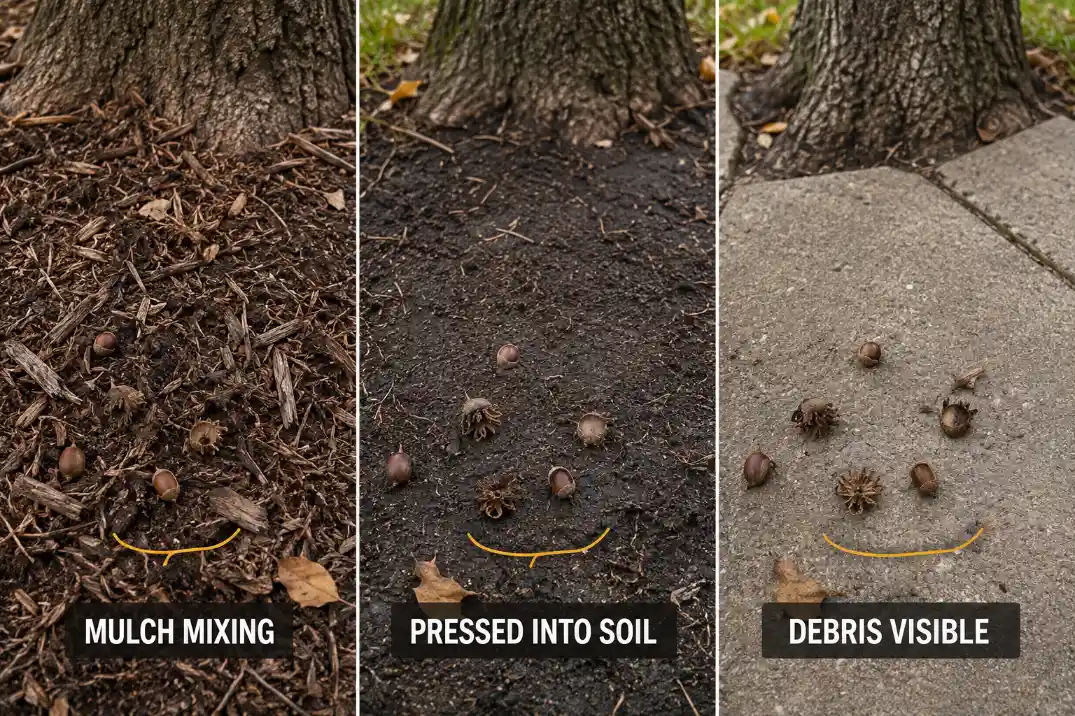
Here, mulch contamination means the practical mixing of unwanted tree debris into the ground layer, not chemical contamination. The warning sign is a bed that still contains shells and fragments after the loose material on top has been removed.
Maintenance Mistake: Fresh mulch can hide an unresolved debris layer, but it does not restore a cleanable surface. Remove what can reasonably be separated before replenishing the bed.
Use enough airflow or raking pressure to move the unwanted material without stripping the ground layer. If the two cannot be separated through most of the drop season, the surface is creating the recurring workload. This comparison of mulch and gravel beside sidewalk strips explains how loose materials create different containment and edge-maintenance demands.
How to Design a Cleaner Drop Zone Under Trees
Do not choose a new ground layer until you know where the cleanup actually occurs. The strongest surface decision made from a canopy outline can still fail if debris rolls downhill, follows runoff, or settles beyond the proposed edge.
Map the area while the tree is actively dropping material. One calm, dry day will not show how the zone behaves after wind, rain, mowing, and repeated foot traffic.
Map the Functional Drop Zone
Use four field checks:
- Mark where most debris lands directly.
- Follow where round or lightweight pieces move afterward.
- Identify overlap with walkways, gates, mower routes, and driveway edges.
- Note where cleanup requires crossing planting, disturbing mulch, or working against a narrow edge.
The purpose is not to calculate an exact radius. It is to identify the smallest practical zone containing most of the recurring work.
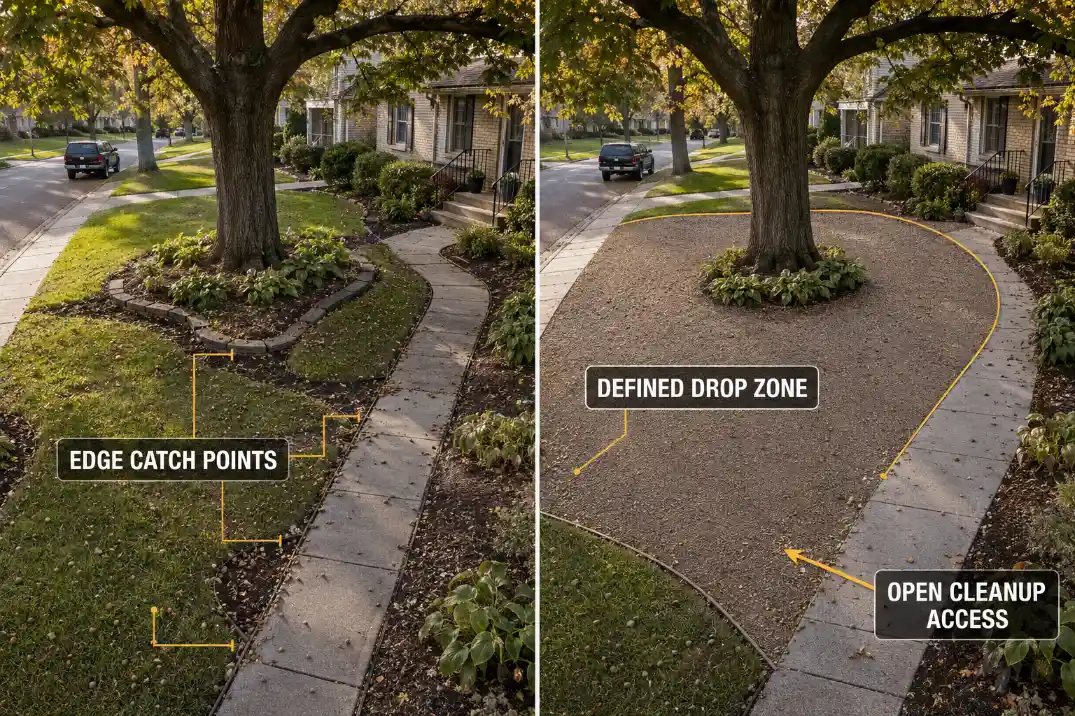
Simplify the Ground Layer and Its Edges
Every extra surface transition becomes a possible catch point. A narrow turf strip, curved mulch edge, stepping-stone gap, and walkway border beneath the same canopy may each require a different cleanup movement.
Where site conditions allow, use one continuous ground-layer behavior through the heaviest part of the drop zone. Keep the approach open enough to reach the debris without stepping through dense planting or repeatedly crossing a fragile lawn edge.
The surface does not have to be hard or bare. It must keep debris reasonably visible and allow it to be removed without taking significant amounts of the ground layer with it. Broader circulation and surface trade-offs are covered in how surface choice affects backyard usability.
Compact Ground-Layer Decision Matrix
- Turf: Reasonable where the drop is light and the area can be inspected before mowing. It becomes inefficient when hard debris stays hidden below the grass or the zone contains narrow mower strips.
- Loose mulch: Appropriate where the planted bed and tree setting justify the extra separation work. It performs poorly as a cleaner drop zone when small shells and pods repeatedly disappear into the material.
- Bare soil: Avoids mixing debris with a separate ground layer, but wet or soft soil allows pieces to become pressed into mud. Bare does not automatically mean recoverable.
- Firm, recoverable surface: Offers the clearest visibility and separation where the surface is stable, low-textured, and accessible. It is a fit condition, not a universal prescription; drainage, existing roots, and construction limits still control whether it belongs there.
Do not pave, raise the grade, excavate, or compact a new surface near a mature tree simply to make cleanup easier. If a permanent change would require work around visible roots or close to the trunk, consult a qualified arborist or landscape professional before altering the area.
The right drop-zone design does not eliminate acorns or pods. It makes their path predictable. When debris stays visible, the busiest route remains protected, and cleanup can approach from an open edge, seasonal fallout becomes a contained maintenance task instead of a problem spread across the lawn, mulch, and walkway.