
Clearing a patio corner can feel productive until the next windy afternoon puts the leaves back in exactly the same place. That repetition is useful evidence: the patio is moving debris along a stable route.
This is not mainly a leaf-removal problem. The real issue is whether wind, surface slope, and physical obstructions repeatedly guide debris into a corner or across the approach to a drain. Once moisture presses that debris into a mat, a collection point that looked cosmetic can begin changing how runoff moves.
The practical prevention model is simple: identify where leaves enter, follow where they settle, expose the route to the drain, and keep that route reachable during the active leaf-drop season.
Why Leaves Collect in the Same Patio Corners
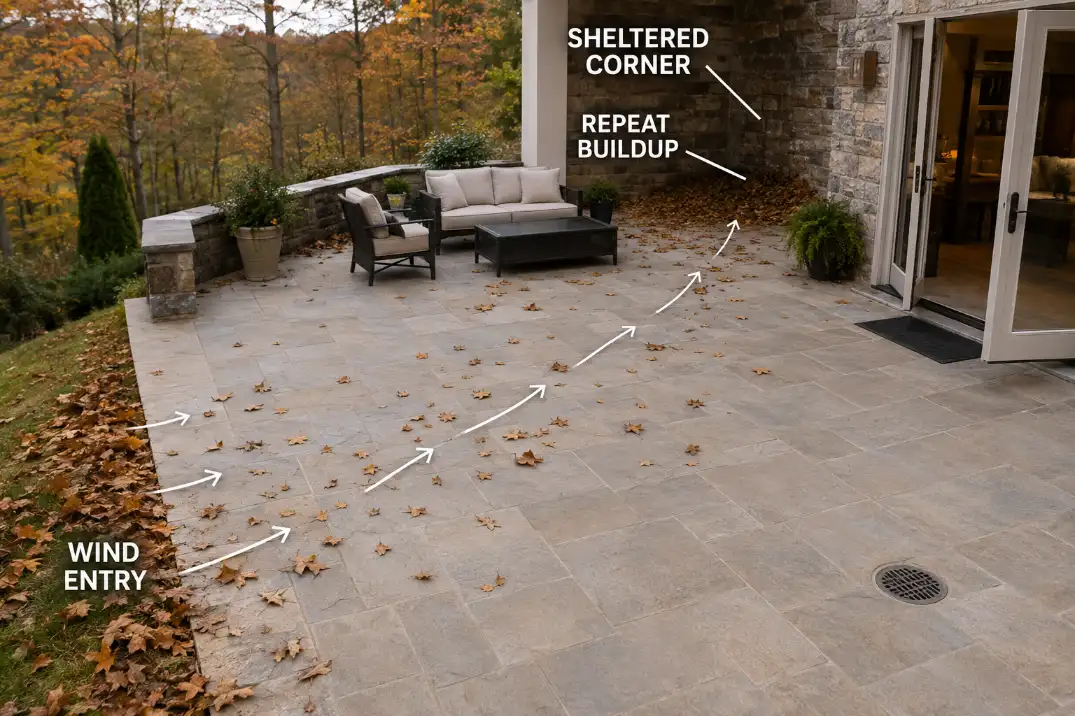
A recurring leaf pile usually marks the point where moving air loses enough energy to release its debris. Open paving allows dry leaves to keep tumbling, while a wall intersection, raised step, planter, storage box, or sheltered corner gives the first layer somewhere to stop.
This explains why leaves from a tree on one side of the yard may accumulate on the opposite side of the patio. The place where leaves land is not necessarily the place where they finally settle.
A collection point normally develops in stages:
- Fresh, dry leaves move easily across open paving.
- A protected edge stops the first layer.
- Later leaves catch against that layer.
- Rain or overnight moisture compresses the pile.
- Fine fragments remain attached to the surface after larger leaves move or are removed.
The useful early sign is not a large pile. It is a thin debris line forming along the same edge after several windy days. Observe that line before clearing it. Note the exposed direction from which the leaves arrive and the wall, step, or object that stops them.
Once the bottom layer becomes wet, the pile is less likely to disperse naturally. Ignoring that first repeated edge allows a temporary wind pocket to become a persistent maintenance point.
How Wind and Surface Slope Create Leaf Traps
Wind determines where dry leaves travel; surface slope becomes more important after the leaves are damp, broken, or mixed with sediment. The strongest trap forms when both forces deliver debris to the same area.
Prevailing wind may push loose leaves toward a fence, house wall, or step. Air movement then changes around that barrier. A protected corner becomes a calm pocket, while turbulence behind furniture can produce smaller secondary deposits nearby.
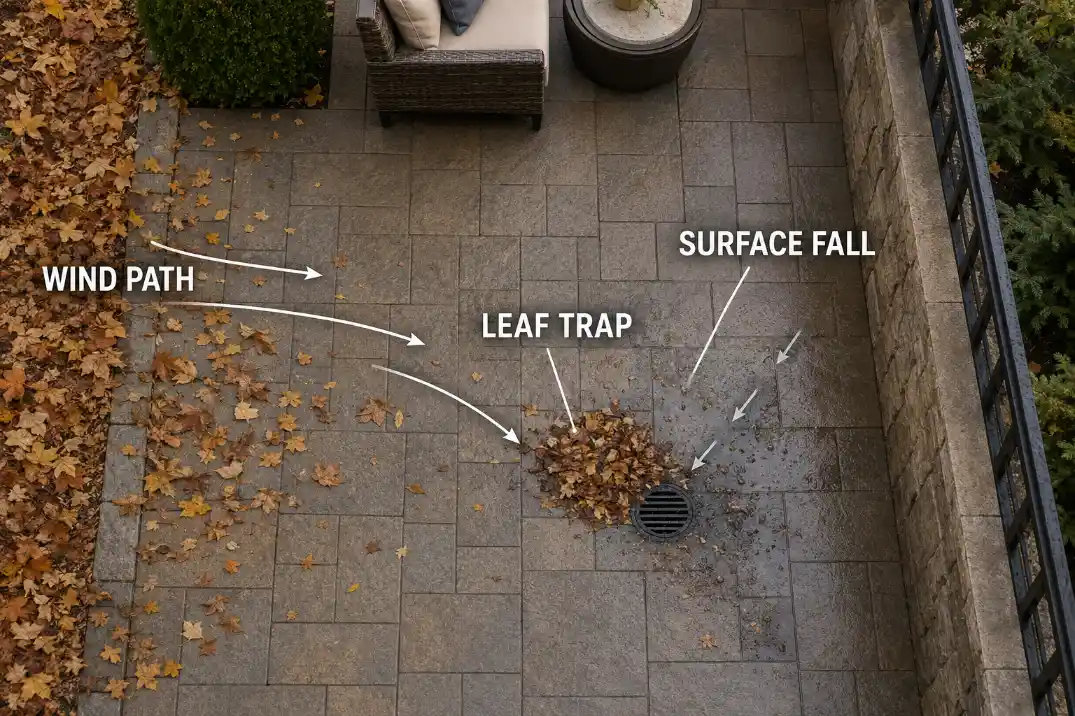
The patio surface adds another direction. Even a slope that is difficult to see can guide rainwater, softened leaves, and fine fragments toward a low edge or drain approach. A paving joint, uneven transition, or cross-slope obstruction may stop the material before it reaches the cover.
This produces three recognizable patterns:
- A wind trap, where dry leaves settle in a calm corner.
- A surface trap, where damp fragments collect along a low seam.
- A combined trap, where wind places the leaves and runoff later presses them toward the drain.
There is no need to estimate an exact slope percentage. During moderate rain, watch the direction of the thin water film and check where the smallest leaf fragments remain afterward. Those fragments often reveal the runoff route more clearly than the largest pile.
Do not assume the corner holding the most leaves is the patio’s intended low point. Wind can build a pile against an uphill wall while water moves in another direction. The correct prevention route has to account for both patterns.
When Leaf Debris Turns Into Drainage Trouble
Leaf buildup becomes a drainage problem before the drain disappears completely. The practical threshold is reached when debris changes the approach of surface water or begins bridging the cover openings.
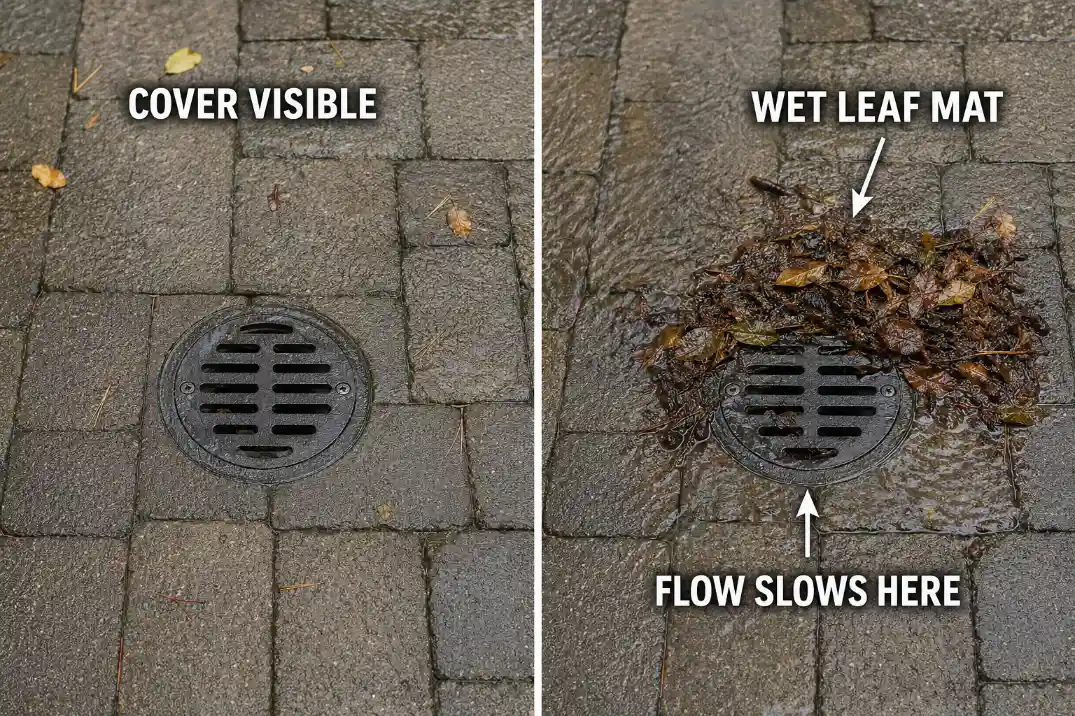
Broad wet leaves can form a base across a grate. Smaller fragments and sediment then fill the gaps, reducing how easily runoff passes through. Water may begin pooling on the uphill side even though part of the cover remains visible.
Watch for:
- A faint water line around the debris
- Leaves packed tightly against one side of the cover
- Runoff bending around the drain
- Fine fragments remaining after the larger leaves are removed
- Water moving toward paving joints or furniture legs instead
Removing only the visible top layer may leave the restrictive material in place. After clearing, the complete drain-cover outline and its openings should be visible. The short surface approach on the uphill side also needs to remain open; a clear grate cannot receive water efficiently if a compacted debris ridge redirects flow before it arrives.
This change can happen quickly after rain during active leaf drop. Dry material that appeared harmless the previous day may compress once saturated and break into smaller fragments during repeated wetting.
Fix Boundary: Clear the visible drain cover and the surface route leading to it, then observe the next rainfall. If water still backs up when both areas are exposed, surface leaves may not be the complete cause. That condition belongs in a broader drainage diagnosis rather than repeated leaf cleanup.
Why Furniture Placement Can Make Cleanup Harder
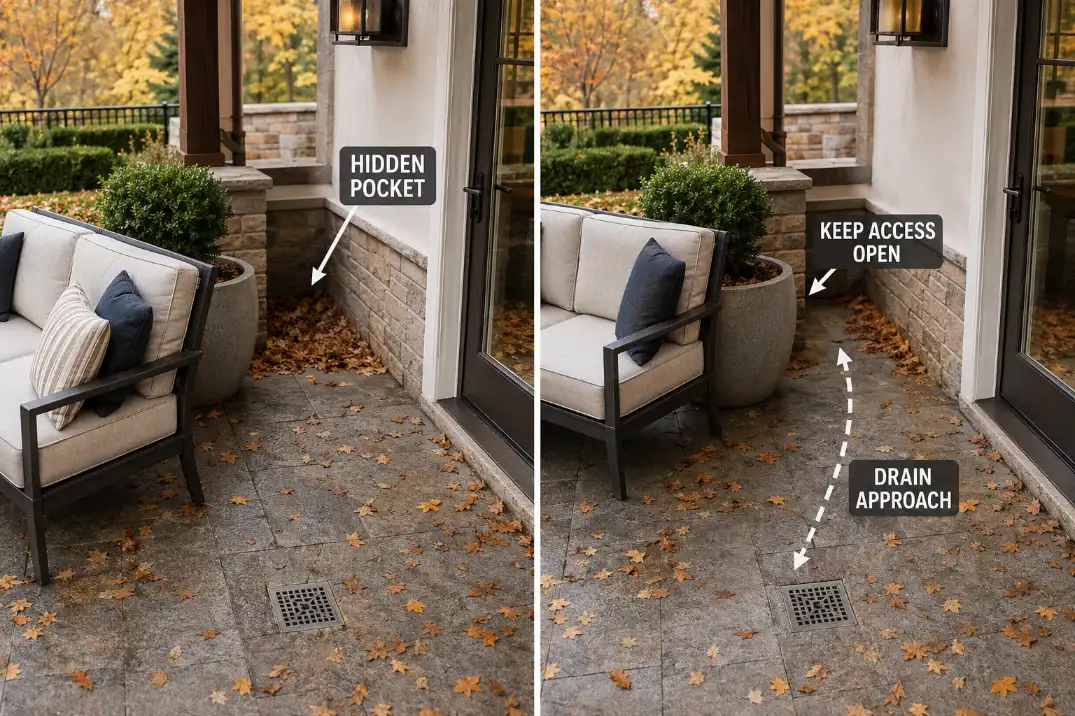
Furniture becomes a maintenance problem when it creates a hidden collection pocket or blocks the direct approach to the drain—not simply because it occupies patio space.
Chair legs, sofa bases, planters, storage boxes, and hanging furniture covers can interrupt moving leaves before they reach the main corner. These obstructions produce smaller deposits that may be invisible from the open center.
A homeowner may clear the obvious pile while leaving damp debris behind a sofa or beneath a covered table. During the next rain, that material moves farther along the slope, making it appear that the cleared drain area filled immediately.
The early sign is a narrow debris line around furniture legs or a darker, damp patch beneath a sheltered edge. Check those areas once leaves begin accumulating elsewhere rather than waiting until the furniture is stored for winter.
The prevention move does not require emptying the patio. A modest seasonal shift may expose the sheltered edge and preserve a reachable route to the drain. Keep doorways and normal walking paths open, and avoid solving one obstruction by moving furniture into another runoff path.
This is a maintenance-access adjustment, not a full redesign. If a short shift makes the drain approach visible and reachable, that is more useful than creating arbitrary clearances throughout the space. Broader patio layout problems that make outdoor spaces hard to use should be addressed separately.
How to Keep the Drainage Path Visible
The most efficient seasonal cleanup route follows the way debris moves across the patio. Beginning in the open center may improve appearance, but it can leave the actual wind pockets and runoff approach untouched.
Start at the exposed edge where leaves enter. Follow the debris line toward the recurring corner, check behind objects that form sheltered pockets, and continue along the surface approach to the drain. Finish by exposing the cover and its openings.
Use this five-point route:
- Find the exposed edge where leaves enter.
- Follow the debris toward the recurring corner.
- Check behind furniture, planters, and covered items.
- Clear the uphill approach used by surface water.
- Confirm that the complete drain-cover outline remains visible.
A paving pattern, wall joint, or fixed edge can serve as a stable visual reference for the drain location. This makes the cover easier to find when scattered leaves begin hiding its outline without adding a marker that becomes another obstruction.
Timing should follow conditions rather than a universal calendar. Increase checks once nearby trees begin their heaviest leaf drop, after windy weather that transports dry leaves, and after rain that compresses them. The problems that make fall backyard cleanup harder often begin when access to recurring pockets is lost before the main cleanup starts.
Maintenance Note: The cleanest-looking part of the patio may not be the most important part of the drainage route. Give priority to sheltered corners, furniture pockets, and the few feet immediately uphill of the drain.
Before leaving the patio after a seasonal cleanup, confirm four conditions:
- The recurring corner is not holding a compressed bottom layer.
- Furniture pockets can be seen without dismantling the entire space.
- The drain approach has no debris ridge capable of diverting runoff.
- The drain-cover outline and openings remain clearly visible.
This routine prevents seasonal leaf fall from becoming a hidden surface restriction. It cannot correct defective grading or a drain that remains slow while fully exposed.
The strongest prevention move is not cleaning more of the patio. It is keeping the specific route followed by wind, wet debris, and runoff visible and reachable before that route closes.