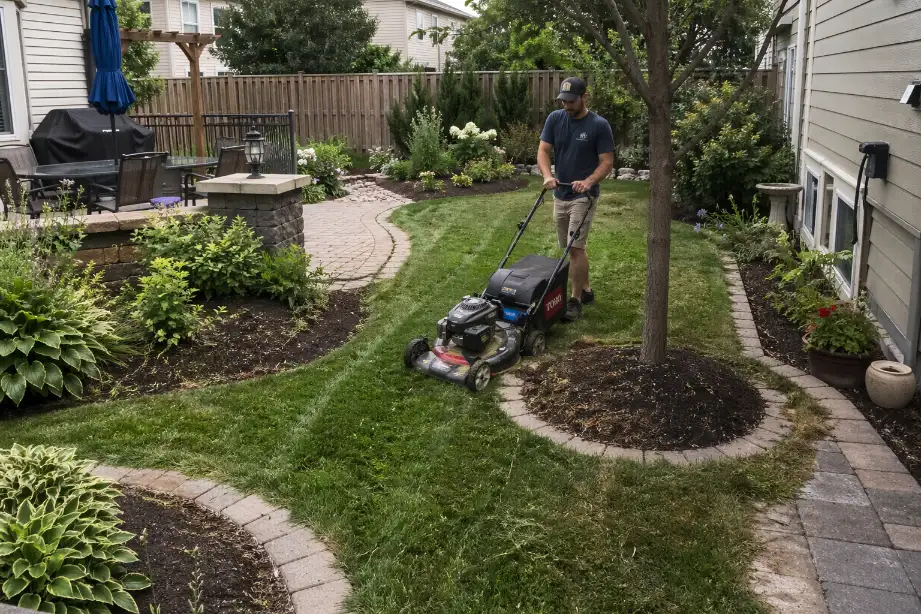
Backyard mowing and trimming usually stop getting easier when the lawn no longer behaves like one open surface. The real problem is not just growth rate.
It is layout friction: too many edges, too many interruptions, and too many leftover strips the mower cannot finish cleanly. Three early checks matter most.
If trimming is taking more than about one-quarter of the full session, if the mower has to turn every 15–20 feet, or if several turf runs are too narrow for one clean pass, the yard is starting to fight the mower instead of helping it.
That is different from a yard that is simply large. A bigger but simpler lawn can still mow quickly. A smaller backyard with tree rings, patio cut-ins, decorative islands, and narrow side strips often takes longer because every interruption adds another slow turn, missed strip, or cleanup pass.
Once the lawn has roughly 50–60 linear feet of edge per 1,000 square feet of turf, mowing often starts feeling more like steering and finishing than cutting.
When the yard starts fighting the mower
Too many soft bed edges
This is one of the first layout problems to become expensive in time. Soft or messy bed lines let grass creep, mulch drift, and mower wheels wander. The edge never feels settled, so every pass turns into correction work.
Narrow turf acting like edging
A strip can still be green and still not function like lawn. Once turf is narrow enough that the mower cannot move through it confidently, it becomes edging that happens to be alive. In practice, strips under about 36 inches wide are where the routine starts getting annoying fast.
Repeated cleanup along curved borders
Gentle curves can still mow well. Deep scallops, sharp pockets, and decorative cut-ins usually do not. They create trim-heavy areas the mower never really finishes.
| BEST FIX FOR MESSY BED EDGES |
|---|
| No-Dig Landscape Edging |
| Best for homeowners trying to clean up trim-heavy lawn borders without turning the fix into a major install. |
| It fits busy backyards where soft bed lines and drifting edges keep creating extra mowing and trimming work. |
| Look for flexible sections, secure anchors, and enough height to hold a cleaner, more predictable mowing line. |
| 🔴 SHOP No-Dig Landscape Edging |
This is where many homeowners misread the problem. They blame fast growth or the mower itself, when the bigger issue is usually unfinished edge work the layout keeps creating.
What people usually misread first
They blame growth before geometry
Fast growth changes frequency, but it does not fully explain why the job feels messy. A lawn can need cutting every 5–6 days in active growth and still be easy if the layout is simple.
They underestimate edge length
Two backyards with similar turf area can feel completely different to maintain if one has far more border turns, bed cut-ins, and interruption points. That is why a smaller yard can consume more time than a bigger one.
They treat trimming as the job instead of the symptom
The symptom is endless trimming. The mechanism is a yard the mower cannot finish cleanly. That distinction matters, because getting faster with the trimmer often just means adapting to a bad pattern.
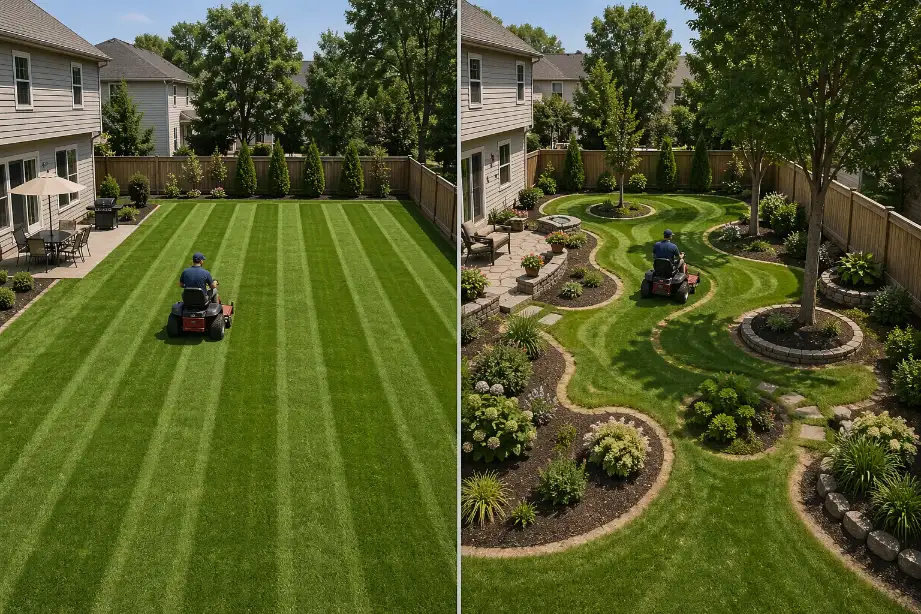
Quick diagnostic checklist
If three or more of these are true, the backyard is structurally high-friction to mow:
- Trimming takes more than about one-quarter of the full session
- The lawn is split into 3 or more disconnected mowing zones
- Several turf strips are too narrow for one clean pass
- The mower must turn or reverse every 15–20 feet in major areas
- Tree trunks, posts, decor, or furniture create repeated hand-finish spots
- Patio and bed edges are too irregular to follow smoothly
- Some sections stay too wet to mow cleanly until the next day
That last one is more important than it looks. A section that stays soft for 24 hours after rain or irrigation does not just narrow the mowing window. It also makes clumping, wheel smearing, and sloppy edges more likely.
In crowded backyards, the same density that makes paths and seating feel tight often shows up in the mowing routine too, which overlaps with the maintenance logic behind When Backyard Plants Start Crowding Paths and Seating.
What to change first
Fix the routine only if the lawn is still mostly open
If the yard still has decent mowing lanes, the first gains come from timing and sequence. Mow before the grass gets far beyond its maintained height.
Avoid cutting when the turf is wet enough for clippings to stick and wheels to smear the border. Use a perimeter pass first, then mow the open center.
A sharp blade belongs here too. These are not glamorous fixes, but they help when the yard still has a workable structure.
Stop defending turf that behaves like detail work
This is the decision point many homeowners delay too long. If a part of the yard repeatedly behaves like edging instead of lawn, it should be evaluated as a design problem rather than preserved out of habit.
Pro Tip: If trimming regularly takes more than one-quarter of the session, stop trying to optimize the trimming routine and start asking which turf areas should no longer be turf.
When a softer border stops making sense
Lawn running against pavers or patio edges
This is where a softer edge often starts losing the argument. If grass is constantly softening into hardscape, or if the line between turf and adjacent material never holds, the mower has nothing stable to follow.
Borders that keep collapsing or drifting
Some backyards do not need a softer, more forgiving edge. They need a firmer one. This is especially true where lawn meets pavers, patios, or other fixed surfaces and the border keeps breaking down under weekly use.
Areas where you need a crisp mowing line
If the yard keeps turning one side of the mower pass into finish work, the problem is not subtle anymore. A harder, more stable edge can remove a surprising amount of weekly correction.
Once the yard needs a firmer, more stable border, a softer edge usually stops saving time.
| BEST BORDER FOR HARD EDGES |
|---|
| Metal Landscape Edging |
| Best for yards where lawn meets patios, pavers, or rigid borders that need a firmer line. |
| It fits layouts that keep losing a clean mowing edge because softer borders drift, spread, or collapse over time. |
| Look for durable metal sections, a crisp profile, and a form that works with straight runs or broad curves. |
| 🔴 SHOP Metal Landscape Edging |
That is why hardscape-adjacent problem zones often feel worse every season instead of easier. The mower is trying to follow a boundary that never really stabilizes, which is part of the frustration pattern behind Cheap Backyard Pavers Shift and Stain.
Design changes that save more time than a better mower
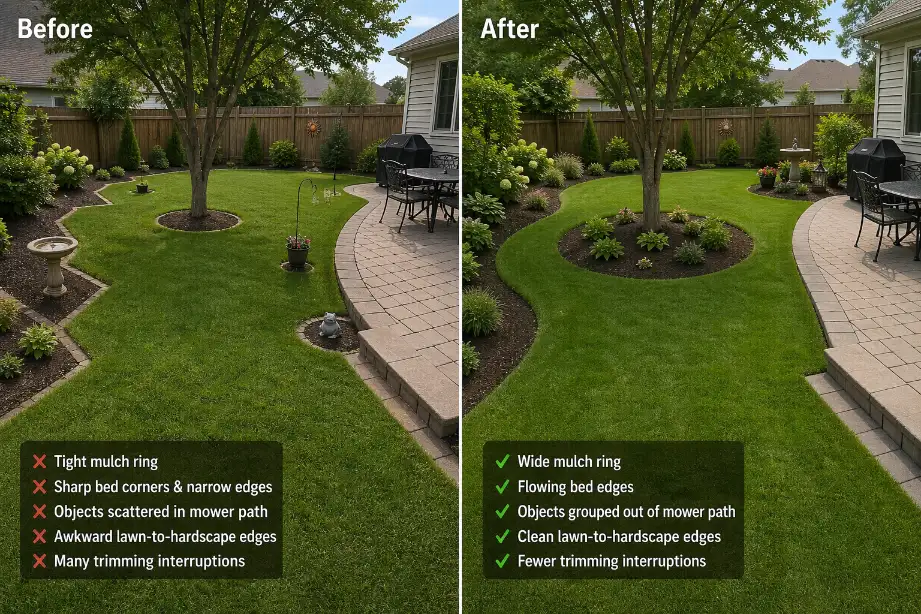
Enlarge mulch rings around trees
This is one of the highest-value fixes because it reduces tight maneuvering immediately and protects trunks at the same time. It also removes one of the most repetitive trim zones in the average backyard.
Turn deep cut-ins into broader sweeps
A border does not need to be straight to be mow-friendly, but it does need to be predictable enough for mower wheels to follow. Deep scallops and hard little pockets are what turn edging into weekly cleanup.
Group scattered objects into one maintained zone
Three little islands are usually worse than one larger bed containing the same features. Grouping does not just improve the look. It creates longer mowable lanes and removes repeated stop-start movement from the routine.
When lawn stops making sense
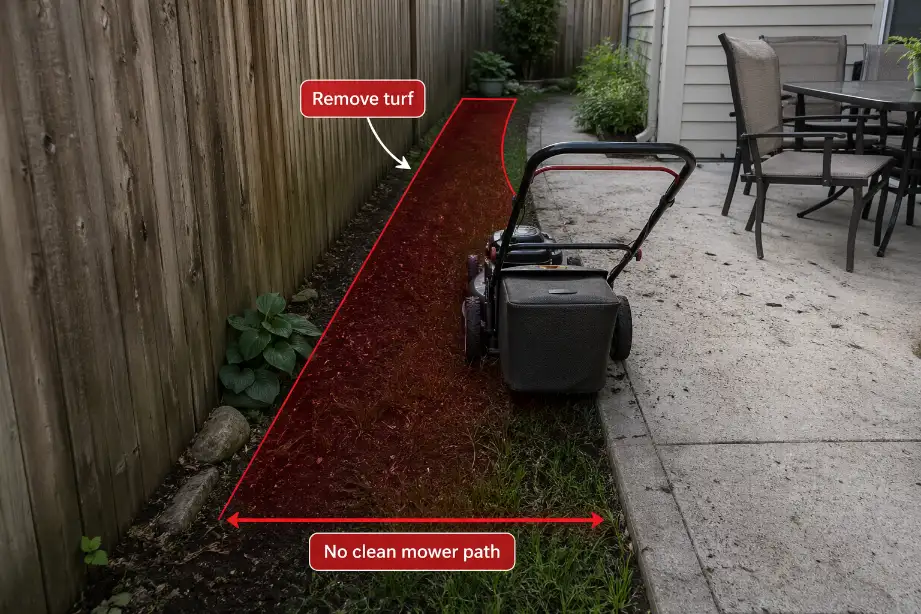
Narrow strips
Once a strip is too narrow for a clean pass, it stops being efficient lawn. It becomes permanent cleanup. This is one of the clearest places to simplify instead of trimming around a bad shape forever.
Deep shade
Grass can still be green and still be a poor maintenance choice. If it never thickens, stays damp, or cuts unevenly, it is not really delivering lawn performance. That is why Deep Shade Backyard Grass Never Fills In often turns into a mowing and maintenance problem as much as a grass-establishment problem.
Slopes and awkward side grades
Even mild grades become a maintenance problem if the mower never moves through them comfortably. Once footing and control become part of every pass, the section has already shifted away from easy lawn use. The same logic is more obvious in Sloped Backyard Hard to Mow Safely, but it applies to plenty of less dramatic backyards too.
Comparison guide: optimize or redesign?
| Backyard condition | Routine fix worth trying | Better long-term move | Priority |
|---|---|---|---|
| Mostly open lawn with a few interruptions | Yes | Improve timing, perimeter pass, blade condition | Medium |
| Tight grass around tree trunks | Briefly | Enlarge mulch rings | High |
| Sharp bed corners and intricate edges | Limited | Simplify to broad curves | High |
| Turf strips too narrow for a clean pass | Rarely | Convert to bed, edge strip, or hard margin | Very high |
| Wet shaded leftovers | Rarely | Reassign away from turf | Very high |
| Scattered decor or island obstacles | Sometimes | Consolidate into grouped beds | High |
The fix that wastes the most time
The biggest time-wasting fix is accepting endless trimming as normal. The second is buying more mower than the yard geometry can actually use. If the lawn is fragmented, a wider deck may improve the open center and still leave the same frustrating borders, side runs, and cleanup zones untouched.
The stronger move is usually subtraction. Remove leftover turf. Merge small interruptions. Straighten or soften the worst edges. Give the mower fewer decisions to make.
The useful reset
If the lawn is still mostly open, routine changes can help right away: mow by growth rather than habit, keep the blade sharp, avoid wet cuts, and open the perimeter first.
But if the same zones keep forcing trimming and awkward corrections every week, the answer is not to become better at frustration. It is to redesign the parts of the yard that behave like detail work instead of usable turf.
That is the real dividing line. Backyard mowing and trimming do not get easier because the homeowner gets more disciplined. They get easier when the yard gives the mower fewer decisions to make.
For broader lawn mowing guidance, see the University of Missouri Extension lawn mowing recommendations.