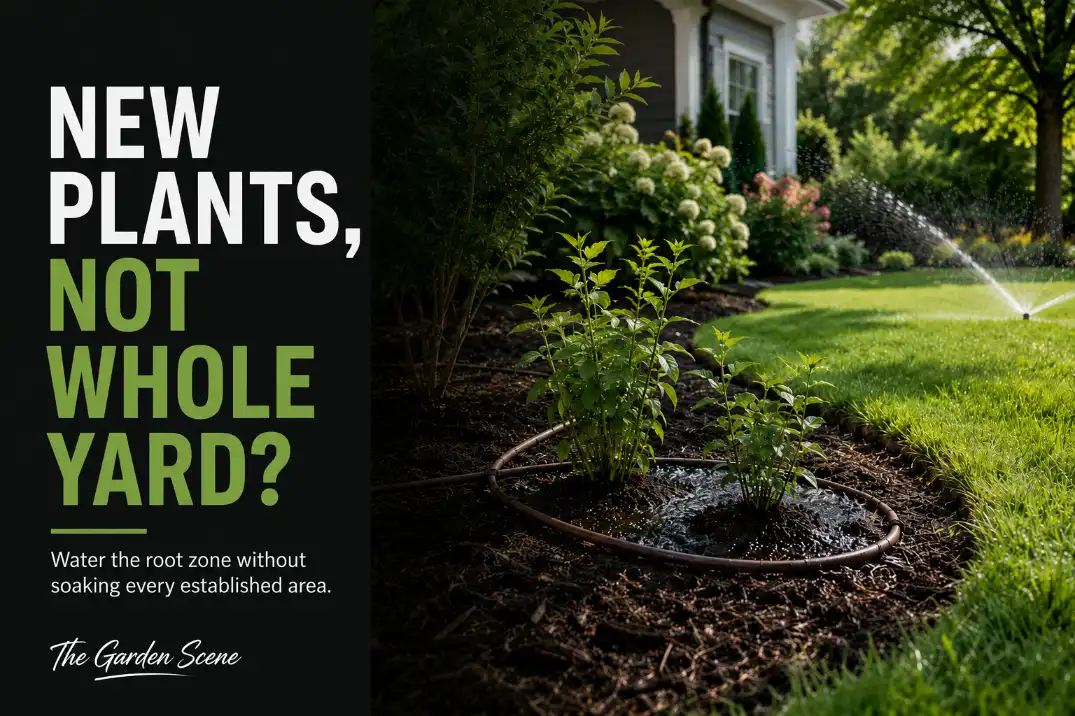
The common mistake after planting something new is to treat the whole yard as if it just got planted. The timer gets longer, every sprinkler zone runs more often, and the yard looks safer because everything is wetter.
That is the wrong control point.
New plants usually need establishment water near a limited root zone. Established lawn, older shrubs, mature perennials, and shaded beds may not need any extra water at all. When the entire yard schedule changes because one new planting pocket needs attention, the water often goes everywhere except the decision point that matters.
The better question is not, “How much more should I water the yard?” It is, “Which new root zones need temporary support, and which established areas should stay on their normal rhythm?”
Why New Plants Need Different Watering Than the Rest of the Yard
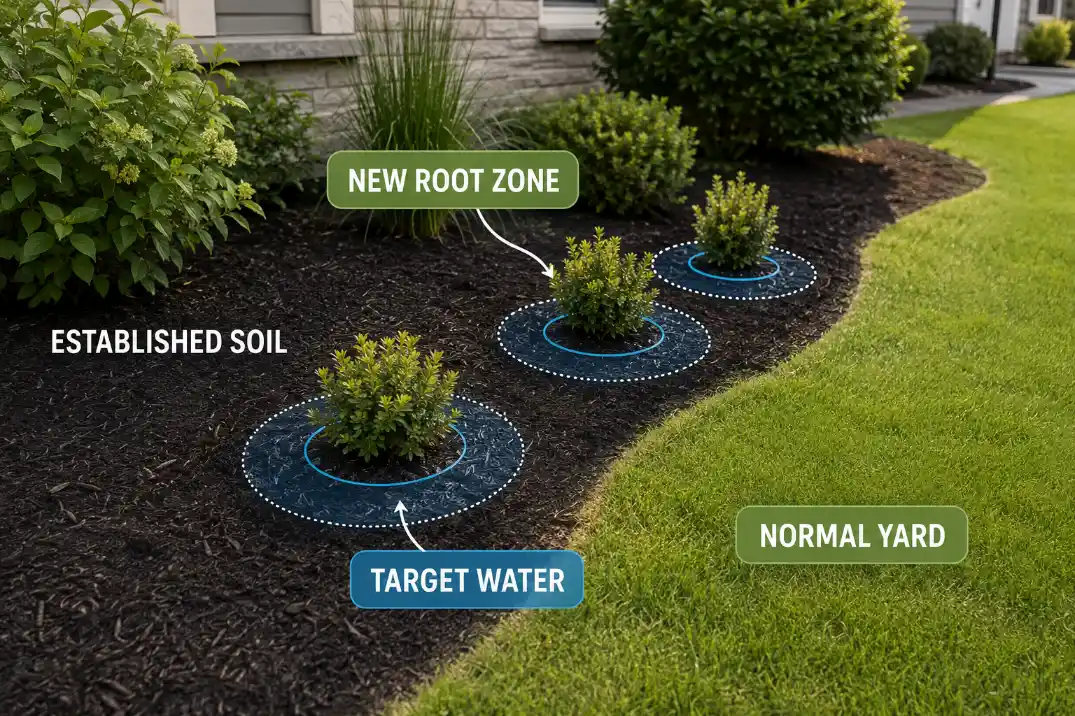
A new plant should be watered according to where its roots actually are, not where the finished bed makes it look like they are. From above, a newly planted shrub or perennial may look settled into the landscape. Below the surface, the working root area is still concentrated near the original root ball and the loosened planting pocket.
That small area can dry differently than nearby established soil. A new plant can wilt while the lawn beside it still looks green. The bed surface can look damp while the original root ball is not receiving enough useful moisture. The visual yard and the active root zone are not always telling the same story.
The root zone is the target
Establishment watering is temporary support while roots begin moving into the surrounding soil. It is not a reason to create a permanently wetter landscape.
That distinction matters in mixed yards. One bed may contain three new shrubs, several older perennials, a mature foundation plant, and lawn nearby. Those plants share a visual space, but they are not in the same watering phase.
Decision Check: The wettest-looking yard is not always the best-watered yard. If water is spread across the lawn, mulch, patio edge, and older plants while the new root ball still dries quickly, the watering pattern is wide but not precise.
How Establishment Watering Creates Overwatering Elsewhere
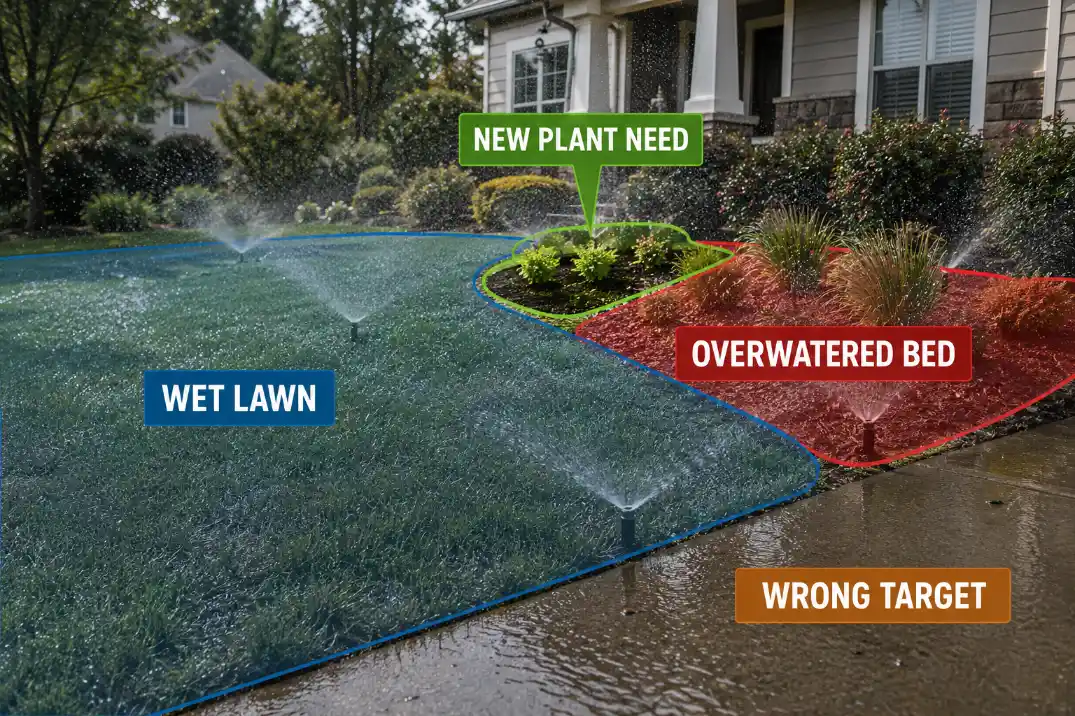
The failure point is applying a temporary plant need to permanent yard areas. A new shrub may need closer watering for a while; the older lawn zone beside it may already be receiving enough.
When the whole schedule is increased, established areas get extra water whether they need it or not. Shaded beds may stay wet long after the new planting pocket dries. Clay-heavy soil may hold moisture below the surface. Mulched areas near the house may remain damp while the root ball of the new plant still needs more direct attention.
That creates a frustrating pattern: the yard can be too wet overall while the new plant still does not receive accurate establishment water.
Where the extra water causes trouble
Established plants that were performing well can begin sitting in soil that stays wet too long. Lawn may become soft, overly lush, or more vulnerable to stress from repeated shallow moisture. Low edges and hardscape borders may collect runoff.
A sprinkler head that seemed acceptable on the old schedule may also become a problem once the run time increases. If water starts landing outside the intended root zone, the issue is no longer just plant care; it can create the same edge wetting and hard-surface runoff described in sprinkler overspray problems on patios, walkways, and siding.
The part many homeowners miss is that established plants are not helped by being treated like new plants. They may already have enough moisture for their current root system. Increasing every zone can turn one temporary planting need into a yard-wide overwatering pattern.
Common Mistake: Raising Every Zone for One New Area
- A new shrub in one bed does not mean the lawn zone needs more water.
- A dry root ball does not prove the whole yard is dry.
- A longer timer can make established areas wetter without solving the new plant’s actual need.
When Hand Watering Works Better Than Changing the Whole Timer
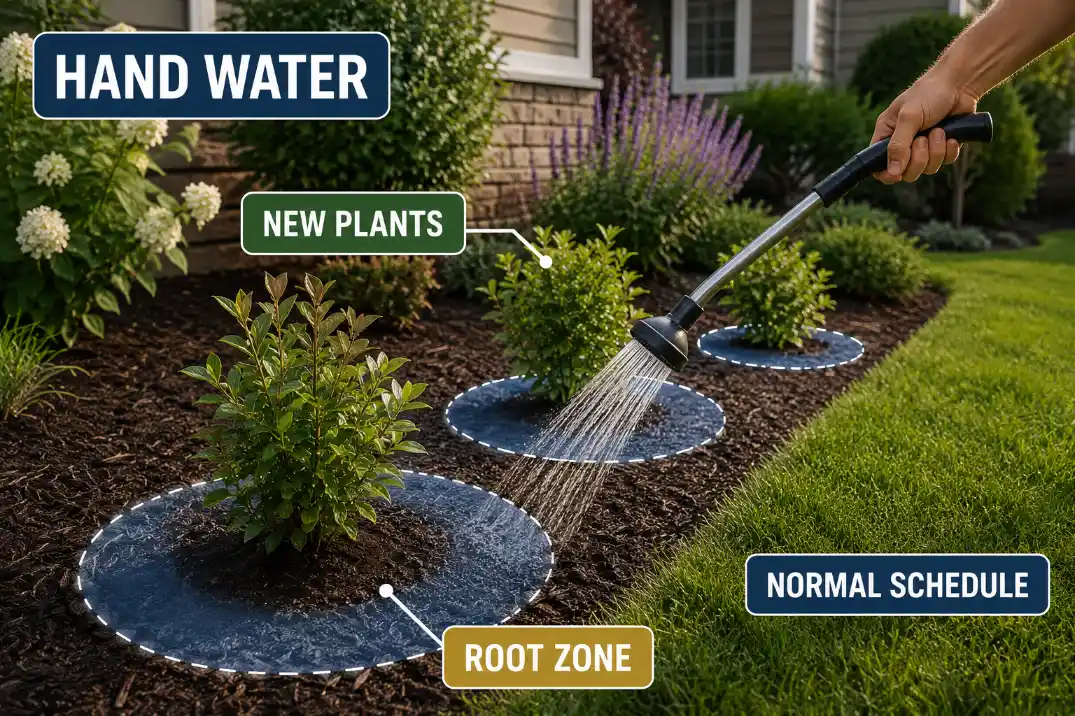
Hand watering is often the stronger choice when the problem is small and specific. If you added three shrubs along a fence, replaced one foundation plant, or tucked several perennials into an existing bed, changing the entire controller may be too blunt.
Direct watering lets you aim at the root ball and the surrounding planting pocket. It also lets you see how the soil accepts moisture. Water that runs across mulch after a few seconds is not doing the same job as water that slowly soaks into the root area.
This approach works best when the new plants are limited in number, scattered through established beds, or outside the most reliable reach of the existing irrigation. It is also useful when you are still testing whether the new planting pocket is drying faster than nearby soil.
Use hand watering as a temporary precision tool
The point is not to hand water forever. The point is to avoid resetting the whole yard for a short-term establishment need.
Check the first few inches of soil near the new root zone, not just the bed surface several feet away. If the new planting pocket is drying faster than the surrounding bed, target that pocket. If nearby established plants are already staying moist, leave them out of the extra watering.
This is especially important in mixed landscapes where sprinkler zones already cover lawn, shrubs, beds, and edges unevenly. When one zone contains plants with very different needs, the same mismatch appears at a larger scale in sprinkler zones that waste water in mixed backyards.
How to Separate New Plant Zones Temporarily
Temporary separation means the extra water follows the new plant need, not the easiest timer setting. The method can be simple: hand watering, a watering can, a slow hose at the planting pocket, or a temporary soaker-style setup for one new bed.
The important boundary is that the extra water belongs to the new planting area. It should not automatically include the entire lawn zone, older foundation shrubs, shaded mulch, or nearby hardscape edges.
Separate by need, not convenience
The easiest zone to change is not always the correct zone to change. A sprinkler timer may control a large area that includes lawn, old shrubs, shaded mulch, and a few new plants. If only the new plants need help, increasing that whole zone simply spreads the mistake.
A better filter is to ask what is actually drying out. Is it the root ball? The surrounding planting pocket? The sunny end of the bed? The sloped edge where water moves away? The plant under reflected heat from a wall or driveway?
Sun exposure, mulch depth, slope, and soil texture all affect how long moisture remains useful. A new plant in hot afternoon sun may need more attention than one in partial shade, even if both were planted the same weekend. A planting pocket in sandy soil may dry faster than a clay-heavy bed that stays wet near the surface.
This is also where broader yard planning matters. A yard with no clear watering logic becomes harder to manage as new plantings, lawn areas, beds, and hardscape edges all compete inside one routine. The better version of outdoor watering layout ideas for yard care starts with separating needs before adding more water.
For temporary new plant zones, keep the rule simple: isolate the new root-zone need first, then decide whether any timer adjustment is truly necessary. If a timer change is used, limit it to the zone that actually contains the new planting and treat it as a short-term adjustment.
When to Return to a Normal Watering Pattern
The last decision is knowing when temporary support is starting to become a habit. A new plant may need extra attention at first, but the goal is to help it stop needing special treatment.
Do not stop abruptly just because the leaves look good for a week. A plant can look fine after a mild stretch and still struggle when heat, wind, or dry weather returns. Instead, taper the extra watering as the root-zone soil begins behaving more like the surrounding soil.
Watch the root zone, not the calendar
There is no universal date when every new plant becomes established. Plant type, planting season, weather, soil texture, mulch, exposure, and root condition all change the timing.
The practical signs are more useful than a fixed schedule. The plant begins holding up better between waterings. New growth appears without constant rescue watering. The root-zone soil no longer dries much faster than the nearby bed. Leaves recover from warm afternoons without requiring the whole yard to be soaked again.
At that point, the normal yard schedule should become the baseline. You may still check the new plant during hot, windy, or unusually dry periods, but the yard should not stay locked in establishment mode.
That distinction can also protect the budget side of yard care. A temporary increase that quietly becomes permanent is one reason irrigation costs creep upward, especially in summer; the same pattern shows up in front yard irrigation costs climbing when watering routines outgrow the actual landscape need.
New plants deserve closer attention than established areas, but that attention should be aimed. Water the root zone, protect the planting pocket, and let the rest of the yard stay on the rhythm that was already working. The right watering pattern is not the wettest one; it is the one that gives temporary support only where the landscape is still trying to establish.
For a neutral horticulture reference on watering newly planted trees and shrubs, see the University of Minnesota Extension guide to watering newly planted trees and shrubs.