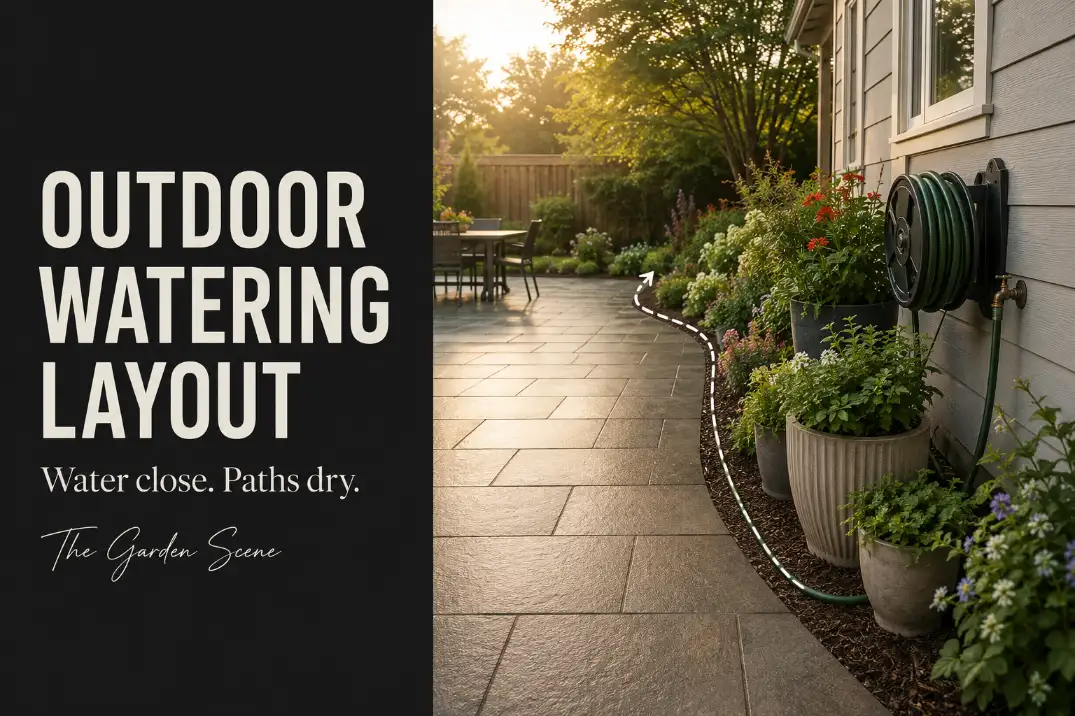
Most outdoor watering problems are not caused by people ignoring their plants. They start when the yard is laid out in a way that makes the right watering pattern hard to repeat.
A hose that crosses a patio path, containers scattered 50 feet from the faucet, or one bed filled with plants that need different moisture levels will fail faster than a simple setup with better access.
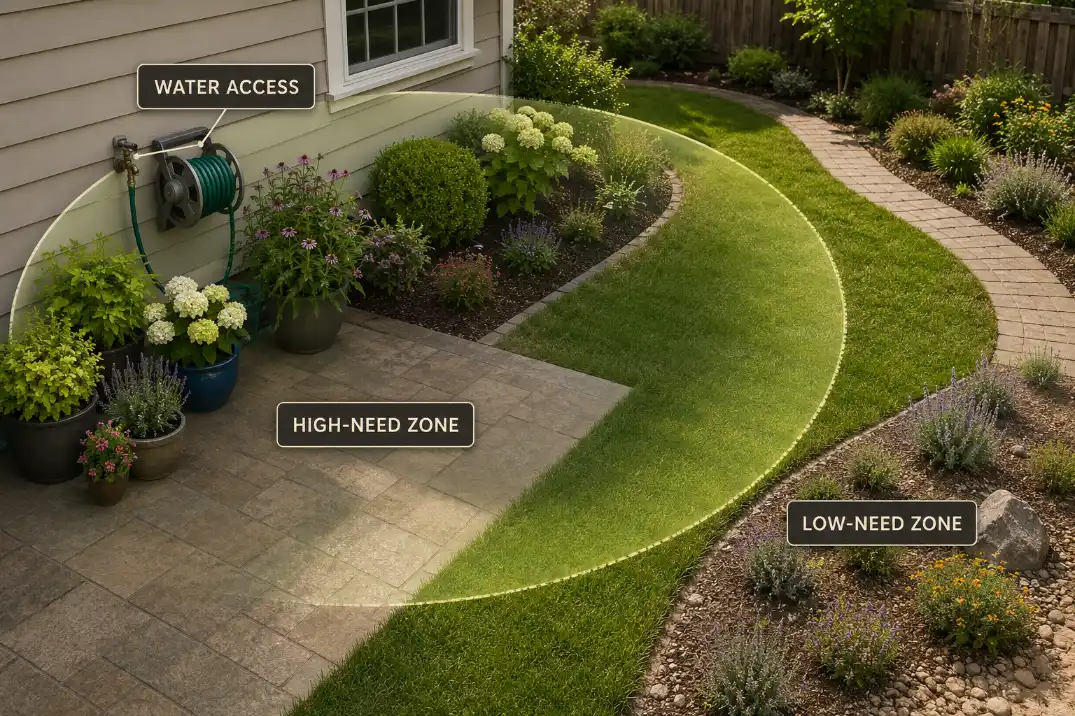
Start with three checks: where the faucet or hose reel sits, which plants need water most often, and whether water reaches soil instead of paving. High-need plants should usually sit within about 25 to 40 feet of easy water access.
Walkways should dry within 10 to 15 minutes after watering. If leaves wilt but the soil is still damp 2 to 3 inches down, the symptom is heat stress, not necessarily drought. A better watering layout separates those signals before adding more water.
Water Access Comes First
The faucet decides more than the plant list
The first mistake is choosing planting locations before checking how water will reach them. A bed can look perfect on paper and still become a maintenance problem if every watering session means dragging a hose around furniture, steps, storage bins, or a gate.
The practical radius is shorter than the hose label suggests. A 100-foot hose may technically reach the back corner, but once it bends around patio edges and planting beds, the useful reach often feels closer to 60 or 70 feet.
Beyond that point, watering becomes slower, less even, and easier to skip during a hot week.
In side yards, the faucet zone is often the quiet control point for the whole backyard. A reel that pulls straight, a place to stand, and enough clearance to coil the hose matter more than another decorative object.
That is why a practical Side Yard Hose Reel and Faucet Zone can change how usable the rest of the yard feels.
Keep thirsty plants inside the short route
The plants that need the most checking should sit closest to water. That usually means herbs, vegetables, hanging baskets, patio containers, newly planted shrubs, and shallow raised beds.
Established shrubs, ornamental grasses, and drought-tolerant perennials can live farther out because they can handle deeper, less frequent watering once they are settled.
This is where many layouts quietly go wrong. People place the prettiest containers where they look best from the house, then realize those pots need water every day in July. The better choice is to make the most frequent task the easiest one.
The Long Hose Problem
Length is not the real failure
A long hose is not automatically a bad layout. A hose that runs cleanly along a fence, bed edge, or patio border can work well. The problem starts when the hose has to cross the places people use every day.
A simple test is better than guessing: pull the hose to the farthest watering point and look at the route.
If it bends around three or more obstacles, crosses a main walkway, or has to pass through the seating area, the layout is not just inconvenient. It is training you to water less carefully.
Kinks usually reveal route geometry
Hose kinks are often blamed on hose quality, but the yard layout is frequently the cause. A sharp turn around a planter, chair leg, railing post, or storage box creates the same weak point every time. The hose may reach, but it does not move cleanly.
This matters around back doors and patio entries. A watering route that cuts across a sliding door path is competing with daily movement, not just plant care.
The same circulation problem shows up in many outdoor layouts where patio walkways and sliding glass doors were not protected before furniture, pots, and utility tasks were added.
A longer hose can make the layout worse
Buying another 25 feet of hose often feels like the obvious fix. Sometimes it helps. More often, it adds weight, drag, storage bulk, and more chances for the hose to cross a usable surface.
The better fix is usually more specific: move the reel, create a smoother edge route, add a short dedicated hose for containers, or place thirsty plants closer to the existing faucet.
A second hose bib only starts to make sense when the main water route repeatedly crosses a primary path or cannot reach an important bed without constant friction.
Beds Need Different Zones
Water by root behavior, not bed shape
A planting bed may look like one area, but the plants inside it may not use water the same way. New shrubs, mature perennials, annual flowers, and sloped bed edges all behave differently.
Watering them as one flat surface usually means one part stays too wet while another dries out.
New plants deserve the most attention because their roots have not yet moved into the surrounding soil. During the first 1 to 2 weeks after planting, they may need very frequent checking.
From roughly 3 to 12 weeks, many new shrubs and perennials still need a more regular watering rhythm than established plants. After that, the goal should gradually shift toward deeper, less frequent watering.
That is why the layout should separate new planting zones from mature low-care zones whenever possible. In dry regions or neighborhoods with watering limits, the stronger move is not forcing thirsty plants into distant beds.
It is choosing plants that match the water pattern, which is the practical decision behind choosing front yard plants for water restrictions.
Shallow watering is the common wasted fix
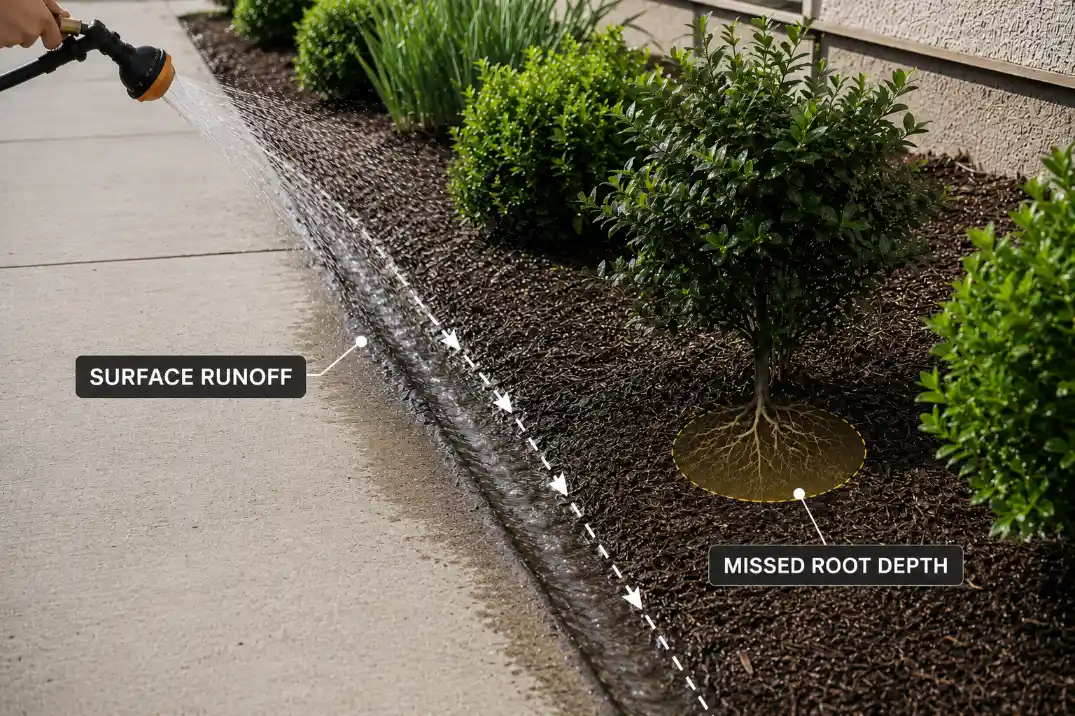
The most common watering mistake is adding more short sessions. It makes the surface look damp, but it may not move water into the root zone. If the top inch is wet and the soil is still dry at 3 inches, the plant has not received useful water.
The opposite misread also happens. Leaves can droop in late afternoon heat even when the soil still has moisture.
If the plant recovers by evening or early morning, the problem may be heat stress rather than a failed watering layout. Soil depth tells you more than the leaf does.
Choose the method by zone, not by gadget
Not every yard needs a full irrigation system. But every yard benefits from watering zones. A hose wand is usually enough for mixed beds near the house because it gives control without overbuilding the setup.
A soaker hose makes more sense for a narrow bed where spray keeps hitting paving. Drip line becomes more useful when the same container group, raised bed, or vegetable area needs water several times a week.
The tool should follow the zone. If the problem is overspray, use a narrower delivery method. If the problem is daily container drying, group the pots before adding drip.
If the problem is a far bed that the hose barely reaches, a second access point may solve more than another nozzle.
| Watering area | Water behavior | Common layout mistake | Better setup |
|---|---|---|---|
| New shrubs | Needs steady early moisture | Planted far from hose reach | Keep within easy deep-soak access |
| Mature beds | Handles deeper, slower watering | Treated like annual flowers | Water less often but more deeply |
| Raised beds | Dries faster than ground soil | Placed at far yard edge | Give it a dedicated short route |
| Patio containers | Can dry within 24 hours in heat | Scattered across the patio | Group near water access |
| Narrow strips | Overspray reaches paving | Wide nozzle used on tight soil | Use wand, soaker, or low-flow line |
| Sloped beds | Water runs before soaking | More minutes added too fast | Water in short cycles |
Containers Dry Faster
Pots need their own mini-zone
Containers are not just small planting beds. They dry from the top, sides, and drainage hole, and the soil volume is limited. A dark pot on hot pavers can dry much faster than the same plant in the ground.
Small pots under about 12 inches wide may need daily water in summer, and in hot, dry, or windy weather they can need attention more than once a day.
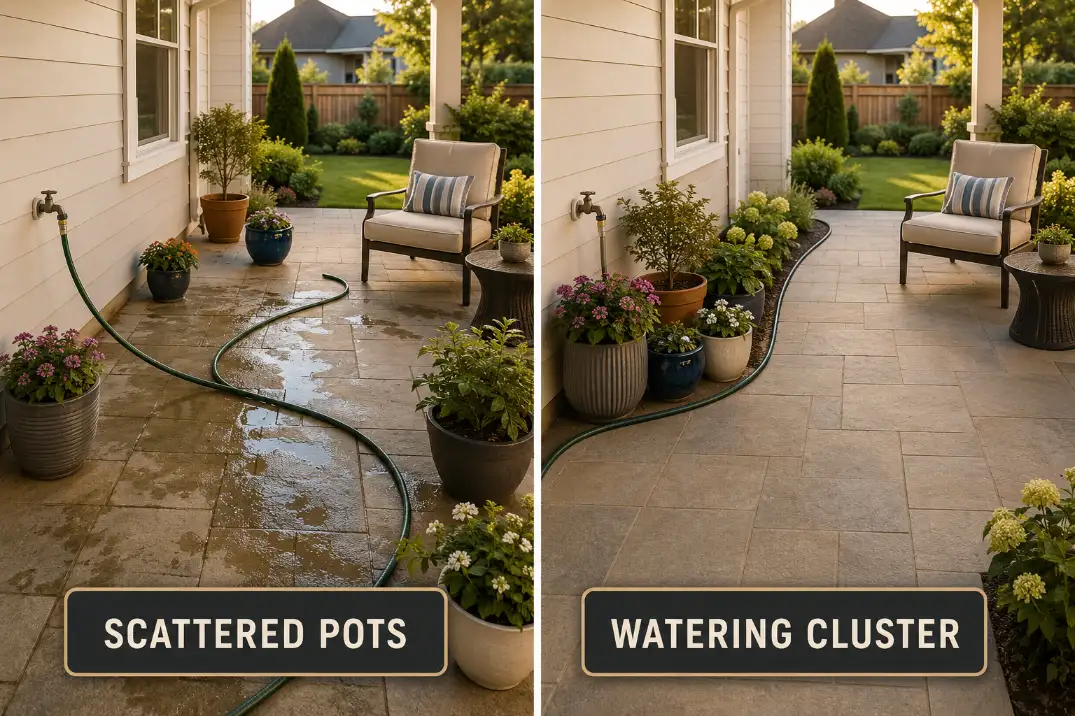
Larger containers hold moisture longer, but only if they have enough soil volume and the plant is not root-bound. Scattered pots are usually the first part of the yard to fail because each one requires a separate stop.
Group by watering need, not just appearance
The best container layout is not a random collection of pretty pots. It is a watering cluster. Put herbs, annuals, and thirsty patio plants near the faucet side of the patio, but keep them out of the main walking route. That lets you water quickly without soaking the seating area.
A small work surface can help when it supports the routine. A potting bench near the edge of the patio gives you a place for a watering can, small tools, and recently watered containers without turning the lounge area into a utility zone.
That is the useful version of a small patio potting bench: not decorative clutter, but a repeatable care station.
Know when hand watering stops making sense
Hand watering works for a few pots. It stops making sense when you have 10 to 12 containers spread across a patio, porch, side yard, and front entry. At that point, the issue is not effort alone. It becomes inconsistency.
The cleaner fix may be fewer pots, larger containers, two grouped watering clusters, or a simple drip line for the highest-need group.
The wrong fix is keeping every pot where it looks best and hoping the routine will somehow become easier.
Walkways Should Stay Dry
Wet paving is a warning sign, not a normal side effect
A walkway that gets wet during watering is easy to dismiss. But it often reveals the real failure: water is hitting hardscape instead of roots. If a walkway stays wet for 20 to 30 minutes, it can become slippery, track dirt indoors, and waste water that never helped the plants.
The symptom is wet paving. The mechanism may be overspray, compacted soil, slope, a nozzle that is too wide, or watering speed that is too fast for the soil to absorb. Adding more minutes usually makes the waste more visible.
Narrow strips need targeted water
Sidewalk strips, front walks, and patio-edge beds are not wide enough for broad spray. When the planted area is only 2 or 3 feet wide, a standard spray pattern often waters the concrete as much as the soil.
A watering wand, soaker hose, or low-flow line usually gives better control. If water runs across the hardscape within the first minute, slow the application before increasing duration.
The same runoff problem is especially visible when trying to water a sidewalk strip without runoff, where narrow soil and hot pavement leave very little room for sloppy aim.
Protect the routes people actually use
The most important dry surfaces are not always the most decorative ones. Back-door landings, garage-to-yard paths, trash-bin routes, front walks, and patio entries need to stay usable during watering.
A good watering layout should let someone walk through the yard without stepping over a hose or around puddles. If watering temporarily shuts down the patio, the layout is borrowing space from the wrong function.
Easy Enough to Repeat
Repeatability beats perfect coverage
The best watering layout is the one that still works on a busy weekday. For a small patio, the routine should usually take under 10 minutes. For a typical backyard planting zone, under 20 minutes is a reasonable target.
If the setup takes longer because the hose route is awkward, the problem is not motivation. The layout is too hard to repeat.
The basic routine should be obvious: pull the hose, water the highest-need zone first, check containers, avoid walkways, and return the hose without blocking a gate or door.
Anything that makes those steps slower will eventually show up as dry pots, uneven beds, or water where it does not belong.
Watch the bill before blaming the plants
A summer water bill spike does not always mean the yard needs more water. It can also mean runoff, overspray, too many scattered containers, or shallow watering that never reaches roots.
If the bill rises while plants still look stressed, longer watering time is usually the less likely fix.
The better question is whether water is reaching the right zones. A yard that wastes water on pavement can cost more and still perform worse than a smaller, better-zoned layout.
That same distinction matters when diagnosing why backyard water bills spike in summer.
Use a quick layout check
- The main hose pulls out without moving furniture.
- High-need plants sit within about 25 to 40 feet of easy water access.
- Containers are grouped instead of scattered across several surfaces.
- Walkways dry within 10 to 15 minutes after watering.
- Water soaks in instead of running off within the first minute.
- New plantings have a separate routine for the first 3 to 12 weeks.
- The hose stores without blocking a gate, door, or daily path.
When the standard fix stops working
A single hose and nozzle stop being enough when the yard has too many different watering behaviors.
Containers may need daily attention, new shrubs may need regular deep soaking, a sidewalk strip may need low-flow control, and a far back bed may be too distant for the same routine.
That is the point where the layout needs a stronger decision. Move high-need plants closer, split the yard into two watering clusters, add a soaker line to a narrow bed, simplify the container count, or consider a second access point.
The right fix is the one that reduces repeated friction, not the one that adds the most equipment.
Final Takeaway
Outdoor watering layout ideas work when they start with the daily route: where water comes from, where the hose travels, which plants need frequent attention, and which paths must stay dry.
The strongest layouts do not water everything equally. They keep thirsty plants close, separate containers from deeper-rooted beds, slow water down where runoff starts, and make the whole routine easy enough to repeat through a hot week.
For broader official guidance on efficient yard watering, see the University of Minnesota Extension water-wise yard guide.