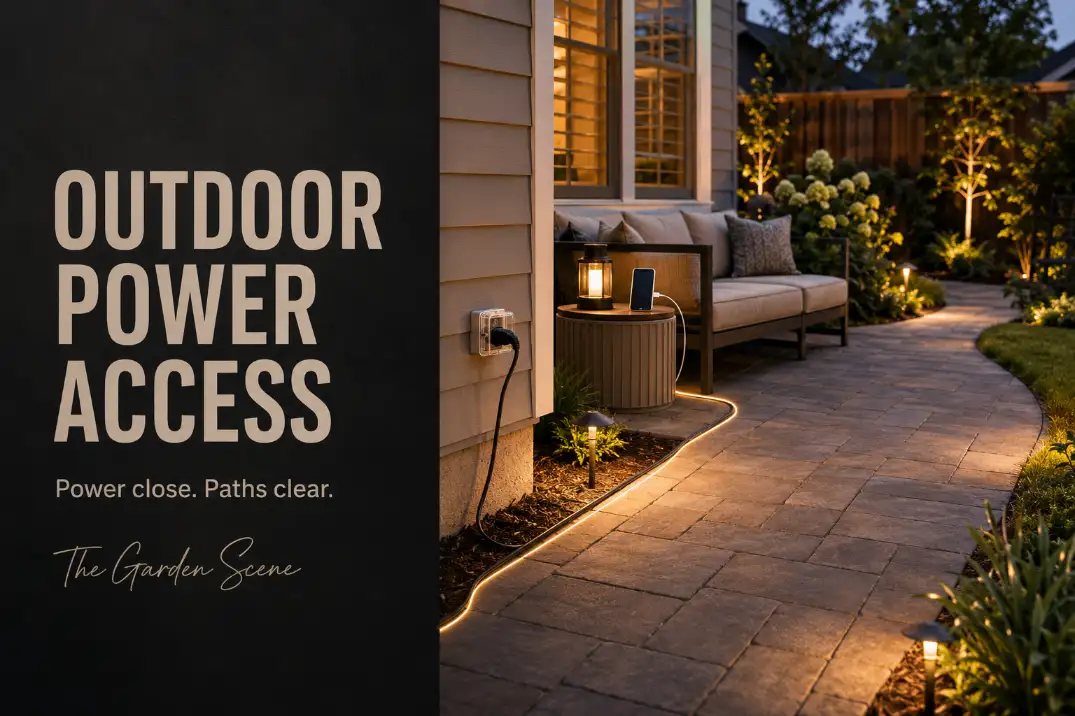
Outdoor power access is not mainly about adding more outlets. It is about placing power where the patio is actually used while keeping the walking route clear.
Start with three checks: where people sit for more than 20 minutes, where lighting needs to begin after dark, and whether any cord crosses a 30- to 36-inch path between the door, seating, grill, or steps.
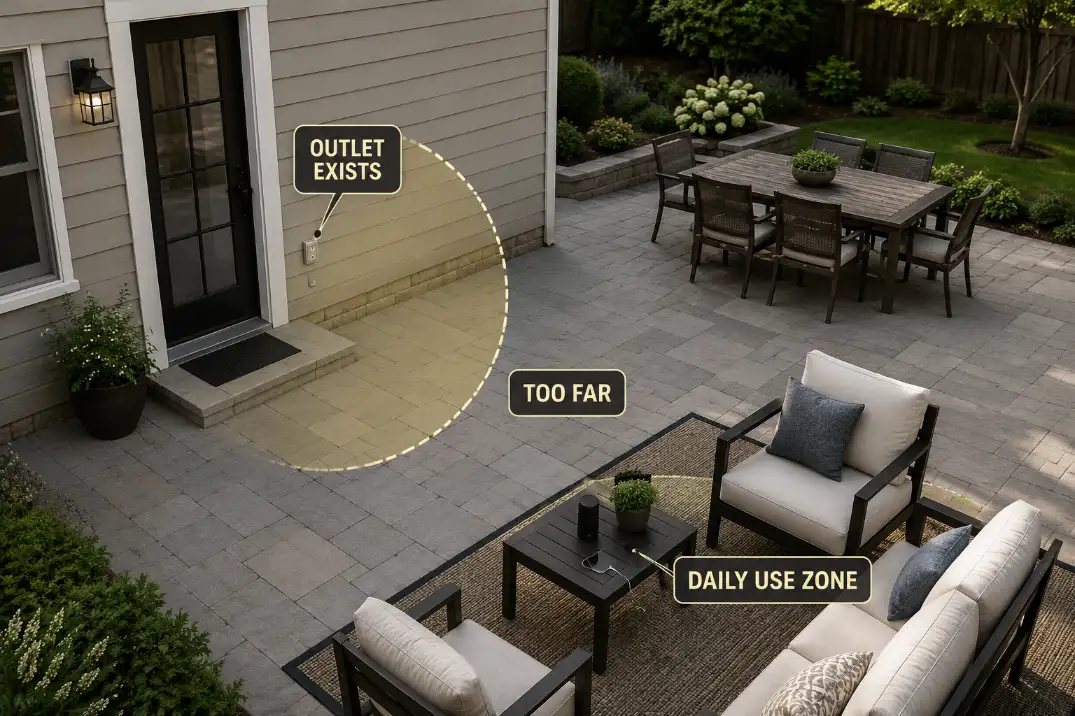
A power point within 3 to 6 feet of the activity usually feels natural. A cord stretched 10 or 12 feet across open patio space usually becomes clutter.
The issue can look similar to a furniture layout problem, but the mechanism is different. A cramped chair zone is a space problem. A chair zone that only works when a cord crosses the entry path is a power access problem.
Fix the route first, then decide whether the answer is a better cord path, a charging station, lighting access, or a permanent outlet.
Power Changes How Spaces Work
A patio can technically have outdoor power and still be inconvenient. One outlet near the back door may help with a blower or holiday lights, but it may not serve the seating area, dining table, work corner, or evening lighting plan.
The outlet is not the access point
The mistake is assuming the outlet location equals usable access. It does not. Access is the relationship between the outlet, the device, the furniture, and the path people use.
A good power point usually sits close to the activity it serves. For a lounge chair, that may mean a side table against the wall.
For lighting, it may mean a protected transformer point near the start of the light run. For dining, it may mean power near the perimeter, not under the table where chairs move.
Once a cord has to cross the center of the patio, the outlet is no longer quietly supporting the space. It is deciding where people walk.
Repeated temporary cords are the warning sign
A temporary outdoor cord for one afternoon is normal. The warning sign is repetition. If the same cord comes out every weekend, every evening, or stays in place for several days, the patio is asking for a better access plan.
That does not always mean new wiring. Sometimes moving the side table 3 feet, starting lighting from a different corner, or shifting the seating zone solves the problem.
But if the cord keeps returning to the same route across the same path, hiding it under a rug or behind planters usually wastes time.
The repeated route usually tells you more than the outlet location does.
Start With Daily Use
The strongest outdoor power access ideas come from use patterns, not product ideas. Watch the patio at three moments: morning, late afternoon, and after dark. Each one exposes a different power need.
Seating needs small, nearby power
Most seating zones do not need a dramatic electrical upgrade. They need small, boring access for phones, tablets, a speaker, a fan, or an occasional laptop.
A phone charger draws very little power. A laptop may use roughly 45 to 100 watts. Those numbers are rarely the main issue. The main issue is whether the cord runs through feet, chair legs, pets, or a door path.
For a lounge chair or reading corner, power should relate to the side table, not the back of the chair. People naturally place phones, drinks, glasses, and books on a nearby surface.
That same surface can become the charging point if it sits close enough to the outlet or a safe routed cord.
A patio that already struggles with door swing, chair pullback, and traffic flow should solve those issues before adding powered accessories.
The same clearance logic that helps patio layouts around sliding glass doors and walkways also keeps power from becoming another obstacle.
Dining zones need access outside the chair zone
Dining areas create more movement than they appear to. A chair may pull back 24 to 30 inches when someone sits down. Add serving traffic, kids moving around the table, and people carrying plates, and the practical route often needs about 36 inches of comfortable clearance.
That is why power should not enter from the middle of a dining zone. A table lamp, speaker, warming tray, or mosquito device should be served from the edge whenever possible: a wall, post, service table, or perimeter outlet.
The common misread is thinking the powered object belongs in the center because the table is central. In real use, the edge usually performs better.
Work corners need shade and power together
A patio work spot is not just a table near an outlet. It needs shade, a usable chair position, Wi-Fi reach, and a cord route that does not cross the entry path. If the laptop faces glare or the cable runs behind the chair, the setup becomes annoying within 15 minutes.
A better work corner places the table near a wall, post, or patio edge, with the user facing into shade and the cord dropping beside or behind the table.
For patios used as work areas even once or twice a week, power should support the furniture position instead of forcing the furniture to chase the nearest outlet.
That is where an outdoor work space on a patio becomes more than a nice setup. It becomes a practical test of whether the patio can support real use without dragging cords through the middle of the space.
Choose the Access Type Before You Buy Anything
Outdoor power access fails when every need gets treated the same. Charging a phone, running string lights, powering a laptop, and using a high-wattage appliance are not the same kind of problem.
Temporary cords are for temporary use
For one dinner, one movie night, or one weekend project, an outdoor-rated cord can be a reasonable access bridge. It should follow the patio edge, stay out of standing water, avoid door thresholds, and remain easy to inspect.
It stops making sense when it becomes semi-permanent. If a cord stays in the same route for weeks, gets covered by furniture, or has to be stepped over daily, the access plan has failed even if the cord itself is rated for outdoor use.
Charging zones are furniture decisions
A charging zone works best when it feels like part of the furniture plan. A side table near a chair, a narrow console against the wall, or a protected shelf near the seating area can serve phones, speakers, and small devices without turning the patio into a cable zone.
The most useful charging zone is usually not the most hidden one. It is the one people actually use. If the charging point is more than 6 feet from the seat, people tend to leave the phone on the ground, stretch a cord across the lounge area, or stop using the setup.
For deeper layout around this exact problem, a dedicated patio power outlet and charging zone plan can help separate casual charging from true outlet placement.
Permanent outlets are for repeated patterns
A new outlet makes sense when the same use returns again and again: weekly outdoor work, regular evening lighting, a seasonal fan, a dining area that always needs power, or a seating zone that cannot be served safely from the house wall.
It also makes sense when the load changes. A small speaker and LED lights are very different from an electric heater, cooking appliance, or tool.
A 1,500-watt heater can use most of the practical capacity of a typical 15-amp, 120-volt household circuit by itself. That is not a design accessory issue anymore. That is a circuit and safety question.
| Access idea | Best use | Works well when | Stops making sense when |
|---|---|---|---|
| Edge-routed outdoor cord | One-night lights, speaker, laptop | The cord stays off the main path | It returns every week |
| Side-table charging spot | Phones, tablets, small speakers | Seating is within 3 to 6 feet | Cords cross chair legs |
| Covered wall outlet | Frequent daily patio use | It serves the activity from the edge | It still forces cords across traffic |
| Lighting service point | Path lights or low-voltage lighting | Transformer stays reachable | Plants or furniture block access |
| Electrician-installed outlet | Repeated seasonal or heavier use | The same access need keeps returning | High-load devices share one casual setup |
Keep Cords Off Paths
Cord safety is not only about the cord rating. On patios, the more common failure is route quality: where the cord lies, what crosses it, and whether people stop noticing it.
The shortest route is often the worst route
The shortest route usually cuts straight from the outlet to the device. That often means crossing the line between the back door and seating, the grill and dining table, or the steps and patio.
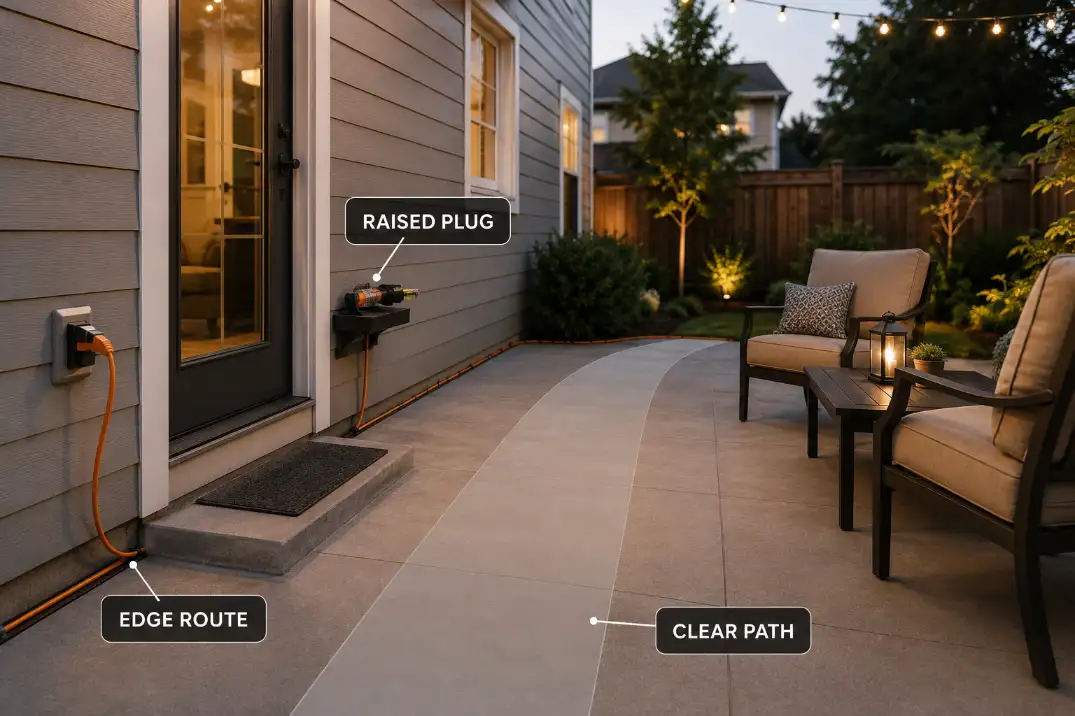
A better route follows the patio edge, fence line, deck rail, house wall, or furniture boundary. It may use a longer cord, but it keeps movement clear. That tradeoff matters more than perfect visual neatness.
Use a simple threshold: if a cord crosses the main walking route even once, treat it as a layout failure. Near a back door, grill, or dining area, the useful path should stay close to 36 inches wide because people are often carrying plates, drinks, cushions, tools, or trash bags.
Raised connections beat hidden connections
A plug connection sitting on damp grass, mulch, or a low patio seam is more concerning than a visible cord routed neatly along the edge. People often try to hide the connection first, but a hidden low connection is harder to inspect and more likely to sit where water collects.
After rain, patios can look dry while grass edges, mulch pockets, and low joints stay damp for several hours. In humid climates like Florida or coastal California, that drying window may be longer. In northern states, freeze-thaw seasons add another issue: low spots and patio joints can shift, trapping moisture where cords naturally settle.
Hiding cords under outdoor rugs can also disappoint. It may clean up the look, but it can trap moisture, create uneven walking spots, and make the cord harder to inspect.
If the route is bad, camouflage is the weak fix. The stronger fix is a better path or a better access point.
Lighting Needs Better Access
Outdoor lighting exposes weak power planning faster than charging does. Phones can be charged somewhere else. Lighting has to start in the right place, at the right time, from the right edge of the patio.
The first powered point controls the whole lighting run
String lights, low-voltage path lights, and plug-in lamps often fail because the starting point is wrong. Once the first powered point is awkward, every other decision becomes a workaround: longer cord, visible transformer, strange light spacing, or a wire that cuts across the patio.
The best access point is usually near the edge where the lighting route begins. That may be a pergola post, fence corner, side wall, deck rail, or protected service area. If the power source starts 10 or 15 feet away from the lighting run, the cord often becomes more visible than the light fixture.
This is why lighting should be tested after dark before anything is made permanent. A patio can look clean at 3 p.m. and feel awkward at 8:30 p.m. when the only available outlet sits behind the chair people use most.
Low-voltage still needs service access
Low-voltage lighting can reduce some installation pressure, but it does not remove the need for a smart service point. The transformer still needs to be reachable, protected, and not buried behind heavy furniture or dense planting.
Small path lights often work best when they guide movement rather than flood the patio. A common planning range is about 6 to 8 feet between low path lights, adjusted for brightness, fixture style, and site conditions.
Too close, and the patio looks overlit. Too far apart, and steps, edges, and transitions disappear.
Once the question shifts from outlet placement to fixture choice, a backyard lighting layout for patios at night can help match the access point to lights people actually use.
Charging Should Feel Natural
Charging is where outdoor power either disappears into daily life or makes the patio look messy. The deciding factor is usually not the charger. It is where the charger lands.
Put charging where hands already go
The best charging point is near the surface people already use: a side table, console, shelf, serving cart, or built-in ledge. If someone naturally sets down a drink, sunglasses, book, or phone there, it can probably support charging too.
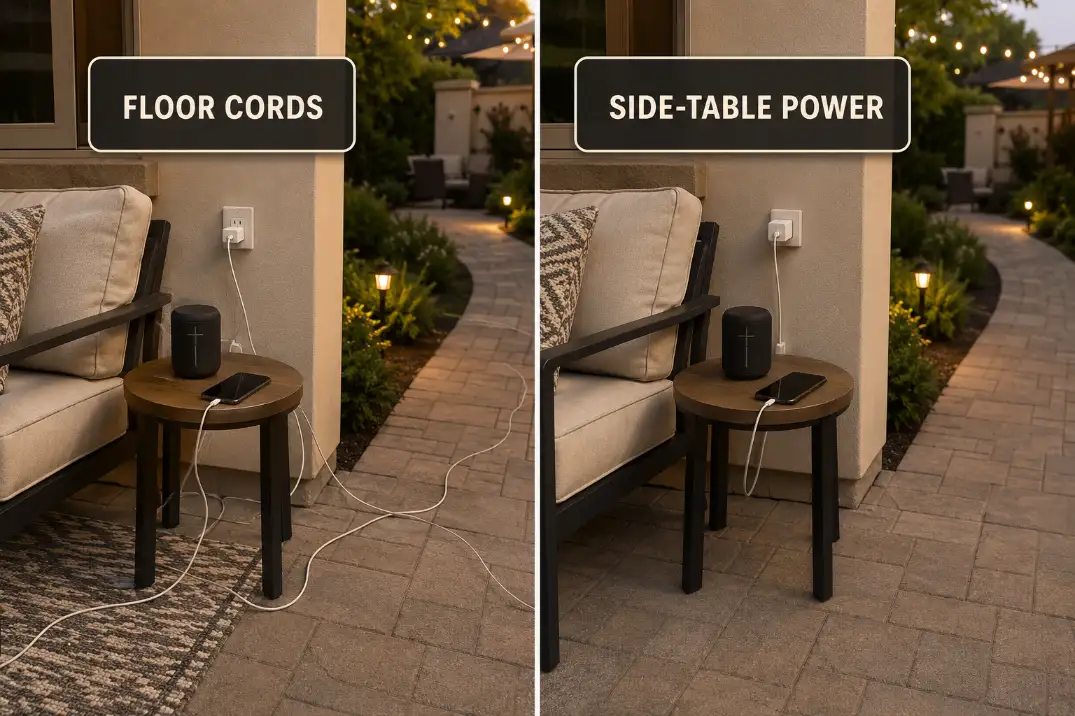
A charging point 2 feet from a chair feels natural. A charging point 9 feet away becomes a cord across the seating zone. That is the difference between useful access and visible clutter.
Small patios especially benefit from one strong charging spot instead of several weak ones. A single side-table power zone can serve a phone, small speaker, and occasional laptop without turning every corner into a device station.
Do not design around rare devices
Homeowners often overestimate rare uses. They plan around a projector, blender, heater, fan, speaker, laptop, string lights, and holiday decor all at once. But daily outdoor power usually has a smaller pattern.
Plan first for devices used weekly during the season. Then separate occasional heavy or unusual uses. A patio that works cleanly for phones, lights, a speaker, and a laptop will usually feel better than one designed around every possible device but filled with cords.
This is the point where routine fixes stop making sense. If one outlet is expected to power lighting, heat, charging, tools, and entertainment at the same time, the issue is no longer “where should I hide the cord?” The issue is whether the space needs a proper electrical plan.
Useful Without Visual Clutter
Good power access should make the patio easier to use without making it look like an equipment area. The goal is not to hide every cord. The goal is to make power feel intentional.
Use edges, posts, and furniture boundaries
Power looks cleaner when it follows lines that already exist: the house wall, fence, railing, planter edge, pergola post, or service side of a table. These boundaries already read as structure, so cords and small access points do not dominate the patio.
The weaker fix is adding objects to cover the problem. More planters, baskets, rugs, or boxes can make the patio harder to clean and harder to use. If the cord route is bad, decoration only delays the correction.
A better rule is simple: if power creates clutter in the center of the patio, move the function to the edge. If moving the function ruins the use, the patio may need a better permanent power location.
Keep the main route obvious
The best outdoor spaces keep movement readable. A back door, grill route, dining approach, and seating path should not require people to step over cords, squeeze between powered objects, or unplug something to use the space.
This is where power access overlaps with basic patio flow. If powered accessories start crowding the entry, the problem is not just electrical. It is circulation. Keeping the patio entry clear matters more than squeezing in another powered feature.
Quick access check before adding anything
Use this short test before buying accessories or planning a new outlet:
- Can the main walking route stay about 36 inches clear?
- Is the powered device within 3 to 6 feet of where it is used?
- Does the cord avoid doorways, chair pullback zones, and step edges?
- Can plug connections stay raised and away from water-prone areas?
- Will this setup be temporary for a weekend, or repeated all season?
- Is any single device close to 1,500 watts or likely to run for hours?
If the answers point to route problems, fix the layout first. If they point to repeated use, heavy loads, or unsafe cord habits, stop treating the cord as the solution.
The Better Idea Is Usually the Cleaner Relationship
Outdoor power access is worth improving when it changes behavior. If people avoid using the patio after dark, skip the work corner, leave phones inside, or drag cords across the same path every weekend, the space is not lacking accessories. It is lacking access in the right place.
The best sequence is selective: protect the walking route, place small charging near daily seating, start lighting from the correct edge, and reserve permanent electrical work for repeated seasonal use or heavier loads.
That creates a patio that feels easier without looking wired, cluttered, or overbuilt.
For broader official guidance on extension cord safety, see the Electrical Safety Foundation International.