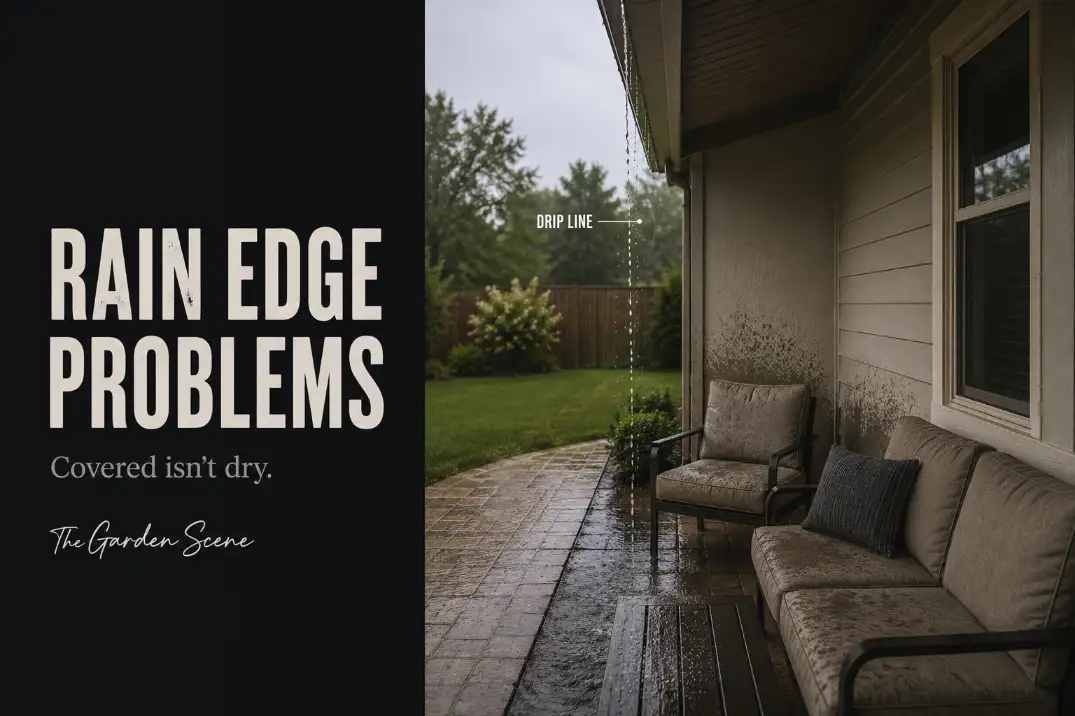
Rain edge problems around outdoor spaces usually start with one narrow failure pattern: roof runoff lands exactly where people pause, sit, step, grill, or enter the house.
The first check is not the whole patio. It is the wet line. If the darkest strip sits 12–24 inches below a roof edge, splash marks climb 6–18 inches up a wall or post, or the same area stays damp more than 4–6 hours after nearby paving dries, the edge is driving the problem.
This is different from a general yard drainage issue. Drainage problems usually spread water across a broader area or move runoff downhill. A rain edge problem is more precise.
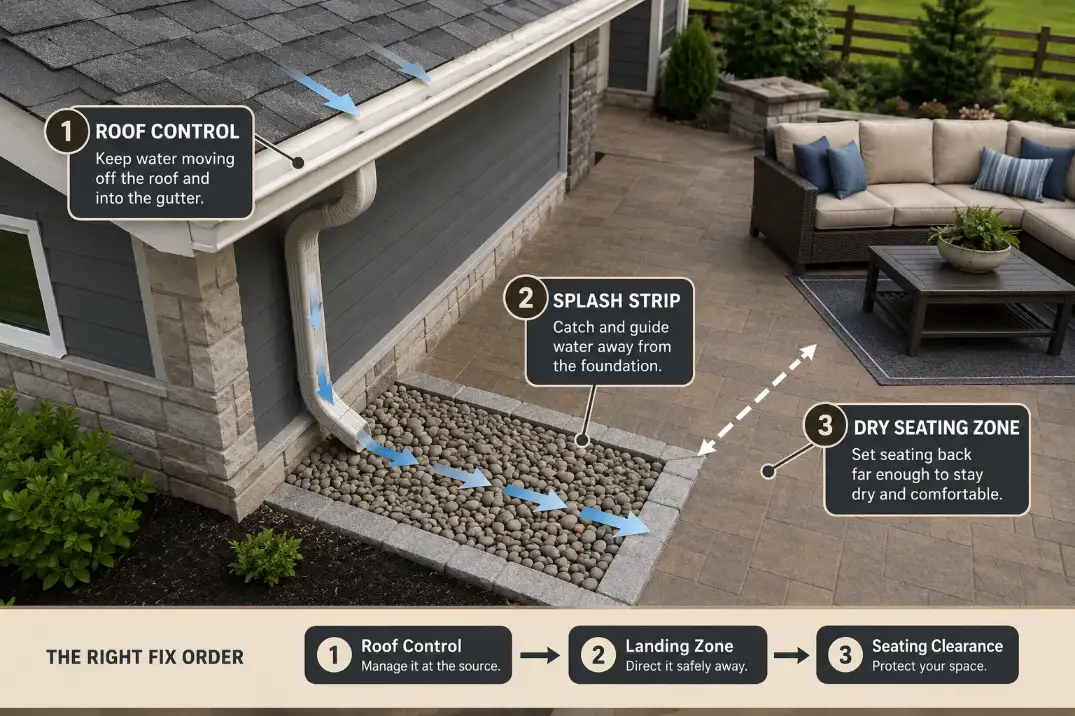
Water falls from above, strikes one strip, then creates splashback, slippery spots, mulch loss, or awkward seating. The quickest repair order is simple: control the roof edge first, protect the landing zone second, and only then worry about the patio surface.
Water Falls Where People Pause
The real problem is location, not volume
A small roof edge can create a bigger everyday problem than a large roof if the falling water lands at a back door, stair landing, grill approach, chair position, or narrow walkway. The issue is not only “too much rain.” It is rain landing in the wrong use zone.
A good outdoor pause zone should sit outside the falling-water strip. As a practical rule, keep chairs, doormats, storage baskets, and standing areas at least 18–30 inches away from the drip line when the patio allows it.
On tight patios, even shifting a chair or small table 12 inches inward can decide whether someone steps into runoff or beside it.
The wet stripe is the useful clue
Rain edge problems often look minor during the first few minutes of a storm. The paving darkens, mulch looks disturbed, or the front edge of an outdoor rug gets damp.
After 20–30 minutes of steady rain, the pattern becomes clearer: the same strip gets wetter, grit moves outward, and splash marks begin to show on lower surfaces.
That is why people often misread the problem at first. They blame the patio material, a low spot, or the furniture layout. Those can matter, but they are usually secondary. If the wettest area follows the roof edge, the wet paving is the symptom. Falling water is the mechanism.
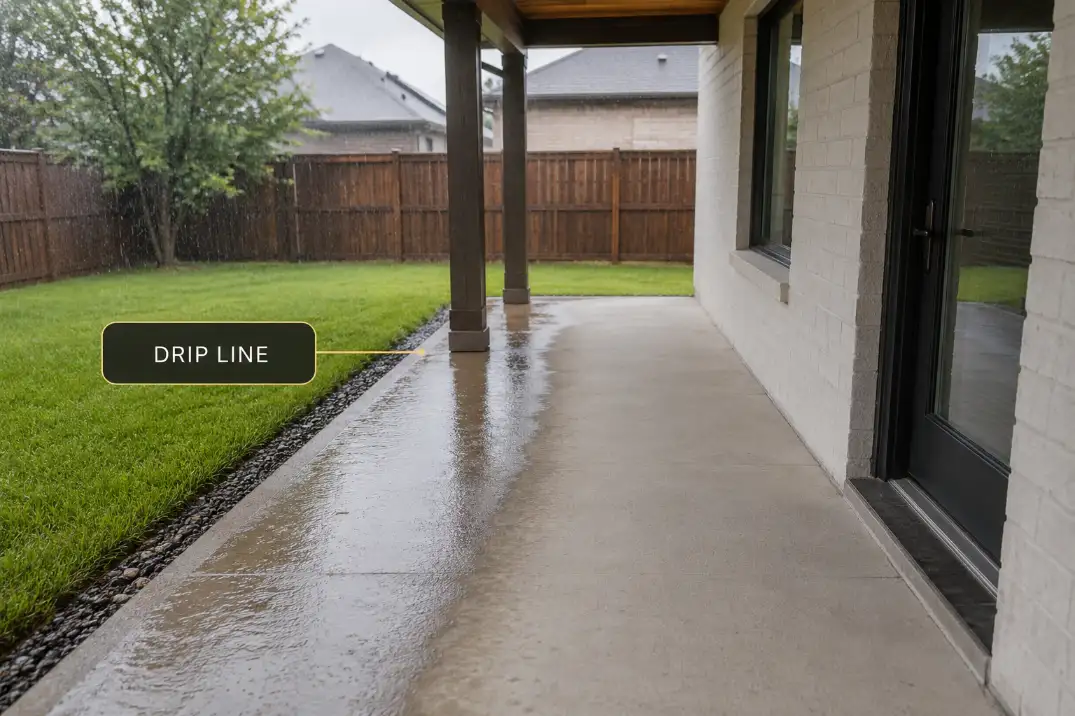
If the patio also holds water after the roof edge stops dripping, then the issue may overlap with Patio Drainage Layout Problems. But the edge still deserves its own diagnosis because resurfacing or re-sloping the patio will not stop water from falling in the same strip.
Roof Edges Create Wet Lines
Gutters are not always the whole answer
A gutter can solve the cleanest version of the problem: water leaves the roof in a sheet or repeated drops and lands in a bad place. But gutters do not fix every rain edge issue.
If water is blowing sideways, dropping from a roof valley, bouncing off a hard edge, or running back under a shallow overhang, the gutter may reduce the volume without fixing the usability problem.
This is where a standard fix gets overestimated. A gutter that moves most of the water away can still leave the most annoying discharge at a corner, valley, or poorly placed outlet.
Watch the edge during real rain before deciding. Hose testing can help, but it often misses wind and roof-valley behavior.
On a gutterless roof edge, the falling line should be treated as part of the layout, not as a surprise after the furniture is placed. The edge itself becomes a water feature whether it was designed that way or not.
Different edge patterns need different fixes
A straight roof drip usually points toward guttering, drip-edge correction, or a controlled receiving strip. A heavy drop at one corner is different. That is usually concentrated flow, and it needs a better outlet path before the ground fix matters.
If water falls in a steady rope from one point for more than 5 minutes during moderate rain, treat that as concentrated discharge, not ordinary dripping.
Splash blocks, decorative gravel, and thicker mulch rarely control that kind of impact for long unless the water has a clear path away.
| Visible sign | More likely cause | Better first move |
|---|---|---|
| Straight wet stripe below roof edge | Missing or ineffective edge control | Intercept or redirect water above |
| Heavy drop at one corner | Roof valley or concentrated outlet | Control the discharge point first |
| Wet paving only during wind | Wind-driven rain under cover | Move the use zone inward |
| Mulch crater below the edge | Repeated impact energy | Build a stronger receiving strip |
| Damp wall base after storms | Splashback or trapped runoff | Break the splash path and improve drying |
| Water sits near house 30–60 minutes | Grading or drainage concern | Fix water movement before finishes |
Covered Does Not Mean Dry
The roof footprint is not the dry footprint
A covered patio can still have a rain edge problem because “under cover” does not mean the entire floor is protected.
The usable dry zone is often 18–36 inches smaller than the roof footprint. Splashback, shallow overhangs, wind direction, and edge runoff shrink the area that actually stays comfortable.
This matters near doors and seating. A chair that looks safely tucked under cover in dry weather may still catch the drip line at the front legs. A grill can stay mostly dry on top while the cook stands in a wet strip at the roof edge.
In humid regions such as Florida and the Gulf Coast, a shaded wet edge may stay damp overnight, which increases mildew, staining, and slippery film.
In drier climates such as Arizona, the same edge may dry faster but still leave dirt rings and mineral marks. In northern states, the risk changes again: a shaded drip line near steps or a landing can freeze overnight when temperatures fall below 32°F, turning a small wet stripe into a safety issue.
Wind changes the usable layout
Rain rarely falls straight down during the storms that reveal these problems. A 10–15 mph wind can push rain several feet under a shallow roof edge, especially on open patios and porches.
The practical response is not always a bigger cover. Often, it is a better dry route and a seating layout that does not depend on the outer edge staying protected.
If only the outer 2 feet of a covered patio gets wet during storms, the cover may still be doing its job. If water repeatedly reaches the back door threshold, furniture backs, rug edges, or wall base, the problem has crossed from normal exposure into layout or edge-control failure.
For spaces where roof cover, furniture, door swing, and posts all compete, Covered Patio Furniture Layout Around Doors and Posts helps separate weather exposure from clearance so the fix does not create a new movement problem.
Splashback Changes the Ground
The landing zone takes the damage
Rain edge water does not simply land. It hits, rebounds, and moves material. That is why the strip below roof edges often looks worse than nearby areas.
Mulch thins out, gravel migrates, soil seals over, and dirt marks climb up siding, posts, chair legs, or step faces.
Splashback is usually strongest within the first 12 inches of impact. On bare soil or fine mulch, visible disturbance can appear after one hard storm.
On compacted ground, water may run sideways before soaking in, which makes the wet zone wider than the roof edge itself.
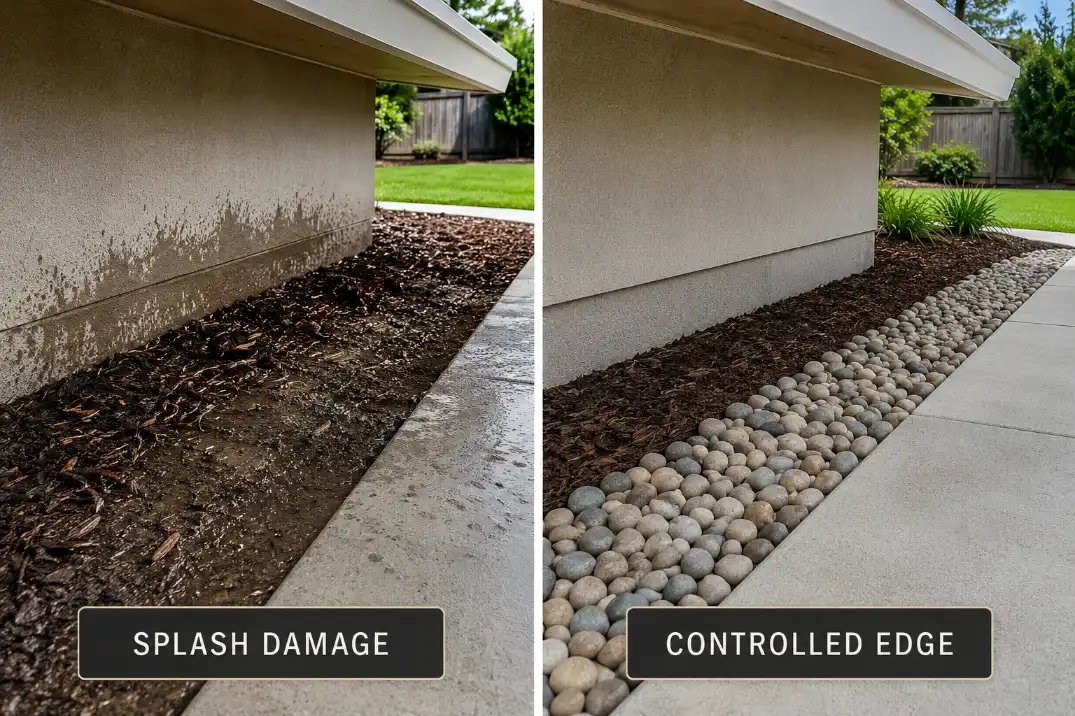
This is where homeowners often underestimate the ground. A neat-looking mulch bed is not automatically strong enough for repeated roof-edge impact.
Replacing mulch every season feels like maintenance, but if the same strip washes out after each storm cycle, the material is being asked to absorb a drainage job.
A better receiving edge usually has structure. For light-to-moderate drip, a 12–18 inch wide splash strip with 3–6 inches of washed stone can reduce rebound and keep mulch out of the impact zone.
The stone still needs containment, slope, and somewhere for water to move. Landscape fabric alone does not solve the impact if water keeps hitting the same spot hard.
If the main symptom is mulch repeatedly moving or thinning near an entry, bed edge, or patio border, the same failure pattern appears in Front Yard Mulch Washes Away Every Season, especially where roof runoff and foot traffic meet.
Pro Tip: Mark the wet edge after a storm with painter’s tape or small stones before buying new mulch. If the same strip fails twice, change the edge condition, not just the material.
Seating Should Avoid the Drip Line
Comfort fails before the patio fails
A rain edge problem does not have to flood the patio to make the space worse. Outdoor seating becomes frustrating when front chair legs sit in the wet zone, cushions catch spray, guests step across damp paving, or the grill user stands where roof runoff lands.
A 3-foot walking route can feel fine in dry weather and still fail in rain if 12–18 inches of it becomes wet.
That is the practical difference between a layout that works on paper and one that works after a storm. The patio may drain correctly, but the use zone is in the wrong place.
The edge seat is usually the weak seat
The edge seat is the chair nearest the lawn, roof edge, or open side of a covered patio. It often looks like the best place to save interior space, but it is also the first place hit by drip, wind-blown rain, and splashback.
Move seating inward before adding accessories. A rug, storage box, or planter will not fix a chair sitting under the drip line. In fact, those items often slow drying.
A rug edge that stays damp more than 24 hours after moderate rain is a warning sign, especially under cover where sun and airflow are limited.
This is why patio layout and water control should be judged together. If furniture keeps forcing people into damp edges, Keep Patio Entry Clear is a useful companion because the dry route from the door matters as much as the seating shape.
Fix the Edge Before the Floor
Resurfacing comes later
The repair that often wastes the most money is resurfacing the patio before solving the falling-water source.
New pavers, a cleaner slab, a nicer finish, or a fresh sealer can improve appearance, but they do not stop roof-edge impact. If water still falls in the same line, the new surface inherits the old problem.
Start above the ground. Check whether the roof edge needs a gutter, a downspout move, a corrected outlet, a rain chain with a real receiving basin, or attention at a concentrated roof valley. Then check the landing zone. The floor finish should not become the main investment until the water path is known.
If water is collecting near the house wall, compare the pattern with Patio Water Pooling Against the House before adding surface treatments. A comfort issue becomes more serious when runoff sits near the foundation side instead of moving away.
Product choices should match the failure
Not every rain edge needs a drain. Light drip may need a stronger splash strip. Concentrated corner flow may need downspout correction. Erosion at the landing zone may need edging, stone containment, splash blocks, or erosion-control material before the patio finish matters.
For that kind of repair decision, Best Drainage Erosion Control Products for Backyards fits better than a general patio upgrade because the problem is water impact and soil movement, not surface appearance.
A quick diagnostic checklist
- The wettest strip sits directly below the roof edge, not randomly across the patio.
- Splash marks appear 6–18 inches up siding, posts, steps, or chair legs.
- Mulch, soil, or gravel shifts after each hard rain while nearby areas stay stable.
- Covered areas stay damp along the outer 18–36 inches while the inner patio dries faster.
- Seating, grill use, or door access crosses the wet line during or after storms.
- Water remains near the house for more than 30–60 minutes after rain slows.
The cleanest repair sequence
First, observe the edge during real rain. Second, mark the wet line after the storm. Third, move furniture and pause zones out of the impact strip. Fourth, intercept or redirect roof water where volume is concentrated. Fifth, rebuild the landing zone with a material that can handle impact and drain.
After those steps, evaluate the patio surface. If it has settled, slopes toward the house, or holds water beyond the drip line, surface correction may be justified. But if the failure line follows the roof, the edge is still the decision point.
For broader official guidance on using planted low areas to collect roof and hard-surface runoff, see the U.S. EPA rain garden guidance.