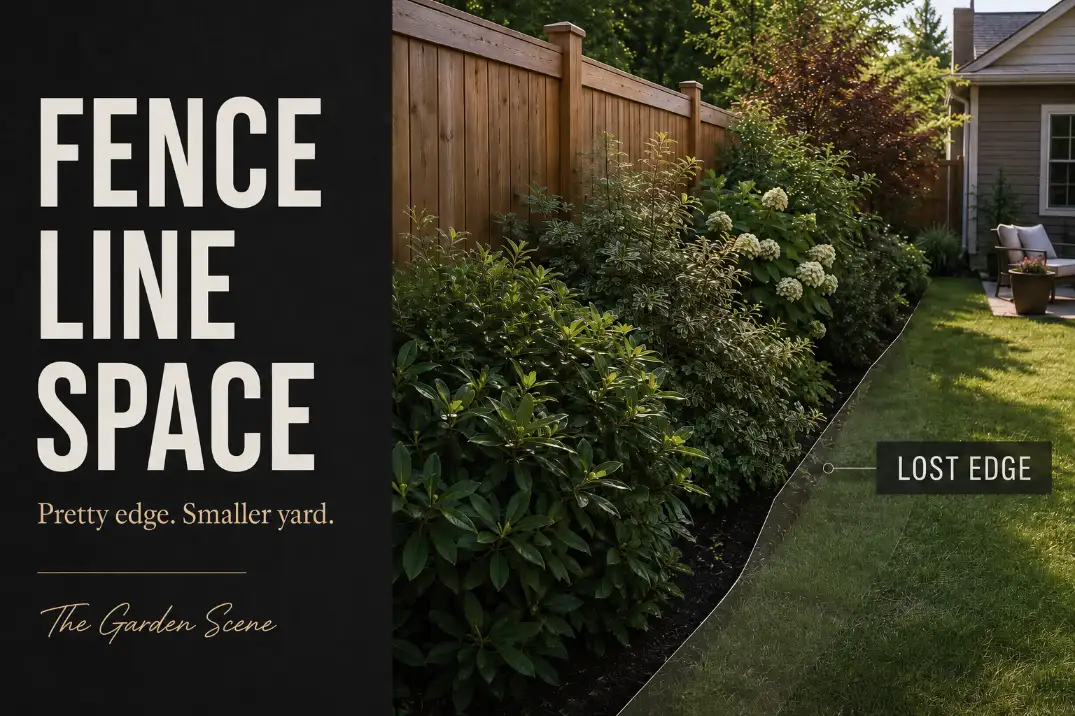
Fence line landscaping should soften the boundary without creating a second boundary inside the yard.
The most common problem is not that the yard is too small; it is that shrubs, mulch, edging, and maintenance gaps slowly move the usable edge inward.
Check mature plant width first, not nursery size. Then check whether you still have an 18- to 24-inch service strip near the fence and whether the open center of the yard still feels wider than the planted edge.
A shrub row that gains just 6 inches along a 40-foot fence line takes about 20 square feet from the yard.
This is different from a privacy problem. More planting may block a view, but it can also make the whole yard feel tighter.
The better fence line usually uses lower layers, selective height, and a clean maintenance strip instead of one continuous green wall.
The Edge Steals Space
A fence line steals space when the planted border becomes wider than the job it needs to do. At first, the edge may look neat: a few shrubs, a mulch line, maybe a soft curve to break up the fence.
After two or three growing seasons, the same edge can feel like it has moved several feet into the lawn.
What to measure first
Before adding plants, measure five things:
- the mature width of each plant
- the planting distance from the fence
- the maintenance strip behind or beside the plants
- the remaining open lawn or patio width
- the exact view line that actually needs screening
If those numbers do not work together, the planting will not stay clean. A 5-foot-wide shrub planted 18 inches from a fence is not a tight design. It is a future pruning problem.
The symptom is tightness, but the mechanism is encroachment
The yard may still have the same property dimensions, but the usable center feels smaller because the edge has become visually and physically heavier. This is why a fence line can look “finished” in photos and still feel wrong in daily use.
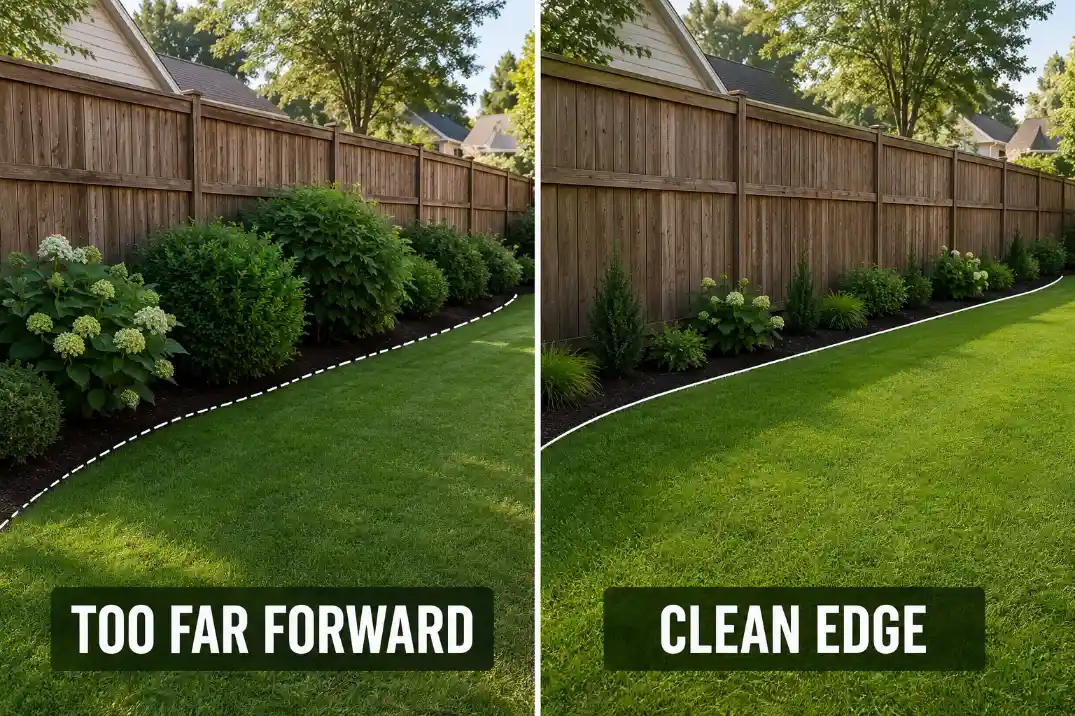
A deep curved bed can make the problem worse. Gentle curves soften a long fence. Deep scallops create mowing pockets, awkward trimming turns, and unnecessary lost lawn.
If the bed edge swings forward every 6 to 8 feet, it may be decorative, but it is also taking working space from the yard.
That same pattern shows up when an overplanted backyard feels smaller even though the square footage has not changed. The plant mass becomes the new boundary.
Layout Check: Lay a garden hose where the future bed edge will sit and leave it for a day. If the yard suddenly feels narrow from the patio or back door, the bed is already too deep.
Planting Too Close
The most common fence line mistake is using planting-day size as the spacing guide. Young shrubs look small, so they get pushed close to the fence and close to each other. That creates quick fullness, but it leaves no room for mature spread.
Nursery size is the wrong reference point
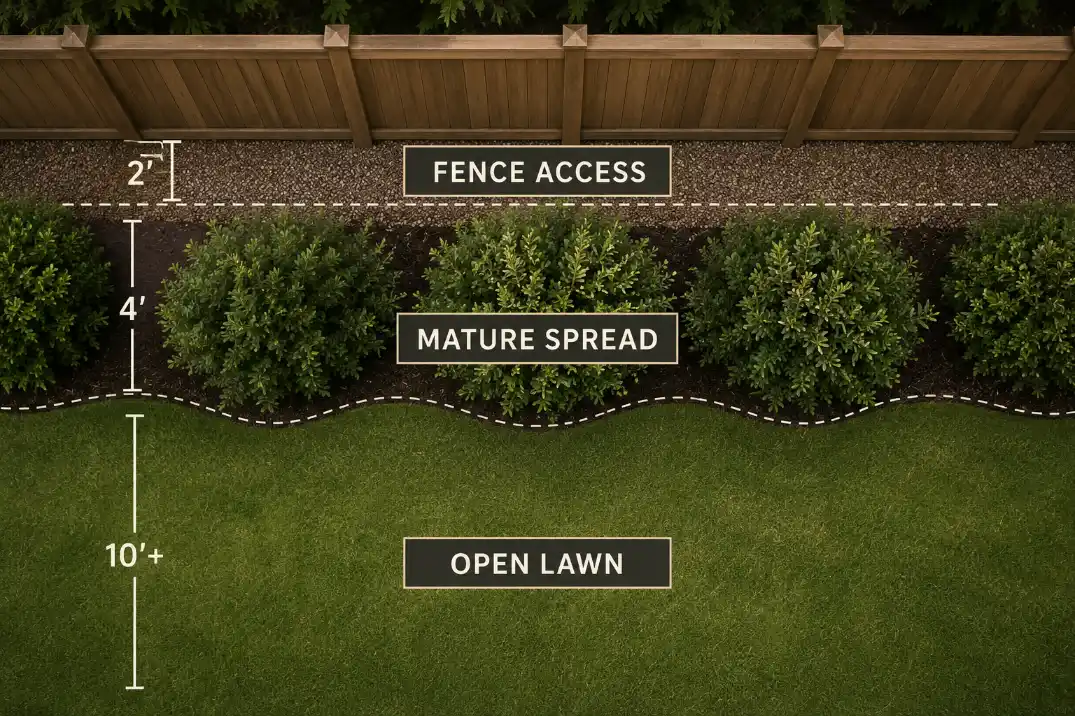
A shrub that is 18 inches wide in a pot may mature at 4 to 6 feet wide. If the mature spread is 4 feet, the center of the plant usually needs to sit at least 2 feet from the fence just to avoid constant rubbing. If you also need access behind it, the spacing needs to increase.
Planting 12 inches from the fence may work for narrow grasses, compact perennials, or very slim upright plants. It usually fails with woody shrubs, spreading evergreens, and hedge plants that need repeated shearing.
When branches press into a wood fence, the issue is not only appearance. Leaves and stems slow airflow, and a damp fence line can stay wet for 24 to 48 hours after normal rain. In humid regions like Florida and the Southeast, that drying delay matters more than homeowners often expect.
Choose by growth habit, not just height
Height gets too much attention. Width and growth habit usually matter more along a fence.
Upright, narrow plants are safer in tight fence lines because they add vertical interest without spreading far into the yard. Spreading shrubs need more depth.
Suckering shrubs can creep beyond the original bed. Vines can be useful on strong structures, but they make fence repair harder and may cross into a neighbor’s side.
Bamboo and aggressive hedge plants are usually too risky unless they are fully controlled.
Buying Check: In tight fence lines, favor plants or narrow screening pieces with a clear mature width. The guide to best plants and materials for narrow side yards fits this decision better than a generic shrub list.
The fix that wastes time
Repeated pruning is the fix people overtrust. Pruning can refine the right plant in the right place. It cannot make a 6-foot-wide plant behave like a 2-foot-wide plant without making it look chopped, stressed, or bare inside.
If a shrub needs hard cutting two or three times every growing season just to keep the lawn edge open, the routine has stopped making sense. The plant is too large for the fence line.
Keep a Maintenance Strip
A fence line without a maintenance strip may look clean at first, but it becomes difficult to weed, trim, stain, wash, inspect, and repair. This is one of the most underestimated parts of fence line landscaping.
The strip can be narrow, but it cannot disappear
For most residential fence lines, an 18- to 24-inch maintenance strip is enough. In very tight yards, even 12 inches is better than planting directly against the fence.
If the strip also supports movement — a mower, wheelbarrow, hose route, trash bin path, or side-yard access — the clear route should usually be closer to 30 to 36 inches.
That access measurement matters more than a perfect planting layout. A fence line beside a gate, garage path, or narrow side yard is working space first and decoration second.
The same rule applies when planning side yard access for mowers and wheelbarrows: if the route fails, the planting design cannot rescue it.
Different fences need different access
A wood fence needs airflow and enough room for staining or board repair. A vinyl fence needs cleaning access, especially where sprinklers leave mineral marks.
A chain-link fence can disappear visually with vines, but vines also create maintenance and neighbor-side spread problems. A shared fence needs the most restraint because anything planted too close can become a two-yard issue.
The maintenance strip does not need to look bare. Gravel, compacted fines, stepping stones, mulch held by firm edging, or a narrow no-plant zone can all work.
Mulch should usually stay around 2 to 3 inches deep and should not be piled against posts or boards.
Gravel looks cleaner under shrubs, but it needs edging or it will spread into lawn and make trimming harder.
Low Layers Near the Fence
A fence already provides height. Adding another tall, continuous wall directly in front of it often creates bulk without solving the real problem.
The stronger design usually starts lower, then adds height only where privacy is actually needed.
Three fence line models that keep the yard open
A low border works when the fence already blocks most of the view. Use compact shrubs, grasses, perennials, or groundcovers in the 12- to 24-inch range to soften the base without dragging the eye inward.
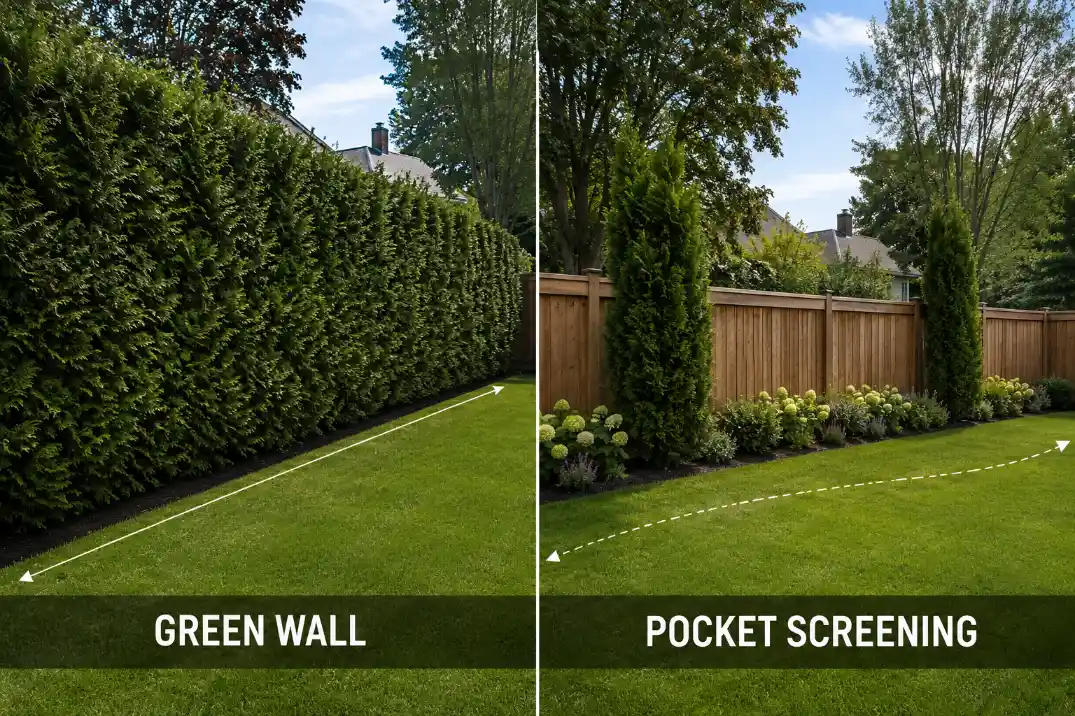
A pocket screen works when only one or two view lines matter. This may be a neighbor window, a patio exposure point, or a dining area that feels open from one angle.
A single upright evergreen, small ornamental tree, or clustered planter can solve that view without turning the whole fence into a hedge.
A slim vertical accent works when the fence looks flat but the yard cannot afford a deep bed. Narrow upright plants, vertical trellis panels, or controlled planters can add rhythm without taking a 4-foot bite out of the lawn.
In very tight spaces, narrow planters and privacy screens for side yards can be more practical than in-ground shrubs.
Use height where the view requires it
The common mistake is treating the entire fence line as if it has the same privacy problem. It rarely does. Most yards need screening at specific points, not everywhere.
A 6- to 8-foot upright plant at one exposed view line can feel lighter than a 4-foot hedge running the full fence. The eye reads breaks as open space. It reads continuous mass as a wall moving inward.
In cold northern states, leave room for snow load and winter spread. Plants that look controlled in June may bend outward under wet snow. In dry desert conditions, the issue is different: dense planting against a sun-facing fence can trap reflected heat, so airflow and spacing become more important than lush coverage.
Avoid the Green Wall
The green wall is the fence line version of overcorrecting. It starts with a reasonable goal: soften the fence, add privacy, and make the yard feel finished. The problem is that continuous tall planting often compresses the yard more than it improves it.
Most yards need interruptions, not a wall
A planted edge begins to feel heavy when the mass is taller than about two-thirds of the fence height for most of the run. On a 6-foot fence, a continuous 4-foot hedge can already feel visually thick in a small or rectangular yard.
This does not mean tall plants are wrong. It means tall plants need a reason. Use them at windows, seating exposure points, neighbor-facing gaps, and awkward sightlines. Skip them where the fence already does the screening.
The condition readers often overestimate is the value of total coverage. The condition they underestimate is how much openness comes from breaks, low layers, and clean negative space.
A shared fence yard needs even more restraint. If seating, shrubs, and a fence all stack into one thick boundary, the yard starts to feel boxed in.
That pattern is common in backyard layout mistakes in shared fence yards, especially when furniture sits close to the planted edge.
A better comparison
| Fence line choice | Best use | Main risk |
|---|---|---|
| Full tall hedge | Strong privacy along an exposed boundary | Makes the yard feel narrower |
| Low planted border | Softens the fence without taking much space | Does not solve major view problems |
| Pocket screening | Blocks specific sightlines | Needs careful placement |
| Bare access strip | Keeps maintenance simple | Can look unfinished without edge control |
| Narrow upright accents | Adds height with less spread | Looks repetitive if overused |
A Cleaner Yard Edge
A cleaner fence line is not necessarily sparse. It is disciplined. It gives the fence a finished base, leaves room for maintenance, and protects the open center of the yard.
Build the edge in the right order
Start by protecting the open center. Decide how much lawn, patio, or usable surface must remain before choosing plants. In a narrow yard, this decision comes first.
Next, mark the maintenance strip. Use 18 to 24 inches as the normal target, and widen it where access matters. Do not let mulch, edging, or plant spread erase that strip.
Then choose plants by mature width. A plant that matures at 3 feet wide belongs in a different layout than one that matures at 6 feet wide. Pot size is temporary. Mature spread is the real design measurement.
Finally, set a simple bed edge. A straight or gently curved edge is easier to maintain than a deep scalloped edge. If the mower or string trimmer has to fight the shape every week, the design is too decorative for the space.
When replacement beats more trimming
The standard fix is pruning, redefining the edge, and refreshing mulch. That works when the plant choices are close to right. It stops working when the bed keeps widening, shrubs keep leaning into the lawn, or the fence side cannot be reached without stepping through plants.
At that point, removal or replacement is the cleaner fix. Pull the worst offenders, reset the bed depth, and rebuild the line around mature size. This often gives the yard back faster than another season of cutting.
Fence line landscaping should make the boundary calmer, not bring the boundary closer. The best version leaves room for growth, room for maintenance, and enough open space for the yard to still feel like a yard.
For broader plant spacing and care guidance, see the University of Minnesota Extension.