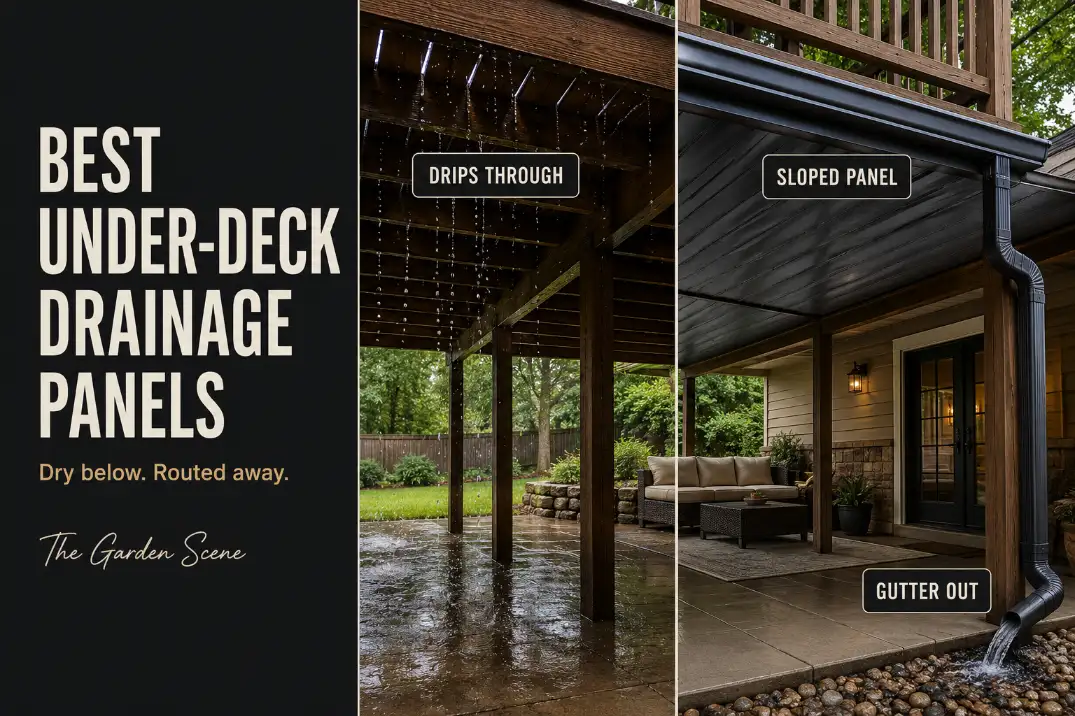
Under-deck drainage panels are worth buying when rain is falling through the deck boards and making the space below too wet for storage, seating, or a small covered patio zone.
They are not the right first purchase if the real problem is yard runoff, water pooling against the house, or damp ground that stays wet even after the deck stops dripping.
Start with three checks before shopping: watch the area during a 20–30 minute rain, mark whether water falls from above or runs in from the yard, and see whether the space dries within 24–48 hours after normal weather returns.
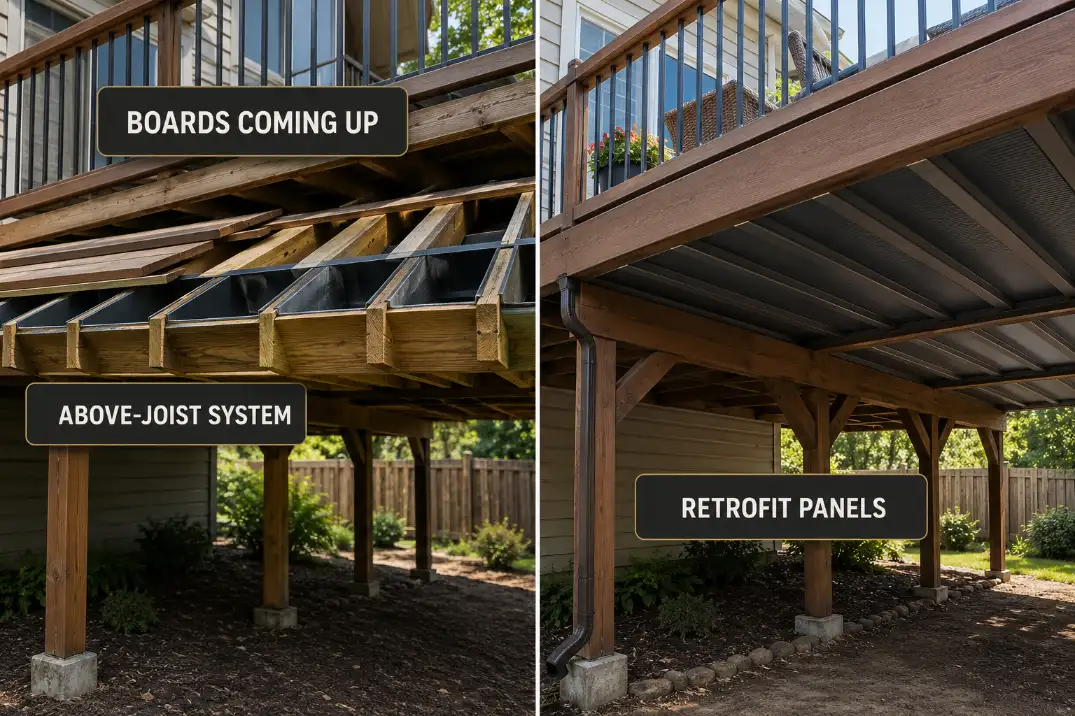
If water mainly comes through the deck boards, shop for a panel, membrane trough, or drainage system. If the deck boards are coming up anyway, choose an above-joist trough system first. If the existing deck surface is staying, choose an under-joist panel or ceiling-style drainage system.
The best product is not simply the panel that looks cleanest. It is the system that creates a slope, catches the water, sends it to a gutter or outlet, and still leaves enough access for inspection.
FIRST BUY WHEN WATER FALLS FROM ABOVE
Under-deck drainage membrane troughs and kits
Choose this category when rain is clearly passing through the deck boards and the ground below is not the main moisture source. Look for trough material, joist-spacing fit, outlet compatibility, and a clear path to a gutter or downspout.
🔴 SHOP UNDER-DECK DRAINAGE MEMBRANE TROUGHS AND KITS
Match the Drainage Panel to the Deck Stage
The strongest buying decision is not brand first. It is deck stage first. A new deck, a rebuilt deck, and an existing deck all point toward different drainage products.
New or rebuilt deck: choose above-joist trough drainage
If the deck boards are being removed or replaced, an above-joist trough system is usually the best long-term choice. It catches rain higher in the assembly before water soaks the framing below. That matters because the under-deck space can look dry while the joists, beams, or ledger area still keep getting wet.
This is the higher-value route when you are already paying for deck work. Waiting until the boards are back down and then adding a ceiling below can still make the lower space more usable, but it usually does less to protect the framing.
Existing deck: choose under-joist panels
If the deck surface is staying, under-joist drainage panels are the practical choice. These attach below the deck framing and create a sloped ceiling that catches water after it passes through the board gaps.
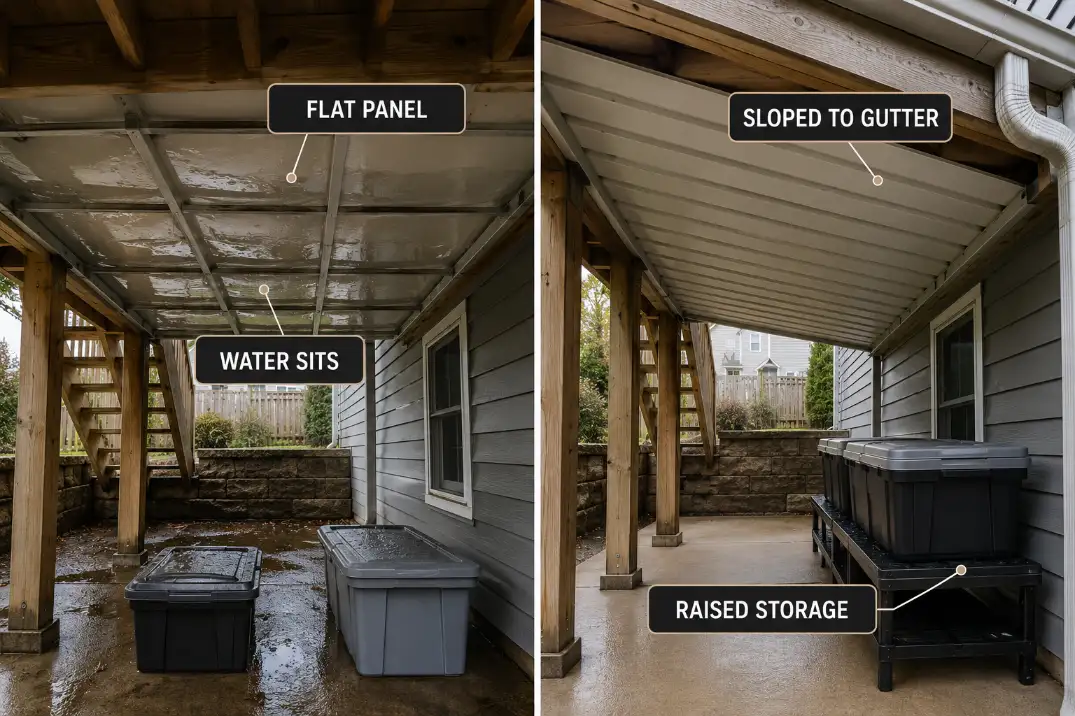
This type can work well for storage bays, grill-tool zones, and covered utility areas, but the slope cannot be guessed. A flat panel is not a drainage system. A panel should clearly move water toward a gutter, outlet, or safe discharge edge.
Finished patio below: choose drainage-rated ceiling coverage
If the space below the deck will be visible from a patio, back door, or seating area, the ceiling look starts to matter. But appearance should not replace drainage logic. A cleaner ceiling below a deck still has to move water, allow inspection, and avoid trapping damp air.
Buying Check: If you want a finished ceiling look, make sure the product is made for exterior under-deck drainage, not indoor drop ceilings, acoustic panels, or decorative wall panels. It should still show a water path, outlet access, and a way to inspect or clean the system later.
What the Panels Must Control
Under-deck drainage is not difficult because water falls down. It is difficult because water spreads sideways, clings to joists, follows seams, carries debris, and dumps wherever the system gives up.
Slope matters more than panel coverage
A panel that covers almost the whole underside can still fail if it sags, sits flat, or ends at the wrong edge. The useful threshold is simple: after a normal rain, water should not be sitting in panel low spots 12 hours later. If it is, the system is holding water instead of moving it.
A slight pitch toward a gutter is more important than a perfect-looking ceiling. For most under-deck storage areas, a working slope and outlet beat a decorative panel that hides the problem.
The outlet is part of the product decision
A drainage panel without a good outlet is only half a purchase. Collected water has to leave the deck area without dumping beside the foundation, onto a muddy strip, or across the walking route below.
This is where cheaper DIY panel jobs often fail. They make the underside look cleaner but send water to a beam edge, stair opening, patio joint, or house wall.
Once the panels collect water, the next buying decision is where that water exits. If the kit does not include a clean gutter or outlet path, shop those parts with the panels instead of treating them as optional add-ons.
DO NOT LEAVE THE SYSTEM HALF-FINISHED
Under-deck drainage downspouts and outlet pieces
Choose these when the panels collect water but still need a safe way to move it away from the house, patio edge, storage zone, or walking path.
🔴 SHOP UNDER-DECK DRAINAGE DOWNSPOUTS AND OUTLET PIECES
Airflow still matters after the panels go in
Panels reduce water from above, but they do not turn the space into an indoor room. In humid climates, shaded under-deck areas can stay damp because air movement is weak. If the space still smells musty after 48 hours of dry weather, the problem is no longer just deck-board drip. It is drying.
Best Panel Types by Under-Deck Use
The best under-deck drainage panel is different for storage, finished seating, and budget utility coverage. Buy for the job below the deck, not only for the product photo.
Best for dry storage: membrane troughs or sloped panel kits
For storage, choose a membrane trough or sloped under-deck drainage panel kit before choosing a finished ceiling look. The goal is to keep bins, tools, folding chairs, seasonal gear, and outdoor toys out of repeated drip zones.
Storage should still sit 2–4 inches off the floor on a shelf, rack, or raised base. Panels stop water from above. They do not stop splashback, damp concrete, or humidity trapped at ground level.
If the under-deck layout is still unclear, Under Deck Space Ideas for Water and Storage is the better planning step because it separates dry bays, drip edges, and service zones before you start filling the space.
Best for a finished sitting area: drainage-rated ceiling coverage
A sitting area below a deck needs more than “mostly dry.” It needs fewer visible drips, a cleaner ceiling, a controlled outlet, and enough ventilation that cushions and chair fabric do not stay damp.
This is where homeowners often make the wrong purchase. Indoor ceiling panels, acoustic panels, and decorative wall panels are not substitutes for an under-deck drainage product. If the lower space needs to look finished, the product still has to be part of an exterior water-control system.
For soft goods, the drying standard is stricter. A plastic storage bin may tolerate a slightly damp zone; cushions will not. If fabric is part of the plan, read the warning signs in Outdoor Cushion Mildew Problems before treating the under-deck space like a normal covered porch.
Best for utility-only coverage: corrugated DIY panels
Corrugated vinyl or plastic panels can work for a simple utility bay, especially where appearance is not the priority. They are usually easier to buy, cut, and handle than full ceiling systems.
The tradeoff is seam control. If the panels are flat, poorly overlapped, or aimed at the wrong discharge edge, they create water shelves. This is acceptable only when the space below is for rugged storage, not cushions, furniture, or a finished patio.
Buying Check: Corrugated panels are not automatically bad. They become bad when they are used as a cheap substitute for slope, outlet planning, and service access.
Under-Deck Drainage Panel Comparison
| Product type | Best use | Strongest buying reason | Main warning |
|---|---|---|---|
| Above-joist trough system | New deck or board replacement | Catches water before it soaks framing | Harder to add after boards are installed |
| Membrane trough kit | Existing deck water control | Targets water falling through board gaps | Must match joist spacing and outlet path |
| Under-joist panel kit | Existing raised deck | Practical retrofit below the framing | Needs clear slope and outlet planning |
| Drainage-rated ceiling coverage | Finished patio or seating below | Cleaner look with water-control purpose | Avoid indoor ceiling products |
| Corrugated DIY panels | Utility storage bay | Lower-cost coverage for rugged use | Easy to install too flat |
| Gutter outlets and extensions | Completing any panel system | Moves collected water away | Often forgotten until leaks appear |
Where Cheap Fixes Usually Waste Money
The obvious fix is to cover the underside with panels and stop seeing the drips. That feels satisfying, but it is not always the real solution.
Caulked seams are not a drainage plan
Caulking every seam can make sense as part of a system, but it should not be the main strategy. Exterior deck structures move, expand, collect grit, and get wet repeatedly. A good system assumes water will enter and gives it a route out.
The goal is not to make the underside behave like an indoor bathroom ceiling. The goal is to collect, slope, discharge, and dry.
A pretty ceiling can hide a bad water path
A bright, finished ceiling makes the area feel upgraded, but the real test is where water exits and whether the lower space actually dries. If the outlet dumps onto the patio edge, beside the foundation, or into a low spot below the deck, the system is unfinished.
When the patio surface below already has drainage issues, Patio Drainage Layout Problems should be checked before assuming panels alone will fix the wet zone.
Ground water beats ceiling panels
If the floor below the deck gets wet from the yard side, panels overhead cannot solve the main problem. Watch the ground during rain. If water runs across the under-deck area, rises from low soil, or stays muddy for days, the first fix is surface drainage.
This is especially important on clay-heavy yards, sloped lots, and Midwest properties that get heavy seasonal rainfall. In those cases, the wet floor may be telling you more than the wet ceiling.
A panel system makes sense only after you know the water is coming mainly through the deck boards. If the yard itself is feeding the wet area, Yard Drainage Problems from Soil, Slope, and Runoff is more important than comparing ceiling panel colors.
When the Panel System Still Needs a Site Fix
Drainage panels can make a wet under-deck area much more useful, but they should not be treated as a cure for every moisture problem below a deck.
Water against the house is a stop sign
Water that exits beside the foundation is not a small detail. The under-deck space may look cleaner, but the drainage job is not complete if collected water ends up against the wall, back door, or slab edge.
The safer route is to move water away from the house, into a suitable drainage path, or toward an area already designed to handle runoff. The outlet should not create a new wet strip where people walk or where storage sits.
If water already pools near the slab, back wall, or door area, Patio Water Pooling Against the House should be handled before you treat the ceiling system as finished.
Very low decks are harder to maintain
Low deck height changes the decision. If there is not enough room to see the panels, clean the outlet, or service a sagging section, a drainage ceiling can become a hidden maintenance problem.
In that case, a simpler ground-level mud-control or storage strategy may be more practical than a full panel system. A product that cannot be inspected is not a low-maintenance product.
A dry, dark storage cave can create new problems
A drier under-deck area can become more useful, but it can also become more attractive for clutter, nesting, and hiding. If bins, bags, cushions, or tools are pushed tight to the ground, drainage panels may create a cleaner-looking version of the same problem.
Storage should stay raised, visible, and easy to pull out. For storage-heavy under-deck spaces, Rodent Hiding Spots Under Decks and Storage is worth checking before turning the whole bay into a covered storage cave.
Best Practical Setup for Most Wet Under-Deck Spaces
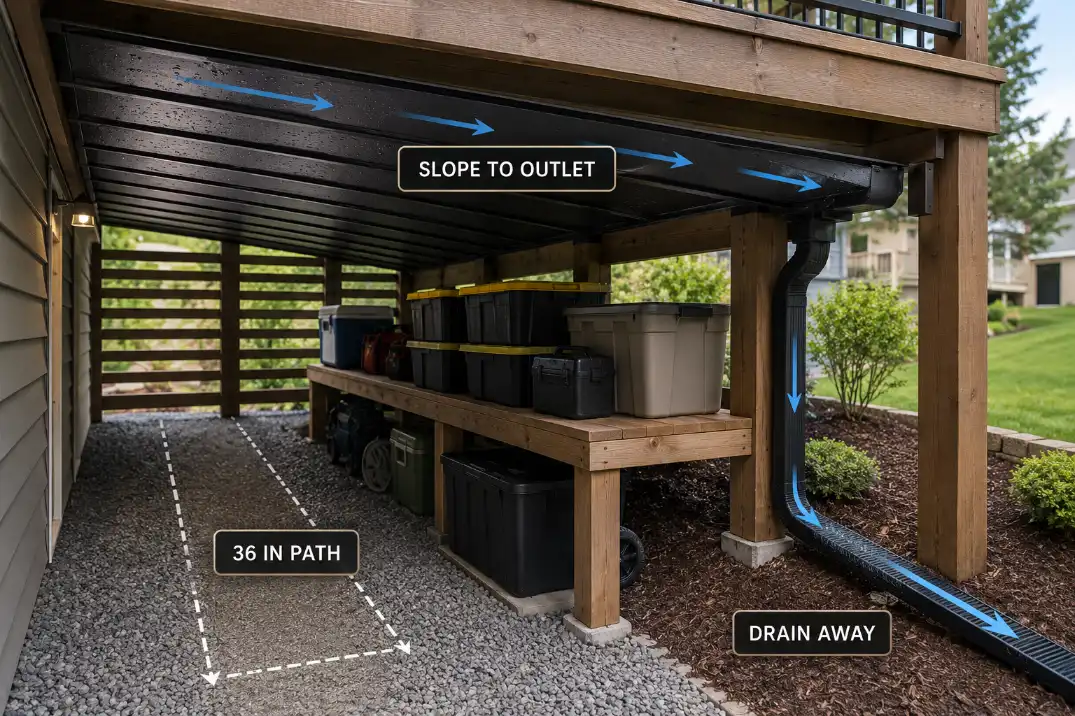
For most homeowners, the best setup is a matched membrane trough or drainage panel system, a planned slope, a gutter or outlet, a drainage extension, raised storage, and enough open edge for airflow.
Use the three-zone layout
Divide the under-deck space into three zones: the naturally drier bay near the house or protected side, the drip-heavy open edge, and the discharge route. Put storage in the dry bay first. Keep the discharge route clear. Do not force the wettest edge to become the seating area just because it looks open.
A 36-inch walking lane is still useful below a deck, especially if the area connects the back door, hose, side yard, trash route, or storage wall. Drainage panels should make the space easier to use, not turn it into a packed crawl-through storage zone.
Start with hard storage before soft seating
A dry-looking under-deck area should prove itself before it gets cushions, outdoor pillows, or fabric chairs. Start with sealed bins, a raised shelf, washable tools, or folding furniture. If those stay clean and dry through several storms, then seating becomes more realistic.
The healthier condition is simple: no active dripping after rain, no water sitting in panel low spots after 12 hours, and no musty smell after 24–48 hours of dry weather. If the space fails those tests, the panels need adjustment or the ground drainage needs attention.
Buy the boring parts with the visible panels
The panel field gets the attention, but the boring parts often decide the outcome. Check whether the kit includes or supports outlet pieces, gutter connection, seam tape, trim, fasteners, and cleaning access. If those parts are vague, the installation may depend too much on improvisation.
Buying Check: Before ordering, measure joist spacing, deck height, beam interruptions, stair openings, post locations, and the planned discharge side. A system that works on straight 16-inch-on-center joists may become awkward around irregular framing.
Questions People Usually Ask
Are under-deck drainage panels better than outdoor storage boxes?
They solve different problems. Drainage panels control water from above. Storage boxes protect individual items from humidity, splashback, pests, and dust. For cushions or fabric, use both: drainage overhead and sealed raised storage below.
Can I install under-deck panels myself?
Some under-joist panel kits are DIY-friendly on simple, straight, accessible decks. The difficulty rises around low deck height, beams, posts, stair openings, irregular joist spacing, and complicated outlet routes. If you cannot maintain slope and service the outlet later, a cheap DIY install can become the expensive version.
Should I choose vinyl, aluminum, or trough-style drainage?
Choose trough-style drainage when the deck boards are already coming up. Choose membrane troughs or under-joist drainage panels when the deck exists and the main problem is water falling through board gaps. Choose aluminum or other finished ceiling-style products only when durability, exterior compatibility, and a cleaner long-term ceiling feel matter more than the lowest cost. Use corrugated panels only for utility-grade coverage where appearance and perfect seam control matter less.
Do under-deck panels make the space completely waterproof?
No. They should make the area controlled and much drier, not indoor-dry. Wind-driven rain, splashback, condensation, humidity, and ground moisture can still affect the space. That is why airflow, raised storage, and a clean discharge route still matter after installation.
Final Verdict
The best under-deck drainage panels are the ones that match the deck stage and the space below. If the deck is being built or rebuilt, above-joist trough drainage is the stronger long-term choice.
If the deck already exists, an under-joist membrane trough or drainage panel system is usually the more practical buy. If the goal is only rugged storage, corrugated panels can help, but only when slope and discharge are handled cleanly.
Do not buy the prettiest ceiling first. Buy the water path first. Once the panels slope correctly, the outlet sends water away, storage stays raised, and the space dries within a normal 24–48 hour window, the area below the deck can become useful instead of just covered.
For broader official moisture-control guidance around homes, see the EPA’s guide to mold, moisture, and your home.