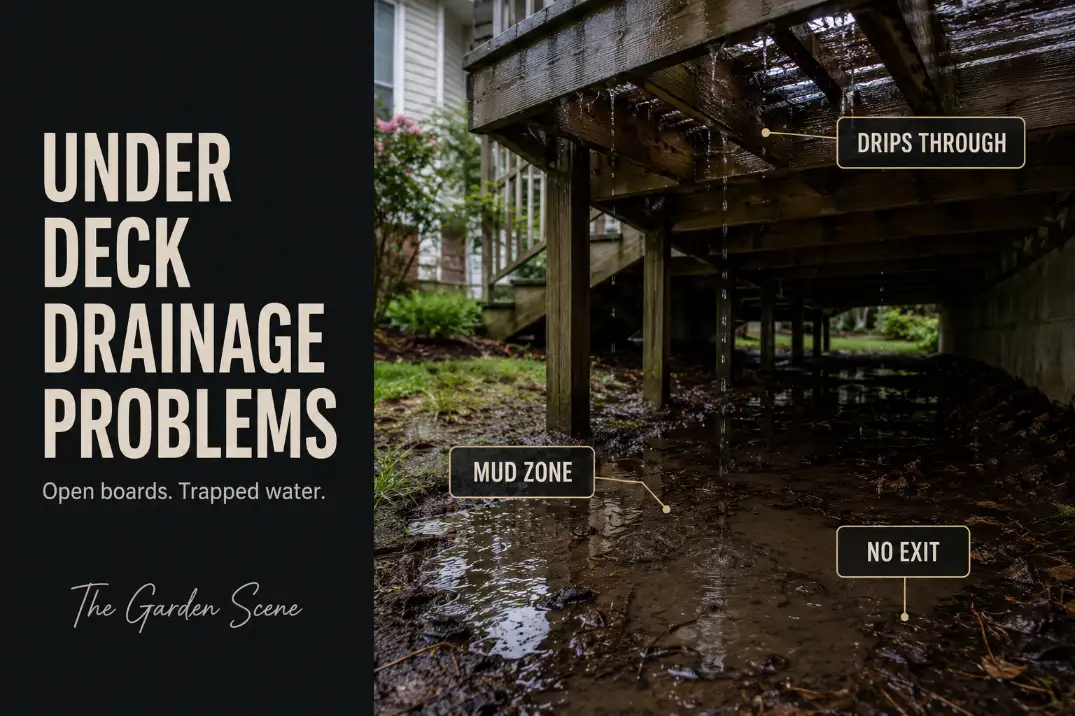
Under deck drainage problems usually start when normal rain behaves like a hidden water system. Rain passes through deck-board gaps, lands in shaded soil, and then has no reliable exit.
The first checks are simple: where the drip lines hit, whether the soil stays soft after 24–48 hours, and whether water can move at least several feet away from the house.
A damp patch after a storm is normal. Mud that still takes a footprint 72 hours later is not just wet weather.
This is different from a deck leak. Most open decks are supposed to let water through.
The failure is below the deck, where flat grade, compacted soil, blocked airflow, or poor discharge turns ordinary rainfall into a damp storage zone. Gravel can clean up the surface, but it will not fix water that has nowhere to go.
Rain Finds Every Gap
Open deck boards are not the enemy. A deck with 1/8-inch to 1/4-inch gaps can be perfectly normal and still send a surprising amount of water below during a storm. The issue is what happens after that water lands.
The deck is not leaking; the space below is collecting
The visible symptom is dripping between boards. The mechanism is repeated collection in the same shaded strips. If rain falls in the same lines under the joists every time, that soil gets compacted, muddy, and slow to dry.
The first puddle may look harmless. The pattern after three or four storms tells you more.
This is where many homeowners waste time. They look upward at the boards, then patch or seal small gaps that were never the main failure.
Unless water is running into the house, hitting a ledger connection, or staining framing in a concentrated spot, the smarter first question is lower: where does the water go after it passes through?
Normal wetness has a recovery window
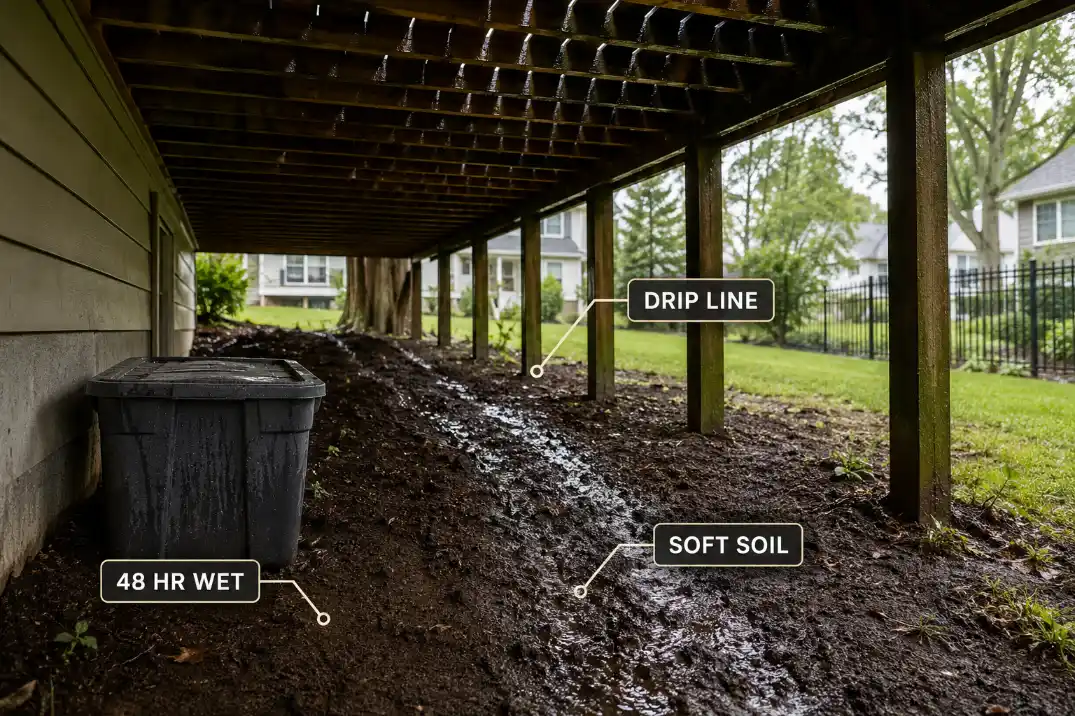
A few wet spots 6–12 hours after rain are normal under an open deck. A dark, soft strip that remains damp for 2–3 days is more meaningful.
In humid regions such as Florida or coastal parts of the Southeast, drying may naturally take longer, but the space should still improve between storms. If it never resets, airflow and exit path matter more than another surface layer.
Mud Starts Under the Joists
Mud usually forms where three things overlap: dripping, shade, and repeated foot traffic. The deck blocks sun. The joists create shaded bands.
If people also walk through the area to reach tools, bins, bikes, firewood, or a side gate, the soil compacts faster.
Compacted soil beats gravel more often than people expect
Readers often overestimate gravel and underestimate compacted soil. Gravel can reduce splash and make a surface look cleaner, but it cannot open a sealed, low, poorly draining base.
If the top 2 inches look stony but your heel still sinks underneath, the gravel is acting like decoration over mud.
A healthier under-deck surface firms up within 24–48 hours after normal rain. A failing one stays tacky, smells earthy or sour, and tracks mud toward the patio, lawn, or back door. That comparison matters because the fix is different. A messy but firm surface may need a better walking layer. A soft, shaded low area needs water movement first.
Look for outside water, not just deck water
Not all under-deck mud comes from rain falling straight through the boards. Sometimes the deck is receiving water from uphill grade, a downspout, a patio edge, or a side yard path. If water flows into the under-deck area from outside, panels alone will not solve the problem.
For a wider diagnosis of whether the problem is soil, slope, or runoff rather than only the deck itself, the same logic applies in Yard Drainage Problems From Soil, Slope, and Runoff.
Water Needs a Planned Exit
The turning point is not whether the area gets wet. It will. The turning point is whether water has a planned exit. Under-deck drainage only improves when water moves from collection to discharge without being left in a low, shaded pocket.
The exit path matters more than the surface finish
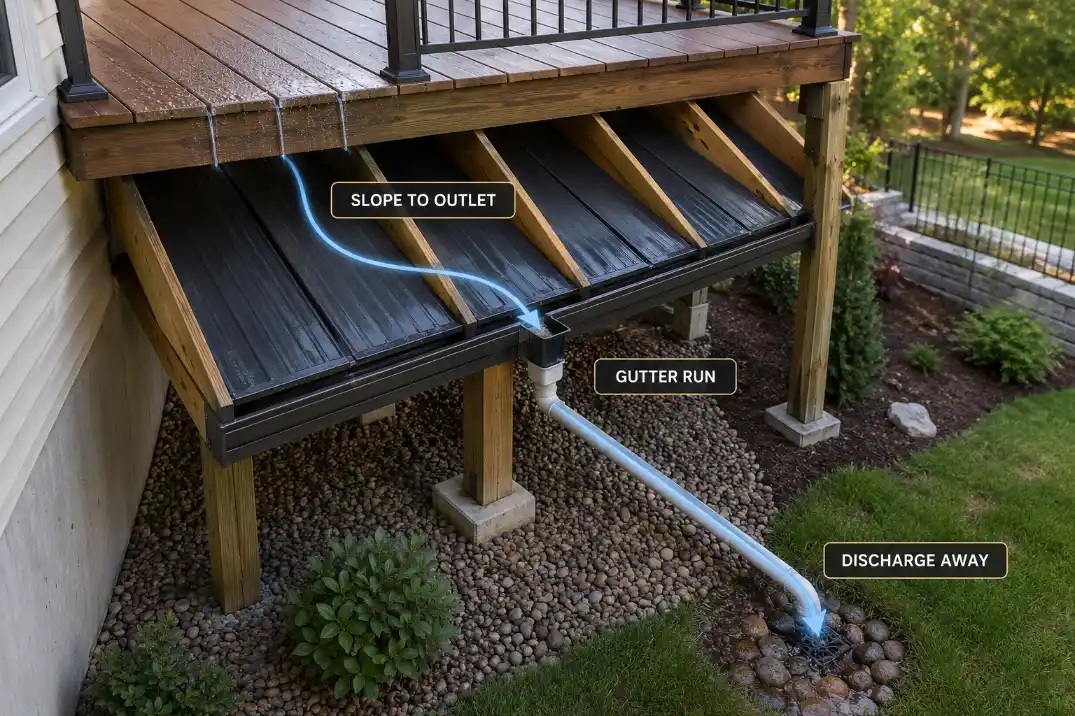
A useful drainage path can be simple: sloped panels to a gutter, a pipe extension, a swale, a lower lawn discharge point, or a drain system where the grade requires it.
What does not work is vague movement. “It runs to the edge somewhere” is not a drainage plan if that edge is beside the foundation or another low spot.
For many under-deck panel systems, a slope of about 1/8 inch to 1/4 inch per foot is enough to move water toward an outlet. The discharge should usually move several feet away from the house, often 6–10 feet or more where grading allows.
If the outlet drops water at the deck corner and that corner stays muddy, the collection system is only half finished.
New deck and existing deck are different decisions
A new or rebuilt deck gives access above the joists. That can make above-joist drainage systems easier to plan before deck boards go down. An existing deck usually points toward below-joist retrofit panels, gutters, or a ground-level drainage correction.
| Situation | Better starting point | Why it matters |
|---|---|---|
| New deck or boards coming up | Above-joist drainage planning | Water can be managed before it reaches framing below |
| Existing deck staying in place | Below-joist panels or guttered retrofit | Less demolition and more realistic installation |
| Low muddy grade below | Slope and discharge correction first | Panels will not fix water trapped at ground level |
| Light splash on firm soil | Gravel or cleaner surface layer | The problem is mess, not standing moisture |
| Storage area needs protection | Drainage plus raised storage | Drying and airflow matter as much as containers |
If the space below is meant to become usable for storage, seating, or a dry walkway, this is where product choice starts to matter.
A guide like Best Under-Deck Drainage Panels makes more sense after the exit route is clear, because panels are only useful when the collected water has somewhere good to go.
Gravel Is Not Always Enough
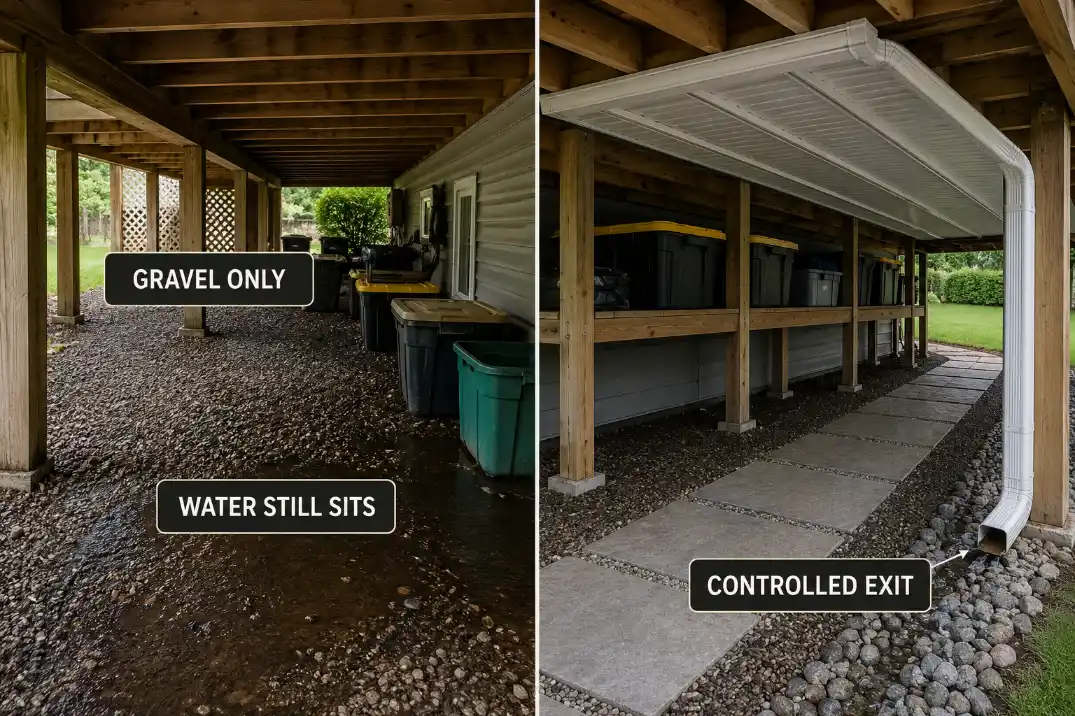
Gravel is useful when the problem is surface mess. It is weak when the problem is water movement. A 3–4 inch layer of clean angular stone can reduce splash, make shoes cleaner, and create a firmer walking surface. It does not automatically solve standing water, clay soil, or runoff entering from another part of the yard.
Gravel helps the top, not the route
Gravel works best when the soil already drains and the main issue is mud splash. In that case, a compacted base, landscape fabric, and clean stone can make the under-deck surface easier to use.
But gravel fails when it is dumped into a low bowl. Water still enters the bowl. Now it is just hidden between stones. The surface may look better while moisture remains underneath, which is worse for storage because dampness becomes harder to see.
Moisture barrier is not a drain
Where local conditions allow it, a heavy polyethylene moisture barrier under gravel can reduce ground vapor, but it should not be treated as a drain or used to trap active runoff.
This is the point where a routine fix stops making sense. If you can dig a 4–6 inch test hole in the wettest spot and the bottom stays slick or fills after rain, do not start with prettier stone. Start with the water source and exit path.
Layout Note: Gravel is a finishing layer when the base drains. It is not a rescue layer for a low, wet pocket.
Storage Makes Moisture Worse
Storage does not create the rain, but it often makes the under-deck problem worse.
Plastic bins, cushions, bikes, firewood, and cardboard boxes reduce airflow and hold dampness close to the ground. The more packed the space becomes, the slower it dries.
Raise first, seal second
A common mistake is buying tighter bins before fixing drying conditions. Sealed bins protect contents from direct splash, but they do not make the under-deck space drier. If the floor stays damp, bins sweat, labels peel, and soft goods smell musty anyway.
Raise storage 4–6 inches off the ground before worrying about perfect containers. Leave several inches behind bins so air can move along the wall or fence side.
Keep the wettest drip line empty if possible. This small change often improves the space more than adding another row of containers.
If the goal is a usable storage zone instead of just a less muddy corner, Under-Deck Space Ideas for Water and Storage fits naturally with the drainage decision because the shelf layout, walking lane, and water route should be planned together.
Damp storage invites other problems
Soft goods are the first to suffer. Cushions, pillows, outdoor rugs, cardboard, paper bags, untreated wood, and seasonal fabric decor do poorly in shaded moisture.
Hard plastic tools, metal racks, sealed outdoor bins, and raised shelves tolerate the space better, but only if the ground is not actively wet after every storm.
Damp, protected clutter also creates hiding conditions. If stored items are packed tight against posts, lattice, or foundation walls, drainage becomes a pest-pressure issue too.
That is where Rodent Hiding Spots Under Decks and Storage becomes part of the same maintenance picture.
Dry Enough to Use
The goal is not always a perfectly dry outdoor room. For most homes, the practical goal is a space that dries predictably, stays firm underfoot, and does not send water toward the house.
That is dry enough to store durable items, walk through without mud, and avoid musty conditions.
Quick diagnostic checklist
- Soil still soft after 72 hours: drainage problem, not cosmetic wetness.
- Water exits beside the foundation: discharge problem before surface problem.
- Gravel feels firm on top but squishy below: stone over wet soil.
- Storage smells musty within a week of storms: airflow and elevation problem.
- Drips fall in repeated strips: collection pattern needs planning.
- Mud tracks to the patio or back door: access path needs a firmer surface.
- Panels sag or hold water: slope, support, or outlet needs correction.
The better repair order
Start with water source. Confirm whether rain only falls through the deck or also enters from downspouts, uphill grade, patio edges, or side yard runoff.
Then fix the exit route. After that, choose the surface layer, storage layout, or drainage panel system.
If water needs to be moved away from a concentrated outlet, a downspout extension, pop-up emitter, swale, or dry well may matter more than the under-deck surface itself.
For that decision boundary, Pop-Up Emitter, Downspout Extension, or Dry Well is more useful than another storage product.
When to stop treating it like a yard fix
Under-deck drainage crosses into a bigger concern when water is touching posts, staying against the foundation, staining framing, or creating a persistent rot smell.
Mud on the ground is one level of problem. Moisture around structural wood or the house wall is another.
The simplest rule is this: if the ground dries, improve the surface. If the ground stays wet, fix water movement.
If structural parts stay wet, stop treating it as a storage-layout issue and get the deck and drainage conditions looked at before adding more materials below.
For broader official guidance on keeping water away from homes, see the University of Minnesota Extension.