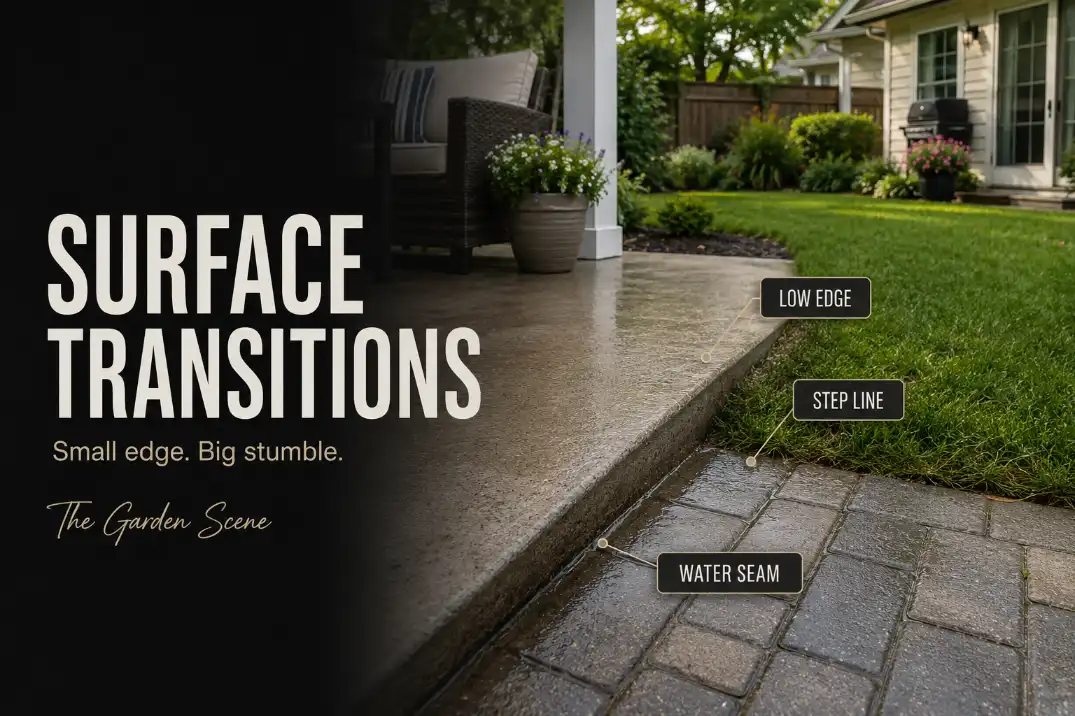
Outdoor surface transitions fail where the foot expects one condition and the yard quietly changes the rules.
The first checks are not decorative: look for height changes over 1/4 inch, edges that stay damp more than 24–48 hours after rain, and walking lines that cut across corners instead of following the designed path.
A patio surface can be stable, a lawn can look healthy, and a deck can be well built, yet the space can still feel awkward because the seam between them is doing too much work.
The best outdoor surface transition ideas do not try to hide every material change. They make the change readable, firm, drained, and easy to step through.
The priority is simple: fix the landing first, control the edge second, and make the transition look finished only after the movement works.
Where Outdoor Spaces Break
The weak point is usually the last step
Most outdoor spaces do not break in the center of the patio or the middle of the lawn. They break in the last 12–24 inches where one surface meets another.
That is where the height changes, the footing changes, the drainage behavior changes, and the eye has to decide where the route continues.
This is why a yard can look complete from a distance but feel awkward during use. A patio-to-lawn edge may look clean until someone steps off it with a tray.
A deck stair may feel safe until the landing below it is loose gravel. A paver path may look intentional until people keep cutting the corner because the arrival point is too narrow.
If people repeatedly avoid a designed edge, the edge is not just a finish detail. It is giving them a better movement signal than the design is.
Decorative edging often solves the wrong problem
Metal edging, stone borders, river rock, and contrasting paver bands can make a transition look polished. They do not automatically make it safer or more usable.
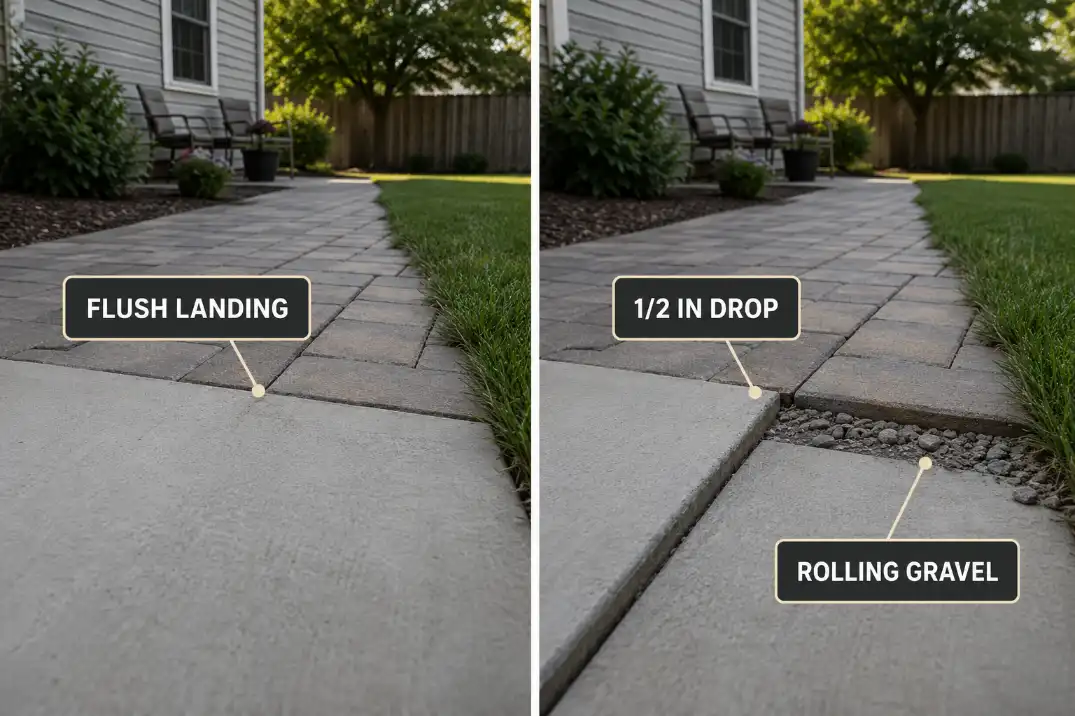
If the lawn has settled 1/2 inch below the patio, a decorative strip only frames the drop. If gravel rolls underfoot at a deck stair, a cleaner border does not make the first step stable.
The useful question is not “What edge looks good?” It is “What happens when a foot, chair leg, cart wheel, or wet shoe crosses this point?”
For door-to-patio areas that already feel awkward, Back Door Patio Transition Awkward fits naturally into the same problem because many transition failures begin at the first step out of the house.
Patio, Lawn, Deck, and Path
Patio to lawn needs a landing zone
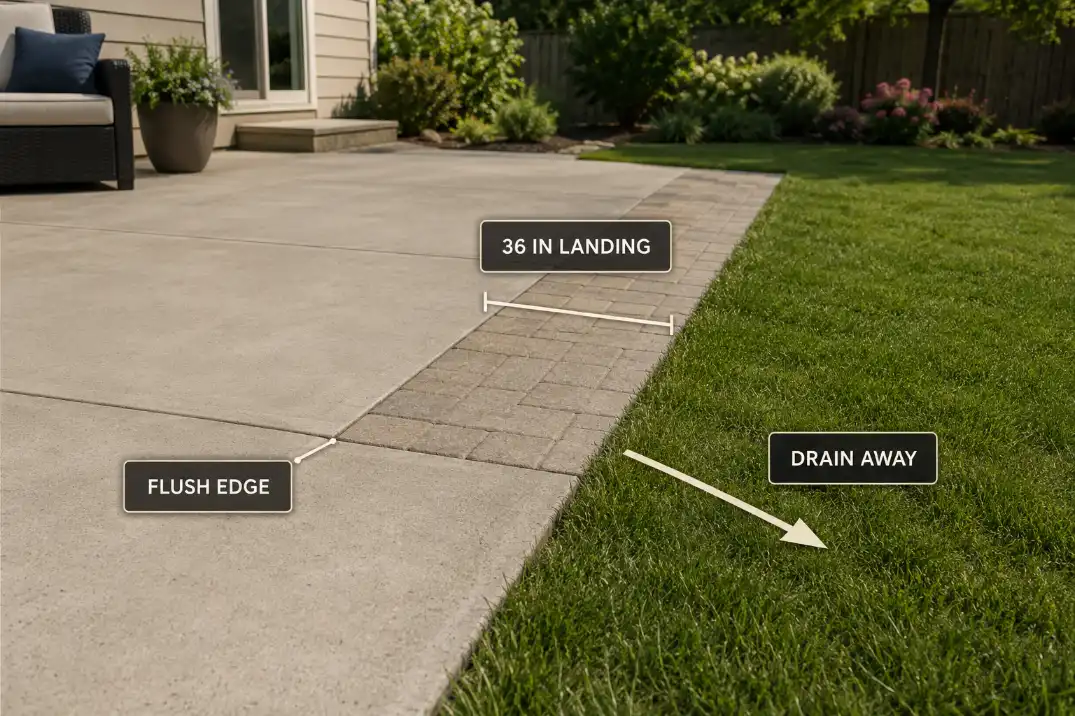
Best practical transition ideas include a 24–36 inch paver landing, a widened path mouth, a flush apron, a contained gravel strip, and a firm stair-base landing.
The right one depends less on the material style and more on where people actually step.
A patio-to-lawn transition usually fails because grass feels softer and more forgiving than it really is. Lawn height changes through the season.
After spring growth, it may sit nearly flush with the patio. After drought, heavy foot traffic, mowing wear, or soil settling, the same edge may drop 1/2 inch or more.
The better fix is a landing zone, not just a border. A 24–36 inch deep strip of pavers, large stepping stones, compacted gravel with stable fines, or a narrow hardscape apron gives the foot a full place to land before the softer lawn begins. That depth matters. A 6-inch decorative strip may look finished, but it rarely changes how people step.
The most reliable patio-to-lawn transition is not the fanciest one. It is the one that receives a normal stride without making people shorten their step.
Deck to ground needs a firm first landing
Deck transitions are less forgiving because the body is already adjusting to a level change. When someone steps down from a deck stair, the next surface needs to feel stable immediately.
Wet mulch, loose pea gravel, sloped soil, and uneven flagstone at the bottom of steps often make the deck feel less safe than the deck itself.
Keep at least 36 inches of firm, clear landing space at the bottom of deck steps before the route bends, narrows, or changes material again. If the deck connects to a lawn, the landing can still be simple, but it should be firmer than the surrounding yard.
This is also where affiliate-supporting safety content fits naturally. If an entry or deck step already feels slick, Best Non-Slip Step Treads for Outdoor Entries can help with the traction layer after the landing and level issue are understood.
Path to patio should arrive clearly
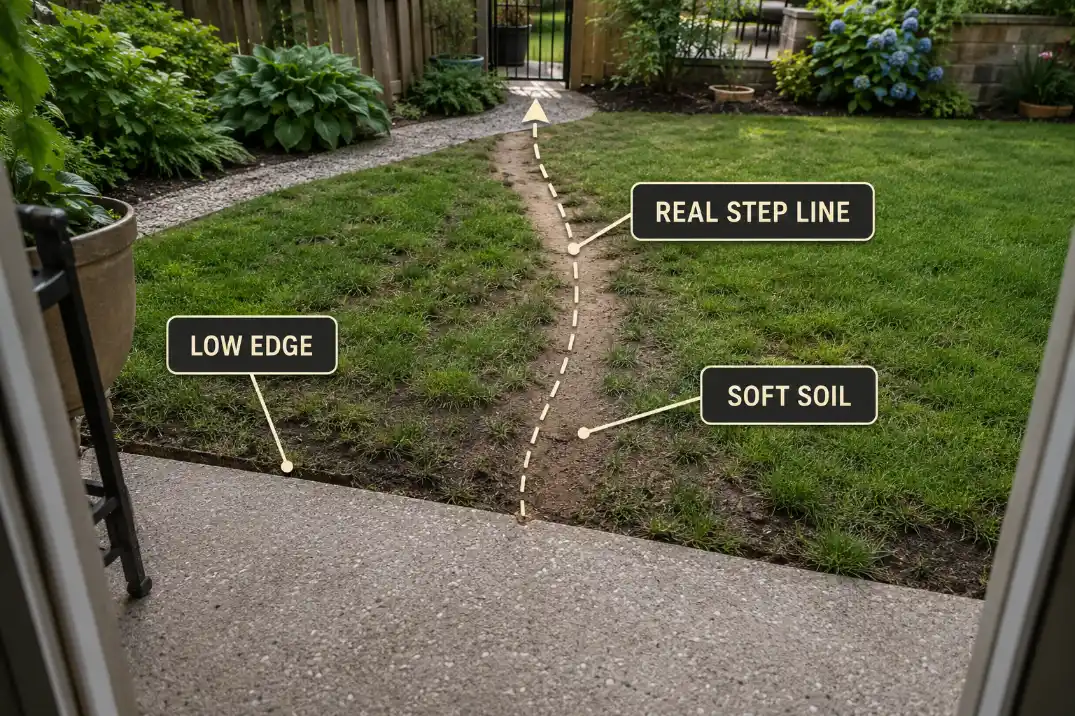
A path that reaches a patio at a shallow angle often creates a worn shortcut. The path may be attractive, but the body wants the cleanest line.
If the last few feet of the path are too narrow or aimed slightly off the real destination, people step across lawn, mulch, or gravel instead.
The fix is usually a widened arrival, not a larger patio. Widen the last 2–3 feet of the path, square off the landing, or shift the final stepping stone so the path meets the patio where people already want to land.
Driveway and front-yard edges behave the same way. If cars, carts, or foot traffic keep crossing a weak boundary, Driveway Edge Problems in Front Yards is closely related because it deals with the same edge-control problem under heavier use.
The Edge People Notice
The eye sees material, but the foot feels height
Homeowners often judge transitions by color, texture, and edging material. Those things matter visually, but the foot notices height and firmness first.
A 1/8 inch change may be visible but rarely changes movement. Around 1/4 inch, the edge starts to matter for rolling carts, older adults, patio chairs, sandals, and nighttime use.
At 1/2 inch or more, the transition should be treated as a functional problem, not a design preference.
That distinction keeps the fix honest. A darker paver border can help define an edge, especially at dusk, but it cannot fix a low lawn, rocking paver, unstable gravel band, or soft soil seam. Contrast helps the eye before the foot lands. The foot still needs a firm surface.
Small changes become bigger under real use
A transition may look acceptable when dry and empty. Add wet shoes, a serving tray, a patio chair, a rolling cooler, or a guest arriving after dark, and the same edge feels different.
This is why the best transition ideas are slightly more practical than the photos that inspire them.
A clean patio edge with a 1/2 inch drop is not improved by a prettier border. A paver path that rocks when stepped on is not improved by more plants around it.
A gravel band that spreads into the lawn is not improved by topping it up every month.
| Transition condition | What it usually means | Better response |
|---|---|---|
| 1/8 inch height change | Mostly visual, low functional impact | Keep clean and monitor |
| 1/4 inch height change | Noticeable underfoot, affects carts and chairs | Add stable landing or reset edge |
| 1/2 inch or more | Trip point or repeated usability issue | Correct grade or rebuild transition |
| Damp seam after 24–48 hours | Water is collecting at the boundary | Fix drainage before refinishing |
| Loose gravel in step line | Surface is moving under use | Add restraint or choose firmer landing |
Level Changes and Trip Points
The sneaky trip points are smaller than people expect
Large steps are usually visible. The more common outdoor transition problem is smaller: a paver sitting 3/8 inch higher than the next one, a patio slab exposed by lawn settling, a deck landing that tilts slightly, or gravel that has migrated away from the edge restraint.
These small changes are easy to dismiss because they do not look dramatic. But they are exactly the changes that catch toes, chair legs, stroller wheels, and garden carts.
A surface does not need to be obviously dangerous to become hard to use. It only needs to interrupt the normal step.
This is where readers commonly underestimate the transition. They look for a major failure, when the real problem is a small edge repeated hundreds of times through daily use.
When a routine fix stops making sense
Adding soil, mulch, or gravel beside a low edge can make the transition look better for a few weeks. It often fails because loose material does not control elevation. Soil washes out. Mulch floats or spreads. Gravel rolls into the walking line.
That routine fix stops making sense when the same edge reappears within one season, when material moves onto the patio after storms, or when the low side stays soft more than 48 hours after nearby areas dry.
At that point, the transition needs a reset: compacted base, firmer landing material, better restraint, or a drainage correction.
If the problem is not only the edge but the surface itself feels slick, Best Low-Slip Patio Surfaces for Family Backyards is a stronger next decision than simply adding another decorative border.
Drainage at the Transition
Water shows the real seam failure
Drainage problems often reveal themselves at transitions before they show up in the middle of the patio.
The seam between two surfaces is where water slows, sediment collects, soil softens, and pavers begin to move. If the patio center dries but the edge stays damp, the transition is acting as a collection point.
A useful residential target is a gentle slope of about 1/8 to 1/4 inch per foot away from the house, door, or main seating area.
The exact surface matters less than the direction of water. A beautiful transition still fails if it sends runoff into a soft lawn pocket, against a deck stair base, or back toward the patio door.
This is the point where decorative gravel often wastes time. Gravel can hide a wet seam without giving water a real exit.
If the edge is already staying wet, Patio Drainage Layout Problems is the more useful next step because the transition may be exposing a larger layout problem.
Climate changes the symptom, not the rule
In humid Florida yards, weak transitions often stay damp long enough for algae, soil softness, and organic buildup to become part of the problem.
In northern states, freeze-thaw cycles can lift pavers and widen small height differences after winter. In dry Arizona conditions, soil can shrink beside concrete and expose a sharper edge even when standing water is not obvious.
The rule stays the same: the transition should dry within a reasonable window, stay firm under a normal step, and make the next surface easy to read.
Smooth Without Looking Forced
Match the transition to the route
A forced transition usually copies a material idea without respecting movement. A curved stone edge may look soft in a photo, but if the shortest walking line is straight, people will cut across it.
A gravel band may look clean around a patio, but if chair legs land on it, the seating area becomes unstable.
The best transition is usually quieter: a widened paver mouth, a flush apron, a compacted landing strip, a low restraint edge, or a short run of stepping stones placed where the foot already wants to go.
The idea is not to make the edge disappear. It is to make the next step obvious.
Use one strong move instead of three small ones
Small outdoor spaces often become awkward when too many transition treatments meet in one place. A deck stair lands on gravel, the gravel turns into stepping stones, the stones cross mulch, and the mulch meets a patio.
Each material may be attractive alone, but together they create too many changes underfoot.
Choose one main move for the transition. For patio to lawn, use a 24–36 inch landing strip. For deck to ground, use a square firm landing at the stair base.
For path to patio, widen the final approach. For gravel to pavers, contain the gravel and keep it out of the primary step line.
If the transition also needs to support furniture, carts, or repeated daily walking, a stable hard surface usually beats a softer decorative edge. Concrete vs Pavers for a Stable Patio is useful when the decision shifts from “what looks good” to “what stays firm under regular use.”
Keep the edge readable after dark
A smooth transition should not disappear at night. Slight material contrast, low path lighting, and clean edge lines can help guests read the change without turning the yard into a runway. This matters most near deck steps, patio doors, outdoor kitchens, and front entries.
The goal is not bright lighting everywhere. It is a readable step-off point. If the surface change is also a visibility issue, Outdoor Step Visibility Ideas can help make level changes easier to read without overlighting the outdoor space.
Quick Transition Checklist
- Check whether the height change is under 1/4 inch, near 1/4 inch, or closer to 1/2 inch.
- Watch where people naturally step instead of trusting the designed route.
- Look for seams that stay damp 24–48 hours after nearby surfaces dry.
- Test loose edges with a chair leg, cart wheel, or normal shoe drag.
- Give high-use transitions a 24–36 inch stable landing zone.
- Fix drainage before adding decorative gravel, edging, or color contrast.
- Keep planting and loose mulch outside the primary walking line.
Questions People Usually Ask
Should outdoor surface transitions be perfectly flush?
Perfectly flush is ideal in high-use areas, but predictable is the real standard. A tiny visible height change may be fine if the edge is stable, dry, and easy to read. A hidden 1/2 inch drop at a patio edge is different because the foot does not prepare for it.
Is gravel a good transition between patio and lawn?
Gravel can work only when it is contained, compacted enough for the use, and kept out of the main step line. Loose gravel between a patio and lawn often becomes a rolling edge rather than a stable transition.
Can plants soften a hard surface transition?
Plants can soften the view, but they should not occupy the landing zone. Keep planting outside the route near patio doors, deck stairs, grill paths, and any area used after dark.
What is the simplest transition fix that usually works?
For many patio-to-lawn edges, the simplest useful fix is a firm 24–36 inch landing strip that sits close to flush with the patio and drains away from the seam. It solves more real movement problems than a narrow decorative border.
Final Takeaway
Strong outdoor surface transition ideas are not just about making patio, lawn, deck, and path materials look connected. They are about controlling the moment where people actually step.
Start with height, firmness, drainage, and the real walking line. Once those work, edging, contrast, plants, and surface texture can make the transition look intentional without making it feel forced.
For broader official guidance on accessible walking surfaces and level changes, see the U.S. Access Board guide to floor and ground surfaces.