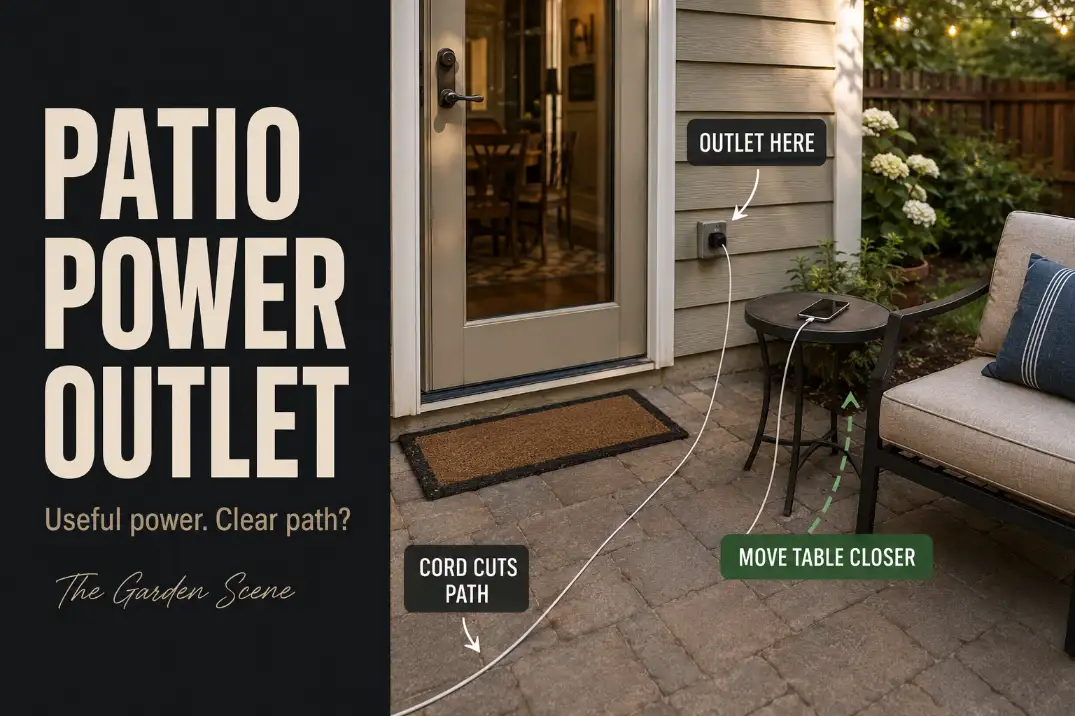
A patio power outlet becomes useful only when the charging spot, table surface, and walking path work together. The outlet itself is rarely the whole problem.
The real issue is what happens after someone plugs in a phone, speaker, laptop, fan, or string light and the cord starts deciding where people can walk.
Start with three checks: can a table sit within about 2–4 feet of the outlet, can the main path stay at least 30 inches clear, and does the cord avoid wet low spots after rain? If the answer is no, adding a longer extension cord usually makes the patio less usable, not more usable.
Outdoor charging should also rely on outdoor-rated equipment, GFCI protection, and a dry surface, not just a reachable plug.
A usable charging zone should feel like part of the layout, not a temporary fix stretched across the floor.
Power Changes How You Use It
Once a patio has reliable power, people use it differently. They stay outside longer, charge phones while sitting, run a speaker during dinner, plug in a laptop for an hour, or add a small lamp after dark. That sounds simple, but it changes the layout.
Build a power pocket, not a utility corner
The best patio charging zone is a small “power pocket”: one outlet, one usable surface, one short cord route, and no conflict with the door path.
It might be a narrow wall console, a side table beside a lounge chair, a rolling cart near the outlet, or a small shaded work surface.
A charging zone fails when the device has nowhere to sit. Phones end up on the ground. Speakers get tucked under chairs. Battery packs sit on damp patio slabs. At that point, the problem is not lack of power. It is lack of a surface.
For very small patios, the same space discipline used in Small Patio Coffee Corner Ideas applies here: the table has to be close enough to use but small enough not to steal the route.
Four charging-zone ideas that actually work
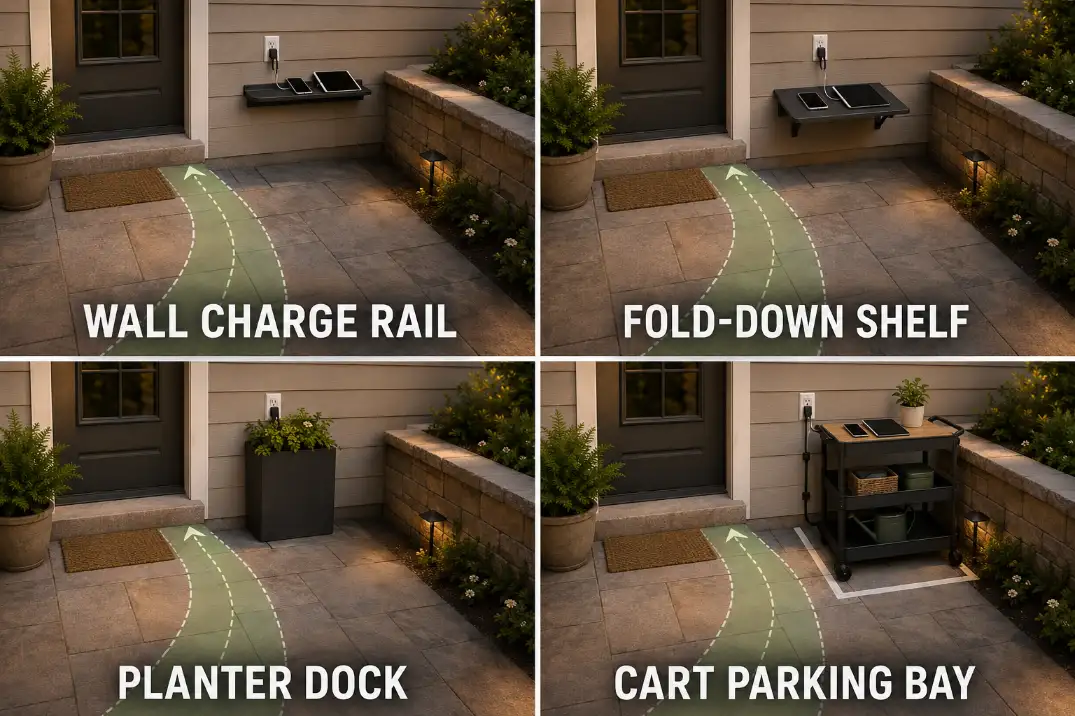
A wall-side console zone works well when the outlet is near the house wall. Use a narrow outdoor console or shelf so the cord drops straight down and stays out of the floor path.
A side-table lounge zone works when one chair is the main sitting spot. Keep the table within arm’s reach and within 2–4 feet of the outlet so the charger does not run across the chair legs.
A rolling cart power pocket works for patios that shift between coffee, dining, and evening use. A compact cart can hold a speaker, phone charger, bug repeller, or small lantern, then roll away when the patio needs to open up.
This is where a cart can do more than decor; a layout like Best Outdoor Serving Carts for Patio Parties can also become a flexible charging station if the outlet is close enough.
A shaded work corner works only when power, glare control, and chair position all agree. If the cord reaches but the laptop screen faces afternoon sun, the setup will still disappoint.
Keep Cords Out of Paths
Cord routing matters more than having several places to plug in. One well-placed outlet can support a patio. One badly routed cord can make the whole space feel clumsy.
The back door route wins
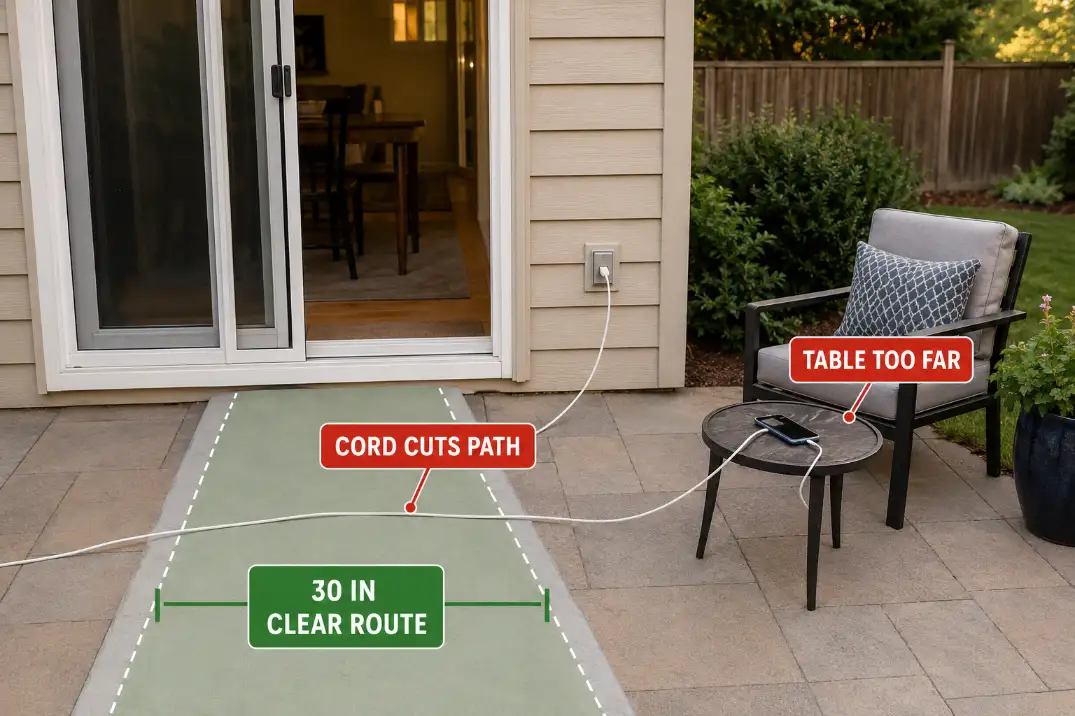
The most important path is the route from the back door to the seating area. That is where people carry plates, step outside at night, pull chairs back, move coolers, or walk barefoot. If a cord crosses that line, it becomes a hidden layout problem.
Keep about 30 inches of clear walking space wherever possible. On a tight patio, 24 inches may be the squeeze point, but it should not also contain a cord, furniture leg, or charger block.
If the charging setup narrows the route below that, move the charging table before buying cord covers.
This matters even more on patios where the door transition is already awkward. A power zone should support the entry sequence, not fight it.
The same route-first thinking behind Keep Patio Entry Clear becomes more important once outdoor cords are involved.
Cord covers are not the first fix
Cord covers can help for a temporary event, but they are often used too early. If the cord runs diagonally across the patio because the table is in the wrong place, covering it does not solve the layout. It only makes a bad route look deliberate.
Use a cord cover only when the cord already follows the best available edge route and still needs protection. If the cord cuts through the center of the patio, the stronger fix is to move the powered item closer to the outlet or change the furniture plan.
Setup Note: A 3–6 foot cord kept along an edge is usually more usable than a 10–15 foot cord stretched through the middle of the patio.
Tables Near the Outlet
The charging surface is what makes the outlet practical. Without it, the outlet may be technically useful but awkward in daily use.
Keep the surface close enough
For phones, speakers, small lamps, and battery packs, aim for a usable surface within about 2–4 feet of the outlet. Once the surface is more than about 6 feet away, the cord often starts shaping the patio instead of the patio shaping the cord.
The table should not block access to the outlet cover. Outdoor outlets often have weather-resistant covers that need room to open. Leave enough hand clearance to plug in and unplug without pushing furniture aside.
If the only table location blocks the door swing or chair pullback, the issue is not the outlet. It is the furniture layout.
For patios where the back door controls everything, Patio Layouts for Back Door Seating is closely related because the door path usually decides which powered zone can work.
Match the surface to the device
A phone needs a small dry surface. A speaker needs a stable place where it will not vibrate toward the edge. A laptop needs more: shade, a flat work surface, a comfortable chair angle, and a cord route that does not sit underfoot.
This is where people often overestimate the value of power. A powered laptop corner still fails if the screen catches glare for most of the afternoon.
If outdoor work is the goal, solve glare and seating position along with the outlet, not after it. The same practical screen-position logic in Patio Laptop Glare Problems applies to any patio charging corner meant for real work.
Weather Protection Matters
Outdoor power has to respect weather even on covered patios. A roof, pergola, or deep eave can reduce exposure, but it does not make the area behave like an indoor room.
Covered is not the same as dry
Wind-driven rain can reach outlets under eaves. Sprinklers can hit the wall below a receptacle. Humid air can leave surfaces damp overnight.
In freezing northern states, wet areas can turn into slick patches. In humid Florida conditions, covered surfaces may stay damp longer than expected.
A charging zone should stay out of splash zones, roof drip lines, and low spots where water sits. If water remains on the patio more than 24 hours after normal rain, do not route cords through that area.
If a sprinkler reaches the charging table, move the table or adjust the irrigation before treating the spot as reliable power access.
Use outdoor-rated cords and devices for outdoor use, and do not leave casual charging setups outside for days. A quick 20-minute phone charge while sitting on the patio is different from a cord that lives outside all week.
Know the stop point
Routine fixes stop making sense when the same outlet is expected to power lighting, a fan, a speaker, seasonal decor, and multiple chargers at once. That is no longer a clever charging zone. It is a sign that the patio use has outgrown the original power plan.
A GFCI-protected outdoor receptacle, a weather-resistant in-use cover, and proper outdoor-rated equipment are basic expectations, not upgrades.
If you need another permanent outlet, a hardwired lighting connection, or power farther from the house wall, that is electrician territory.
The symptom is “we need power outside.” The mechanism is different: the patio layout now depends on power in more than one place.
Lighting and Charging Together
Lighting and charging often compete for the same outlet. That is where a patio can start to look messy even if each individual item makes sense.
Night safety comes before device convenience
If one outlet is handling string lights, a speaker, phone charging, a fan, and seasonal decor, the area around the receptacle becomes a plug cluster. It may still work electrically, but it no longer works visually or spatially.
Prioritize night movement first. Steps, table edges, chair legs, and the door route matter more than having the most convenient phone charger.
If the patio still feels dim, the fix may be better lighting placement rather than more plug-in lamps. A zone-based setup like Patio Lighting Zones for Dining, Lounge, and Grill Areas can reduce the pressure on one outlet.
Separate fixed jobs from flexible jobs
Fixed or semi-fixed lighting should handle the patio’s regular nighttime use. Charging should stay flexible. That might mean wall lighting or low-voltage lighting for visibility, while the outlet supports phones, speakers, or occasional work sessions only when people are outside.
This keeps the outlet from becoming the control center for the entire patio.
Useful Without Looking Technical
A good charging zone should not announce itself as a utility corner. It should look like a normal part of the patio: a table, shelf, cart, or work surface that happens to make power easy.
Hide the logic, not the access
Do not bury the outlet behind heavy furniture or planters. You still need to reach it. The better move is to keep the cord route quiet: short, edge-based, and out of the normal walking line.
A narrow console against the wall, a side table beside the main chair, or a small rolling cart near the outlet can make power available without making the patio feel technical.
The design should be easy to understand at a glance: devices go here, cords stay there, people walk through here.
| Setup choice | Works well for | Stop using it when |
|---|---|---|
| Side table within 2–4 ft of outlet | Phone, speaker, small lantern | Cord crosses the door path |
| Wall-side console | Clean charging station near the house | It blocks outlet access or door swing |
| Rolling cart near outlet | Flexible charging, party use, speaker placement | It gets parked in the walking route |
| Outdoor-rated extension cord | Short temporary use | It stays outside for days or crosses wet areas |
| Plug-in lighting | Occasional accent lighting | It replaces proper visibility at steps or paths |
| Laptop charging corner | Shaded work sessions | Screen glare or cord route makes use awkward |
First move before buying anything
Place the table first. Then walk the patio normally. Open the door. Pull out the chair. Carry a plate from the house to the seating area. If the charging table or cord interrupts that movement, the zone is not ready.
Next, check the wet path. Look for roof drip lines, sprinkler reach, low spots, and areas where leaves collect. A charging setup that looks clean on a dry afternoon can become the wrong setup after one storm.
Finally, decide whether the outlet is being asked to do too much. If the patio needs power for lighting, work, cooling, entertainment, and decor, the answer is not a better extension cord. The answer is a better outdoor power plan.
Questions People Usually Ask
Should every patio seating area have a charging table?
No. One well-placed charging table is usually better than several small cord points. Add another only when the patio has truly separate zones, such as dining on one side and lounge seating on the other.
Is a patio charging cart a good idea?
Yes, if it stays close to the outlet and does not become a rolling obstacle. A cart works best for flexible use: parties, speaker placement, lanterns, or occasional phone charging.
Can I leave an outdoor extension cord plugged in all season?
That is usually the wrong boundary. Extension cords are best treated as temporary outdoor tools, not permanent wiring. If the need is constant, plan a proper outdoor electrical solution.
Where should a charging zone go on a small patio?
Place it near the outlet, along a wall or edge, outside the main door-to-seat path, and away from wet low spots. If those four conditions cannot happen together, change the furniture layout before stretching the cord.
For broader official safety guidance, see the Electrical Safety Foundation International.