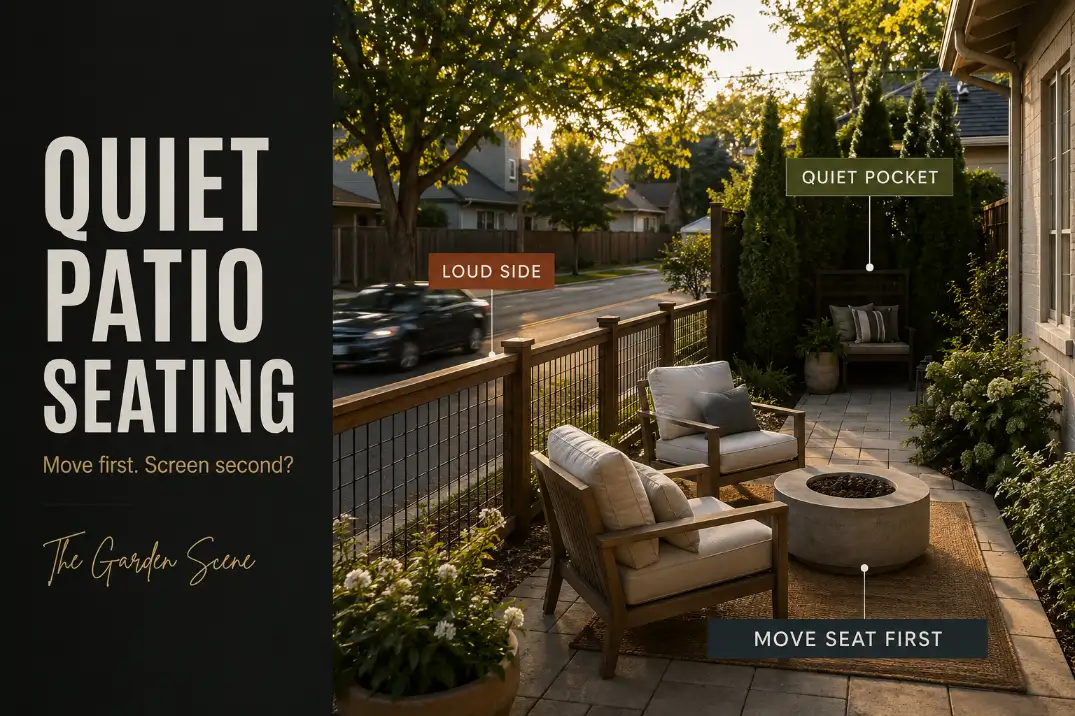
A quiet patio seat usually fails because the chair is sitting in the noise path, not because the yard needs one more screen.
Before buying panels, hedges, or a fountain, check three things: which side is loudest, whether the chair faces directly into that sound path, and whether moving the seat 4 to 8 feet creates a calmer pocket.
A useful quiet zone does not need silence. It needs conversation to feel normal at 3 to 6 feet without raised voices.
If the patio still feels harsh after a 10-minute seated test during the noisy part of the day, the problem is usually exposure, reflection, or nearby activity — not simply the lack of taller plants.
The mistake is treating noise like a view problem. Views can be hidden from one line. Sound wraps around corners, reflects off hard surfaces, and follows open gaps. That is why the best quiet seating fix often starts with the chair, not the barrier.
The Loudest Side
Listen from chair height
The loudest side is not always the side that looks most exposed. A street may be visible from the patio, but the sharper irritation may come from a neighbor’s AC unit, pool pump, driveway gate, barking zone, or outdoor dining area.
Do not judge the patio from the back door. Sit where the chair would actually go for 2 to 3 minutes, then rotate your body 90 degrees and listen again.
If the sound gets sharper when your ear faces one direction, that direction matters more than the general openness of the yard.
Traffic noise behaves differently from neighbor noise. Road sound often arrives as a steady sheet, especially when cars pass every 10 to 30 seconds.
Neighbor voices are more intermittent, so they may feel more intrusive even when they are not constant. That distinction matters because steady road noise can sometimes be softened with layout and masking, while direct voices need more distance, angle change, and a protected edge.
If the main issue is traffic near the seating edge, the layout logic in Patio Seating Near a Busy Street is especially useful because the first improvement usually comes from moving the seat out of the direct exposure zone.
Separate volume from attention
A low mechanical hum may be louder in a technical sense, but voices often feel worse because the brain follows speech.
That is why a patio can feel calmer after the chairs are turned away from a neighbor’s deck, even if the overall noise level has not changed much.
The symptom is “this patio feels noisy.” The mechanism is often that the seated ear is aimed directly at the most attention-grabbing sound. Fixing the listening angle can matter as much as adding a screen.
Move Before You Screen
Distance beats a rushed barrier
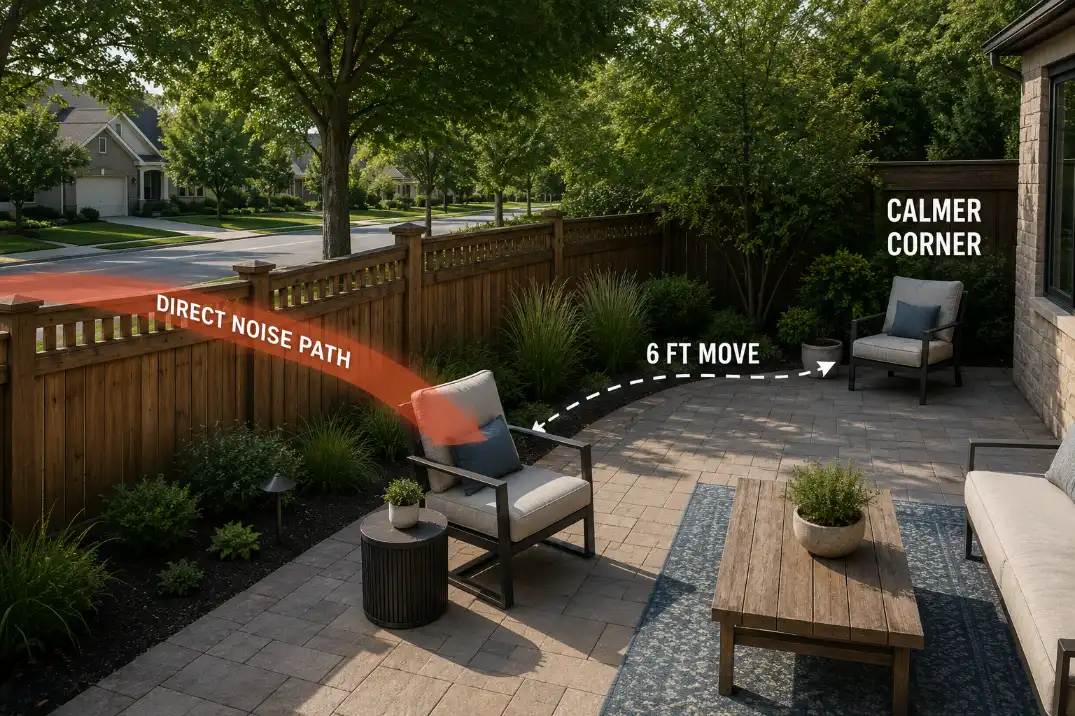
The most common wasted fix is adding a screen exactly where the chair already feels wrong. A screen can help, but it cannot rescue a seat that remains on the loudest edge of the patio.
Move the chair first, then decide whether the new spot still needs screening.
A 4-foot shift may be enough when the noise comes from a side-yard unit or gate. For road noise, 6 to 10 feet often changes the experience more noticeably because the seat is no longer sitting in the most direct sound path.
On small patios, even rotating chairs 30 to 45 degrees away from the source can reduce the feeling of exposure.
The broader ideas in Outdoor Noise Buffer Ideas work best after the seating location is already chosen. Buffers are support layers. They should not be asked to fix a bad listening position by themselves.
Keep the quiet pocket usable
A quiet corner is not useful if it blocks the back door, grill route, or main walkway. Keep at least 30 to 36 inches of open walking space behind or beside the seating.
If someone has to squeeze around the chair every time they cross the patio, the layout will not survive daily use.
Use this quick test before committing:
- Sit in the proposed spot for 10 minutes during the noisy part of the day.
- Check whether conversation works at 3 to 6 feet without raised voices.
- Leave 30 to 36 inches open for the main route.
- Rotate the chair 30 to 45 degrees away from the sound source.
- Keep the chair back at least 12 inches from scratchy shrubs, walls, or fence surfaces.
- Notice whether the seat actually feels calmer, not just more hidden.
Layout Check: Test the chair location before buying anything tall. A bad seat behind a new screen is still a bad seat.
Hard Surfaces Can Make Noise Feel Sharper
Reflection is not the same as source noise
Some patios feel louder than the yard around them because sound is bouncing inside the seating area. Concrete slabs, flat privacy fences, stucco walls, large sliding glass doors, and covered patio ceilings can reflect sound back toward the chair.
This is why two seats only 5 or 6 feet apart can feel different. One may sit in a softer garden edge. The other may sit between a hard wall and a hard fence, where sound feels brighter and closer.
The fix is not always a thicker barrier. Sometimes the better move is to soften the surfaces around the seat: a planted edge, cushions, an outdoor rug where practical, textured planters, or a less exposed chair angle.
These do not soundproof the patio, but they can make the quiet pocket feel less harsh.
Watch the fence-line echo
A straight fence can visually screen the patio while still leaving the seating area acoustically hard.
This is especially common when the chair sits close to the fence, facing across a bare concrete pad. The view may feel private, but the sound still feels exposed.
If neighbor noise is the main irritation, Backyard Neighbor Noise Solutions is a better next step than simply planting the entire fence line evenly.
The useful question is not “How do I hide the fence?” It is “Which edge protects the seated ear?”
Plants Soften the Edge
Plants support the pocket
Plants are useful, but they are often overestimated. A narrow row of shrubs does not make a patio quiet by itself. Plants help most when they support a better seating position, soften a hard boundary, and make the chair feel backed rather than exposed.
A 12-inch planter with sparse grasses may look finished but will not change much about the experience.
A 24- to 36-inch-deep planting edge with evergreen mass, textured leaves, and uneven surfaces has more practical value because it creates a softer edge around the seating zone.
The best planting is usually near the quiet pocket, not only along the property line. If all the plants sit at the far fence while the chair remains in the open middle of the patio, the layout may look improved but feel almost the same.
Avoid the thin green wall mistake
The thin green wall mistake happens when all the plants are placed in one straight line while the seating remains fully exposed. From the chair, the patio still faces the noise. The plants create a boundary, but they do not create a protected sitting position.
A better setup wraps one side and the back of the seat while keeping the front open. That gives the body a sense of shelter without trapping heat or making the patio feel boxed in.
In humid regions, especially parts of Florida and the Southeast, this matters because airflow can be just as important as screening.
| Patio condition | Better first move | Why it works |
|---|---|---|
| Chair faces street directly | Move seat 6–10 feet back or rotate it | Reduces direct sound exposure |
| Noise comes from one side | Add a side layer near the seat | Protects the listening position |
| Hard fence reflects sound | Add planting depth in front of it | Softens the boundary surface |
| Patio is already tight | Use one protected edge | Avoids a boxed-in layout |
| Voices carry from neighbor deck | Change seat angle first | Reduces speech focus |
Water Sounds Can Help
Use water as masking, not blocking
Water features help when they mask sharp or uneven sound close to the seating area. They do not block noise. A small fountain placed 20 feet away near the fence often becomes decoration, not useful sound masking.
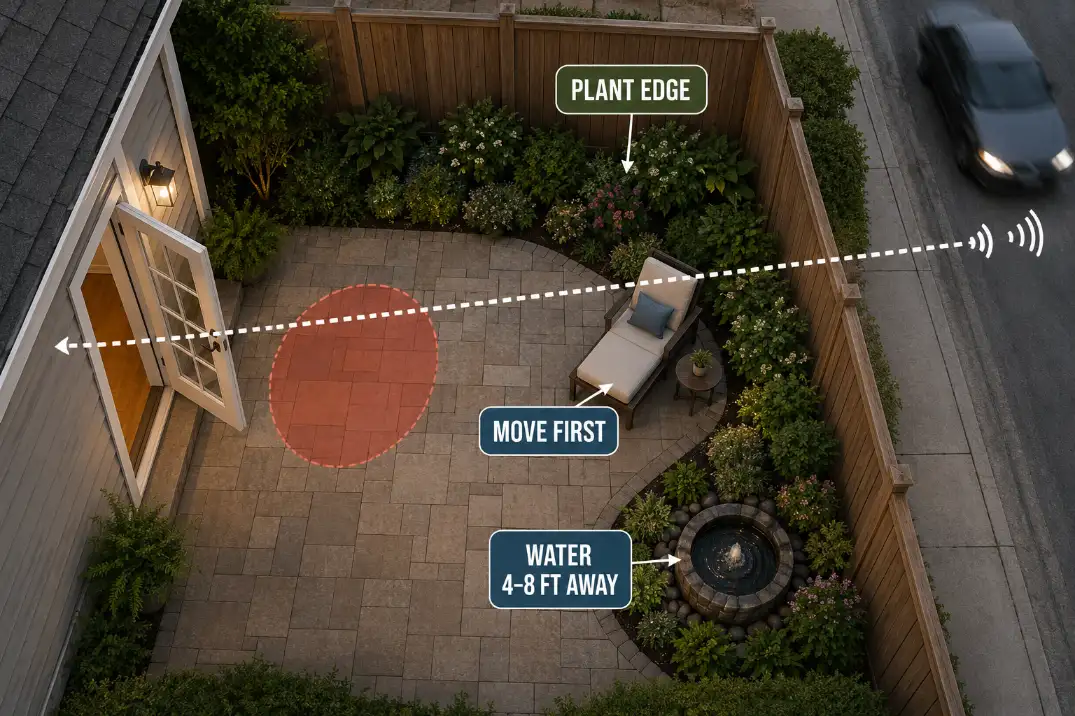
If you want water to change the sitting experience, place the sound within about 4 to 8 feet of the seat. The sound should be steady and soft, not splashy enough to become another irritation.
This works better for distant traffic or light neighborhood noise than for loud voices, barking, music, or leaf blowers.
For placement decisions, Outdoor Water Features for Yard Noise is the stronger companion topic because the distance between the listener and the water matters more than the size of the basin.
Know when water becomes clutter
Water stops making sense when the patio already has too many competing sounds. If the AC unit, grill fan, road noise, and fountain all run together, the space may feel busier rather than calmer.
The goal is not to add sound. The goal is to replace the most irritating edge with a steadier, closer sound.
In dry climates, a small feature may need more frequent refilling during hot weeks. In freezing northern states, it may be seasonal rather than year-round.
That does not make water a bad fix. It just means water should support the quiet pocket, not carry the whole design.
Dining Is Not the Quiet Zone
Dining creates its own activity
Dining areas are usually not the best quiet zone because they create movement, chair scraping, serving trips, and conversation across a table.
A dining table also needs open space on several sides, which often pulls it into the more exposed middle of the patio.
That openness can work for meals but feel wrong for reading, coffee, or evening sitting. If you are trying to create one quiet seat, do not give the dining table the protected corner by default.
Give that corner to the lounge chair, reading chair, or small two-person conversation setup.
The problems in Outdoor Dining Noise Problems are related but different. Dining noise is about activity and group use. Quiet seating is about the listening position of one or two people.
Keep the quiet seat small enough to stay protected
A quiet patio zone often works better with two chairs and a small table than with a full sofa set. Larger furniture pushes the layout back into the open center of the patio, where sound exposure is usually worse.
This is where people commonly underestimate furniture depth. A lounge chair may need 30 to 36 inches of usable depth before it feels comfortable, and deep outdoor seating can need more once someone reclines.
If the quiet corner only works when the chair is perfectly pushed in, the layout is too tight.
Once the seat is moved into a calmer corner, the chair itself starts to matter. Oversized lounge furniture can push the quiet zone back into the exposed part of the patio, while compact, supportive options like those in Best Outdoor Reading Chairs for Patio Corners are easier to keep inside a protected pocket.
Seating That Feels Protected
Build one strong edge
A quiet patio seat does not need to be surrounded. It needs one strong protected edge and one smart angle away from the loudest side. That edge can be a hedge, planter, privacy panel, fence corner, low wall, or the side of the house.
The most reliable layout is usually a loose corner or L-shape: one planted or built edge behind the chair, one side layer toward the noise, and an open front. This avoids the closed-booth feeling while still giving the seat a calmer boundary.
The protected edge should sit close enough to influence the chair, usually within a few feet, but not so close that it crowds the body. A chair jammed tight against a wall may look tucked in, but it often feels stiff and uncomfortable after 20 minutes.
A related layout approach appears in Patio Privacy Ideas for Secluded Seating, especially when the goal is to make a seat feel protected without closing off the whole yard.
Know when the standard fix stops working
The standard fix stops working when the noise source is high, constant, or too close. A second-story deck, elevated road, loud mechanical unit, or music source just beyond the fence may overpower small patio adjustments.
In those cases, a quiet seating move can still improve comfort, but it will not create a silent retreat.
If you still need raised voices after moving the seat, rotating it, softening the hard edge, and testing during the loudest 20-minute period, the patio may need a more serious barrier, a different zone, or a different expectation.
That is the practical boundary. A quiet patio is a comfort layout, not a soundproof room.
Questions People Usually Ask
Is a tall fence the best way to make patio seating quieter?
Not always. A tall fence can help if it interrupts the direct sound path, but it often disappoints when the chair stays in the same exposed location. Move and angle the seat first, then decide whether fence height is still the limiting factor.
Do plants actually reduce patio noise?
Plants help most as part of a layered edge. They soften hard boundaries and reduce the exposed feeling around the seat, but a thin row of plants rarely fixes direct road or neighbor noise by itself.
Where should a fountain go for noise masking?
Place it near the seating area, usually within 4 to 8 feet, so the listener hears the steady water sound before the distant noise. A fountain placed at the far fence may look right but do very little for the seat.
What is the simplest quiet patio setup?
Use two chairs angled away from the loudest side, keep 30 to 36 inches of walking space open, add one protected edge behind or beside the chairs, and test the spot during the noisiest part of the day before buying more screening.
For broader official context on outdoor noise levels, see the US EPA.