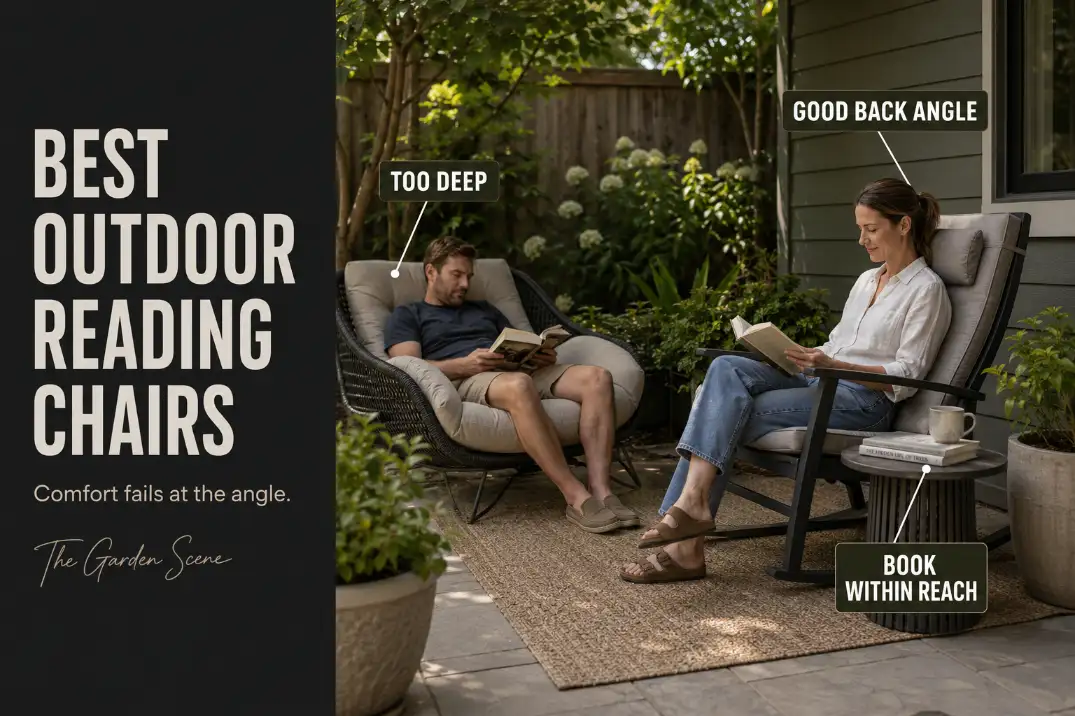
The best outdoor reading chairs for quiet patio corners are not always the biggest, softest, or most reclined chairs.
A good reading chair keeps your back supported, your book at a natural angle, and your feet stable for at least 30 to 45 minutes without constant shifting.
The first checks are seat height, back angle, cushion firmness, and whether the chair still fits the corner with a side table and walking clearance.
For most patios, the safest starting point is a seat height around 16 to 19 inches, a back angle closer to upright than nap-mode, and enough room to keep 30 inches of route clearance nearby.
This is different from buying a pool lounger or deep conversation chair. Those may feel relaxed for 10 minutes, but they often make reading harder because your neck, wrists, and lower back do the work the chair should be doing.
Quick Buying Decision
Start with the posture, then choose the style
For a quiet reading corner, buy the chair that supports the reading position first and the patio style second. The chair should let you sit back while keeping your eyes naturally aimed toward the page, not down into your lap or forward over your knees.
A chair that feels comfortable in a showroom can fail outside because patio reading is slower. You may stay in the same position for 20, 40, or 60 minutes.
Small posture flaws show up fast: raised shoulders, unsupported elbows, feet dangling, or a cushion that compresses until the chair feels lower than it looked.
This is why the first product filter should be posture, not style. If the chair makes your neck and lower back work after 30 minutes, the outdoor finish will not save the reading corner.
BEST FIRST CHOICE
Cushioned outdoor patio armchairs
Choose this for a quiet reading corner that needs real support, not deep lounging.
Best for upright posture, steady arms, and a compact patio footprint.
Avoid it if you mainly want a recliner or nap chair.
🔴 Shop cushioned outdoor patio armchair options
Avoid buying only by cushion thickness
Cushion thickness is easy to overestimate. A 5-inch cushion can still feel bad if the seat slopes too far back or the backrest is too low. A thinner, firmer cushion on a better frame often reads better than a thick pillow seat on a poorly angled chair.
The wasted fix is adding more throw pillows to a chair that is fundamentally too deep. One lumbar pillow may help. Three loose pillows usually mean the chair shape is wrong for reading.
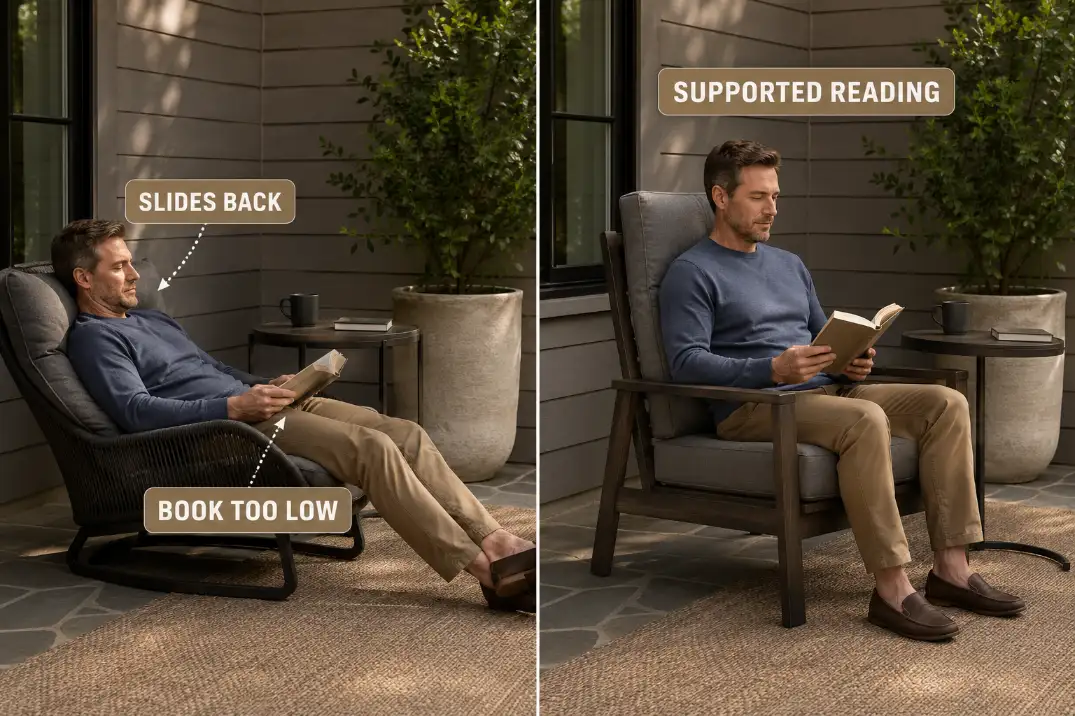
What Makes an Outdoor Chair Good for Reading?
The back angle matters more than the label
“Lounge chair” is a broad category. Some outdoor lounge chairs are built for conversation, some for sunbathing, and some for relaxed upright sitting.
For reading, the best back angle is usually roughly 100 to 110 degrees from the seat, not a deep recline. Once a chair leans far past that, the book tends to drop, the chin tucks, and the neck starts working.
This is where a good reading chair differs from a nap chair. A nap chair invites the body to recline. A reading chair supports the torso while leaving the arms relaxed enough to hold a book, tablet, or drink without strain.
Seat depth decides whether you sit or sink
Seat depth is the quiet failure point. Around 20 to 23 inches works well for many adults. Once the seat gets much deeper than 24 inches, shorter users often slide back, lose foot contact, or need a pillow just to sit upright.
That symptom is not “the chair needs more pillows.” The mechanism is poor body fit. If your lower back cannot reach the backrest while your feet stay stable, the chair is not doing reading work.
Arms should support, not trap
Outdoor reading chairs need arms, but not oversized arms that force your elbows outward. A useful arm height lets shoulders drop naturally. If the arms are too high, your shoulders lift after a few pages. If they are too low or too far apart, your forearms hang unsupported.
For most buyers, softly rounded arms are better than thin metal rails. They give you a place to rest a book briefly, shift position, or stand up without pushing on a wobbly frame.
Choose the Chair Type by Patio Corner
For a fixed quiet corner: high-back lounge chair
A high-back lounge chair is the best default when the reading spot is already chosen. It works especially well along a fence, beside a planter, under a pergola, or near a shaded house wall. The chair does not need to move much. It just needs to support repeated use.
Look for a frame that feels planted, not springy. A chair that rocks unintentionally on pavers, gravel, or an uneven slab will make a quiet corner feel slightly restless.
For changing shade or view: swivel rocker
A swivel rocker makes sense when the corner has two useful directions: morning sun one way, afternoon shade another, or a garden view that shifts across the day. It is not automatically better than a fixed chair. It is better only when the movement solves a real layout problem.
Give a rocker or glider about 8 to 14 inches of extra movement space behind and beside the chair. If it bumps a wall, planter, or side table, the motion becomes annoying instead of relaxing.
If the issue is changing shade and view direction, a fixed chair may feel limiting. That is when a swivel rocker becomes a useful product choice, not just a comfort upgrade.
FLEXIBLE CORNER PICK
Patio swivel rocker club chairs
Choose this when your reading corner needs to follow shade, breeze, or view changes.
Best for smooth motion, cushioned comfort, and longer sitting sessions.
Avoid it if the corner is too tight for a chair that turns and rocks.
🔴 Shop patio swivel rocker club chair options
For stretched-out reading: adjustable recliner
An adjustable outdoor recliner works when you want one chair for reading, resting, and occasional napping. It is less ideal for very tight corners because the full footprint can expand to 60 to 72 inches when reclined.
The mistake is buying an adjustable chair because it looks versatile, then using it in a corner where it can only stay half open. If the chair cannot recline without blocking the route, choose a fixed reading chair instead.
Fit the Chair to the Quiet Patio Corner
Keep the center clear
The best reading corner usually sits at the edge of the patio, not in the middle. That edge placement makes the seat feel protected and keeps the main route open.
If the patio corner itself still feels exposed, the same placement logic used in Outdoor Quiet Zone Ideas can help you decide whether the chair belongs near planting, shade, a fence, or a soft sound buffer.
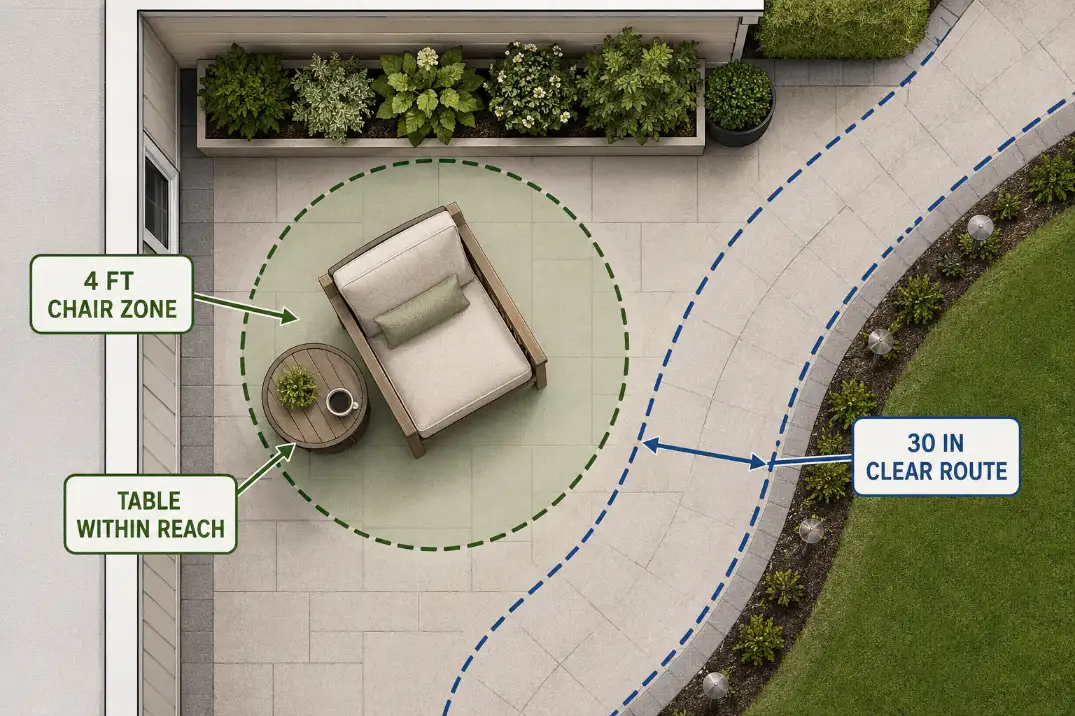
A single reading chair with a small table usually needs about a 4-by-4-foot zone to feel intentional. That does not mean the chair itself is huge. It means the chair, legs, table, and entry angle all need breathing room.
Test the stand-up path
Before buying, imagine standing up with a book in one hand and a drink on the table. You should not have to twist around the chair arm, step over an ottoman, or back into a planter. A 30-inch clear route beside the chair is a good practical threshold.
Seat height matters here too. Low chairs can look relaxed but become awkward for daily use, especially if the seat drops below about 15 inches.
If this is already a known problem on your patio, Outdoor Seating Height Mistakes explains why a chair can look comfortable but still feel hard to use.
| Chair type | Best use | Watch out for | Fit threshold |
|---|---|---|---|
| High-back lounge chair | Main reading chair | Seat too deep or soft | 16–19 inch seat height |
| Swivel rocker | Changing shade or view | Needs movement clearance | 8–14 inches behind |
| Adjustable recliner | Reading plus resting | Long full-recline footprint | 60–72 inches open |
| Adirondack chair | Casual short reading | Low seat and steep recline | Better with footrest |
| Egg or papasan chair | Cozy accent corner | Too deep for upright reading | Needs firm back pillow |
Which Outdoor Reading Chair Types Are Worth Buying?
High-back cushioned lounge chairs
This is the strongest category for most quiet patio corners. A high back supports the shoulders and gives the chair a more settled feel.
It also works visually in a corner because the chair creates a small destination instead of looking like loose furniture dropped on the patio.
Choose medium-firm cushions over extra-soft cushions. If the cushion collapses after one season, the seat height changes and the chair becomes harder to stand from.
In humid climates such as Florida, quick-dry cushion construction matters more than extra plushness. Cushions that stay damp for more than 24 hours after rain are not just inconvenient; they make the reading corner less usable.
Swivel rockers and gliders
Swivel rockers are worth buying when the motion is smooth and controlled. They are not the best choice on every small patio.
If the frame feels wide, the base looks bulky, or the motion forces the chair into nearby furniture, a fixed chair will usually feel calmer.
They work especially well where the chair needs to face both a garden edge and a conversation area. In that situation, the chair can serve daily reading without becoming single-purpose furniture.
Just avoid turning a tight patio into a furniture obstacle course; Patio Furniture Mistakes in Small Backyards covers the same clearance problem at a full-layout scale.
Adjustable outdoor recliners
Recliners are useful only when the patio corner has enough open length. This is the category buyers most often overestimate, because the chair looks compact when closed and much larger when opened.
Recliner comfort only matters if the chair can actually work in the space. If full recline blocks the route, clips a table, or forces the chair into the middle of the patio, the better purchase is a fixed high-back chair.
READING PLUS RESTING
Padded zero gravity chairs
Choose this for relaxed reading with leg support.
Best for reclining, long lounging, and nap-friendly corners.
Avoid it if you need upright posture.
🔴 Shop padded zero gravity chair options
Adirondack chairs
Adirondack chairs are popular, but they are not the automatic winner for reading. The low seat and backward recline can feel relaxing for a short break, then become awkward if you read for 45 minutes.
They work better with a footrest and a side table that sits high enough to reach without leaning.
Use Adirondacks for casual outdoor reading, not as the main solution for someone who wants a true book chair.
Egg chairs and papasan-style chairs
Egg chairs look cozy in photos, but many are too deep for reading unless they include a firm back cushion. They also take more visual space than buyers expect. In a small corner, a bulky rounded chair can make the patio feel decorated but less usable.
If you like that cocooned feeling, measure the full width and check the entry angle before buying. Deep seating can work beautifully in the right patio, but Deep Seating in Small Patios is where many buyers misjudge comfort versus usable space.
Material and Cushion Choices That Actually Matter
Match the frame to the climate
Aluminum is a strong low-maintenance choice for many U.S. patios because it handles moisture better than untreated steel.
Powder-coated steel can work, but scratches matter more in coastal areas where salt air speeds up corrosion. Teak and acacia can look excellent, but they need more seasonal care if you want the finish to age evenly.
In dry Arizona-style heat, UV exposure is often harder on cushions and synthetic wicker than rain. In northern states, freeze-thaw storage matters: cushions should come inside or stay in a dry deck box before winter moisture sits in the seams.
Choose cushions by recovery, not softness
A good outdoor reading cushion should feel supportive after 30 minutes, not just soft in the first 30 seconds. If the front edge compresses flat, the knees rise, the back rounds, and the book drops lower.
Cushions with removable covers are easier to keep clean, but that alone does not make them better. Breathability, drainage, and firmness matter more. In shaded corners, a cushion that dries in 4 to 8 sunny hours is much more practical than one that feels luxurious but stays damp into the next day.
Shade also changes the decision. A chair that is comfortable at 9 a.m. may feel unusable by 3 p.m. if the corner traps heat.
If the reading spot depends on afternoon comfort, Backyard Layout for Shade, Seating, and Airflow is a useful companion before choosing the final chair location.
Quick Checklist Before You Buy
- Sit back fully: your lower back should touch support without sliding.
- Check seat height: about 16 to 19 inches fits many patio reading setups.
- Check seat depth: around 20 to 23 inches is safer than oversized deep seating for upright reading.
- Keep a 30-inch route open beside or behind the chair.
- Allow 8 to 14 inches of motion clearance for rockers or gliders.
- Place a side table within about 12 to 18 inches of the arm.
- If you shift position every 10 minutes, the chair style is probably wrong, not just the cushion.
Questions People Usually Ask
Are zero-gravity chairs good for outdoor reading?
They can be good for relaxed reading, but they are not the best all-purpose patio reading chair. Many zero-gravity chairs place the body too far back for upright book reading.
They work better for tablets, audiobooks, or short reading sessions where recline is part of the appeal.
Is a rocking chair better than a lounge chair?
Only if the motion helps the corner. A rocking chair is better on a porch or covered patio where the floor is flat and there is room behind the chair. A fixed high-back lounge chair is usually better when the corner is tight, planted, or meant to feel still.
Do I need an ottoman?
Not always. An ottoman helps with longer reading sessions, but it also increases the footprint. If adding an ottoman blocks the route or makes the chair hard to enter, choose a slightly more supportive chair instead of forcing a footrest into the corner.
What is the most common buying mistake?
Buying a chair that looks cozy in a product photo but is too deep, too low, or too reclined for reading. The comfort problem usually appears after 15 to 20 minutes, when the body starts compensating for the chair’s angle.
For broader seating ergonomics, see OSHA’s chair guidance.