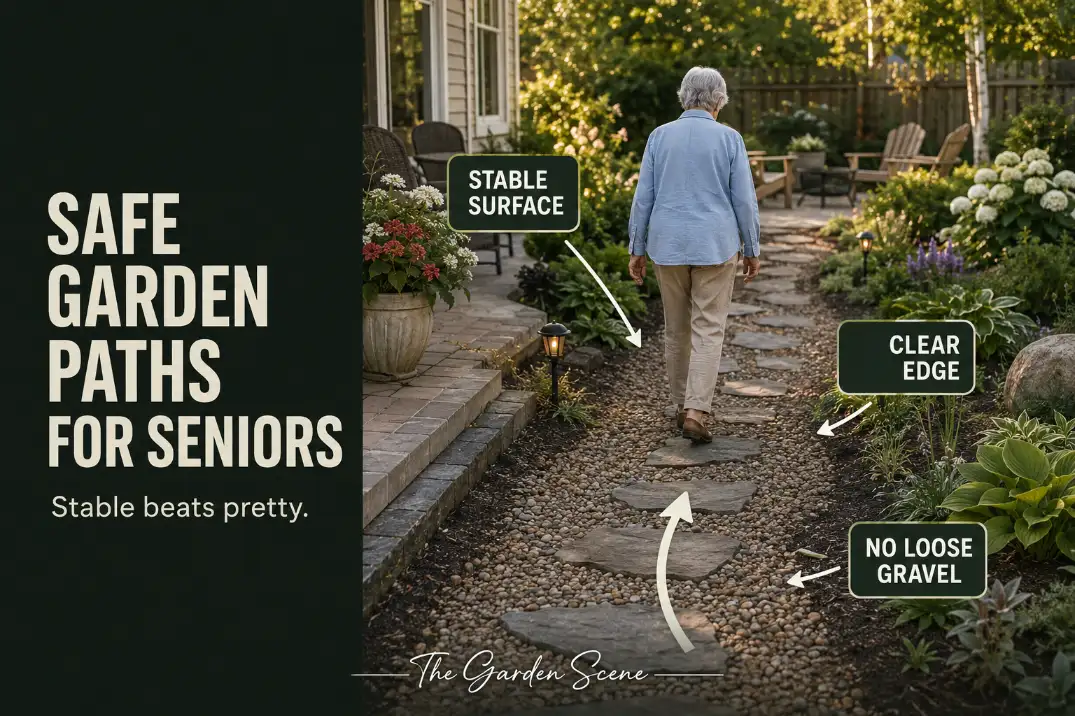
The safest garden path for seniors is a continuous, firm, textured route at least 36 inches wide, with 42 inches feeling better where someone may use a cane, walk beside another person, or carry garden items.
The first checks are not decorative. Does the surface stay steady under a slow step? Can the edge be seen from 6–8 feet away? Does the route still feel predictable 12–24 hours after rain?
A garden path can look finished and still feel unsafe if gravel shifts, stepping stones break rhythm, or a small slope pulls the body sideways.
The useful distinction is simple: a decorative path is designed to be seen, while a senior-friendly path must be trusted while moving. A 1/4-inch lip may look minor, but repeated uneven spots, loose stones, or a sideways tilt can make someone watch their feet instead of the yard.
For the same reason, a senior garden path should connect with the larger outdoor layout instead of acting like a separate feature.
When the route leads to a patio, chair, gate, or raised planter, it should support the same clear movement logic used in Accessible Outdoor Space Ideas: fewer surprises, clearer edges, and less need to recover balance mid-step.
Quick Path Safety Checklist
Use this first, before replacing plants or buying more edging.
- Keep the main walking route at least 36 inches clear; 42 inches is better for a cane, helper, or garden basket.
- Add a wider place to pause, turn, or stand beside someone near seating, gates, raised beds, or work zones; 60 inches is a useful target where turning matters.
- Make sure surface pieces do not rock, sink, or shift when stepped on slowly.
- Correct lips, raised joints, or abrupt edges near 1/4–1/2 inch, especially near turns or seating.
- Check whether the edge still reads clearly at dusk, not only at noon.
- Recheck gravel, mulch, or pavers 12–24 hours after rain or irrigation.
- Treat repeated seasonal movement as a base or surface problem, not a cosmetic problem.
Stable Beats Decorative
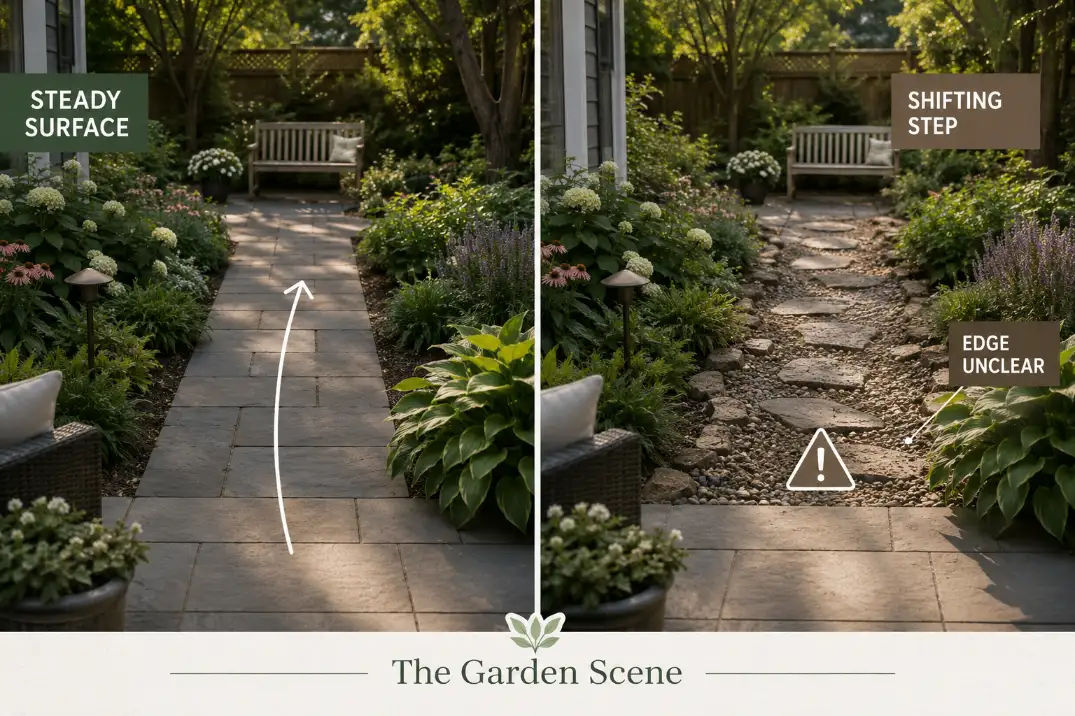
A safe garden path for seniors starts with one non-negotiable idea: the foot should meet the same kind of support from the first step to the last.
Smooth textured concrete, well-set pavers, compacted crushed stone, and firm resin-bound surfaces installed over a proper base usually perform better than loose pea gravel, bark mulch, or widely spaced flagstone.
The Main Route Needs a Higher Standard
Decorative side paths can be looser and more informal. The main route cannot. The path from the back door to a patio chair, from the driveway to the front entry, or from the patio to a raised planter should not ask for careful foot placement every few steps.
The common mistake is choosing the surface by how it photographs. Loose gravel, rustic stepping stones, and irregular flagstone can look warm and natural, but they often require small balance corrections with every step.
For older adults, the tiring part is often not one dramatic trip hazard. It is 20 small corrections across a short route.
The Surface Should Not Ask for Balance
A healthier path lets the walker look ahead. A failing path makes the walker look down. That is the symptom. The mechanism underneath is surface movement, irregular spacing, poor edge contrast, or a base that no longer supports the top layer.
Adding more decorative stone to a soft path usually wastes money if the base underneath still moves. The better priority is the base: compacted subgrade, adequate depth, drainage away from the walking line, and a surface that does not deform after rain.
If a path feels firm in dry weather but gets spongy the day after watering or a storm, the issue is not the top layer alone. The base is holding moisture or the route is collecting runoff.
In that case, adding another inch of gravel or mulch may make the path look refreshed while making the walking surface less predictable.
For patios and connecting walkways, the same surface logic appears in Best Low-Slip Patio Surfaces for Family Backyards, where the safest choice is rarely the most decorative one in the sample display.
Edges Should Feel Predictable
Edges matter because they tell the body where the safe walking zone ends. A path can be wide enough on paper and still feel uncomfortable if grass, mulch, planting, or shadow blurs the boundary.
Clear Edges Reduce Hesitation
For senior-friendly garden paths, the edge should be visible without constant looking down. A steel, paver, concrete, or stone border can work, but it should not create a raised trip line.
As a practical rule, abrupt vertical changes over 1/4 inch deserve attention, and anything approaching 1/2 inch should be corrected near turns, gates, steps, or seating.
The mistake many homeowners make is overestimating width and underestimating edge clarity. A 42-inch route with messy edges can feel less secure than a 36-inch route with a firm surface and obvious boundary.
Dusk Is the Better Edge Test
A path that looks clear at noon can become harder to read in evening light. Shadows flatten small lips. Mulch and dark pavers can blend together. Plant edges can hide where the walking surface actually ends.
The practical test is simple: stand 6–8 feet back at dusk and look at the route from the angle someone would actually approach it. If the edge disappears, the path needs more contrast, cleaner trimming, better lighting, or a simpler border.
This is where garden design and access design overlap. A front or backyard route that looks welcoming still needs the same practical discipline discussed in Front Yard Visitor Path Mistakes: the path should guide movement without forcing guesses.
Pro Tip: Trim path-edge plants before they touch the walking line, not after they already make people step inward.
Gravel Can Shift Too Much
Gravel is not automatically unsafe, but loose gravel is often overrated for senior paths. The problem is not that stone exists. The problem is stone movement under slow, careful steps.
Pea Gravel Is Usually the Wrong First Choice
Pea gravel rolls. That rounded shape can work in a decorative zone, drainage strip, or area beside a bench, but it is rarely the best main walking surface for older adults. A 2–3 inch layer of loose pea gravel can feel like walking across marbles, especially with a cane, walker, or stiff-soled shoe.
If gravel is used for a main path, angular compactable material is usually the better direction. Crushed fines or decomposed granite can lock together more predictably when installed over a prepared base. Even then, it needs edging, compaction, and correction after heavy rain or seasonal washout.
Gravel Failure Has a Pattern
The warning sign is not just scattered stones. It is a repeated shallow rut in the center of the path, gravel pushed toward the edges, and a slightly lower walking track after several weeks of use. That tells you the surface is moving instead of supporting.
| Material | Use for senior main path? | Why it works or fails | Best correction |
|---|---|---|---|
| Textured concrete | Strong choice | Firm, continuous, and easy to read | Avoid glossy sealers |
| Well-set pavers | Strong choice | Stable if joints stay flush | Correct lips near 1/4–1/2 inch |
| Compacted crushed fines | Use carefully | Can lock together if edged and compacted | Recheck after heavy rain |
| Resin-bound surface | Use carefully | Can feel firm if installed over a stable base | Avoid weak base preparation |
| Flagstone | Use carefully | Attractive but often irregular | Use larger stones with tight joints |
| Pea gravel | Avoid as main route | Rolls and shifts under slow steps | Move to decorative or drainage zones |
| Bark mulch | Avoid as main route | Compresses, floats, and hides edges | Use in beds, not primary walking routes |
The table matters because a senior path should be selected by use, not just by style. The best surface for a garden border is not always the best surface for the route someone depends on every day.
Stepping Stones Need Rhythm
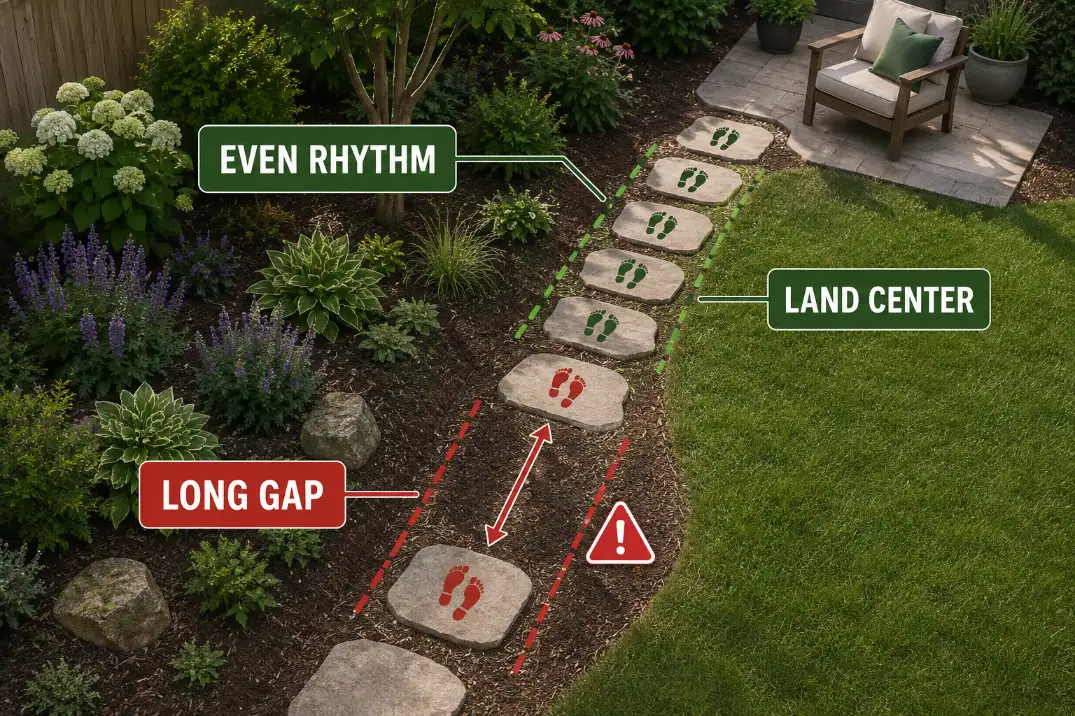
Stepping stones are one of the most misread path choices. People often ask whether the stones are “flat enough,” but flatness is only one part of the decision. Rhythm matters just as much.
The Step Pattern Should Not Change Suddenly
For seniors, stepping stones work best when each stone is large, stable, level, and placed at a consistent stride. Stones that alternate between short and long gaps force the walker to adjust mid-route. That adjustment becomes more noticeable when carrying pruners, a watering can, or a small basket.
A practical spacing range is often about 18–24 inches from center to center, but the right number depends on the user’s natural stride.
The safer test is to walk the path slowly without looking down. If your foot keeps landing near an edge instead of the center, the rhythm is wrong.
Mobility Aids Change the Answer
A stepping-stone path may be acceptable for a short garden accent, but it becomes weaker when someone uses a cane, walker, or needs a companion nearby. The gaps interrupt the walking surface. The cane tip may land between stones. A walker needs continuous support rather than separate landing points.
That is why stepping stones are usually not the best primary route from the back door to a patio chair, from the driveway to the front entry, or from the patio to a garden work area. They can still belong in the landscape, but they should not carry the most important movement.
If stones rock after freeze-thaw cycles, sink into wet soil, or become hidden by groundcover, the standard fix of resetting one stone stops making sense.
At that point, the route needs a more continuous surface. For narrow planting areas, Stepping Stone Access in Sidewalk Strips shows where stones help and where they start becoming awkward instead of useful.
Slope Makes Paths Harder
Slope changes the path from a surface decision into a movement decision. A slightly sloped path may still be usable, but the body has to manage direction, speed, and balance at the same time.
Side Tilt Is Often Worse Than Forward Slope
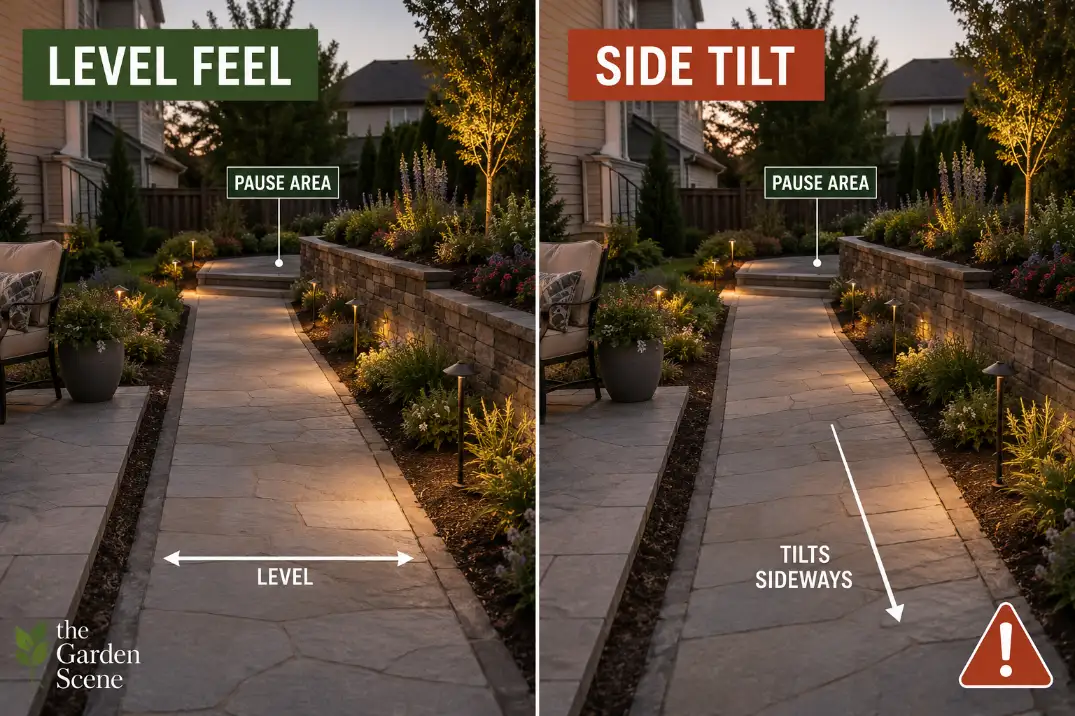
Homeowners usually notice uphill and downhill movement first. But cross slope, the sideways tilt across the path, is often more uncomfortable. A path that leans sideways makes every step feel like a correction.
For a senior-friendly route, keep the walking surface as close to level across its width as possible. A cross slope near 2% is a useful upper comfort benchmark. If a rolling garden cart drifts sideways, water sheets toward one edge, or the walker keeps stepping inward to compensate, the path likely has a cross-slope problem.
A 5% Grade Changes the Design
A gentle running slope may still work, but once the route approaches about 5%, the design needs more support. That may mean a wider path, a more textured surface, a handhold nearby, better lighting, or a short resting point rather than one continuous push uphill.
A larger garden path does not need a rest area every few steps, but a pause point every 25–40 feet can help on longer or slightly sloped routes. Near seating, gates, raised beds, or turns, widening the route toward 60 inches gives someone more room to pause, turn, or reset balance without standing half on the edge.
This is especially important in yards where drainage and slope already make movement harder. If the path also collects runoff, the safer repair order is slope and drainage first, surface second.
The same priority shows up in Fix Slope, Drainage, and Erosion in the Right Order, because a path built over a moving wet base rarely stays safe for long.
Lighting Is Part of Slope Safety
A sloped or turning path needs readable edges after dark. Low path lights should show the walking line, not glare into the eyes. The goal is to reveal changes before someone steps onto them.
Where the route includes steps, slopes, or uneven transitions, Path Lighting for Steps, Slopes, and Walkways fits naturally with the path design itself. Lighting is not decoration here. It is part of the walking surface information.
Pro Tip: Test a senior path at dusk, not only at noon. Many edge and slope problems appear when shadows flatten the surface.
A Path That Builds Confidence
The best senior garden path does not announce itself as “accessible.” It simply feels calm. The surface is firm, the edge is readable, the slope is not surprising, and the route gives enough room to move without rushing.
Build the Main Route First
Prioritize the route someone uses most often: back door to patio chair, driveway to front door, patio to garden bed, or house to gate. Secondary garden loops can stay more decorative, but the main route should be stable enough for everyday use.
This is where people commonly underestimate fatigue. A path that is acceptable once may be tiring after several passes in one afternoon. If a person uses the same route 4–6 times while watering, carrying cushions, or visiting the garden, small defects become bigger.
Know When Repair Stops Working
A routine fix is reasonable when the problem is isolated: one loose paver, one overgrown edge, one low spot after a storm. It stops making sense when the same defect returns every season.
If gravel keeps spreading, stones keep rocking, edges keep disappearing by midsummer, or the route changes after every heavy rain, the path is not asking for another cosmetic refresh. It is asking for a more stable path system.
A senior-friendly path should not depend on perfect attention. It should tolerate a slower step, a distracted glance, a light rain, and a change in evening visibility.
That is why the winning path is often simpler than the prettiest option: fewer loose parts, fewer surprise gaps, and fewer edges that disappear into planting.
Questions People Usually Ask
What is the safest garden path surface for seniors?
The safest surface is firm, continuous, textured, and easy to read visually. Textured concrete, well-set pavers, firm resin-bound surfaces, and compacted angular stone usually perform better than loose pea gravel, bark mulch, or widely spaced stepping stones.
How wide should a garden path be for seniors?
A 36-inch clear route is a useful minimum benchmark. A 42-inch route feels better for a cane, helper, or carried items, while wider 60-inch areas help near turns, seating, gates, or garden work zones.
Are gravel garden paths safe for seniors?
Gravel can be safe only when it is compactable, contained, and maintained. Loose rounded gravel is usually a poor main-route choice because it shifts underfoot and makes slow walking less predictable.
When should you rebuild instead of repair a senior garden path?
Rebuild or redesign when the same problem returns every season, when the path feels different after rain, or when the walker has to look down more than ahead. Those are system problems, not simple cosmetic flaws.
Because senior paths often fail at width, slope, and surface changes, broader official route guidance is available from the U.S. Access Board.