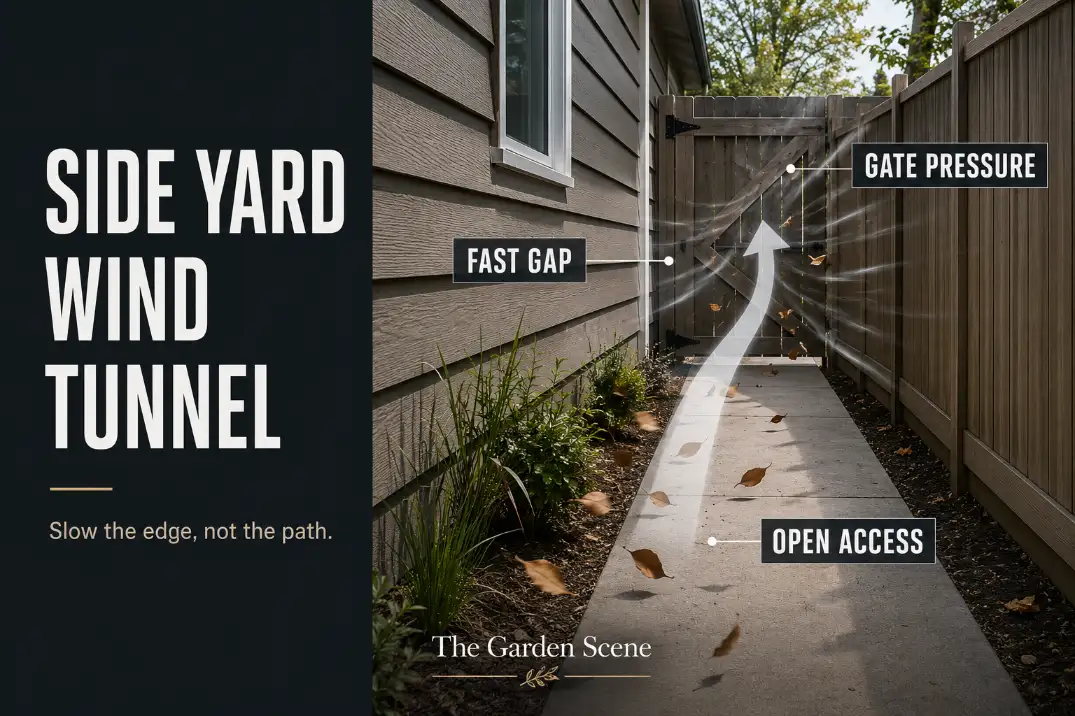
A wind tunnel side yard is usually fixed by slowing the first fast edge, not by sealing the whole passage. Start with the windward opening, the gate pressure point, and the usable access path before adding screens or plants.
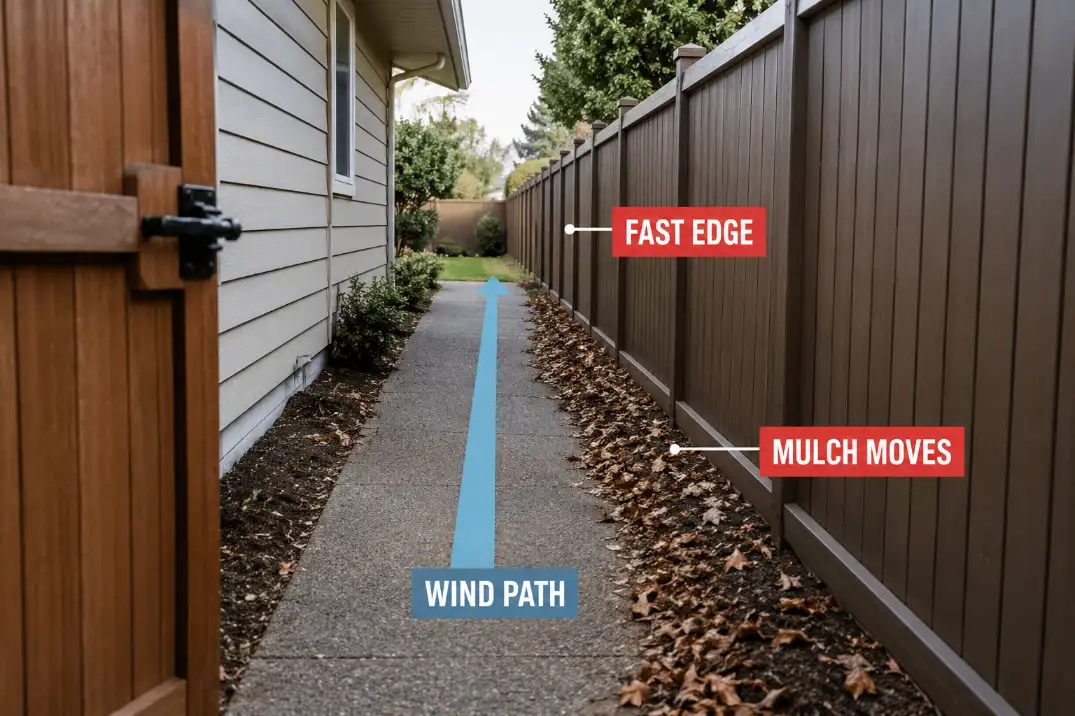
If the side yard is only 4 to 8 feet wide, lined by a house wall and solid fence, and leaves or mulch move in the same direction after most breezy afternoons, the problem is probably corridor acceleration rather than general yard wind.
The quickest useful checks are simple: does the gate rattle within 5 to 15 minutes of gusts, do lightweight items move along one path, and can you still preserve about 36 inches of clear walking or rolling space after any fix?
That last number matters. A wind solution that blocks trash bins, hoses, mower access, or AC service usually creates a new side yard problem.
Why Side Yards Speed Up Wind
The corridor shape is the real issue
A side yard becomes uncomfortable when air is guided between two long vertical surfaces. The house wall, fence, garage wall, neighbor structure, or tall hedge can create a narrow slot that gives wind direction and speed.
The gust may begin outside the yard, but the side yard shape turns it into a more focused path.
This is why the first visible symptom can be misleading. A rattling gate, dry planting strip, blown mulch, or noisy bin lid is usually not the root problem.
Those are the places where the wind announces itself. The mechanism is the corridor.
A common wasted fix is adding one heavier object at the noisy spot. A heavier pot, denser mulch, or stronger latch may survive the gust better, but it does not slow the air that caused the problem.
If the same leaves keep collecting in the same corner after every windy day, the side yard is still acting like a channel.
Hard surfaces make the gust feel sharper
Concrete, pavers, gravel, vinyl fencing, stucco walls, metal gates, and bare foundation edges all make the side yard feel more abrupt. They reflect sound, heat, and movement instead of absorbing much energy.
A 5-foot side yard with a hard walkway and bare fence line often feels harsher than a 4-foot side yard softened by soil, mulch, and flexible planting.
Fence height is often overestimated here. A 6-foot privacy fence may block views, but it can still leave a fast wind path along the face of the fence.
In some layouts, the taller solid surface makes the pressure point at the gate or back corner more obvious.
The better question is not “How do I block all the wind?” It is “Where can I slow the first fast edge without ruining the side yard’s access?”
The Narrow Gap Effect
Straightness can matter more than width
A narrow side yard is not automatically a wind tunnel. A 4-foot passage can feel calm if it has staggered planting, broken edges, open fence sections, or turns that interrupt airflow. An 8-foot passage can feel harsh if it is straight, bare, and lined with hard surfaces.
The most useful threshold is the access line. If bins, a mower, a wheelbarrow, or garden tools need to move through the space, keep roughly 36 inches clear.
A screen, planter, or shrub that narrows the route below that may calm one gust while making the side yard awkward every week.
That is why edge-based fixes usually work better than centerline fixes. A 12- to 18-inch planting strip, a short semi-open panel, or staggered planters along one side can slow airflow without turning the passage into an obstacle course.
For side yards that already function as service routes, Side Yard Utility Corridor Ideas can help keep access, storage, and screening from competing with each other.
Use a quick field test before building
You do not need equipment to find the first fast edge. On a breezy afternoon, tie two or three short ribbons to temporary stakes, gate hardware, or a fence post. Watch them for 10 minutes.
The most useful spot is not always where leaves end up; it is where movement first becomes fast and steady.
Then test a temporary interruption. A loose panel, tall cardboard sheet, or movable planter placed near the windward edge can show whether the side yard calms before you install posts or buy permanent screens.
If gate rattle drops, mulch stops skittering, or leaves no longer shoot through the same line, you found the right zone.
Pro Tip: Test screen placement before testing screen height. A short barrier in the right place often beats a tall barrier installed too late in the wind path.
Gates and Corners Matter
The gate is often the pressure point
Many side yard wind problems become obvious at the gate. The gate may rattle, flex, slam, or hum even when the rest of the yard does not seem extreme. That usually means the moving air is concentrating at an opening or solid panel.
The fix is not always a heavier latch. Hardware matters, but a latch only controls movement after pressure arrives. If the gate is a flat solid panel in a narrow wind slot, pressure can keep returning.
A better latch, small controlled gaps, open-slat construction, or better alignment may reduce noise without turning the entrance into a sealed wall.
Gate clearance also matters more than it seems. A planter or screen placed too close to the hinge side can make the gate harder to use, especially when bins or tools need to pass through.
If the entrance already feels tight, check Side Yard Gate Swing Clearance before placing anything permanent near it.
Corners create the second problem
The wind usually accelerates along the side yard first. Then it hits a back fence, patio edge, AC pad, bin area, or corner and changes direction.
That second hit can create leaf piles, noise, swirl, or a gust that spills into the backyard seating area.
This is where a tall end screen often fails. It catches air after it has already sped up. The better fix is usually earlier and softer: slow the edge before the corner, then let the corner breathe.
If the corner becomes a dead-end, the side yard may feel less windy in one exact spot but more turbulent around the edges.
| Side Yard Signal | More Likely Meaning | Better First Response |
|---|---|---|
| Mulch moves in one direction | Air is traveling as a corridor | Break the edge with low planting or porous screening |
| Gate rattles during short gusts | Pressure is concentrating at the opening | Adjust latch, reduce solid-panel pressure, preserve swing space |
| Plants dry faster along one fence line | Wind and reflected heat are working together | Use tougher edge plants and mulch, not delicate fillers |
| Leaves collect at one back corner | Air is hitting a dead-end | Add an earlier wind break, not only a corner barrier |
| Trash bin lids flip repeatedly | Objects sit in the fast path | Relocate bins or shield the windward side without blocking access |
Plants That Slow the Edge
Use plants as friction, not as a wall
Plants work best in a wind tunnel side yard when they add texture along the edge. They do not need to become a hedge. In many narrow passages, a 12- to 18-inch strip of upright grasses, compact shrubs, or flexible perennials can slow the first layer of air better than one bulky evergreen that crowds the walkway.
The strongest plant choices are usually flexible and narrow. They bend, recover, and hold their shape without constant tying. In dry desert conditions, reflected heat from gravel and walls can make wind drying worse.
In humid climates, some airflow may be useful for drying the passage after rain, so the goal is not to seal the space. It is to reduce the sharp gust.
New plants also need time. A young planting strip may take 6 to 12 months before it meaningfully changes wind movement.
If the side yard needs relief now, combine planting with a short porous panel or staggered planters instead of expecting small new plants to do the whole job.
For plant choices that fit tight corridors, Best Plants and Materials for Narrow Side Yards is more useful than choosing plants only because they look dense at the nursery.
Know when plants are the wrong first fix
Plants stop making sense when they solve wind by creating access trouble. If the planting needs weekly tying, trimming, or staking just to keep the path open, it is no longer fixing the side yard. It is becoming the side yard problem.
A healthy edge planting should bend slightly during gusts, recover within a day, and stay mostly inside its intended strip. A failing one leans into the walkway, sheds leaves, blocks bins, or needs constant correction.
In that case, a semi-open screen or planter-based layout may be the better first move.
Screens Need Openings
Porous screens usually beat solid walls
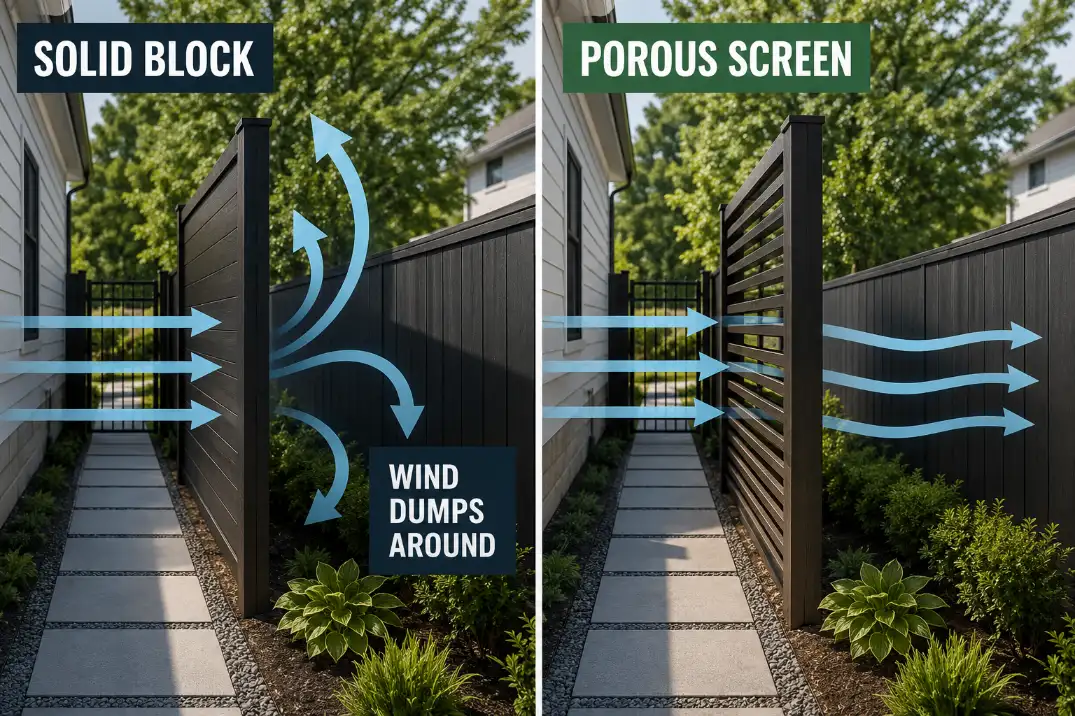
A solid panel feels logical because the problem is wind. In a narrow side yard, though, a fully sealed barrier can force air around the end, increase pressure at the gate, or create swirl near the corner. The useful goal is controlled leakage, not total blockage.
In larger windbreak design, density and gaps affect how much wind is slowed and where turbulence forms. In a residential side yard, the practical lesson is simple: choose a screen that lets some air pass through it.
Slats, lattice, mesh, staggered boards, or layered planters usually behave better than a flat sealed wall in a tight corridor.
This is also where privacy and wind comfort diverge. Privacy wants visual blockage. Wind comfort wants speed reduction.
If you need both, Narrow Planters and Privacy Screens for Side Yards can help you choose a layout that interrupts sightlines without turning the passage into a pressure box.
Place the screen before the problem area
A screen placed where leaves collect is often too late. The better location is usually before wind reaches the gate, bin zone, AC pad, or back corner. Even a 2- to 3-foot interruption can change the feel of the side yard if it sits at the first fast edge.
Do not extend the fix farther than the problem requires. If a short porous screen and planting strip reduce gate rattle and stop mulch migration, a full-height screen down the entire side yard may add shade, cost, and maintenance without improving comfort.
Pro Tip: After installing any screen, recheck the side yard during the next breezy day. If the gate is quieter but the corner now swirls harder, the screen may need more openness or a different position.
Less Wind Without Blocking Access
Keep the side yard’s job intact
A side yard is rarely just a landscape strip. It may carry trash bins, hoses, wheelbarrows, dogs, utility access, drainage, and AC service. A wind fix that blocks those jobs will feel successful for a few days and irritating for years.
The access route should stay obvious. Keep the main walking and rolling line around 36 inches where equipment needs to pass.
Keep screens outside gate swing zones. Avoid placing dense planters where people must squeeze past them every day. If the side yard includes an AC unit, do not turn the unit into a windbreak or box it in for appearance.
Air-conditioning equipment needs airflow and service access, so a wind solution near it should be especially careful.
Before screening around equipment, review Side Yard AC Screening Without Blocking Airflow so the wind fix does not create a mechanical clearance problem.
Fix in the right order
First, find the wind direction and the first fast edge. Second, check the gate or corner where pressure becomes noisy. Third, add friction along one side with plants, staggered planters, or a semi-open screen. Fourth, walk the route again with the objects that actually use it: bins, hoses, mower, wheelbarrow, or service access.
That order matters because the obvious fix is often the wrong first fix. A tall solid screen may look decisive, but if it narrows the passage, blocks gate movement, or dumps wind around the end, it has not solved the side yard. It has only moved the problem.
Quick diagnostic checklist
- The side yard is 4 to 8 feet wide and lined by two hard vertical surfaces.
- Leaves, mulch, or dust move in the same direction after most breezy days.
- The gate rattles, flexes, or slams within 5 to 15 minutes of gusts.
- Plants along one edge dry faster than nearby beds within 24 to 48 hours.
- A solid fence gives privacy but does not reduce the fast wind path.
- A proposed fix would reduce the clear access path below about 36 inches.
Questions People Usually Ask
Should I close off the side yard completely?
Usually no. Closing the side yard can reduce one direct gust, but it often shifts pressure to the gate, roofline, or back corner. A semi-open interruption is usually safer than a sealed wall in a narrow passage.
Are tall hedges better than screens?
Only if there is enough mature width and maintenance access. In many side yards, a narrow mixed edge or staggered planter line is more practical than a hedge that needs frequent trimming during the growing season.
Is wind tunnel behavior worse in winter?
It can be. In northern states, bare deciduous plants, colder gusts, and snow drifting can make the corridor feel sharper. In summer, the same side yard may show the problem through dried plants, moving mulch, or hot reflected air instead.
The Best Fix Is a Slower Edge, Not a Closed Corridor
The strongest side yard wind fixes do not try to stop every bit of air. They slow the first fast edge, protect the gate from pressure, and keep the access route usable.
That usually means a measured combination of porous screening, tougher edge planting, better gate control, and fewer objects sitting directly in the wind lane.
If the side yard still works after the fix, the solution is probably right. If it becomes tighter, darker, harder to roll through, or harder to service, the wind problem has simply been traded for an access problem.
For broader official guidance on how windbreak height, density, and gaps affect wind reduction, see Iowa State University Extension.