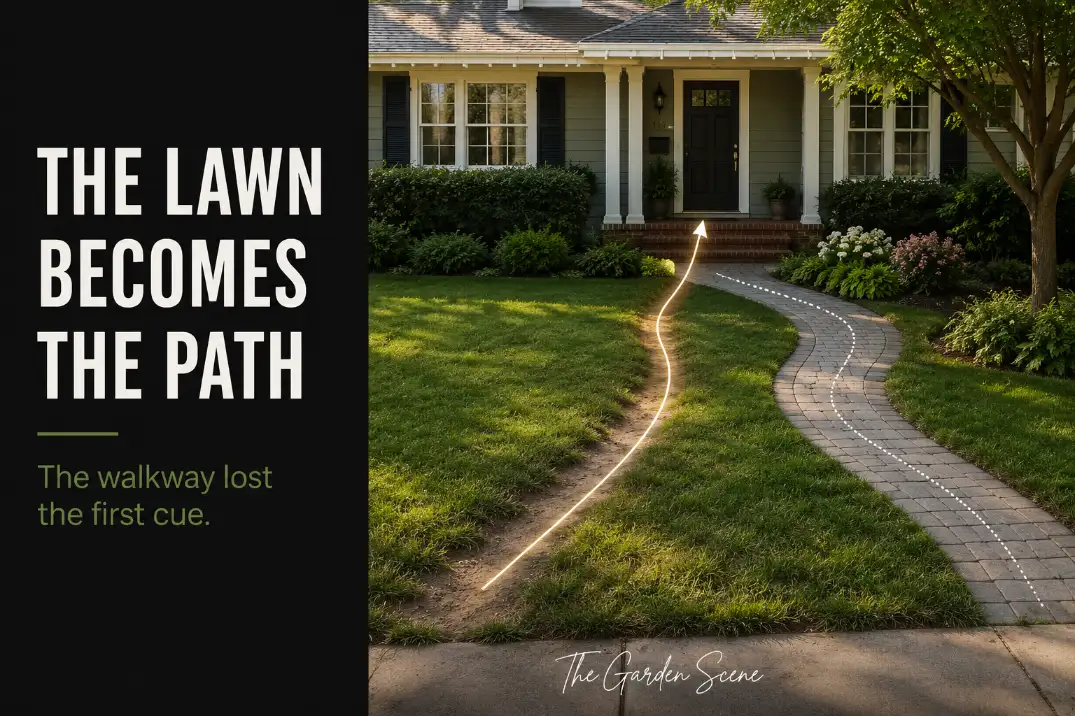
Guests usually cut across the lawn because the yard gives them a stronger route than the walkway does. That worn diagonal strip is a desire path, not just turf damage. It records the line people choose when the front door is visible but the official path is late, hidden, indirect, or uncomfortable.
The first checks are simple: where does a guest step in from, what route do they see within 3 seconds, and how much longer is the paved path than the shortcut?
If the grass route saves 6 to 10 feet, or if the correct path requires a sideways turn that feels unnecessary, most visitors will not think of it as rude. They will think of it as obvious.
The mistake is treating the thin grass as the problem. The grass is the symptom. The real mechanism is a front yard that points the eye toward the door but sends the feet somewhere else.
Why Guests Cut Across the Lawn
A visitor path fails when the intended route is less direct, less visible, or less comfortable than the shortcut. That is why reseeding the worn strip rarely lasts. Fresh seed may hide the damage for 4 to 8 weeks, but it will not change the route decision.
The shortcut starts before the lawn damage
People do not wait until they are halfway across the yard to choose a route. They choose when they leave the sidewalk, close the car door, or step around a parked vehicle.
If the front door, porch light, house number, or welcome mat is visible before the walkway entrance, the lawn becomes the mental path.
This is especially common in suburban front yards where the walkway begins near the driveway but the door sits offset 8 to 15 feet away. The paved path technically exists, but guests see the door first and the route second. That order matters.
A better front yard route works like a quiet instruction: enter here, follow this line, arrive at the door.
When that logic breaks, the problem often overlaps with the same arrival mistakes covered in Front Yard Walkway Offset From the Door and Driveway, where the walkway is present but still feels like the long way around.
Lawn repair is usually the wrong first fix
Reseeding, patching, or adding a small “please use walkway” sign treats the visible scar, not the decision that created it. The more useful question is: why did the lawn look more like a path than the path did?
A healthy route says, “this is the way in.” A failing route says, “the door is over there.” That distinction is why edging, mulch, and small border plants often disappoint. They can make the mistake look neater without changing how people move.
Pro Tip: Stand where a guest first arrives, not where you usually stand as the homeowner. If the intended route is not clear in 3 seconds, the yard is inviting shortcuts.
The Path They See First
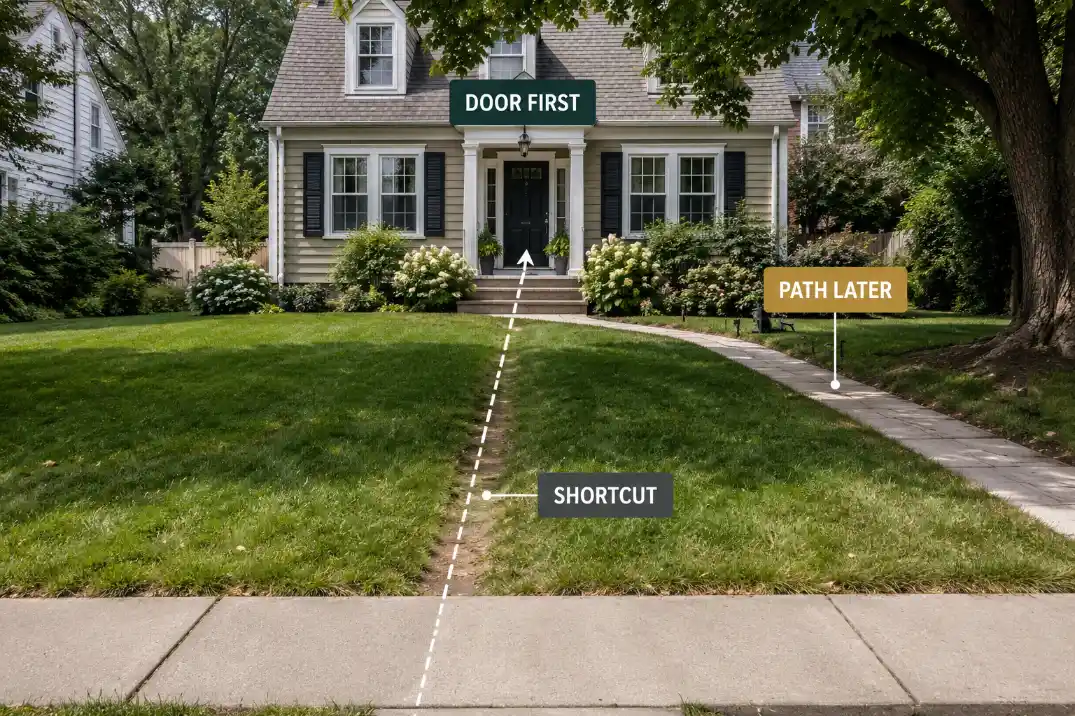
The first visible path is not always the paved one. It may be the open line between shrubs, a gap beside the mailbox, the shortest route from a driveway, or the strip delivery drivers already use.
Sidewalk arrivals need a clear path mouth
From the sidewalk, the walkway entrance should feel wider and more inviting than the lawn edge beside it. A 36-inch clear walking width is a practical minimum, but the first few feet of the path often need stronger visual weight than the rest of the walk. A 42- to 48-inch opening feels more natural where the route begins or turns.
Homeowners often overestimate walkway width and underestimate path mouth visibility. A wide walk can still fail if its starting point hides behind a hedge, mailbox, parked car, tree trunk, or deep planting bed.
If the entrance is only obvious from inside the yard, it is not obvious enough for guests.
Driveway arrivals often create the real visitor route
Many guests do not arrive from the sidewalk. They step out of a car, close the door, and aim straight for the entry. If the driveway edge sits closer to the front door than the walkway entrance does, the driveway becomes the real arrival point.
This is where many front yards with large driveways go wrong. The design is planned for curb appeal from the street, while actual movement starts at the passenger-side car door.
A lawn shortcut between the driveway and porch is not random wear; it is the route the layout forgot to build.
That movement deserves a real decision, not a leftover strip of turf. The same driveway-to-door logic is central in Front Yard Design for Driveway and Front Door Access, especially where parking patterns control how visitors actually enter the yard.
Walkways That Miss the Door
A walkway does not need to be perfectly straight. It does need to feel intentional. Curves become a problem when they read as decoration instead of guidance.
Decorative curves can create bad route math
A gentle curve works when it moves people around a tree, slope, planting bed, drainage feature, or grade change. It fails when the curve adds distance without explaining why.
As a practical threshold, if the paved route adds more than about 6 to 8 feet compared with the lawn shortcut, planting alone is unlikely to stop the behavior. Guests may not calculate the distance, but they feel the delay.
This is why a prettier border along the existing curve often wastes time. It improves the look of the wrong route without making that route the one people want to take.
Turns need comfort, not just paving
A 36-inch walkway may work in a straight line, but a turn near porch steps, planters, a railing, or a post often needs 42 to 48 inches of clear space to feel usable. If the turn feels tight, people drift toward the open lawn.
The problem gets sharper after rain, during leaf drop, or in freezing northern states where edges can feel slick. If the official walk stays wet for 24 to 48 hours after storms while the lawn route feels open, visitors will keep trusting the wrong line.
The final approach also has to connect cleanly to the door area. If the landing is crowded by planters, packages, or a storm door swing, the route can fail at the last 3 feet.
That same pressure shows up in Front Door Landing Clearance, where an entry can look decorated but still leave no good place to stand.
| If the shortcut starts here | The likely mechanism | Better first correction |
|---|---|---|
| Sidewalk edge | Path mouth is hidden or weak | Widen or visually frame the walkway entrance |
| Driveway edge | Parking route was never built | Add a short connector path or arrival pad |
| Middle of curved walk | Paved route adds unnecessary distance | Shorten, straighten, or make the curve purposeful |
| Beside crowded planting | Official route feels narrower than the lawn | Reset plants for mature spread clearance |
| Same spot after reseeding | Circulation problem, not turf failure | Stop patching grass and fix the route cue |
Planting That Blocks the Shortcut
Planting can help, but only when the correct route already makes sense. If the walkway is confusing, plants become barriers people step around, through, or over.
Blocking is weaker than guiding
The goal is not to punish the shortcut. The goal is to make the correct route easier to read.
Low shrubs, ornamental grasses, boulders, or edging plants can work when they frame the intended path and close the open diagonal across the lawn. A random plant dropped into the shortcut line usually looks like an obstacle, not a design decision.
A stronger fix combines three moves: make the walkway entrance visible, reduce the open lawn invitation, and guide the eye toward the door.
For yards where foot traffic already damages plants near the walk, Front Yard Plants for Sidewalk Shortcut Traffic is a useful companion because plant toughness alone does not correct a bad route.
Mature spread matters more than nursery size
A plant that looks perfect at installation can crowd the walking line two seasons later. This is a common underestimate. A small shrub may sit politely 8 inches from the walk on planting day, then push into the route once it reaches mature size.
For many compact shrubs and grasses, set the crown 12 to 18 inches farther from the walkway than looks necessary at first.
In humid regions like Florida, fast growth can close the route quickly. In dry Arizona yards, the issue may be less growth speed and more rigid, thorny, or sharp plants placed too close to the arrival line.
Driveway Arrivals Matter Too
Driveway movement is often the missing piece. Guests, delivery drivers, and family members do not always use the route that looks best from the street.
Check the passenger-side path
Stand where a visitor exits the passenger side of a parked car and walk naturally to the front door. If your first step aims toward grass, the design has already failed.
A short connector path from driveway to walkway can solve more than a full front yard redesign. It does not need to dominate the yard. Even a 36- to 42-inch-wide connector can remove the reason for cutting across turf, especially when it joins the main walk before the final door approach.
This matters more when people carry groceries, manage a stroller, guide older visitors, or make repeated trips from the car. A route that only works for an empty-handed homeowner is not a strong visitor path.
Delivery traffic can prove the pattern first
Sometimes the first worn strip is not made by guests. It is made by package delivery. Drivers choose the fastest visible route from street, driveway, or sidewalk to the door, then repeat it enough times to train everyone else’s eye.
If boxes often land at the wrong side of the entry, the path problem may be connected to the drop zone. In that case, Front Yard Package Delivery Zone Ideas can support the same goal: make the correct route and the correct landing spot easier than the shortcut.
A shortcut that reappears within one growing season after repair is no longer a lawn problem. It is a circulation problem with grass on top.
Make the Right Route Obvious
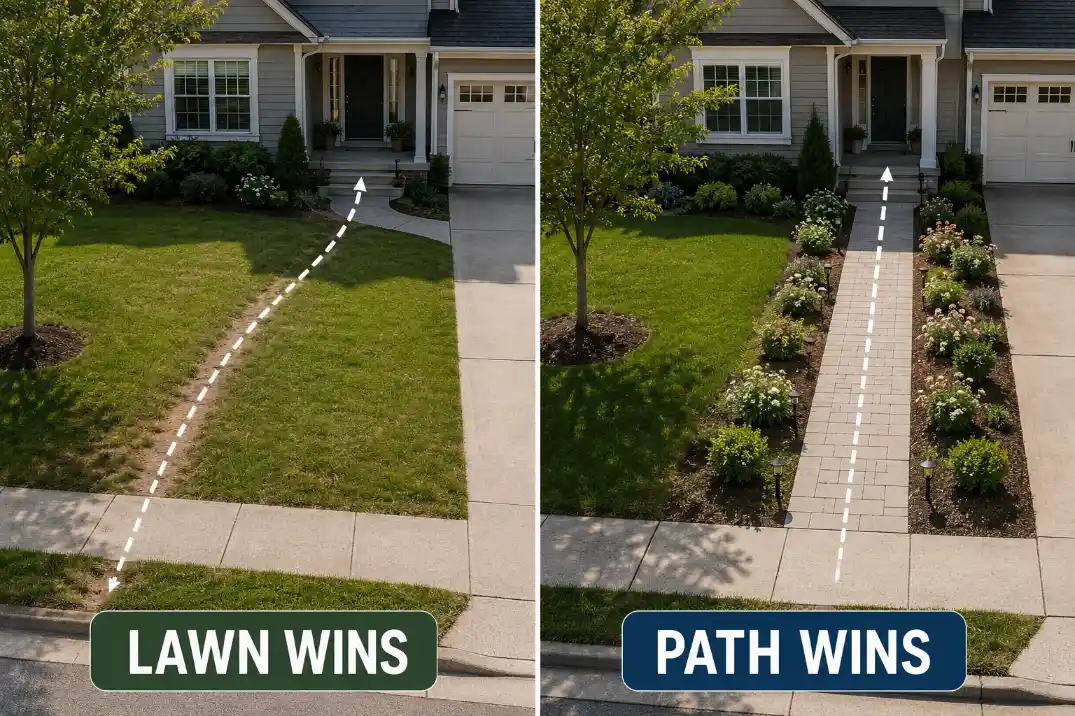
The best fix is not always a new walkway. It is the smallest change that makes the correct route feel automatic.
Test the desire path before building
Before adding permanent pavers, test the route for 7 to 14 days. Use a garden hose, landscape flags, temporary mulch strip, or flat stepping stones to mark the line people already want to walk. Watch whether guests, delivery drivers, and family members naturally follow it.
If they do, you have found the route. Then you can decide whether it should become a short connector path, a widened walkway mouth, a stepping-stone access line, or a planting adjustment.
This simple test prevents a common mistake: spending money on a pretty route that still misses the real arrival pattern.
Use a fix hierarchy
Start with route clarity before plant barriers. Start with access before decoration. Start with the arrival point people actually use, not the one the yard was originally designed around.
If the shortcut begins at the sidewalk, widen or frame the path entrance. If it begins at the driveway, build a connector. If it cuts across a decorative curve, shorten the route or make the curve feel necessary. If the shortcut appears because the landing is crowded, clear the final approach before changing the lawn.
For small entries where every step has to work hard, Front Entry Usability Ideas gives a broader way to think about arrival, standing room, packages, and daily movement without crowding the door.
Use this quick route check
- Can the walkway entrance be recognized from the sidewalk in 3 seconds?
- From the driveway, does the first natural step land on paving instead of lawn?
- Is the clear walking width at least 36 inches?
- Do turns and entry points have closer to 42–48 inches of usable room?
- Does the paved route add more than 6–8 feet compared with the shortcut?
- Do plants leave room for mature spread, not just installation size?
- Does the final landing let someone stand, turn, and open the door comfortably?
- Has the same shortcut returned within one growing season after repair?
A front yard visitor path works when guests do not have to decide. The walkway, planting, driveway connection, and front door all point to the same answer. Once the paved route becomes the easiest route to read, the lawn finally stops acting like the walkway.
For broader official accessibility guidance, see the U.S. Access Board accessible routes guide.