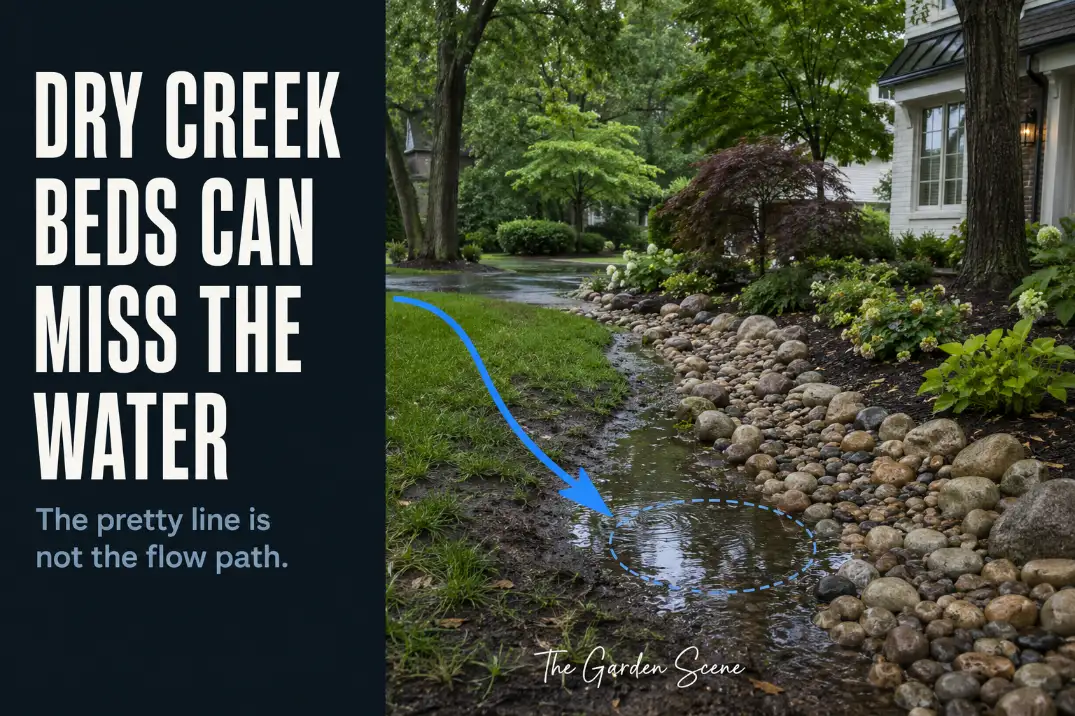
A dry creek bed fails as drainage when it is treated like a decorative stone line instead of a controlled water route. The first checks are not the curve, color, or rock style.
They are whether water enters the bed, whether the slope continues through it, and whether the bed reaches a safe outlet. If water does not enter the bed during the first visible runoff, the stone line is already failing its first job.
A creek bed that looks clean on a dry afternoon can still fail during the first 15–30 minutes of heavy rain if runoff slips beside it or stops halfway through. Puddling beside the bed is only the symptom.
The mechanism is usually missed flow, lost grade, undersized stone, weak edge control, sediment clogging, or a bed that ends before water has somewhere useful to go.
A decorative creek bed may improve the look of a low area. A drainage creek bed has to collect, carry, slow, and release water without creating a new wet spot.
Decorative Lines Do Not Drain
A dry creek bed is not a visual route. It is a hydraulic route. That means the bed has to match the way water already moves across the yard, not the place where a curving line happens to look best.
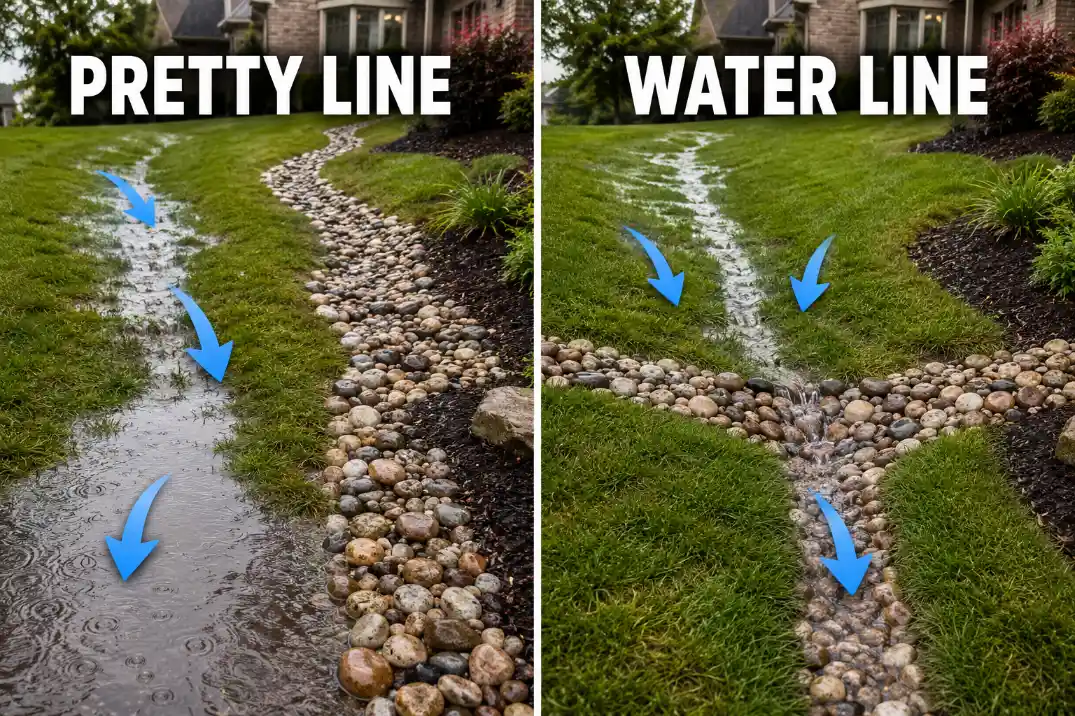
The most common mistake is building a clean-looking ribbon of stone across a lawn or planting bed while the real runoff path stays 2–4 feet away during a storm.
When that happens, the dry creek bed becomes a landscape border while water keeps cutting through turf, mulch, or soil beside it.
The pretty line is not the water line
Water follows grade, hardscape edges, downspout discharge, compacted soil, and the lowest available route. If the channel is even slightly off that route, it may stay dry while the surrounding yard gets muddy.
A practical test is to watch the yard during steady rain, not hours later after everything has pooled. If water appears beside the creek bed before it appears inside it, the layout is wrong. If mulch washes away along a separate path, that wash line matters more than the visible stone shape.
This is where a wider drainage read matters. If water is coming from more than one source, the creek bed may need to work as one part of a route, not as the whole solution.
The same decision logic behind a Yard Drainage Solution Guide applies here: source, path, slope, and outlet come before appearance.
The first failure is usually collection
Many failed dry creek beds are not too short or too shallow at first. They simply do not receive the water. Runoff from a patio, driveway, slope, or downspout needs a clear entry point. If the opening is blocked by edging, raised soil, turf lips, or decorative boulders, water can skim around the bed.
Pro Tip: Before changing stone or digging deeper, run water from a hose at the suspected source for 10–15 minutes. If it does not enter the creek bed naturally, the layout is wrong.
Start With the Water Source
The source is more important than the curve. A dry creek bed that starts in the wrong place often looks intentional but performs like decoration.
Roof water is different from slope water
Roof runoff from a downspout arrives fast and concentrated. Slope runoff arrives wider and often carries soil, mulch, leaves, or grass clippings. Those two conditions need different entry treatment.
A narrow creek bed may handle sheet flow from a mild slope, but the same bed can be overwhelmed by downspout discharge during a 1-inch rain if water enters at one sharp point.
If the creek bed begins below a downspout, the first 3–6 feet should act like an impact zone. A wider receiving pocket, larger center stone, and a stable bottom matter more there than a graceful curve.
For roof-water problems, a dry creek bed may not be the best first move. Sometimes the better move is to carry water farther away before it reaches the landscape bed, especially if the outlet is too close to the foundation.
That decision overlaps with Pop-Up Emitter, Downspout Extension, or Dry Well when roof water needs a real discharge point rather than a prettier surface route.
Entry mouths need to be open, not raised
Sheet flow needs a low, open edge. A raised border may make the creek bed look finished, but it can also keep water outside the channel. This is one of the easiest mistakes to miss because the bed looks clean when dry.
The entry should let water slide into the stone, not hit a lip and turn away. If the first visible movement during rain is water running along the outside edge, the channel is not collecting flow. That problem should be corrected before adding more rock.
Watch the first storm, not the final puddle
The final puddle only tells you where water stopped. The first storm movement tells you where it came from. A creek bed planned from the puddle backward can miss the actual problem, especially in yards with clay soil, compacted turf, or a patio edge that redirects runoff.
A useful threshold: if standing water remains beside the creek bed for more than 24–48 hours after normal rain, the bed is not intercepting or releasing water well enough.
In sandy or well-graded areas, surface water should usually clear much faster. In heavy clay, slower drying is normal, but water sitting outside the bed still points to routing failure, not just poor soil.
The Slope Must Continue
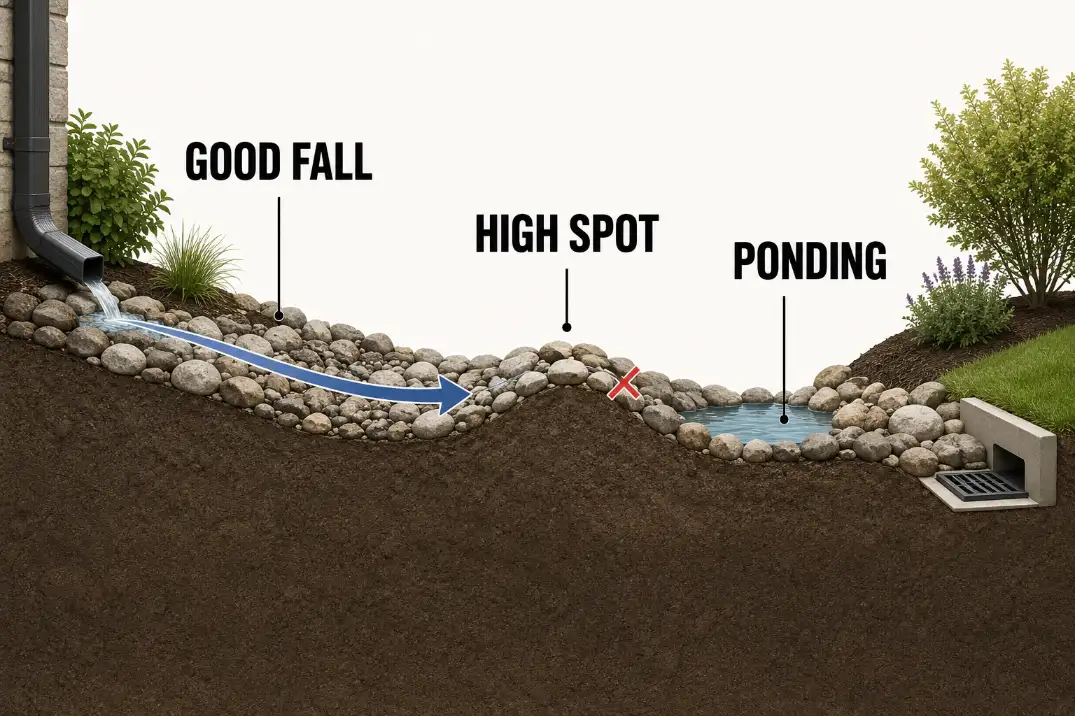
A dry creek bed needs continuous fall. It does not need to be steep, but it cannot rely on random low spots and hope water keeps moving.
Small slope breaks create big failures
The most common construction mistake is creating a channel that falls in one area, flattens in the middle, then rises slightly near the end. Even a 1-inch high spot can hold water, collect sediment, and turn the bed into a stone-lined puddle.
For drainage, a mild fall of about 1–2% is often enough when the outlet is clear. That means roughly 1–2 inches of drop over 8 feet. Steeper sites may need check stones, planted edges, or a wider bed to slow water, but flat yards need extra care because there is less margin for error.
The outlet decides whether the bed is real drainage
A dry creek bed that ends in another low spot is not a fix. It is a relocation. The outlet should release water to a safe lower lawn area, stormwater-approved discharge point, rain garden, swale, or another acceptable destination.
It should not send water toward a neighbor, across a walkway, against a foundation, or back into the same soggy bed.
This is where many homeowner fixes stop making sense. If the yard has no lower exit, a longer dry creek bed will not solve the drainage pattern by itself.
The better fix may be a swale, catch basin, French drain, dry well, or regrading plan. The comparison in French Drain vs Swale vs Dry Creek Bed is more useful than simply adding more stone.
Stone Size Changes Performance
Stone is not just a finish material. It controls speed, stability, clogging, and how much debris stays visible after a storm.
Fine gravel looks clean but clogs faster
Small gravel can make a dry creek bed look tidy at first, but it also traps silt, leaves, and soil. In a runoff path, fine material can seal the gaps between stones after a few storms. Once that happens, water moves over the top instead of through and around the stone.
Pea gravel can work as a decorative shoulder or filler, but it is usually weak as the main flow material. In faster channels, stones in the 2–6 inch range are often more stable, especially where roof water or slope runoff enters with force. Larger center stone helps resist movement, while smaller stone can soften the sides without becoming the main drainage surface.
Bigger is not always better
Large stone can also fail if it is used without shaping the channel below it. Oversized rock scattered on flat soil may look rugged, but water can weave underneath, expose fabric, or jump the bed edge. The channel profile still matters.
The healthier condition is a bed where water stays centered during rain and the stones remain mostly in place after storms. A failing condition is obvious after 2–3 rain events: stone migrates downhill, exposed fabric appears, soil collects in the middle, or water cuts a new path along the edge.
Fabric helps separation, not bad grading
Landscape fabric can keep stone from disappearing into soft soil, but it can also become the shelf where sediment collects. It is separation, not drainage design.
Fabric does not correct a bad route, a flat channel, or a missing outlet. It can even become part of the clogging problem when sediment washes into the creek bed.
Soil and fine debris build on top of the fabric, seal the surface, and force water to run over the stones. If the bed receives muddy runoff from an exposed slope, stabilizing the soil source matters more than adding another layer underneath.
Pro Tip: After the first major storm, check four places before calling the bed finished: the entry, the middle low point, both edges, and the outlet. Most failures show up there first.
Edges Fail Without Planning
Edges are where many dry creek beds quietly lose performance. The channel may be deep enough and the stone may be heavy enough, but the water escapes because the sides are weak.
Raised edges can block entry
A dry creek bed needs edges that guide water without keeping it out. If the bed is bordered by a raised lip of soil, metal edging, pavers, or mounded mulch, sheet flow may never enter the channel. The edge makes the bed look finished but prevents it from doing the job.
This is especially common near patios and walkways. Water runs along the hard edge, reaches the creek bed, then continues past it because the channel opening is too high or too narrow. If the larger problem is water crossing a hardscape surface, the fix may need to intercept flow before it spreads.
That is closer to the problem described in Patio Drainage Layout Problems than a purely decorative creek-bed issue.
Soft edges erode when flow concentrates
The opposite mistake is leaving the edge too loose. Bare soil, light mulch, and shallow planting pockets can wash into the creek bed during storms. Once soil enters the stone, the channel starts filling from the sides.
In humid regions with frequent summer storms, this can happen within one season. In drier places like Arizona, it may show up after fewer but more intense rain events.
A stable edge usually needs compacted shoulders, planted reinforcement, stone that overlaps the side slightly, or a graded transition that lets sheet flow enter without cutting a trench.
Quick diagnostic checklist
| Problem you see | Likely mechanism | Stronger next move |
|---|---|---|
| Water runs beside the creek bed | Channel misses the real flow path | Move or widen the entry, not just the stone |
| Water ponds in the middle | Slope breaks or a high spot blocks flow | Regrade before adding rock |
| Stone moves after storms | Flow is concentrated or stone is undersized | Use larger center stone and slow the entry |
| Mud fills the bed | Upstream soil or weak edges are washing in | Stabilize edges and the source area |
| Water sits over 48 hours | Outlet or soil absorption is failing | Add a real exit or choose another drainage fix |
When to Choose Another Fix
A dry creek bed is best when water already moves across the surface and needs a stable, attractive route. It is weaker when the problem is underground saturation, deep clay, foundation water, or a low area with no outlet.
Choose a swale when the flow is broad
If runoff spreads across a wide lawn, a shallow grass or planted swale may do more than a narrow stone bed. A swale slows and spreads water instead of concentrating it. That matters on sloped yards where erosion is already starting.
If the slope is cutting soil, exposing roots, or pushing mulch downhill after every storm, fix order becomes more important than creek-bed style.
The drainage-first logic in Fix Slope Drainage and Erosion in the Right Order fits that situation better than adding a decorative rock channel after damage has started.
Choose a French drain when the soil stays wet from below
A dry creek bed handles surface water. It does not solve saturated soil by itself. If the lawn feels spongy for days, water seeps from the ground, or the wet area has no visible surface flow, the issue may be subsurface water. A French drain or regrading plan may be more appropriate than another layer of river rock.
This is a common overestimate: people assume visible stone equals drainage capacity. The underappreciated part is outlet logic. Without somewhere safe for water to go, stone only changes the appearance of the wet area.
Choose a basin or channel drain when hardscape controls the water
When water comes off a driveway, patio, or garage apron in a defined sheet, a creek bed may be too indirect. The right move may be to intercept the water at the hard edge before it spreads into the yard.
A catch basin works better for point water. A channel drain works better for line water crossing a hard edge. That distinction is explained more directly in Catch Basin vs Channel Drain for Runoff, and it matters because the wrong inlet can miss the water even when the drain itself is well built.
The Mistake That Wastes the Most Time
The biggest wasted fix is adding more stone to a bed that is already in the wrong place. More rock can hide erosion for a while, but it does not change the water source, correct a high spot, stabilize a weak edge, reduce sediment, or create an outlet.
The better order is simple: confirm the water source, mark the actual flow path, verify continuous fall, build a stable entry, size the stone for the force of water, and make sure the exit does not create a new problem.
If one of those steps fails, the creek bed should be redesigned before more material is added.
If the yard has no lower outlet, a dry creek bed is usually not the first fix. It may decorate the wet area, but it cannot create drainage by itself. And if water does not enter the bed, stay in the bed, and leave the area safely, the feature is not functioning as drainage. It is a stone-covered wet spot.
A good dry creek bed should look quiet when dry and obvious when it rains. Water should enter early, stay centered, slow down without escaping, and leave the area without standing beside the stone for days.
That is the difference between a dry creek bed that decorates runoff and one that controls it.
For broader official guidance on slowing, spreading, and managing stormwater on-site, see EPA Soak Up the Rain.