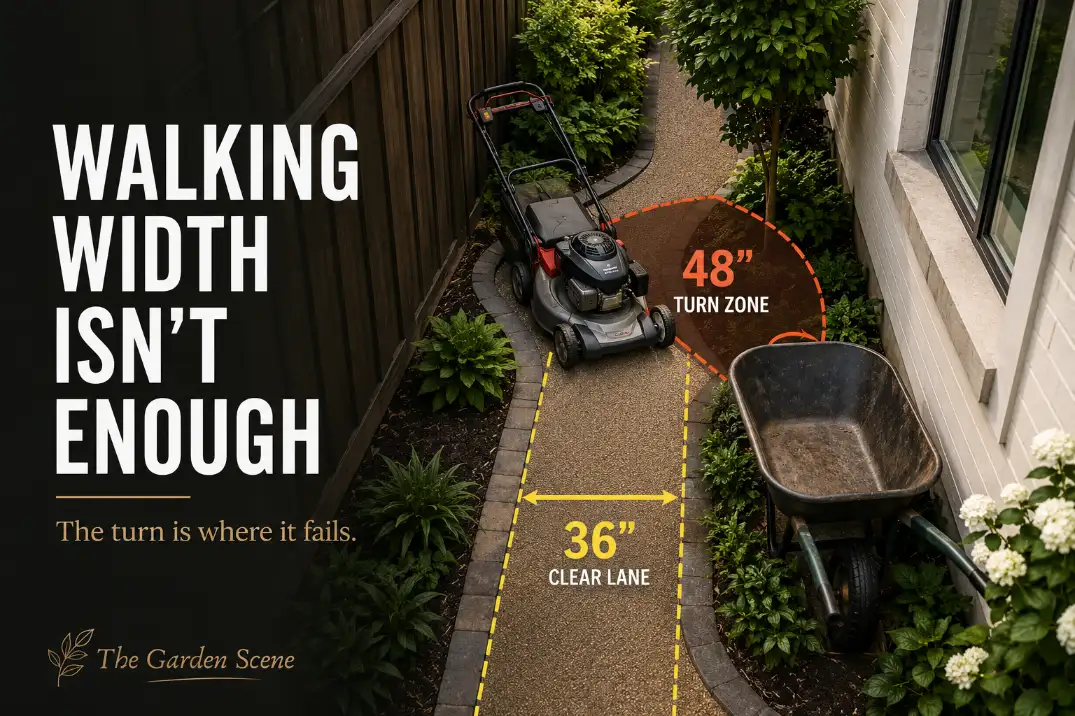
A side yard access path for mowers and wheelbarrows fails when it is designed as a walkway instead of a working lane. A 30-inch path may feel fine on foot, but a mower, wheelbarrow, garden cart, or trash bin needs shoulder room, turning space, firm edges, and a gate opening that does not steal the first few feet of movement.
Start with three checks: measure the narrowest clear point, test the largest item while turning, and look at the edge after rain or mowing.
A useful side-yard lane usually needs about 36 inches of clear passage for ordinary push mower and wheelbarrow movement, more at bends, and a surface that still feels firm 24–48 hours after rainfall.
The problem is not always “too narrow.” Sometimes the visible symptom is scraped planting or muddy edging, while the real mechanism is lateral load: equipment wheels drift, turn, lean, and push against the path edge.
Quick Route Test Before You Rebuild
Measure the real lane, not the visible path
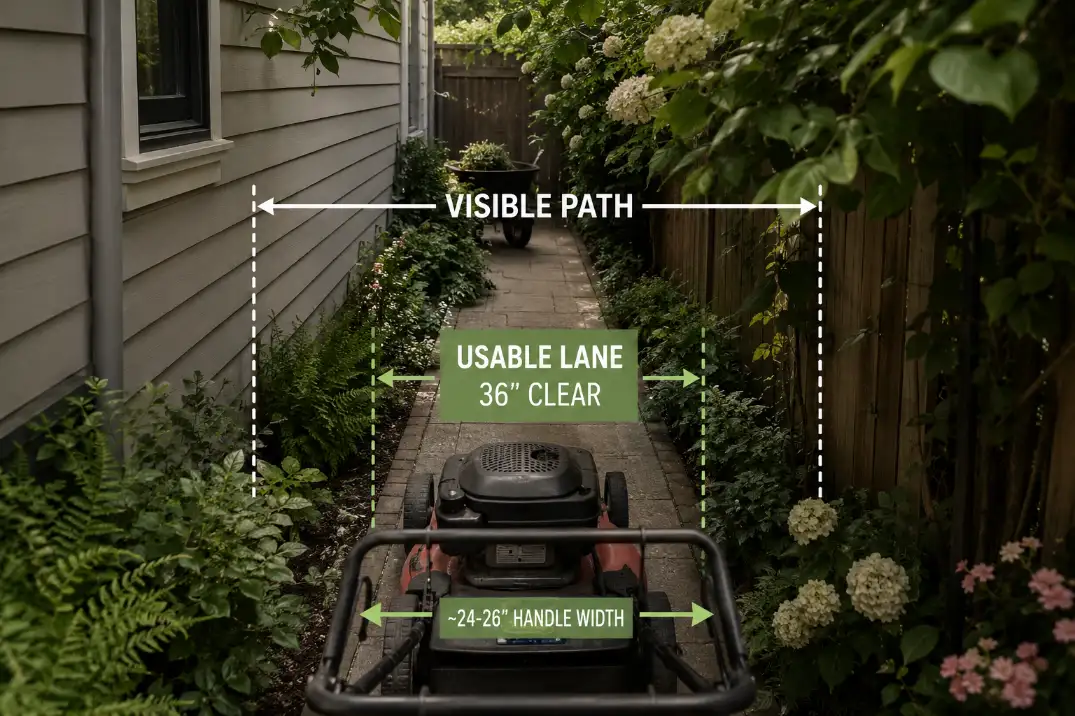
Before changing materials, run a simple route test. Measure the path at ground level, then measure again at handle height. Mower handles, wheelbarrow grips, hose reels, gate latches, utility boxes, and leaning plants often reduce the working lane more than the paving itself.
A path that measures 36 inches on the ground but has plants leaning 6 inches into the route is not a 36-inch access lane. It is closer to a 30-inch working space, and that difference shows up every time equipment turns.
Test the first 6–8 feet after the gate
The first few feet after a gate or corner matter more than the straight middle of the path. Open the gate fully, push the mower through, and try to straighten it without lifting or backing up repeatedly. Then do the same with a half-loaded wheelbarrow.
If the route only works when the ground is perfectly dry, the plants are freshly trimmed, and the wheelbarrow is empty, it is not reliable access. It is a narrow walkway being forced to do utility work.
Repeat the test after rain
A side-yard access lane should still function 24–48 hours after normal rain. If the edge ruts, gravel spreads into planting, or the wheelbarrow starts sinking near the border, the failure is not cosmetic. It is a base, drainage, or edge-support problem.
This is where many narrow side yards overlap with the problem described in Side Yard Paths That Feel Uncomfortable: the path exists, but the usable corridor is smaller than the visible corridor.
Walking Width Is Not Enough
Foot traffic hides the real constraint
Walking through a side yard is a poor access test. People adjust their shoulders, step around plants, and slow down naturally at tight points. Equipment does not adapt that gracefully. A mower has a fixed body width, a wheelbarrow has handles that flare behind the tub, and both need mistake space when the ground is wet or uneven.
That is why a path that feels open enough at 30 inches can still fail. If planting leans into the lane after watering, edging sits high, or gate hardware protrudes into the route, the side yard may be technically passable but practically annoying.
The useful distinction is simple: walking comfort answers, “Can I pass through?” Equipment clearance answers, “Can the largest item move through without lifting, scraping, tipping, or crushing the edge?” Those are different standards.
The first practical threshold
For most homes, treat 36 inches as the minimum useful clear lane for push mower and wheelbarrow movement. That does not mean every side yard needs a wide paved walkway. It means the usable space between walls, fences, planting, edging, utility boxes, hose reels, and gate hardware should stay near that width after everything grows, swings, or gets wet.
Below about 30 inches of real clear width, a side yard often becomes a carrying lane instead of a rolling lane. That is the point where homeowners start lifting the mower, turning the wheelbarrow diagonally, or avoiding the route entirely.
Pro Tip: Measure the narrowest point at handle height, not just at the surface. Wheelbarrow handles and mower bars often create the real pinch point.
Mower Width and Turns
The mower deck is not the whole mower
Homeowners often measure the mower deck and assume the path only needs that much room. That misses the wheels, side discharge area, handle angle, and steering correction that happens when the mower is pulled backward or turned.
A common push mower deck is around 21–22 inches, but the practical working envelope can be closer to 26–30 inches once wheels, hands, and minor movement errors are included. The extra inches in a 36-inch lane are what prevent constant edge scuffing.
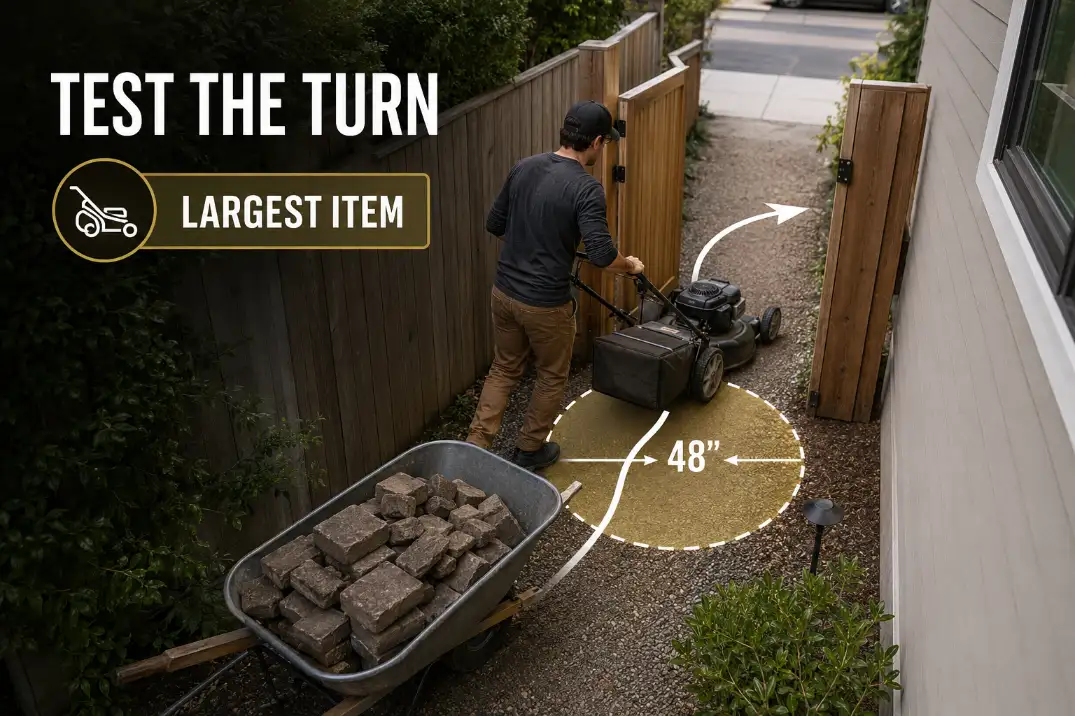
The mower also needs a place to change direction. A straight 36-inch lane is useful; a 36-inch lane with a hard 90-degree bend immediately after a gate is much less useful. At bends, 42–48 inches of turning room often changes the path from technically passable to actually usable.
Riding mowers change the category
These numbers are for typical push mowers, self-propelled mowers, wheelbarrows, and garden carts. A riding mower is different. Once a mower deck reaches 42 inches, 46 inches, or wider, many side yards cannot serve that equipment without becoming a wider service corridor.
For riding mower access, the gate, turn radius, slope, and landing space matter more than the walking path itself. Trying to squeeze a riding mower through a narrow side yard usually leads to damaged edges, scraped fences, or a route that only works with repeated backing and correction.
If the side yard is part of a larger tight-access layout, the decision logic in Side Yard Layout Ideas for Tight Access applies here: solve the movement sequence first, then decorate around it.
Turns expose layout mistakes fast
A mower usually reveals layout problems before a person notices them. Watch what happens at the first bend. If the mower has to be lifted, dragged sideways, or backed up more than once, the path is not functioning as an equipment route.
This is where cosmetic widening often wastes time. Adding a few stepping stones, a prettier gravel strip, or a cleaner border may improve the way the side yard looks, but it does not fix the turn if the mower still cannot swing through. The repair has to happen at the pinch point, not evenly across the entire lane.
Wheelbarrows Expose Weak Edges
Edge strength matters more than edge neatness
Wheelbarrows are harder on side-yard paths than they look. A loaded wheelbarrow can easily put 100–200 pounds of combined load through a narrow wheel contact area.
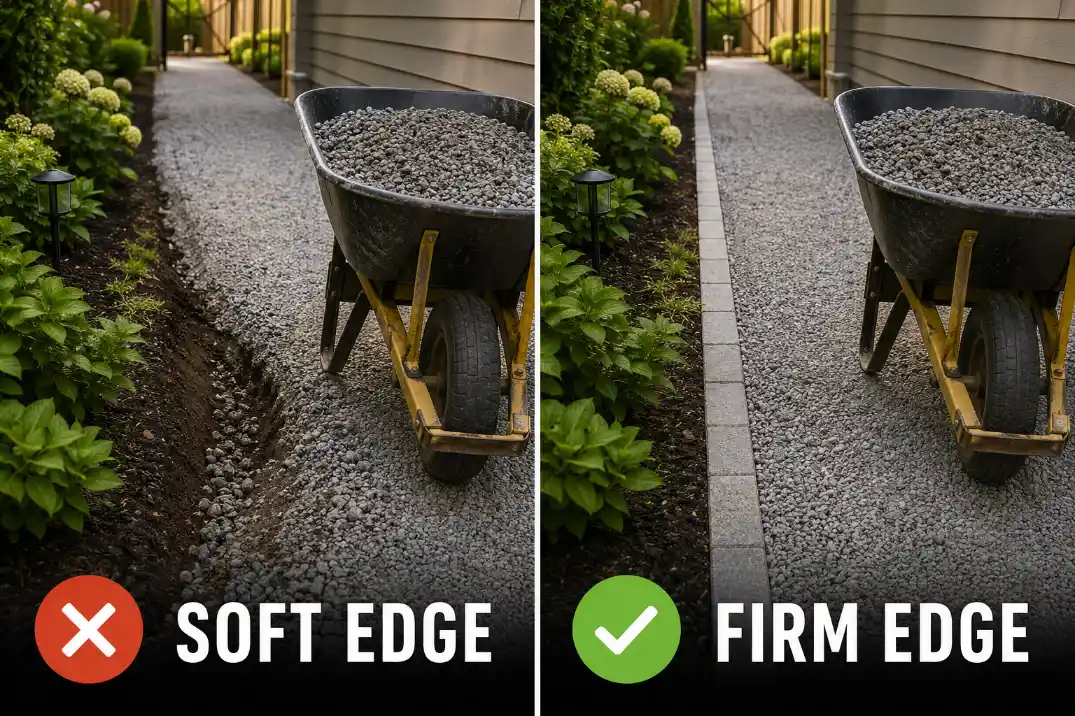
When that wheel drifts toward a soft soil edge, the path does not fail because the surface is ugly. It fails because the edge has no support.
Loose gravel, thin pavers, and mulch borders often look acceptable during dry weather. After rain, the same edge may slump, rut, or spread into planting. If the rut stays visible more than 48 hours after normal rainfall, the issue is no longer routine cleanup. It is a support problem.
The common overestimate is the surface material. People assume pavers, gravel, or flagstone automatically make a route stronger.
The underestimated condition is the shoulder beside the lane. A 36-inch surface with 3 inches of soft, collapsing edge on both sides may behave like a 30-inch path.
Choose the surface by load, not appearance
Mulch can work for light foot traffic, but it is weak under repeated wheelbarrow use. Decorative gravel drains well but spreads quickly if it has no firm edging. Stepping stones may look tidy, yet they often create awkward wheel bumps unless they are flush and closely spaced.
For a working side-yard lane, compacted crushed stone, compacted fines, pavers on a proper base, or a narrow concrete strip are usually more reliable than a decorative path treatment.
The best choice depends on drainage and use, but the principle is the same: the surface must stay firm under wheels and the edge must resist sideways pressure.
If the access lane stays damp after storms, drainage becomes part of the access problem. A path that firms up within 24 hours is very different from one that remains soft for two days.
When access and water problems overlap, Side Yard Ideas for Drainage and Access is the stronger planning frame than a simple walkway upgrade.
What failing edges look like
The most useful warning signs are not small weeds or faded mulch. Look for a paver edge that drops more than 1/2 inch, gravel that migrates into the bed after each storm, or soil that stays slick where the wheelbarrow exits the hard surface.
Those are symptoms. The mechanism is repeated side loading. Each pass pushes the edge outward a little, especially where the wheelbarrow turns, stops, or transitions from hardscape to soil.
If the same edge needs topping up after every few uses, adding more material is just resetting the failure.
| Condition | Healthy access lane | Failing access lane | What to fix first |
|---|---|---|---|
| Clear working width | About 36 inches open | Under 30 inches after plants lean in | Remove pinch points |
| Turn area | 42–48 inches at bends | Mower needs lifting or backing twice | Widen the bend |
| Edge behavior | Stays level after use | Drops more than 1/2 inch | Rebuild edge support |
| Rain recovery | Firm in 24–48 hours | Muddy or rutted after 48 hours | Fix drainage/base |
| Planting overlap | 0–3 inches into lane | 6+ inches into lane | Reset mature spacing |
Steps, Gates, and Bends
The obstruction is often at the start
The worst access problem is not always the narrowest middle section. It is often the first movement after a gate, stair, or corner. A gate leaf that opens into the lane can steal the exact space needed to straighten a mower or line up a wheelbarrow.
For equipment access, the gate opening should be judged as a movement zone, not just an opening width. A 36-inch gate can still feel cramped if the latch, post, slope, or first bend forces the equipment to enter at an angle.
A 42-inch opening is noticeably easier for many yard tools, especially when a wheelbarrow is loaded or the mower must pass through without scraping.
This is why gate clearance deserves its own check. The issue is not simply whether the gate opens. It is whether the open gate leaves a clean landing zone on both sides.
The same failure pattern appears in Side Yard Gate Swing Clearance, where the swing arc competes with the working route.
Small lips become big problems under load
A 1/2-inch edge drop is an early warning. A 1–2 inch lip can already feel rough with a loaded wheelbarrow. A 4–6 inch step changes the route completely because wheels no longer roll through cleanly.
That is the point where the standard fix stops making sense. If you need to lift the mower every time or unload the wheelbarrow before crossing a step, the side yard is not serving as equipment access.
At that stage, the better decision may be a different route, a relocated gate, or a dedicated service pad rather than another surface upgrade.
Short, steep ramps are also commonly overestimated. They look like a simple fix, but they can become slippery, awkward, or too abrupt for a loaded wheelbarrow. A ramp only helps when there is enough run, traction, and landing space to use it without fighting the equipment.
Pro Tip: If the route requires a “careful maneuver” every time, design around that spot. Repeated careful maneuvers are where fences, edging, and planting usually get damaged first.
Planting Beside the Lane
Mature size beats nursery size
Planting beside an equipment lane should be chosen by mature spread, not how tidy it looks on planting day. A shrub that starts 12 inches wide can become a 30-inch obstruction in two seasons. Ornamental grasses may look airy, but wet foliage can flop into the lane after irrigation or summer storms.
The most common misread is treating plant softness as harmless. Soft plants still take space. They also hide edging, hold moisture against the path, and make the lane feel narrower.
In humid climates such as Florida, dense side-yard planting can keep the access strip damp longer, while in dry Arizona-style conditions the larger problem may be brittle stems breaking under equipment contact.
A practical planting rule is to leave a growth buffer outside the clear lane. If the path needs 36 inches of usable passage, do not plant a 24-inch-wide mature plant with its edge exactly on the path line. Give the plant its mature spread and preserve the working corridor separately.
For tighter side yards, Best Plants and Materials for Narrow Side Yards is more useful than choosing plants by appearance alone because the plant and surface have to work as one access system.
Pruning is not a layout fix
Pruning can recover a few inches, but it should not be the main strategy for equipment access. If the lane only works during the week after trimming, the design is too dependent on maintenance.
That becomes especially obvious in late spring and early summer, when fast growth can erase 4–8 inches of clearance quickly.
The better approach is to keep tall or spreading plants outside the equipment shoulder and use lower, tighter edging plants only where wheels will not drift. If the path edge is already weak, planting close to it adds another source of moisture, roots, and hidden movement.
Plan for the Largest Item
The worst-case pass sets the standard
The largest item sets the real standard. That may be the push mower, wheelbarrow, garden cart, snow blower in northern states, or trash bin that has to move through the same side yard.
Planning around average daily foot traffic is what causes the access path to disappoint later.
Run a worst-case test before rebuilding. Move the largest item through the route when the gate is fully open, the hose is mounted, plants are at current size, and the ground is not perfectly dry. If the route only works under ideal conditions, it is not robust enough.
A healthy side-yard access path should pass these checks:
- The narrowest clear lane stays near 36 inches after planting and fixtures are included.
- The largest item can turn without lifting or scraping.
- Edges stay level after repeated wheel contact.
- The path firms up within 24–48 hours after normal rain.
- Gate swing, latch hardware, and first landing space do not compete with the route.
- The route still works after two mowing cycles without fresh ruts or crushed planting.
Fix the pinch point before upgrading the finish
The highest-value fix is usually not replacing the whole path. It is correcting the point where movement fails. That may mean widening one bend to 48 inches, rebuilding 6–12 inches of edge support, moving a hose reel, changing the gate swing direction, or pulling planting back from the working shoulder.
Once the movement problem is solved, the surface choice becomes more useful. Gravel, pavers, concrete, and compacted fines can all work in the right setting, but none of them rescue a path that is too tight at the gate or too weak at the turn.
If mowing and trimming are already difficult across the yard, the access route should be treated as part of the maintenance system, not a decorative side feature; Backyard Mowing and Trimming Made Harder explains that broader pattern well.
The clearest decision rule is this: if the mower or wheelbarrow fails in the same place twice, fix that location before spending money elsewhere. A side yard access path earns its space when the largest item moves through without negotiation.
Questions People Usually Ask
Is 30 inches enough for a mower path?
Sometimes, but it is usually a bare minimum, not a comfortable working lane. A small push mower may pass through 30 inches in a straight line, but turns, handles, plants, and edge drift can make it frustrating. For a side yard that also handles wheelbarrows, 36 inches is a better practical target.
Should the access path be paved?
Not always. Paving helps only if the lane has enough width, drainage, and edge support. A compacted gravel or paver path can work well, but a thin hard surface over soft soil will still rut, settle, or spread under wheelbarrow loads.
What is the first thing to change in a tight side yard?
Change the worst pinch point first. That is usually a bend, gate landing, weak edge, step, or plant encroachment zone. Full-path replacement is often unnecessary until those movement failures are understood.
For broader official guidance on firm, stable outdoor travel surfaces, see the U.S. Access Board.