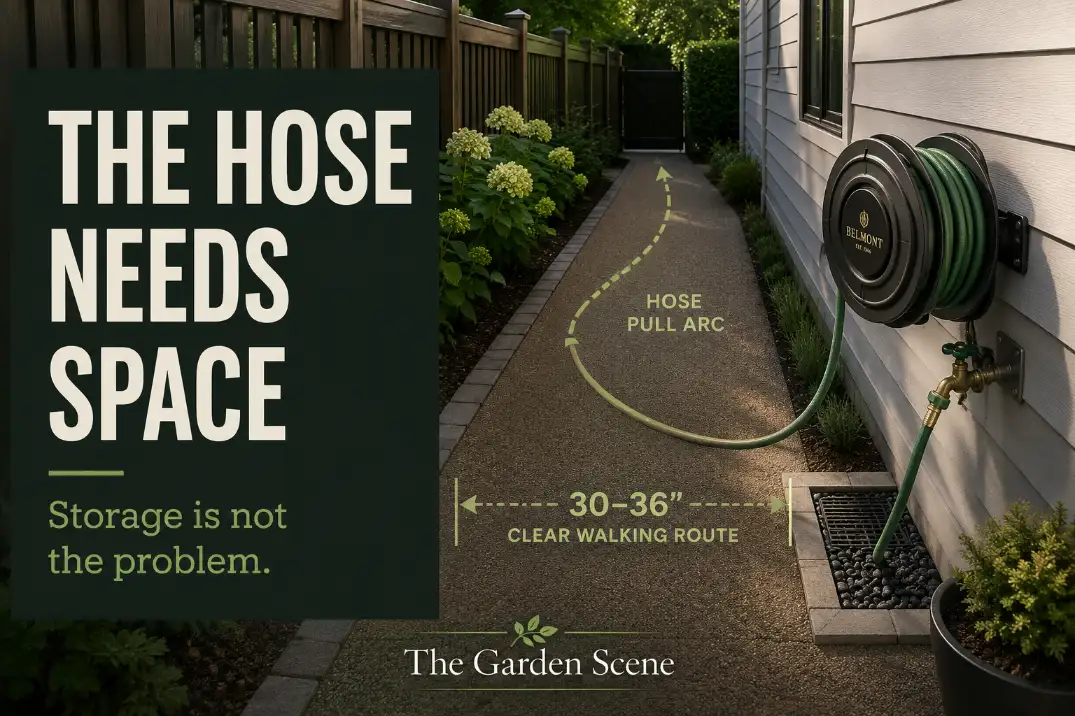
A side yard hose reel works best when it is treated as a small working zone, not just a storage accessory. The common failure pattern is simple: the reel looks tidy when the hose is wound, but the hose blocks the path, the faucet is hard to reach, or water keeps softening the ground below it.
Start with three checks: can you stand at the faucet without leaning over plants or bins, can the hose pull out with at least 24 inches of working space, and does the ground dry within 24–48 hours after normal use?
That makes this different from a general side yard clutter problem. A messy side yard can often be improved with storage.
A bad faucet zone fails because access, pull direction, drainage, and tool placement all meet in one tight spot. If that small zone is wrong, a prettier reel will not change how the space works.
Give the Hose a Zone
The best hose reel location is not always the neatest-looking wall. It is the spot where the faucet, hose pull, walking route, and wet surface can work together without fighting each other.
The reel needs standing space, not just wall space
A wall-mounted reel may only project a few inches, but the person using it needs room to face the faucet, pull the hose, and rewind without twisting into the fence. A practical working target is about 30–36 inches of clear standing width.
In very tight side yards, 28 inches may work for occasional watering, but it starts to feel awkward if you are carrying tools, walking a dog, or moving bins through the same corridor.
The reel should sit just outside the main walking line whenever possible. If the handle, hose loop, or connector sticks into the path by more than 4–6 inches, it will get bumped more often than it gets used comfortably.
Hidden is not always better
A hidden reel behind a planter, screen, or storage bin sounds tidy, but it often creates a worse pull angle. The hose drags across plant stems, catches on edging, rubs against siding, or crosses the only walking lane.
That is why the hose zone should support the larger side yard system. If the same corridor also handles bins, gates, meters, or service access, the hose cannot be planned as a separate decorative corner.
A route-first layout like Side Yard Utility Corridor Ideas usually works better than trying to hide every outdoor item against the wall.
Reach the Faucet Easily
The faucet matters more than the reel. A high-quality hose reel mounted around an awkward spigot still leaves you bending, scraping your knuckles, or fighting the connection every time you water.
Keep the handle and connection visible
The faucet handle should be easy to see and turn from a normal standing position. If you have to reach behind the reel, under a shelf, or through a screen, the zone is already too tight. Leave about 6–8 inches of open working space around the spigot handle and hose connection.
That space is not cosmetic. It lets you tighten a leaking washer, remove a hose before a freeze, or shut the water off quickly when a nozzle fails.
In northern states, where winter temperatures drop below 32°F, easy faucet access matters even more because hoses should be disconnected before freezing weather.
Store fewer things at the wet point
People often overestimate how much storage belongs beside the faucet. Gloves, sprayers, plant food, pruners, wash brushes, and nozzles all seem logical near water.
The problem is that the faucet zone is wet and high-motion. Too many small items turn it into a catchall, then the hose knocks everything over.
Keep the immediate faucet zone for water-use items only: a nozzle, short connector, hose guide, and maybe one small wall hook. Store bulk tools farther down the side yard or in a separate wall system.
A focused storage plan like Hide Backyard Tools and Supplies Without Creating Clutter works better than crowding every useful item around the spigot.
Pro Tip: Mount the reel so the hose connection is comfortable to reach for the main user, but not so low that hose loops rest on wet ground.
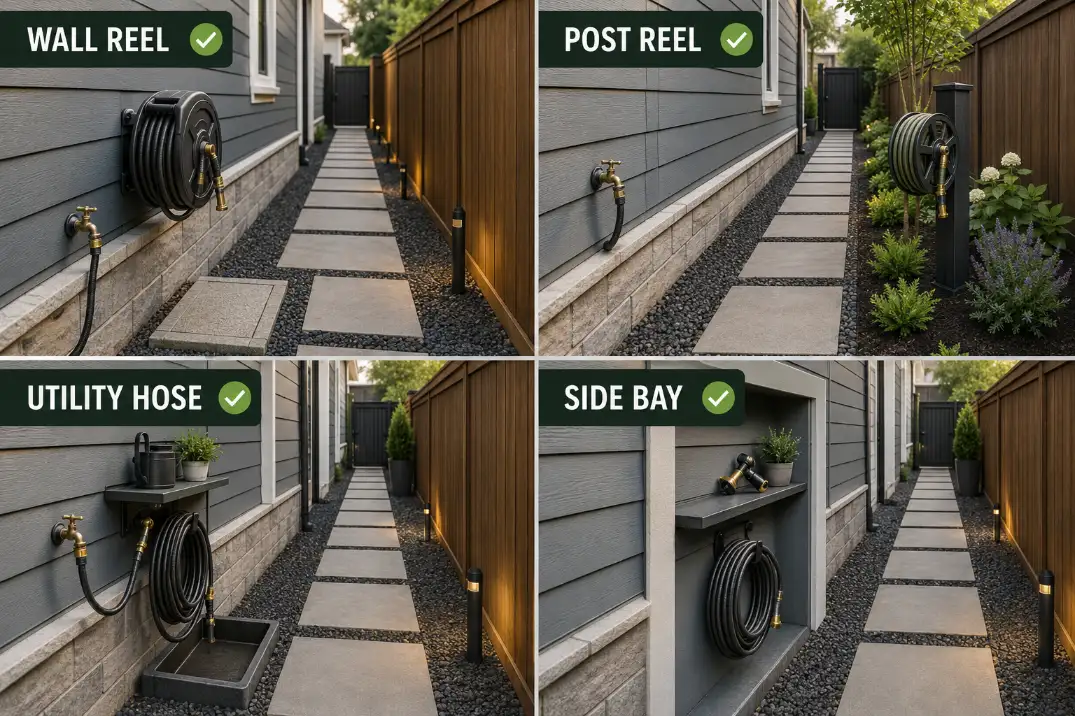
Four Hose and Faucet Zone Ideas That Actually Work
A useful hose zone does not have to be elaborate. The strongest setups are usually simple because they give the hose one predictable job and keep the walkway open.
Wall reel with a dry pad
This is the best default setup for many narrow side yards. Mount the reel beside the faucet, keep the pull direction straight, and add a small dry pad below the connection point.
It works especially well when the side yard is at least 36 inches wide and the hose can pull toward the front or back yard without crossing a gate.
Post-mounted reel near the garden edge
A post-mounted reel can help when the faucet is reachable but the wall location sends the hose in the wrong direction. Use a short leader hose from the faucet to the reel, then place the reel near the garden edge where the hose can pull forward without cutting across the walking lane.
This is cleaner than forcing a wall reel into a corner where the hose immediately bends around plants, bins, or a fence post.
Short utility hose station
Not every faucet needs a 75-foot hose. If the side yard faucet is mostly used for rinsing tools, filling watering cans, or washing muddy shoes, a short 10–25 foot utility hose may work better. It stores faster, dries faster, and creates less clutter than a full garden hose.
Side bay with reel, hook, and nozzle shelf
If the side yard also handles bins or service access, build a small side bay instead of spreading hose parts along the walkway. The bay can hold the reel, one nozzle hook, and a narrow shelf while the main route stays open. The key is to keep the shelf shallow enough that it does not become another obstacle; the bay should support the path, not steal it.
Pull-Out Space Matters
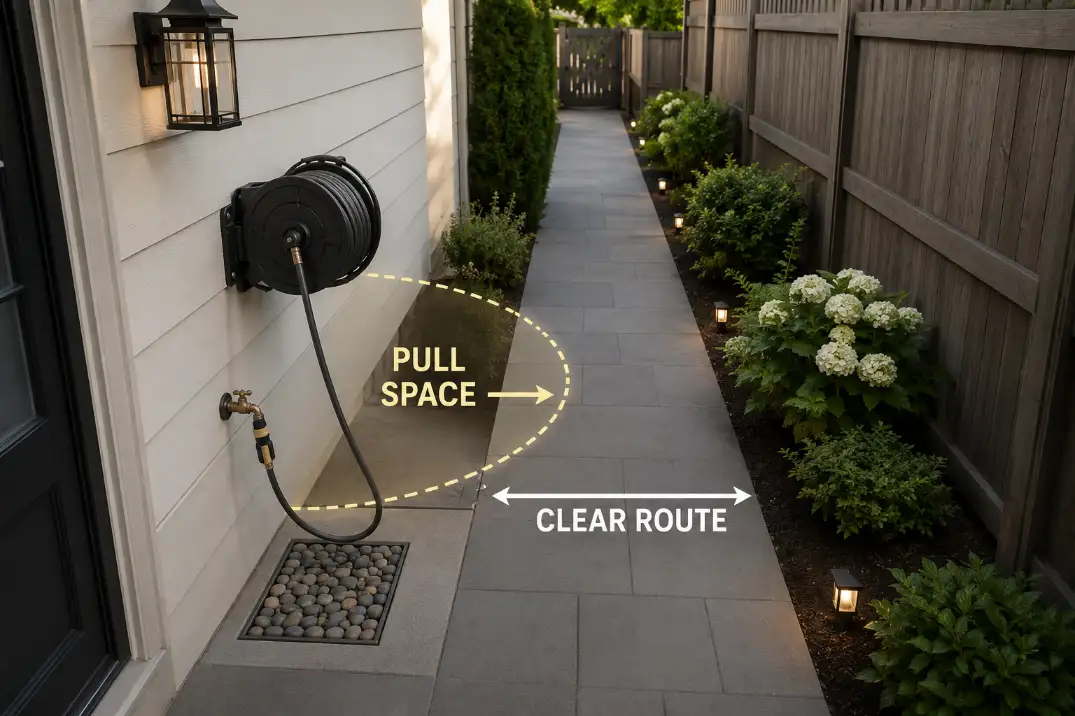
The stored hose is not the real test. The pull-out moment is the test. A hose that looks neat on the reel can still fail when it crosses the side yard diagonally, blocks the gate, or rubs against rough surfaces.
Test the first 6 feet
The first 6 feet of hose movement usually tells you whether the placement works. Pull the hose out slowly and watch where it naturally goes.
If it immediately scrapes a fence post, catches on a planter, or crosses the only walking lane, the reel is in the wrong position or needs a guide.
For most small side yards, a 50-foot hose is easier to manage than a 75-foot or 100-foot hose. Longer hoses add weight, bulk, and rewind friction. Longer is only better when the yard truly needs the reach.
Tangling is the symptom, not the mechanism
A tangled hose is usually the visible symptom. The underlying mechanism is often a poor pull angle. If the hose leaves the reel sideways, bends sharply around a corner, or drops into gravel, it will keep tangling no matter how carefully you rewind it.
A simple hose guide can help when the route is mostly correct. It is a waste of time when the reel itself is mounted in the wrong place. If the hose has to make an immediate hard turn every time, move the reel or change the route before buying more accessories.
| Zone Idea | Best Side Yard Condition | Avoid If |
|---|---|---|
| Wall-mounted reel | Faucet is beside a clear pull route | Reel projects into the walking lane |
| Freestanding reel box | There is a stable side bay or pad | It blocks a gate or sits loose on gravel |
| Retractable reel | Hose pulls mostly straight from the wall | Hose must turn sharply around corners |
| Post-mounted reel | Faucet is awkward but beds are nearby | Leader hose would cross the main path |
| Short utility hose | Used for rinsing, filling, and quick tasks | Expected to water distant beds |
Wet Spots Near the Faucet
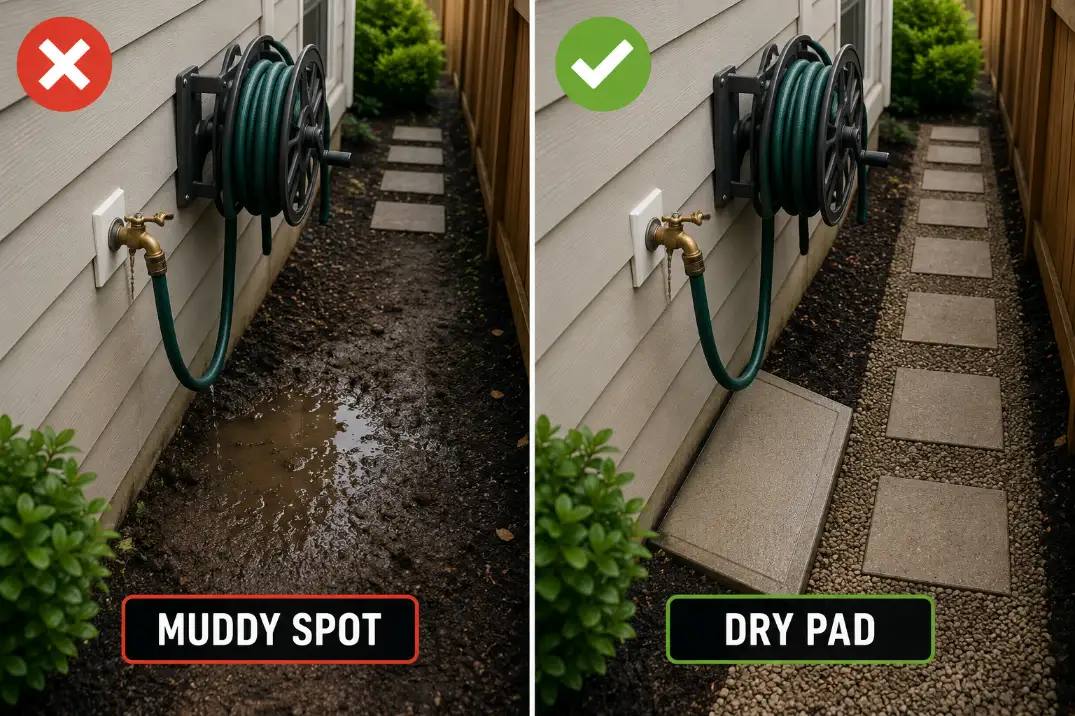
A wet spot below the faucet is not automatically a drainage emergency. The useful question is how long it stays wet and whether the surface is changing.
Normal dampness should not become soft ground
After filling watering cans or rinsing tools, a small damp area is normal. But if the soil stays muddy after 24–48 hours in mild weather, or the surface starts sinking under foot traffic, the faucet zone needs a better base.
In humid climates like Florida or along coastal parts of California, drying can be slower, but persistent softness still matters. A compact pad of pavers, concrete, or gravel over a stable base can protect the wall edge and keep shoes out of mud.
The surface should shed water away from the foundation. A gentle slope of about 1/8 to 1/4 inch per foot is enough for a small splash zone without making the area feel tilted.
Repeated splash can look like a bigger drainage problem
This is where readers often overestimate the scale of the issue. They look for a whole-yard drainage fix when the main problem is repeated small water use in the same 2-square-foot patch. Fixing that patch may solve the daily nuisance.
But if the faucet area stays wet because runoff, downspouts, or side-yard grading are already sending water through the corridor, the hose zone should not be patched alone.
When water and movement problems overlap, Side Yard Ideas for Drainage and Access gives the stronger framework.
When the Faucet Location Is the Real Problem
Sometimes the reel is not the problem. The faucet is simply in the wrong working position for how the side yard is used.
Move the reel first, not the plumbing
If the hose only needs a better pull direction, moving the reel 2–4 feet away from the faucet with a short leader hose may be enough. This is often the lowest-effort fix when the spigot is reachable but poorly aligned with the watering route.
The routine fix stops making sense when the hose still crosses a gate, wraps around bins, or bends hard around a corner after the reel is moved. At that point, a larger reel or decorative box is only making the same bad route look tidier.
Consider a secondary water point only when the route keeps failing
A secondary hose bib or remote hose point can make sense when the faucet is on the wrong side of the house, the hose repeatedly crosses a high-use walkway, or garden beds sit far beyond a tight corner.
That is a bigger decision than buying a reel, so it should be justified by repeated use, not a one-season inconvenience.
In freezing climates, temporary extensions and exposed connections need extra caution. Any hose or line that holds water through temperatures below 32°F can freeze, split, or leak later.
If winterization would be hard to remember, keep the setup simple and easy to disconnect.
Watering Without Clutter
A good hose and faucet zone should make watering feel almost boring: reach, turn, pull, water, rewind, done. The more steps the setup requires, the less likely it is to stay tidy.
Use three small zones
Divide the area into water control, hose movement, and tool support. The faucet and shutoff stay clear. The hose has a predictable pull path. Tools sit nearby but not underneath the wettest point.
This is especially useful in side yards that serve as the connection between the front and back yard. If the hose zone steals the walking lane, the whole corridor starts feeling smaller.
A route-first approach like Narrow Side Yard Walkway Flow helps keep the hose from becoming another obstacle.
Quick hose zone checklist
- Keep a 30–36 inch practical walking target beside the faucet zone.
- Leave 6–8 inches around the faucet handle and hose connection.
- Test the first 6 feet of hose pull before committing to reel placement.
- Use a 50-foot hose unless the yard truly needs more reach.
- Add a dry pad if the area stays muddy longer than 24–48 hours.
- Store only water-use items at the faucet, not general tools.
- Disconnect hoses before freezing weather when temperatures may drop below 32°F.
Once the faucet stays reachable, the hose pulls cleanly, and the ground dries fast, the side yard stops feeling like a utility mess and starts working like a small service zone.
Questions People Usually Ask
Is a retractable hose reel worth it in a side yard?
It can be, but only when the hose pulls mostly straight from the reel. Retractable reels are less forgiving when the hose must turn sharply around a gate, planter, or fence post. In those cases, placement matters more than reel type.
Should the hose reel be beside the faucet or somewhere else?
Beside the faucet is usually best, but not always. If the faucet sits in a cramped corner, mounting the reel a few feet away with a short leader hose can create a cleaner pull direction and better standing space.
Can I hide a hose reel inside a screen or cabinet?
Yes, but only if the screen does not block the faucet handle, trap the hose at a sharp angle, or force you to pull through a narrow slot. A partial screen beside the zone usually works better than a closed cabinet around the whole reel.
For broader official guidance on outdoor water efficiency, see EPA WaterSense watering tips.