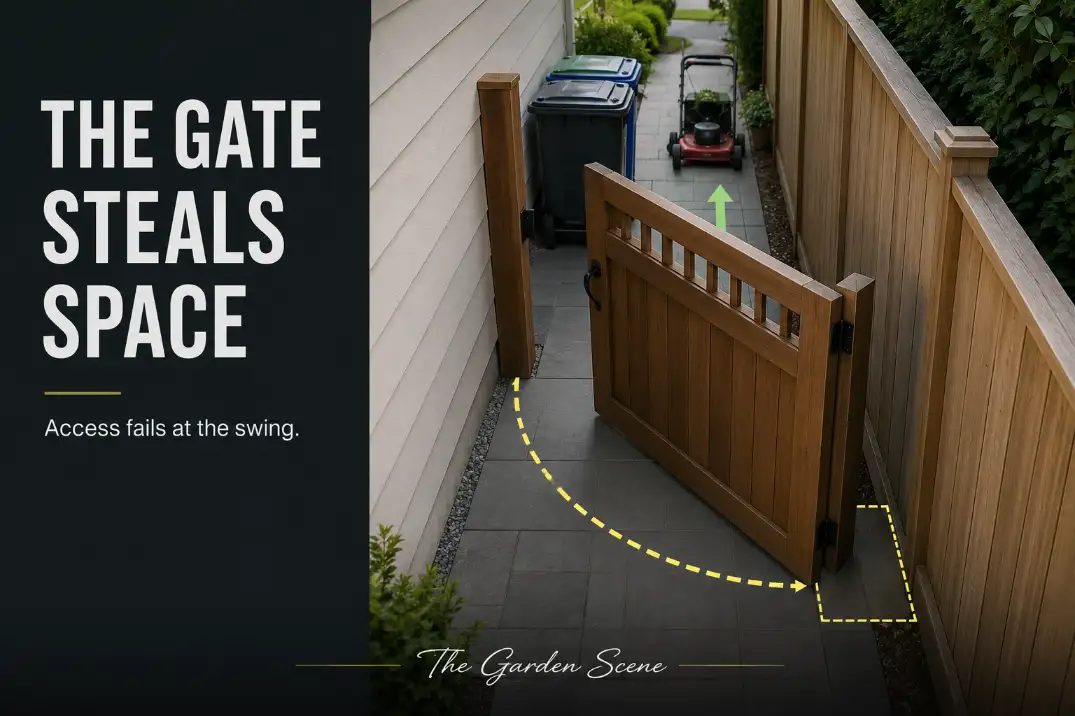
Most side yard gate swing clearance mistakes happen because the gate is measured closed but used open. A 36-inch gate can sound adequate, yet still fail when the open gate leaf steals the first 12–24 inches of working space, blocks the latch side, or forces a sharp turn with a bin or mower.
The first checks are simple: open the gate to 90 degrees, roll the largest weekly object through it, and test whether you can close the latch with one hand while standing in the path.
This is not the same as a narrow walkway problem. A tight walkway can still work if movement stays straight. A swing gate adds a moving panel, a pause point, a latch action, and often a turn.
That is why trash bins, push mowers, wheelbarrows, strollers, and full hands reveal the mistake faster than casual walking does.
The Gate Controls Access
The open gate is the real measurement
The practical clearance is not the distance between closed gate posts. It is the usable space left when the gate is open and a person or object is moving through it. If the gate opens only 75 degrees because it hits a fence, shrub, bin, or wall-mounted item, the opening may behave much smaller than the number on a tape measure.
For everyday side yard use, 36 inches of clear passage is a common practical target. It can work for walking, many trash bins, and some push mowers when the approach is straight.
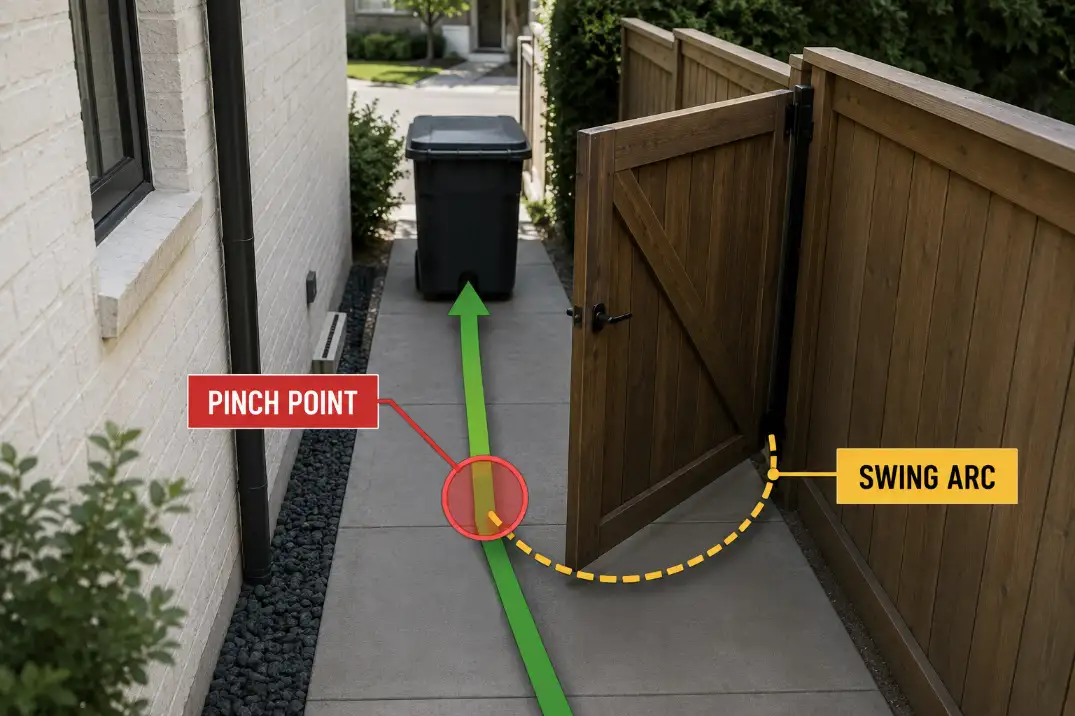
Below about 30 inches of actual clear pass-through, the space starts acting like a pinch point, especially when the user is steering something with wheels.
This is where many homeowners overestimate gate width and underestimate gate position. A wide gate that opens into the only standing area may feel worse than a slightly narrower gate with a clean swing and straight approach.
In a working side yard, the gate is part of the access route, not a separate fence detail. That same access-first logic matters in Side Yard Utility Corridor Ideas, where storage, drainage, and movement all compete for the same narrow strip.
The first 3 feet decide whether the gate works
The first 3 feet on both sides of the gate matter more than most people expect. This is the landing zone where you stand, turn, pull, push, and steer. If that zone contains a planter, bin bay, hose reel, AC screen, step, or fence return, the gate may still open but the route will feel awkward.
A gate that technically opens is not automatically usable. If the first 3 feet are crowded, a wider gate often only gives you a wider way into the same bad turn. That is the part many quick fixes miss.
The symptom is a gate that feels annoying. The mechanism is more specific: the user, the object, and the open gate leaf are trying to use the same working space at the same time.
What Actually Passes Through
People are the easiest test, not the best test
Walking through an empty gate is a weak test because people can turn their shoulders, step sideways, and tolerate a short squeeze. The better test is the largest object that must pass through every week or every season.
A residential trash bin is often around 24–28 inches wide at the body, but the wheels, handle angle, and your hand position need more room. A push mower may fit through the same opening but still catch at the handle.
A wheelbarrow is harder because the handles sweep wider during a turn. The object may fit through the gate and still fail the approach.
Pro Tip: Test the gate with the object loaded, not empty. A full trash bin or loaded wheelbarrow changes the turning radius and removes the easy “just lift it” workaround.
Better clearance depends on the job
The mistake is not always choosing a gate that is too narrow. More often, the mistake is choosing a gate without matching it to the job. A 36-inch opening may be enough for straight walking and light bin movement.
A 42-inch opening feels noticeably better when the side yard also handles a mower. A 48-inch opening is usually more forgiving for wheelbarrows, carts, and awkward turns.
| Use case | Bare minimum | Better target | Why it fails |
|---|---|---|---|
| Walking with bags | 30–32 inches | 36 inches | Latch side leaves no body room |
| Trash bin rollout | 32–36 inches | 36–42 inches | Wheels hit the open gate leaf |
| Push mower | 36 inches | 42 inches | Handle needs more room than deck |
| Wheelbarrow or garden cart | 36–42 inches | 48 inches | Handles need turning space |
| Occasional larger equipment | 48 inches | 4–5 feet | One narrow leaf becomes the bottleneck |
This is especially important when bins live near the gate. A bin bay that looks tidy can still fail if it forces a hard turn at the opening.
The better test is not whether the bin fits in storage, but whether it rolls cleanly from storage through the gate, which is also the core issue in Where to Put Trash Bins in a Narrow Side Yard.
The Latch Side Problem
The latch needs a standing zone
The latch side is where a surprising number of gate layouts fail. You need space to stand while unlatching, pulling, pushing, and closing the gate. If that space is taken by a shrub, wall, storage item, or raised edge, the gate becomes awkward even if the opening is wide enough.
A useful threshold is at least 18 inches of usable space at the latch side when the gate must be opened while carrying bags, tools, or a bin handle. Less than about 12 inches often turns the latch into a shoulder-twist move instead of a natural hand movement.
This is commonly misread as a hardware problem. A new latch may help if the latch sticks, but it will not fix missing body space. Replacing hardware is a wasted fix when the real issue is where the user has to stand.
Hardware can shrink the usable opening
Handles, thumb latches, hinge barrels, cane bolts, gate stops, and decorative trim all reduce practical clearance. A handle that projects into the path at hip height is annoying. A lower stop or bolt near the bin wheels can be worse because it catches equipment during the turn.
The difference is simple: post-to-post width is the measured opening; hardware-to-hardware space is closer to the usable opening. For side yard gates, the second number matters more.
Turns Make Gates Harder
A narrow opening plus an immediate turn is the worst combination
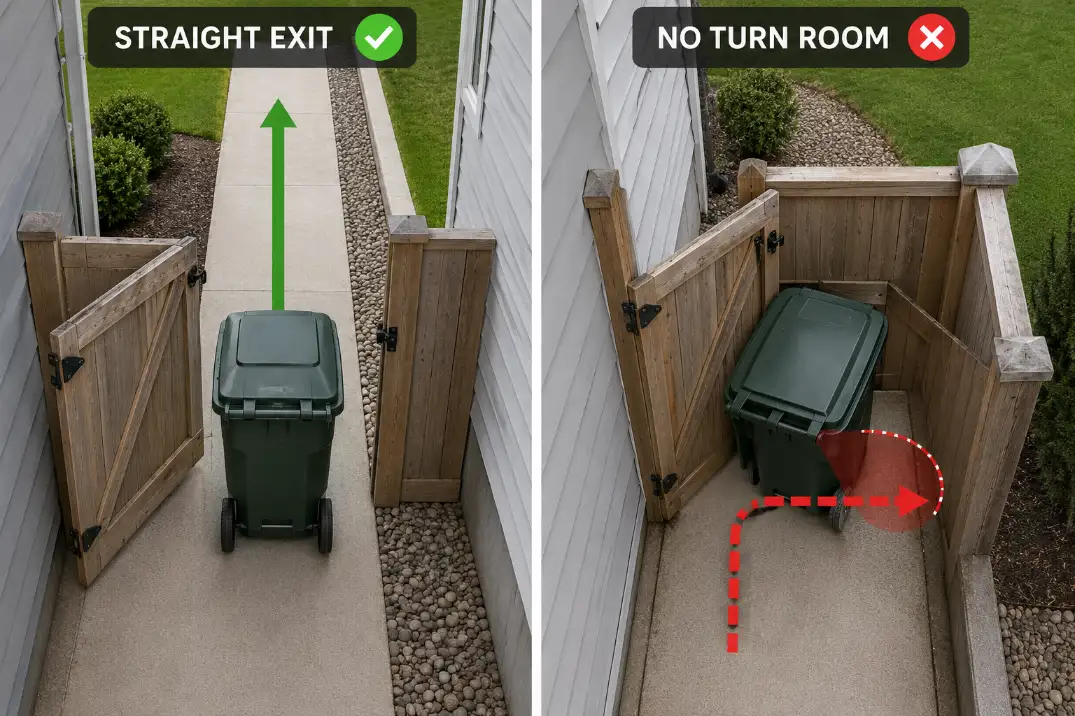
A side yard gate becomes much harder when the route turns before the object has fully cleared the opening. This often happens near AC units, short fence returns, trash bin screens, house corners, steps, or side-yard storage. The gate gets blamed, but the real obstruction is the turn.
The more likely cause is usually the approach angle, not the gate width alone. A homeowner may replace a 36-inch gate with a 42-inch gate and still feel blocked because the open gate leaf still occupies the turning zone. The less likely cause is that the gate is simply too narrow in isolation.
That distinction changes the fix. If the approach is straight and the object barely fits, widening the gate may solve it. If the approach is crooked, the better fix may be clearing the landing zone, reversing the swing, shifting the latch, or using a different gate type.
Narrow side yards punish small mistakes
In a 4-foot-wide side yard, every inch has a job. A gate post, latch handle, planter edge, bin wheel, or storage hook can consume the margin that made the route usable.
That is why swing clearance should be judged together with the whole walking route, especially in spaces already struggling with Narrow Side Yard Walkway Flow.
The condition people overestimate is the gate number. The condition they underestimate is the movement before and after the gate.
If the object must pause, turn, and be controlled with one hand, surrounding clearance matters more than the opening width by itself.
Easy With Full Hands
The full-hands test exposes bad gate planning
A gate is not truly convenient if it only works when both hands are free. Carry two grocery bags, open the gate, pass through, and close it without setting anything down. If that takes more than about 10–15 seconds, or if you have to step into a planting bed, the gate is not working cleanly.
This test reveals three problems at once: poor latch position, poor swing direction, and lack of standing room. It also catches gates that blow shut in windy side yards or drag after wet weather.
Seasonal movement can turn a marginal gate into a bad one
Wood gates can swell in humid summers, sag after wet periods, or drag after freeze-thaw movement in northern states. A gate with only 1/4 inch of bottom clearance may work in dry weather and scrape after a rainy week. A more forgiving bottom gap is often closer to 1–2 inches, depending on surface type, slope, and debris.
That does not mean every sticky gate needs rebuilding. Tighten hinges, adjust the latch, and clear gravel first. But if the gate still cannot open to 90 degrees, or the open leaf blocks the only turning area, routine adjustment has stopped making sense.
Practical Fixes That Actually Change the Outcome
Clear the landing before widening the gate
The first repair should usually be clearing the landing zone, not buying a wider gate. Remove or relocate anything that occupies the first 3 feet around the opening. That includes planters, loose edging, bin stops, hose storage, decorative screens, and low items that catch wheels.
This is the highest-value fix because it changes the movement pattern. A wider gate with the same blocked landing may still feel bad. A clean landing with the same gate can sometimes solve the whole problem.
If the entire side yard is tight, the gate should support the route instead of competing with it. That may mean simplifying the first landing area before adding storage or planting, a priority also covered in Side Yard Layout Ideas for Tight Access.
Change the swing direction when the leaf blocks the route
If the open gate leaf crosses the working path, changing the swing may do more than widening the opening. A gate that currently swings into the narrowest part of the side yard may work better if it swings away from the route.
That said, swing reversal is not automatic. A gate that swings outward can block a driveway, sidewalk, alley, neighbor-side access, or a required safety path. The better direction is the one that keeps the open leaf out of the real movement route during normal use.
Widen only after the straight-passage test
Widening the gate makes sense when the largest object still struggles even on a straight approach. If a mower, wheelbarrow, or bin cannot pass comfortably with the gate fully open and the landing clear, then the opening is the limiting factor.
But if the object passes straight and fails only during the turn, widening may be the wrong investment. In that case, the turn, landing, or swing arc is still the real problem.
Use double, sliding, or removable access selectively
A double gate is useful when everyday access can happen through one leaf and occasional wider access can happen through both. It is not useful if one leaf is blocked by a planter, slope, post, or storage item.
A sliding gate can help when there is no good swing arc, but only if the fence line has enough uninterrupted side space for the panel to move. In many narrow side yards, that condition is the limiting factor.
A removable fence panel can work for rare equipment access, but it is usually too inconvenient for weekly bin or mower movement.
Pro Tip: Choose the gate type for the movement frequency. Weekly access needs convenience. Once-a-year equipment access can tolerate a slower solution.
When the Problem Is the Gate, Not the Layout
Sometimes the layout is fine and the gate itself is the problem. If the gate drags, sags, drops at the latch side, or no longer lines up after rain or winter movement, start with hinges, posts, latch alignment, ground clearance, and drainage near the threshold.
The difference is easy to test. If the gate opens fully to 90 degrees and objects still struggle, you likely have a layout or clearance problem. If the gate will not open fully, scrapes the ground, or needs lifting to latch, the hardware or post alignment deserves attention first.
Quick Diagnostic Checklist
- Open the gate to 90 degrees and measure the actual clear pass-through.
- Roll the largest weekly object through while it is full or loaded.
- Check whether the open gate leaf blocks the first 3 feet of landing space.
- Test the latch with one hand occupied.
- Look for hardware, trim, stops, or bolts projecting into the route.
- Recheck after heavy rain, humidity, or freeze-thaw movement if the gate sticks seasonally.
When the Standard Fix Stops Working
A wider gate cannot fix a bad landing
Widening the gate stops making sense when the gate opens into a wall, bin bay, fence return, step, or hard turn. The opening may grow, but the movement pattern stays broken.
The better priority is clear: fix landing space and swing direction first, then widen the gate if the largest object still fails the straight-passage test. Cosmetic upgrades, heavier hardware, and prettier latches should come later. They improve a working gate; they do not rescue a bad access route.
For a side yard that feels cramped beyond the gate, the issue may be part of a larger path, storage, and clearance pattern. That is where Side Yard Mistakes That Make Tight Spaces Feel Cramped connects the gate problem to the rest of the corridor.
A good side yard gate almost disappears from the routine. You open it, pass through, close it, and keep moving. If it makes you pause, twist, lift, back up, or set something down, the mistake is usually not just the gate. It is the clearance around the swing.
For broader official guidance on gate and door clear openings, see the U.S. Access Board guide to entrances, doors, and gates.