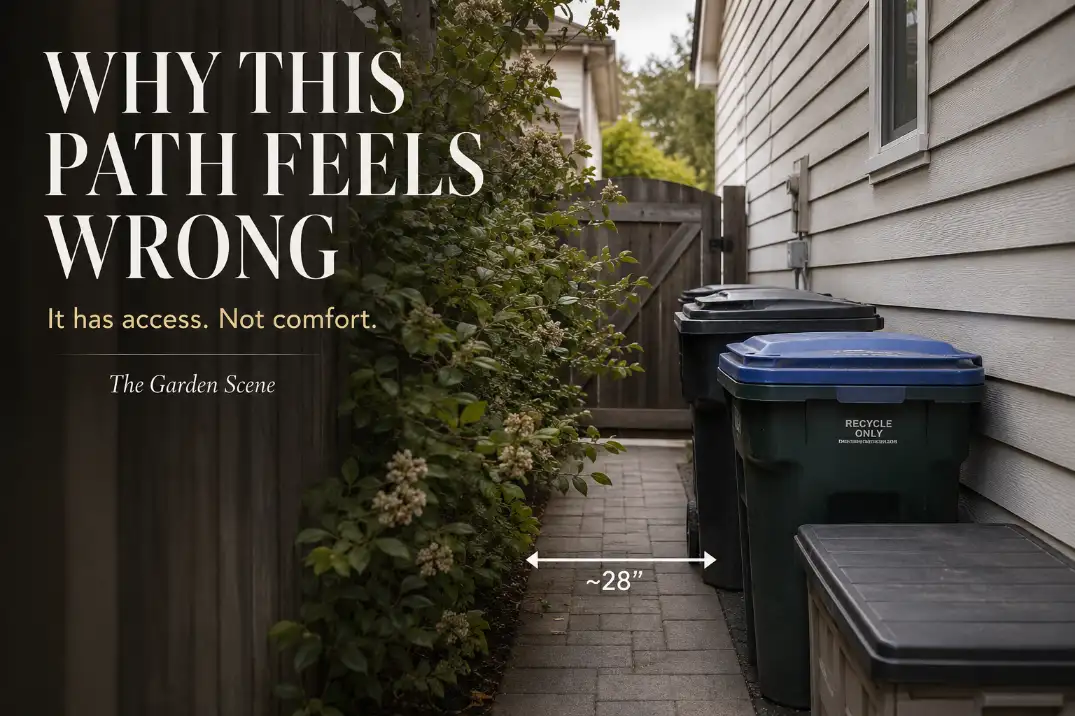
A side yard path can be technically passable and still feel uncomfortable. The problem is usually not style; it is the body constantly negotiating width, footing, drainage, and shoulder clearance.
Start with the narrowest clear point, not the total side yard width. If the usable lane drops below 30 inches, if plants brush shoulders between 30 and 60 inches high, or if the surface stays damp for more than 24–48 hours after rain, the path is already asking too much from the person using it.
This is different from a plain path. A plain path may lack charm; an uncomfortable path makes people slow down, turn sideways, avoid it after dark, or carry items through it with one arm tucked in.
First, Classify the Side Yard You Actually Have
Before changing materials, classify the space. Many side yard paths fail because the design treats every narrow side yard as if it can handle planting, storage, drainage, lighting, and walking with equal priority. It cannot.
3–4 Feet Wide: Access Corridor, Not Garden Room
At 3–4 feet wide, the side yard should behave like a clean access corridor. This is not the place for wide shrubs, loose storage, decorative stepping stones with gaps, or bins parked in the walking lane. The goal is a protected clear path, usually close to 30–36 inches wide, with everything else minimized.
4–6 Feet Wide: Path Plus One Controlled Edge
This range can support a path and one controlled edge: slim planting, a gravel drainage strip, a low wall-side utility zone, or narrow storage. It usually cannot support all of those at once. If the path also handles trash bins or tools, protect at least 36 inches of usable movement.
6–8 Feet Wide: Separate the Jobs
This is where the side yard can start to feel intentional. A walking lane can sit beside a drainage edge, vertical planting, or a compact utility strip. The key is separation. The path should not also be the runoff channel, plant overflow zone, and storage zone.
8 Feet or More: Comfort Comes From Zoning
Wider side yards can become small garden rooms, but comfort still depends on a clear route. If the walkway bends around every feature, the extra width gets wasted. In larger side yards, the best layouts usually separate access, planting, drainage, and storage into visible zones.
Why a Finished Side Yard Path Can Still Feel Wrong
A path can look complete in photos and still feel awkward in daily use. That is the failure pattern many homeowners miss. The material may be attractive, the edging may be neat, and the plants may be healthy, but the path still asks the body to hesitate.
Looks Finished Is Not the Same as Feels Usable
A finished path has a surface. A usable path has a predictable walking line. Those are different things. A side yard can have pavers, gravel, edging, lighting, and planting and still fail if the clear path pinches down at the gate, at the AC unit, or beside overgrown shrubs.
This is where the ideas in Narrow Side Yard Walkway Flow become more important than surface decoration. Flow is not just visual movement; it is whether the person walking through the space can move without constant correction.
The Air Space Matters as Much as the Ground
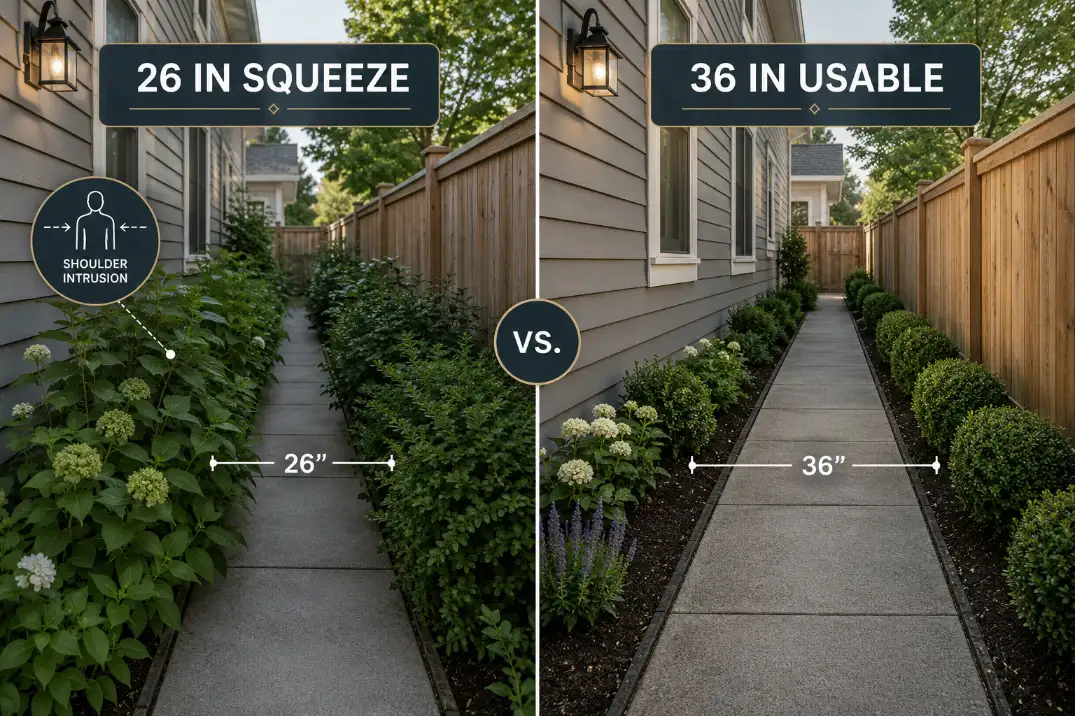
Many people measure the floor and ignore the walking envelope. A 34-inch path can still feel tight if shrubs lean in at elbow height or if wall-mounted fixtures catch bags and sleeves.
The most irritating conflicts usually happen between 30 and 60 inches above the ground. That is where hips, elbows, trash bags, garden tools, and shoulder-carried items pass through.
A low groundcover may soften the path without making it feel smaller. A shrub that leans into the route at 42 inches high changes the whole experience.
Pro Tip: Measure the path at shoulder height, not just at the ground. Comfort usually disappears in the walking envelope before it disappears on the floor.
The Width Ladder That Explains Most Comfort Problems
The clear walking width matters more than the listed side yard width. A 5-foot side yard can feel worse than a 4-foot side yard if bins, plants, downspouts, or gate hardware reduce the usable lane.
| Clear path width | How it usually feels | Best use |
|---|---|---|
| Under 24 inches | Squeeze zone | Service access only |
| 24–30 inches | Passable but tense | Occasional access |
| 30–36 inches | Workable for one person | Light daily use |
| 36–42 inches | Comfortable daily path | Bins, tools, garden use |
| 48 inches or more | Generous | Carts, two people, flexible use |
The practical threshold is simple: below 30 inches, most people start adjusting their body. Around 36 inches, the path begins to feel like it was meant to be used. At 42 inches, carrying items becomes much less awkward.
What People Usually Misread First
The most common mistake is blaming the surface material before checking the movement pattern. Gravel, pavers, concrete, mulch, and stepping stones can all work in a side yard, but none of them will make a bad walking line feel natural.
Decorative Stepping Stones Often Break the Stride
Stepping stones look simple, but they often fail in side yards because they require precise foot placement. If stones are spaced more than about 24 inches center to center, shorter users may stretch or shorten their stride.
If one stone sits more than 1/2 inch higher or lower than the next, the path starts to feel cautious instead of easy.
That is more noticeable in a side yard than in an open garden bed. In a wider yard, a person can drift around an awkward stone. In a narrow side yard, the wall, fence, and planting edge decide where the feet must land.
Plants Are Often Overestimated as the Fix
Planting can soften a tight side yard, but it does not fix a bad path. In fact, plants often cause the comfort problem after one growing season.
A compact shrub that looks harmless at 18 inches wide in spring may push 8–12 inches into the walking lane by late summer, especially in humid climates where growth is fast.
If the usable lane drops from 36 inches to 28 inches by August, the issue is not just maintenance. It is a planting-size mismatch.
For tighter side yards, the plant and material choices in Best Plants and Materials for Narrow Side Yards matter because mature spread is part of path comfort.
Drainage Is Often Underestimated
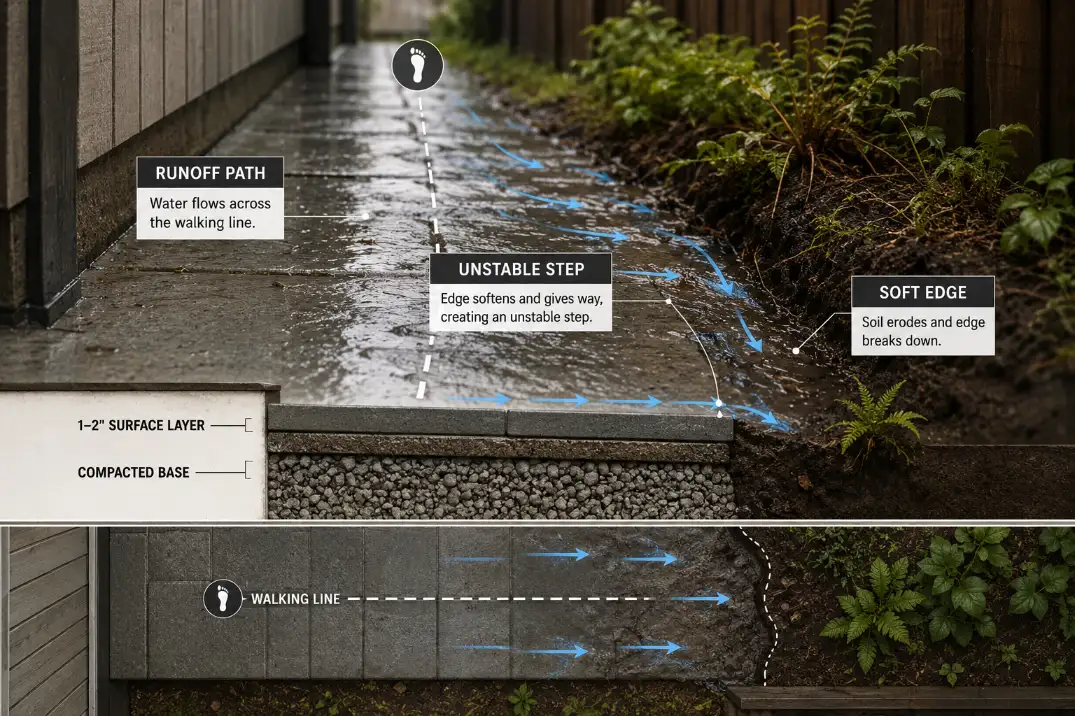
A side path does not need standing water to feel bad. A thin film of algae, soft soil at one edge, or gravel that migrates after storms can change how people walk.
If water remains on the surface more than 24 hours after normal rain, or one strip stays soft for 48 hours while nearby areas dry, the path is not performing evenly.
This is common where downspouts, roof valleys, narrow overhangs, and fence lines concentrate runoff. Before upgrading the finish, check whether the path is being used as a drainage route.
The access-and-water logic in Side Yard Ideas for Drainage and Access is more useful than simply choosing a prettier surface.
Quick Diagnostic Checklist
Use this before spending money on materials:
- Clear walking width is under 30 inches at the tightest point.
- Plants, hooks, fixtures, or gate hardware intrude between 30 and 60 inches high.
- The path stays damp more than 24 hours after moderate rain.
- Stepping stones force a shortened or stretched stride.
- The surface shifts, rocks, or depresses more than 1/2 inch underfoot.
- The route requires turning sideways while carrying bins or tools.
- Night use feels worse because edges, steps, or slopes are unclear.
If three or more of these are true, the problem is not cosmetic. The path needs functional correction before visual improvement.
Why the Obvious Fix Often Fails
The obvious fix is to resurface the path. That can help, but only after the path’s geometry is right. A new surface on the same awkward route usually makes the side yard look newer without making it easier to use.
A Better Surface Cannot Correct a Bad Walking Line
A path should let the body move without constant steering. Side yard paths often fail because the walking line bends around objects that should have been moved, raised, narrowed, or consolidated.
A hose reel at shin height, a gate latch that catches clothing, or bins parked halfway into the route will keep the space uncomfortable even if the surface is upgraded.
If storage, planting, and access are all competing for the same strip, Side Yard Layout Ideas for Tight Access is the stronger starting point than a surface-only refresh.
Gravel Is Useful, But Not Automatically Comfortable
Gravel is often treated as the easy answer. It drains well, looks informal, and fits narrow spaces. But loose gravel deeper than about 2 inches can feel unstable under frequent foot traffic, especially for older adults, kids, and anyone carrying loads.
Crushed stone with fines usually compacts better than round pea gravel, but it still needs edging, a prepared base, and a stable depth. A common waste of time is adding more gravel to a path that is already migrating.
If gravel spreads into planting beds or collects at low points within a few weeks, the issue is slope, base preparation, or edge control.
Better Layout Moves for Paths That Feel Uncomfortable
This is where the article should not become a generic list of side yard ideas. The useful question is not “what can I add?” It is “which move removes the friction?”
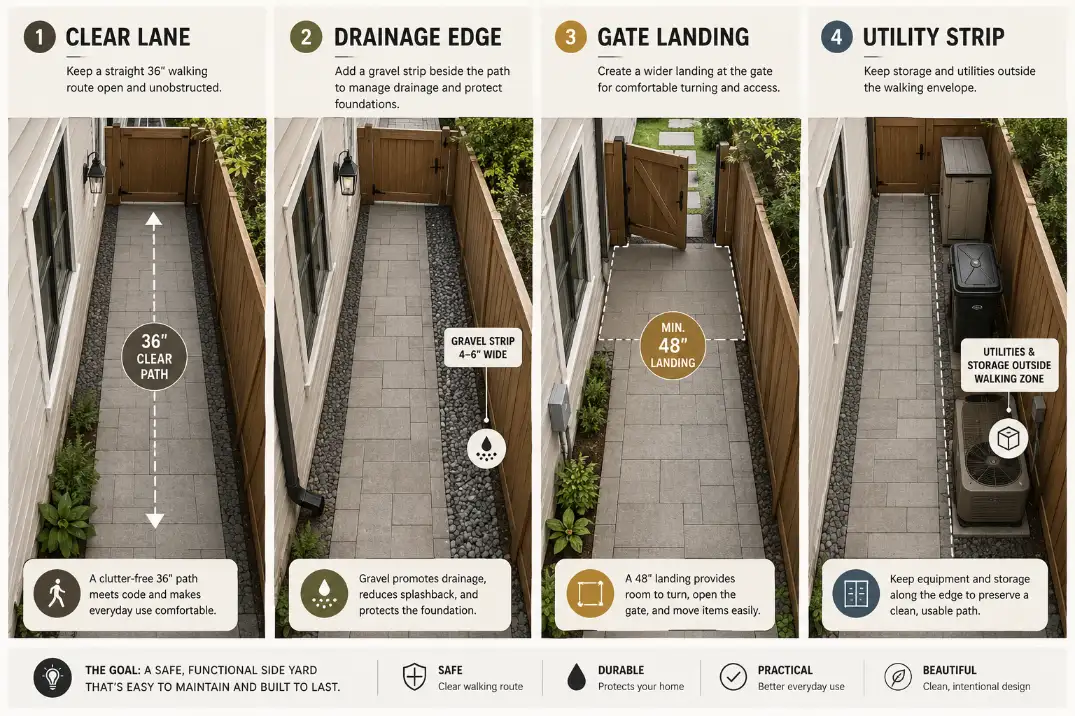
If the path feels tight when dry, fix clearance first. If it feels risky after rain, fix drainage first. If it works for walking but fails with bins, tools, or a garden cart, fix the gate and carrying route before changing the surface.
Keep One Edge Visually Quiet
In a narrow side yard, one quiet edge makes the whole path feel calmer. That may be a plain fence line, a clean house-wall edge, or a narrow gravel strip. If both sides are visually busy, the path feels tighter even when the measurement is acceptable.
Move Storage Out of the Walking Envelope
Storage is not automatically the problem. Bad storage placement is. A slim wall-side utility strip can work if it does not interrupt the 30–60 inch walking envelope. Bins, tools, hose reels, and shelves should not force the user to angle their shoulders.
Create a Gate Landing, Not Just a Gate Opening
Many paths fail at the gate. The walkway may be 36 inches wide, but the gate area pinches down to 26 inches with a latch, post, bin, or plant right where someone needs to turn. A small landing zone of 36–42 inches near the gate often improves comfort more than upgrading the entire path.
Use Plants as Edges, Not Obstacles
Plants should define the path, not invade it. In side yards, the safest planting strategy is usually low, narrow, and predictable. Tall plants can work if they are set back or trained vertically, but loose shrubs beside a narrow lane often become a trimming problem.
Let Drainage Run Beside the Path, Not Through It
A drainage strip beside the path is usually better than a path that doubles as the water channel. If runoff repeatedly crosses the walking line, the surface will feel less stable even when it looks dry most of the time.
When the Standard Fix Stops Making Sense
There is a point where trimming, edging, topping up gravel, and adding solar lights become maintenance theater. The routine fix stops making sense when the path fails in the same place repeatedly.
Repeated Wet Spots Mean the Path Is Receiving Water
If the same strip turns muddy after every storm, do not start with more mulch or decorative stone. First identify the water source. Common culprits include a downspout aimed into the side yard, a roof valley discharging onto a narrow strip, soil pitched toward the fence, or a hard surface upstream sending water across the path.
Even a 1/4 inch per foot slope can move enough water to matter in a confined side yard. In Midwest regions with seasonal storms or northern states with snowmelt, repeated flow can loosen edging, lift pavers, and create freeze-thaw movement over winter.
Repeated Trimming Means the Planting Choice Is Wrong
If a plant needs cutting back every 2–3 weeks in the growing season just to keep the path usable, it is the wrong plant for that edge. The fix is not more discipline. It is a narrower mature plant, a raised planter set back from the lane, or a hard edge that protects the walking line.
Repeated Awkward Carrying Means the Path Is Undersized for Its Job
A path used only for occasional walking can survive tighter dimensions than a path used for trash bins, bikes, strollers, ladders, garden carts, or grill access. If the real job includes moving objects, design for the object, not the person alone.
A standard residential trash bin often needs around 28–30 inches of working width when rolled carefully, but comfort improves when the route has closer to 36–42 inches of clear space. If the gate opening is narrower than the path, the gate becomes the real bottleneck.
Practical Fixes in the Right Order
Start with the changes that protect movement, then address surface and style.
1. Clear the Walking Envelope First
Trim or remove anything that narrows the path from ground level to about 6 feet high. Shift hose reels, hooks, small storage items, and planters out of the movement lane. If a plant cannot stay outside the lane at mature size, replace it rather than trimming it forever.
2. Correct the Worst Pinch Point
Do not average the path width. A 40-inch path with one 24-inch squeeze still feels like a 24-inch path. Fix the narrowest 3–6 feet first because that is where the body anticipates conflict.
3. Stabilize the Surface Only After Water Is Understood
If water crosses the path, redirect it, slow it, or give it a controlled place to soak in before adding finish material. Permeable pavers, compacted crushed stone, or concrete can all work, but each fails faster when runoff is unmanaged.
4. Add Light Only Where It Reduces Hesitation
Lighting helps when the issue is uncertainty: a step, slope, gate, turn, or edge. It does not fix a narrow lane. For side paths used at night, low-glare fixtures placed every 6–8 feet near decision points are usually more useful than bright decorative lights scattered evenly.
For paths with steps, slopes, or low-light transitions, Path Lighting for Steps, Slopes, and Walkways is more relevant than general backyard ambiance lighting.
The Best Side Yard Paths Feel Boring in the Right Ways
A comfortable side yard path does not need to be dramatic. It needs to be predictable. The feet should know where to land. The shoulders should not brush anything. Water should not choose the walking line as its route. The gate should not be the tightest point. The surface should feel the same at the beginning, middle, and end.
The mistake is trying to make the side yard charming before making it calm. In a narrow space, small failures feel larger because there is nowhere for the body to compensate.
Fix the narrowest, wettest, or most awkward 3–6 feet first; that is usually where the whole path’s comfort is being decided.
The best side yard path is not the one that looks most designed. It is the one your body stops noticing.
For broader official guidance on reducing runoff across walkways and hard surfaces, see University of Minnesota Extension.