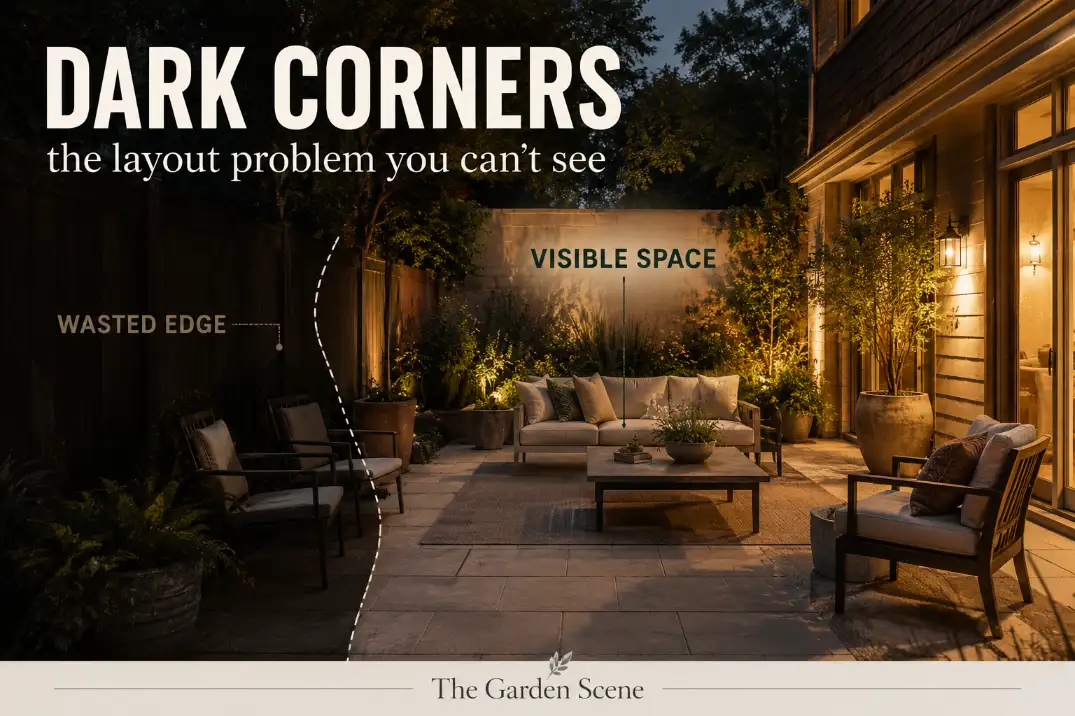
Dim backyard corners usually make layout problems worse because they erase the edge of the usable space.
The issue is not just “not enough light.” It is uneven light: a bright patio door, grill light, or wall fixture makes the center feel usable while the corners fall out of view.
Check three things first: whether the corner is used after sunset, whether the path beside it narrows below about 30 inches, and whether the bright-to-dark shift happens within 6–10 feet. That contrast is often more disruptive than a generally low-light yard.
This differs from a truly bad furniture layout. A poor layout feels awkward in daylight too. A dim-corner problem often looks acceptable at 2 p.m. but starts pushing people, chairs, toys, and serving pieces into the same middle zone after dusk.
If the space works during the day and collapses at night, lighting is probably amplifying the layout problem rather than causing it alone.
The 3-Point Corner Test
Before buying another fixture, judge the corner by three things: edge, route, and anchor. If one of those fails after dark, the corner can distort the whole backyard lighting layout.
Edge: Can you see where the usable space ends?
A usable patio edge should be readable without guessing. You should be able to see the fence line, planting bed, paver edge, chair legs, and any level change. A 2-inch step or raised edging strip is enough to change how people move at night if it sits in shadow.
When the edge disappears, the yard feels smaller. People stop treating that side as usable space and move toward the brighter middle. That is why a patio can feel crowded even when the square footage is technically enough.
Route: Can people move without slowing down?
Walk the route after sunset without using your phone flashlight. If people slow down, turn sideways, or cut through the seating area, the lighting is not supporting the layout.
For most patios, a 30–36 inch clear walking path feels comfortable. Under 30 inches starts to feel tight, and under 24 inches becomes a squeeze point, especially when chairs are pulled out. If the dark corner sits beside that route, it will make the passage feel narrower than it is.
Anchor: Does the corner have a job after dark?
Not every corner needs to be bright. But every corner that affects evening use needs a role. It may anchor a seating area, mark a path turn, define a grill route, show a gate, or create visual depth behind the patio.
A corner with no job can stay quiet. A corner that controls movement should not disappear.
If you are already thinking beyond one fixture, a broader look at Best Backyard Lighting Layout for Patios at Night can help separate layout lighting from decorative lighting.
Why Dark Corners Shrink the Usable Yard
A backyard corner can be physically open and still function like dead space. At night, people tend to avoid areas where they cannot read footing, see chair legs, or judge the edge of a planting bed.
The result is predictable: everyone gathers in the brightest 60–70% of the patio or yard, while the dim edge becomes visual storage.
The corner disappears before the furniture does
Most homeowners notice the furniture first. They think the sectional is too large, the dining set is in the wrong place, or the grill station needs to move. Sometimes that is true.
But when the darkest corner is also where circulation should pass, lighting deserves attention before another furniture reshuffle.
A healthy outdoor layout usually has a readable edge, a clear path, and at least one destination that still feels usable after sunset. When the corner drops into shadow, the layout loses one of those anchors. The yard feels smaller because the eye stops early.
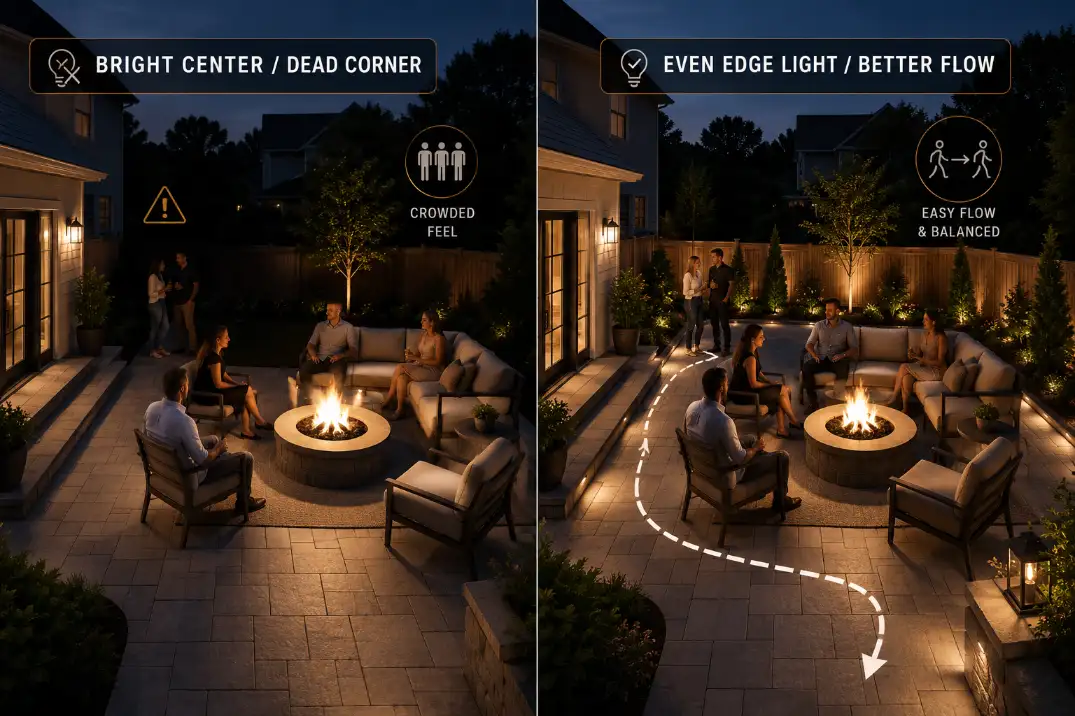
Bright centers can make corners feel darker
The most common mistake is adding a strong light near the back door and assuming the whole yard improved. In reality, a 700–1,000 lumen wall light near eye level can make a 100–200 lumen corner fixture feel almost invisible. Your eyes adapt to the brighter source, so the corner reads darker by comparison.
This is also why a patio can feel both too bright and too dim at the same time. The center may have glare, while the edge remains unusable. That combination is worse for layout than a softly lit yard with lower but more even light.
Use the comparison below to decide whether the corner is truly underlit or whether the bright center is stealing the layout.
Quick Diagnostic Checklist
Use this after sunset, not during the day.
- Walk the main route with no phone flashlight; if your pace slows near the corner, the corner is not readable enough.
- Measure the narrowest passage beside furniture; under 30 inches feels tight, and under 24 inches becomes a squeeze point.
- Stand at the patio door and look for one bright source dominating the view; glare often hides the darker edge.
- Check whether chairs drift toward the light after 20–30 minutes of use.
- Look for unlit level changes, edging, hose reels, planter feet, or toy storage within the shadowed corner.
- Turn off one bright fixture for 5 minutes; if the corner becomes easier to see, contrast was part of the problem.
What People Usually Misread First
They blame the far corner when the near light is the bully
A dim corner is not always underlit in isolation. Often, the fixture closest to the house is overpowered, poorly aimed, or too high. The eye gets pulled toward the brightest spot, then fails to read the rest of the yard.
That is why replacing a small corner light with a stronger one can disappoint. You may create two competing bright spots with a dark gap between them. The layout still feels broken because the route from one zone to another remains unclear.
Outdoor lighting glare is one of the most common reasons a yard feels harsh and dim at the same time. If the visible bulb is the first thing you notice from a chair, the problem may be closer to Patio Lighting Glare Mistakes than to a simple lack of brightness.
They overestimate brightness and underestimate uniformity
More light is not automatically better. For many residential patios, low-level path or accent lighting in the 100–300 lumen range per fixture is enough when it is aimed well and repeated consistently.
A single harsh fixture can be less useful than three lower-output fixtures spaced 6–10 feet apart.
What people underestimate is uniformity. If one area is five times brighter than the adjacent corner, the darker area feels unsafe even if it has some light. A modest, even wash usually improves backyard flow more than one dramatic upgrade.
Pro Tip: Before buying fixtures, place two battery lanterns in the dark corner for one evening. If the furniture suddenly feels better placed, the layout problem is partly a visibility problem.
What Not to Buy First
The fastest purchases are often the weakest fixes. A brighter floodlight may improve security visibility, but it rarely improves patio traffic flow. It can flatten the space, throw hard shadows, and make seating feel exposed.
Decorative string lights are also easy to overestimate. They help atmosphere, but they usually do not show a step edge, a path turn, or the gap behind a chair.
Random solar stakes can mark a border, but if the corner sits under tree shade or gets used late in the evening, weak output after cloudy days becomes a real limitation.
Do not add furniture to “activate” the corner before testing visibility and clearance. A bench, planter, or side table in a dark corner may only add another object for people to avoid.
Which Fixture Solves Which Corner Problem?
| Dark-corner problem | Better first fix | Avoid first |
|---|---|---|
| Path turn disappears | Two low, shielded path lights before and after the turn | One bright stake directly on the corner |
| Seating corner feels unused | Soft wall wash or low accent behind seating | Harsh spotlight aimed at chairs |
| House light makes corner look black | Lower house-light output, then add edge light | Adding a stronger corner bulb |
| Grill zone pulls traffic inward | Separate task light over grill or prep area | Flooding the whole patio |
| Step or paver edge is hidden | Downward step or path light | Decorative string lights only |
This is where fixture choice should follow the job. If the corner affects movement, light the route. If it affects comfort, soften the surrounding surfaces. If it affects cooking, separate the task light from the lounge light.
This is especially common with patios that combine dining, lounging, and grilling. Each activity needs a different kind of light, but the transitions matter as much as the zones.
If the grill is bright and the seating corner is dim, people often drag chairs toward the grill path, which makes the working area feel cramped.
A more useful approach is to think in zones, as explained in Patio Lighting Zones for Dining, Lounge, and Grill Areas.
Why the Obvious Fix Often Fails
The obvious fix is to add one bigger light to the dark corner. That works only when the corner is a destination, such as a bench, small table, or gate. If the corner is part of circulation, one bright point can create glare, hard shadows, and a new visual stop.
A corner needs edges, not a spotlight
The goal is to reveal boundaries: the fence line, step edge, planting bed, chair legs, or path curve. Spotting the center of a dark corner often leaves the edges vague.
That is backwards. Layout problems improve when people can read where to walk and where not to place furniture.
For walkways and side-yard transitions, low fixtures aimed downward usually matter more than decorative uplights. A 2-inch step, a sloped paver edge, or a hose crossing the corner can change how people move at night.
If the dim corner connects to a route, Path Lighting for Steps, Slopes, and Walkways is more relevant than another patio mood-light idea.
Glare steals usable space
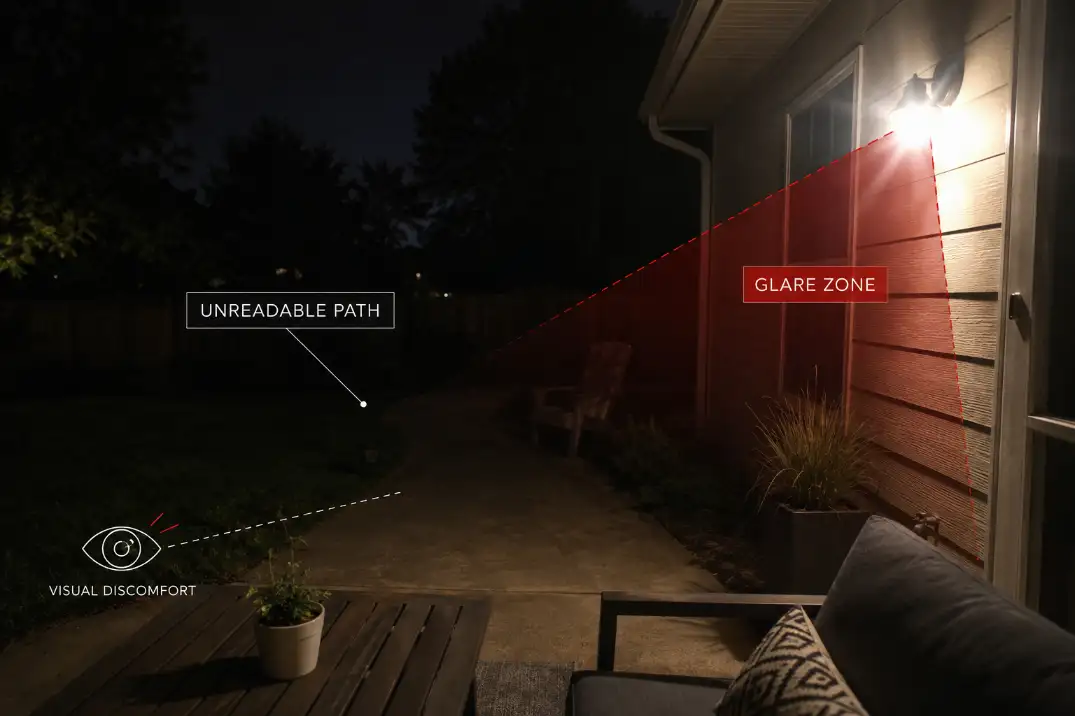
Glare is a symptom; poor control is the mechanism. A visible bulb, shiny reflector, or fixture aimed across eye level makes the viewer look away. Once people avoid looking toward a corner, they also avoid using the space near it.
This is where routine fixes stop making sense. If you have already added bulbs twice and the corner still feels bad, do not keep increasing wattage.
Change fixture position, shielding, beam direction, or spacing. A 300-lumen shielded fixture aimed down can outperform a 900-lumen exposed bulb that hits people in the eyes.
The glare pattern below is the reason a brighter light can make the route harder, not easier, to read.
Better Fixes for Dim Backyard Corners
Start with the route, then light the destination
If the corner is beside a path, gate, steps, grill route, or trash-bin route, light the movement first. Keep the path readable for at least 30–36 inches of clear width where possible.
In tight patios, even 28 inches may work if furniture is fixed and the route is short, but below that the space will still feel cramped no matter how attractive the lighting is.
If the corner is a seating or planting destination, use softer area light or a low accent aimed at the vertical surface behind it. Lighting the fence, wall, or tall planting lightly can make the corner feel present without blasting the floor.
Use layers instead of one correction
A reliable small-yard lighting pattern often uses three layers: a low path cue, a soft vertical surface cue, and a task light only where work happens.
The corner does not need to compete with the house light. It needs enough definition to keep furniture and movement from collapsing inward.
This is especially important on small patios, where every fixture is close to someone’s eyes. If the space is under about 120 square feet, oversized fixtures and tall exposed bulbs can clutter the view as much as furniture does.
For compact spaces, How to Light a Small Patio Without Clutter is the better direction than simply adding more fixtures.
Solar marks edges; low-voltage solves frequent-use corners
Solar lights can be useful when the goal is simple edge marking. They make sense along a quiet planting bed, a casual path, or a corner that only needs a soft cue.
But they are less reliable under shade, after several cloudy days, or when the corner needs to stay readable late into the evening.
Low-voltage landscape lighting is usually the better choice when the corner affects steps, regular seating, grill traffic, pets, children, or a route used several nights a week. It gives more consistent output, better fixture control, and cleaner placement options.
Keep the light warm, low, and controlled
For residential backyards, warm light around 2700K to 3000K usually feels more comfortable than cool blue-white light. Cooler light can make shadows look sharper and hard surfaces feel harsher, especially on pale concrete or light pavers.
In humid Florida yards or coastal California areas, glare can feel worse when moisture in the air catches a bright exposed source.
Warm light will not fix a bad layout by itself. But it makes low-level lighting easier to live with, which matters because the best corner lighting is usually subtle and repeated, not dramatic.
When Lighting Is Not the Main Problem
Some backyard corners are dim because they are already functionally abandoned. Lighting will not rescue every awkward layout.
The clearest cutoff is this: if the corner is unusable at noon, lighting is not the first fix. If it works in daylight but fails within 30 minutes of evening use, lighting probably changes the outcome.
A standard lighting fix also stops working when the corner contains a physical obstruction. A deep sectional, oversized dining chair, leaning storage box, or shrub extending 18–24 inches into the route will still force traffic inward. Light can reveal the problem, but it cannot give back the missing clearance.
The Smart Order of Repairs
Remove, then test, then install
Start by removing anything temporary from the corner: spare pots, unused chairs, hose reels, kids’ toys, or seasonal storage. Then test the space at night with temporary lights. This prevents a common waste of money: installing permanent fixtures to support a layout that should have been simplified first.
Next, reduce glare from the brightest existing fixture. Shield it, lower its output, change the bulb, or aim it down. Only after that should you add corner lighting. Otherwise, you may be designing around a bad reference point.
Add light where decisions happen
People need light where they choose a step, turn around furniture, set down a drink, or pass behind a chair. That usually means corners, transitions, and route edges—not the open middle of the patio.
For most backyards, spacing low fixtures about 6–8 feet apart along a route creates better guidance than placing one strong fixture at the destination.
On larger patios, 8–10 feet may work if surfaces are even and there are no steps. On sloped yards or uneven pavers, tighter spacing is safer.
Pro Tip: After installation, sit in every main chair and look toward the corner. If you can see the bulb directly from normal seated eye level, the fixture is probably creating some glare.
Questions People Usually Ask
Should every backyard corner be lit?
No. A corner that is purely planting, privacy screening, or background can stay quiet. Light the corners that affect movement, seating balance, gates, steps, or activity zones.
Are solar lights strong enough for dim corners?
Sometimes, but they are better as edge markers than true layout lighting. In cloudy Midwest weeks, shaded yards, or late-night use, solar output can fade too much to support a corner that controls movement.
Is one floodlight enough?
Usually not for layout problems. A floodlight may improve security visibility, but it often flattens the yard, creates glare, and leaves furniture decisions unresolved. Controlled, lower lighting normally works better for patios and corners people actually use.
What if the corner still feels bad after lighting?
Then the lighting exposed a deeper layout issue. Recheck furniture clearance, plant overgrowth, surface level changes, and whether the corner has a real purpose. A corner with no role will still feel awkward, even when visible.
Dim backyard corners make layout problems worse because they remove usable edges from the nighttime plan. The best fix is rarely a brighter bulb.
Clear the corner, reduce glare, light the route, define the edge, and only then decide whether the furniture layout needs to change.
Do not light the corner just because it is dark. Light it because it controls the route, the edge, and the way people decide where the patio actually ends.
For broader responsible outdoor lighting principles, see DarkSky International.