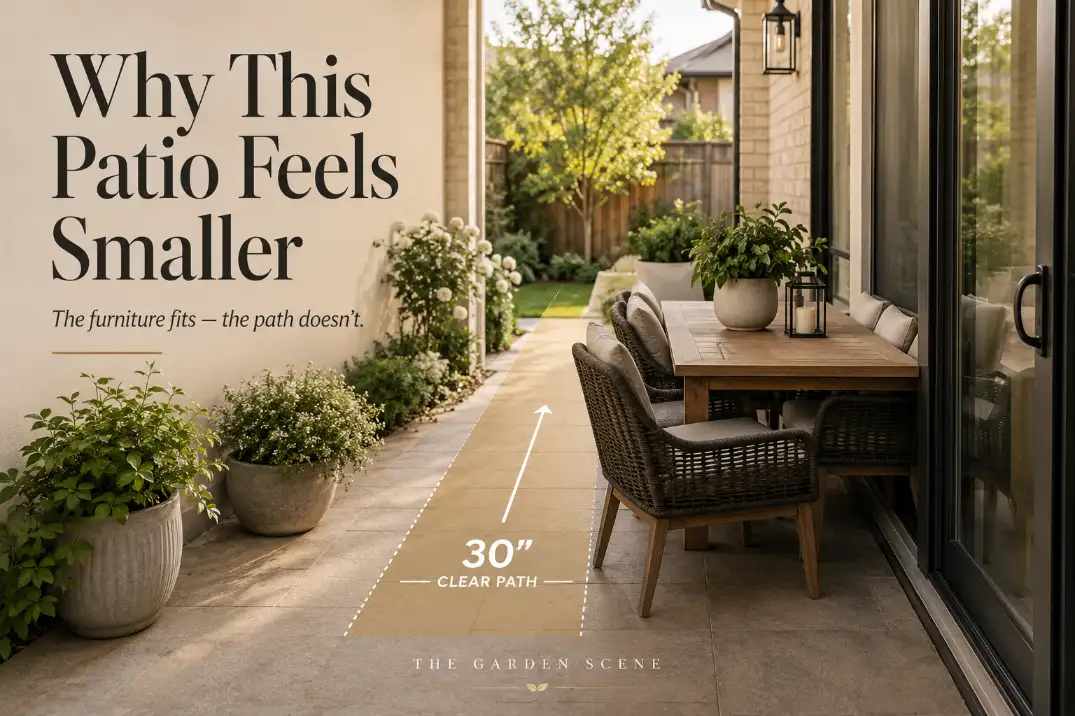
The best patio furniture layout by size starts with the route people use most, not the furniture set that looks best online. Keep the main walking path at least 30 inches wide, allow 24–30 inches behind dining chairs, and leave the door zone clear before adding a sectional, grill cart, or extra lounge chair.
If the patio feels cramped, the furniture is not always too large; more often, the chair pullback, chaise, or table position is crossing the path from the house to the yard.
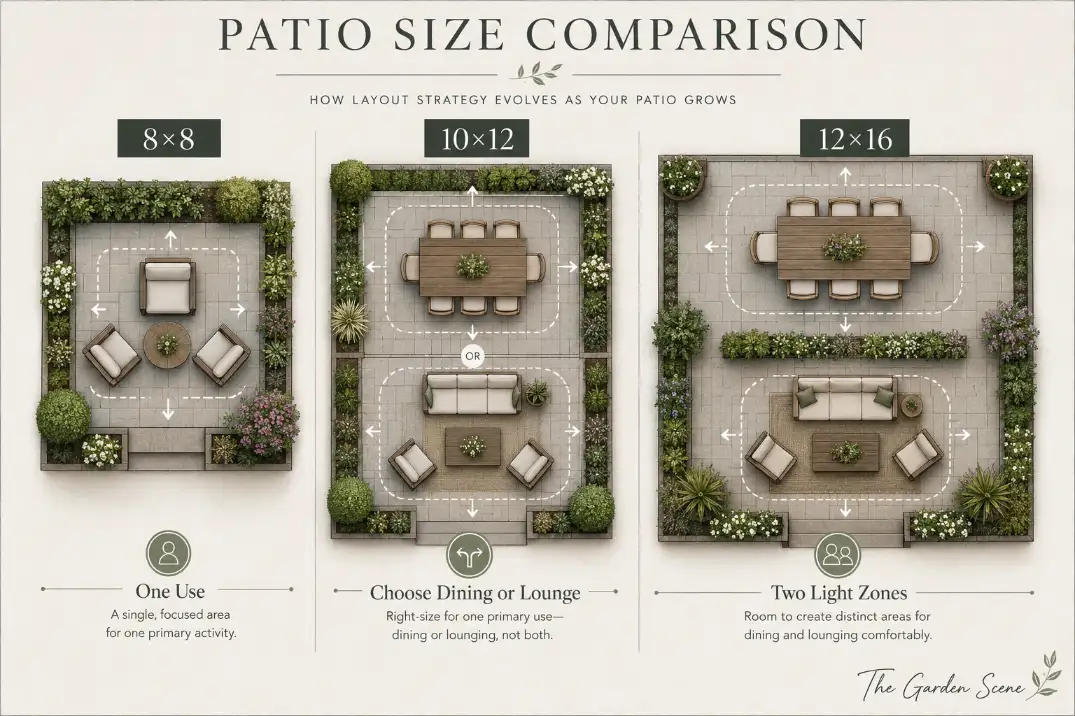
For most patios, the quick answer is simple: use bistro seating for 6×8 or 8×8 spaces, a loveseat-and-chair layout for 8×10 patios, one main function for 10×12 patios, a conversation layout for 12×12 patios, and two light zones for 12×16 patios or larger.
A layout problem looks like “not enough space,” but the real mechanism is usually overlapping movement.
Best Patio Furniture Layout by Size
| Patio size | Best first layout to try | Why it works | Usually avoid |
|---|---|---|---|
| 6×8 | Folding bistro set or two slim chairs | Keeps the door path open | Fixed deep lounge chairs |
| 8×8 | Bench against one edge plus one chair | Uses the perimeter instead of the center | Full dining set |
| 8×10 | Loveseat on the long side plus one side chair | Preserves one clean walking lane | Chaise sectional across the short side |
| 10×12 | 4-seat round dining set or compact lounge group | One clear purpose feels intentional | Dining and lounging at equal size |
| 12×12 | Four-chair conversation layout or small sectional | Creates balance without over-zoning | Oversized rectangular table |
| 12×16 | Dining plus light lounge, or lounge plus grill cart | Supports two functions if the path stays clear | Two full outdoor rooms |
This table is not about what can technically fit. It is about what still works after someone pulls out a chair, carries food outside, opens the door, or walks past another person.
Start With the Path, Not the Furniture
The clearance that matters most
A 30-inch walkway is the minimum that keeps most patios usable. A 24-inch gap can look fine when the furniture is staged, but it often fails once chairs are pulled out or people are moving with plates and drinks.
If the space needs to work for a stroller, walker, serving cart, or older guests, use 36 inches as the safer planning number.
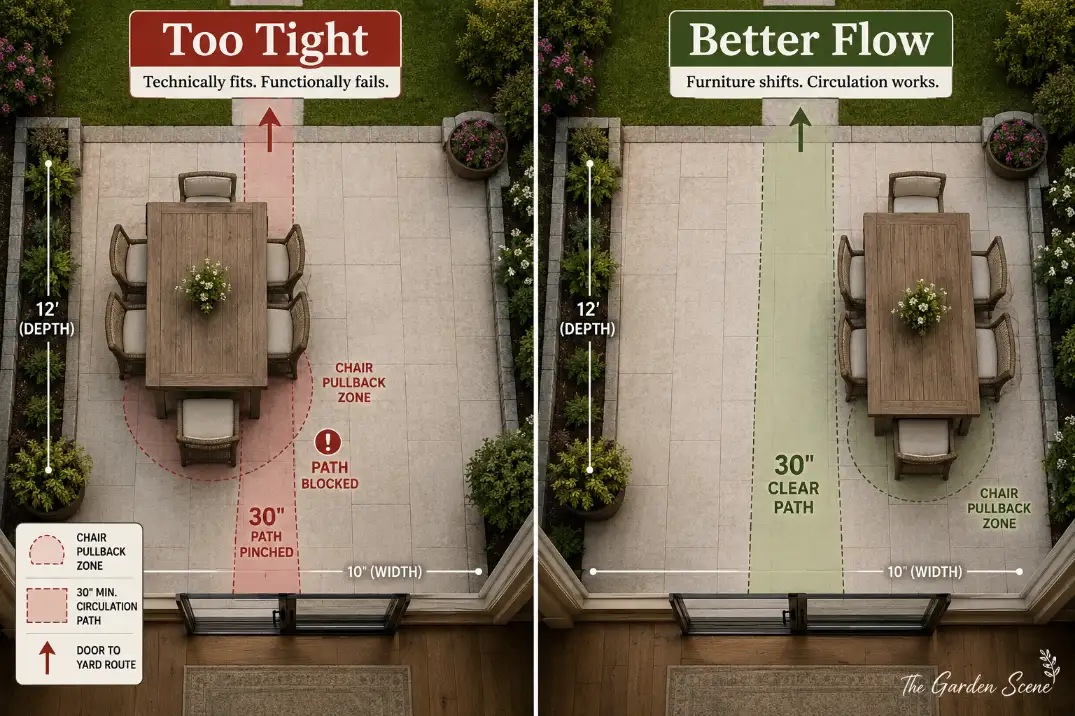
Dining layouts need their own clearance. A 42- to 48-inch round table may fit on paper, but chairs need space behind them. Plan roughly 6 feet across for a small dining setup once chairs are occupied, not just the table diameter.
Crowding is the symptom, not the cause
A crowded patio is the visible symptom. The cause is usually conflict between furniture depth and movement. A chaise crosses the walkway. A dining chair backs into the door path. A coffee table sits where people naturally step.
That is why buying a smaller side table rarely fixes a truly awkward layout. The better first move is usually rotating the seating group, moving the longest piece to the longest clear edge, or shifting the main walkway to one side.
For patios where the door route controls everything, Patio Layouts for Sliding Glass Doors and Walkways gives a more focused way to solve that conflict.
Layout Ideas for Small Patios
6×8 and 8×8 patios: keep the center light
A 6×8 patio has only 48 square feet, and an 8×8 patio has 64 square feet. Once a door route claims part of that area, the usable furniture zone may be much smaller.
The most reliable layout is a folding bistro set, two slim chairs with a small table, or a bench tight to one edge.
The mistake is buying by seat count. Four seats sound better than two, but on a patio this small, four fixed chairs often turn the entire slab into chair legs. A narrow bench can be better because it keeps one side visually quiet and leaves the middle open.
For this size, furniture depth matters more than cushion thickness. Chairs around 24–27 inches deep are usually easier to place than deep lounge chairs over 30 inches.
If the patio is 96 inches wide and the chair is 32 inches deep, one piece already consumes a third of the width before anyone sits down.
For very compact layouts, 8×8 Patio Furniture Layout Ideas is useful because it treats the space as a real constraint, not a mini version of a larger patio.
8×10 patios: put the longest piece on the long edge
An 8×10 patio can feel comfortable if the layout has one anchor piece and one flexible piece. Place a loveseat along the 10-foot edge, add one chair near an open corner, and use a side table instead of a large coffee table if the walkway cuts through the space.
Avoid placing a chaise or loveseat across the 8-foot side unless the door and yard access are somewhere else. That short-side placement often leaves no graceful way to move through the patio.
A diagonal chair can help soften the layout, but diagonal furniture is often overestimated. It looks open in photos, yet it can create triangular dead space behind the chair. Square the main pieces to the patio edges first, then angle only one movable chair if the circulation still works.
10×12 patios: choose the lead use
A 10×12 patio has enough room to be genuinely useful, but not enough room to do everything equally. Choose dining if you eat outside more than twice a week. Choose lounging if the patio is mostly for morning coffee, evening sitting, or watching kids in the yard.
For dining, a 42- to 48-inch round table usually works better than a long rectangular table because it softens chair angles and makes circulation easier. For lounging, a loveseat, two chairs, and a small table can work if the coffee table stays about 18–24 inches deep.
The test is practical: pull every chair back 24 inches and walk from the door to the yard. If you turn sideways more than once, the layout is too tight. The tradeoff between eating and sitting is covered more directly in 10×12 Patio Furniture Layout for Dining and Lounging.
Layout Ideas for Medium and Larger Patios
12×12 patios: build one strong conversation center
A 12×12 patio is often the first size where a real conversation layout feels natural. Four chairs around a low table work well because the layout is balanced without needing a second zone. A compact sectional can also work if it sits along two edges and leaves one side open.
Keep 16–18 inches between lounge seating and the coffee table. Less than 12 inches feels tight when people sit down; more than 24 inches makes the table feel too far away to use comfortably.
Pro Tip: On square patios, leave one corner intentionally open. A plant, small stool, or clear floor area often improves the layout more than another chair.
12×16 patios: create two light zones, not two full rooms
A 12×16 patio has 192 square feet, enough for two functions if one stays secondary. A dining table near the house and a bench or pair of lounge chairs at the far end can work. So can a lounge area plus a grill cart.
What usually fails is a full dining set, full sectional, grill station, and storage bench all competing for the same walkway.
The best layout has a circulation spine: one clear route, ideally 30–36 inches wide, running between the zones or along one edge. That path should not pass through the dining chair pullback area.
Covered patios need extra caution because posts, roof supports, fans, and door swings shrink the usable rectangle. A patio that measures 12 feet wide may behave like a 9- or 10-foot-wide space if posts interrupt the best furniture wall.
For those constraints, Covered Patio Furniture Layouts Around Doors and Posts is more useful than a simple size chart.
14×18 patios and larger: avoid scattered furniture
Larger patios fail when furniture floats too far apart. A seating group should feel connected enough for conversation, usually with chairs no more than about 7–8 feet from the opposite seat. Beyond that, people stop using it as one group.
Instead of spreading furniture evenly across the slab, create zones with a reason: dining near the kitchen door, lounge seating toward the view, grill or prep near the service side. Empty space between those zones is not wasted. It is what keeps the patio from feeling like an outdoor furniture showroom.
Choose the Furniture Type That Matches the Patio Size
Bistro sets work when flexibility matters
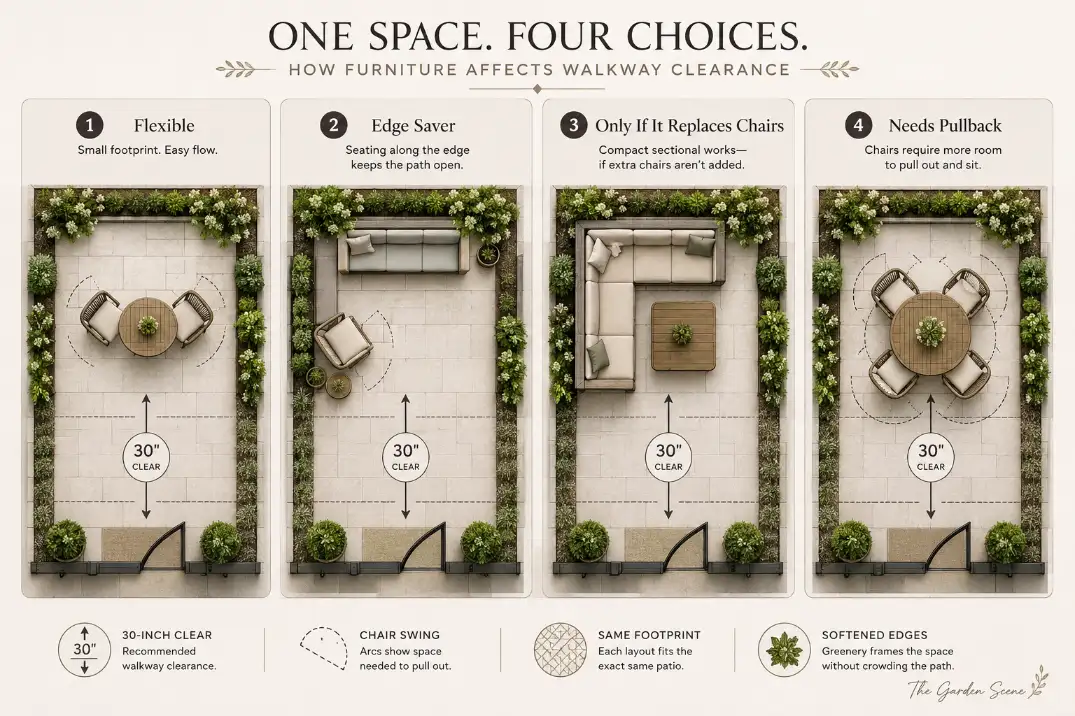
A bistro set is not only for tiny patios. It works whenever the patio needs to stay flexible: apartment patios, side-yard slabs, townhouse decks, and spaces where furniture must move for cleaning or storage.
Folding chairs are especially useful when guests are occasional rather than daily.
The tradeoff is comfort. A bistro set is good for coffee, drinks, or a short meal. It is not the best choice if the patio’s main purpose is two-hour dinners.
Benches save space only against an edge
Benches are often described as space-saving, but that is only true when they sit against a wall, rail, planter edge, or fence line. A freestanding bench in the middle of a small patio can block movement as much as chairs do.
A bench works best when it replaces two loose chairs and keeps one side of the patio visually calm. It works poorly when it becomes another obstacle between the door and the yard.
Sectionals work when they replace loose chairs
A sectional can be efficient because it seats several people along the perimeter. But it stops making sense when the chaise blocks the only route or when the corner piece forces everyone to walk around the longest side.
On patios under 10 feet wide, choose a compact, armless, or low-profile sectional only if it sits cleanly along the edge. The goal is fewer loose legs and clearer circulation, not just more cushions.
For small sectional decisions, Small Patio Sectional Sofa Layout Ideas helps separate useful sectionals from pieces that overpower the patio.
Dining sets need chair clearance, not just table space
A dining set may fit when the chairs are pushed in, but that is not the real layout. The real layout includes people sitting, standing, pulling chairs back, and walking behind them.
For small patios, round tables are usually more forgiving. Rectangular tables work better when the patio has a long uninterrupted edge and the chairs do not back into the main path.
The Mistake That Changes With Patio Size
Under 80 square feet, the main mistake is buying furniture by the number of seats instead of the depth of each piece. Two comfortable seats beat four cramped ones.
From 80–120 square feet, the mistake is trying to combine dining and lounging. This is the range where one strong purpose almost always feels better than two weak ones.
From 120–160 square feet, people often center everything. Centering can look tidy, but it wastes the edges and forces traffic around all sides. Moving the main piece to an edge usually creates more usable space.
From 160–220 square feet, the mistake is creating two zones without a circulation spine. The zones may fit, but people still cut through the dining chairs or squeeze behind the sofa.
Above 220 square feet, the mistake reverses. Furniture gets scattered too far apart, and the patio loses comfort. Large patios need grouping, not just more pieces.
What Changes on Decks, Balconies, and Covered Patios
Decks, balconies, and covered patios follow the same clearance rules, but the edges matter more. Railings reduce usable depth, apartment doors often create stricter entry paths, and covered patios may have posts, ceiling fans, lights, and roof drip lines that limit where furniture can sit.
On balconies, folding or stackable furniture usually beats fixed lounge furniture because storage and cleaning access matter. On wood decks, avoid using a rug to hide layout problems if it traps moisture underneath.
In humid climates, a rug or cushion cluster that stays damp longer than 24 hours after normal rain is not just inconvenient; it is a sign the layout is slowing drying.
Grills also need more caution under covered spaces. Treat the grill as a service zone, not a social centerpiece. Keep it out of the chair pullback area and away from the main door path.
Quick Layout Checklist Before You Buy
- Mark a 30-inch main path with tape or chalk before placing furniture.
- Pull dining chairs back 24–30 inches and test the walkway again.
- Keep 16–18 inches between lounge seating and a coffee table.
- Place the longest furniture piece against the longest clear edge.
- Avoid adding accessories if the main path is already under 30 inches.
- Check the patio during the hottest 2–3 hours of the afternoon before choosing the main seating spot.
- After rain, avoid making any corner the lounge zone if it stays wet longer than 24 hours.
When the Standard Fix Stops Working
Removing one chair is not always enough
Removing a chair works when the issue is furniture volume. It does not work when the patio’s door, slope, posts, or walkway are forcing every layout into the same conflict.
If the main path still cuts through the dining set after one chair is removed, the furniture count is not the real issue. The arrangement is. Shift the table, rotate the layout, or move the primary seating group to an edge.
Accessories can make a small patio worse
Storage benches, ottomans, plant stands, bar carts, and large side tables often feel practical. On patios under 100 square feet, they usually become obstacles unless they replace something else.
A storage bench only helps if it also functions as seating and stays against an edge. A bar cart only helps if it can park outside the walking route. If every useful item has to be moved before dinner, the layout is not working.
Surface problems are not furniture problems
If chairs rock, rugs stay wet, or water pools under the table, furniture placement can only do so much. The layout may be reacting to a surface or drainage problem. In that case, buying smaller furniture is often a temporary fix.
A patio should drain away from the house and dry predictably after normal rain. If one furniture zone stays wet while the rest of the patio dries, solve the surface issue before making that corner the main seating area.
When layout and site problems overlap, Fix Drainage or Layout First? helps clarify which problem deserves attention first.
Questions People Usually Ask
What is the best patio furniture layout for a small patio?
The best small patio layout usually has one main use, one open walking path, and furniture placed along the edges. For patios under 100 square feet, a bistro set, bench-and-chair layout, or loveseat with one chair usually works better than a full conversation set.
How much space do you need around patio furniture?
Use at least 30 inches for the main walking path, 24–30 inches behind dining chairs, and 16–18 inches between lounge seating and a coffee table. These clearances matter more than the patio’s listed square footage because they reflect how the space works when people are actually using it.
Is a sectional good for a small patio?
A sectional is good for a small patio only when it replaces several loose chairs and sits along the edge. It is a poor choice when the chaise crosses the walkway, blocks the door route, or forces people to step around the longest side.
Should patio furniture face the house or the yard?
Furniture should face the best view or main conversation point unless that blocks circulation.
If facing the yard interrupts the door-to-yard route, keep the main piece along the edge and angle one movable chair instead of rotating the whole group into the walkway.
For broader official guidance on clear accessible routes, see the ADA Standards for Accessible Design.