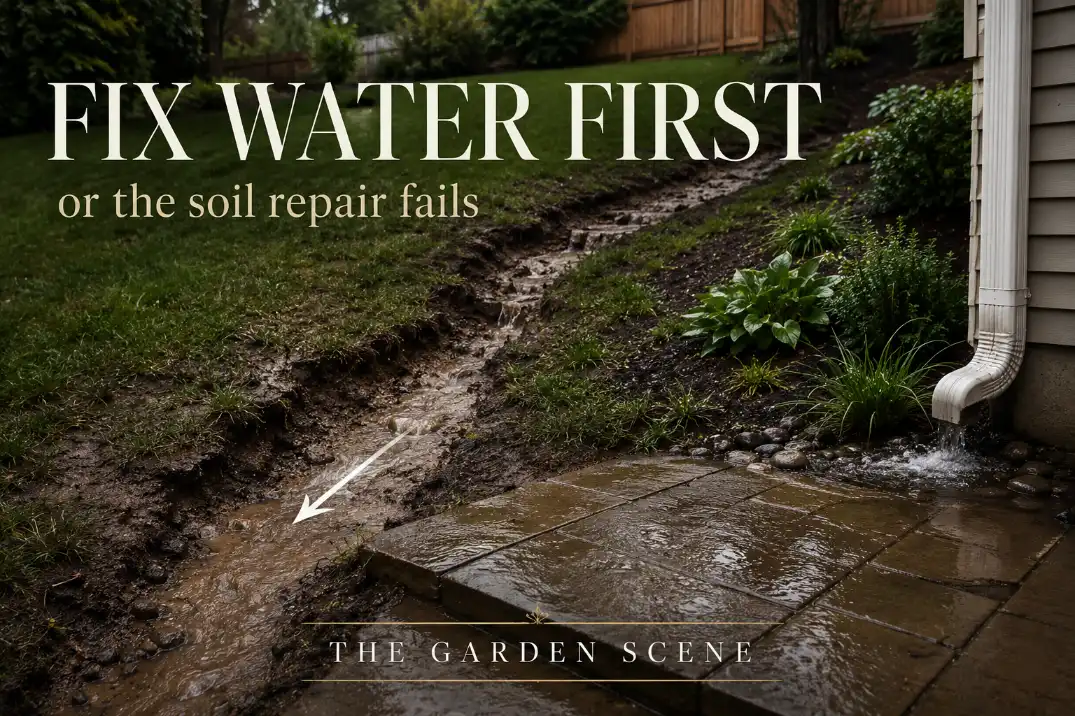
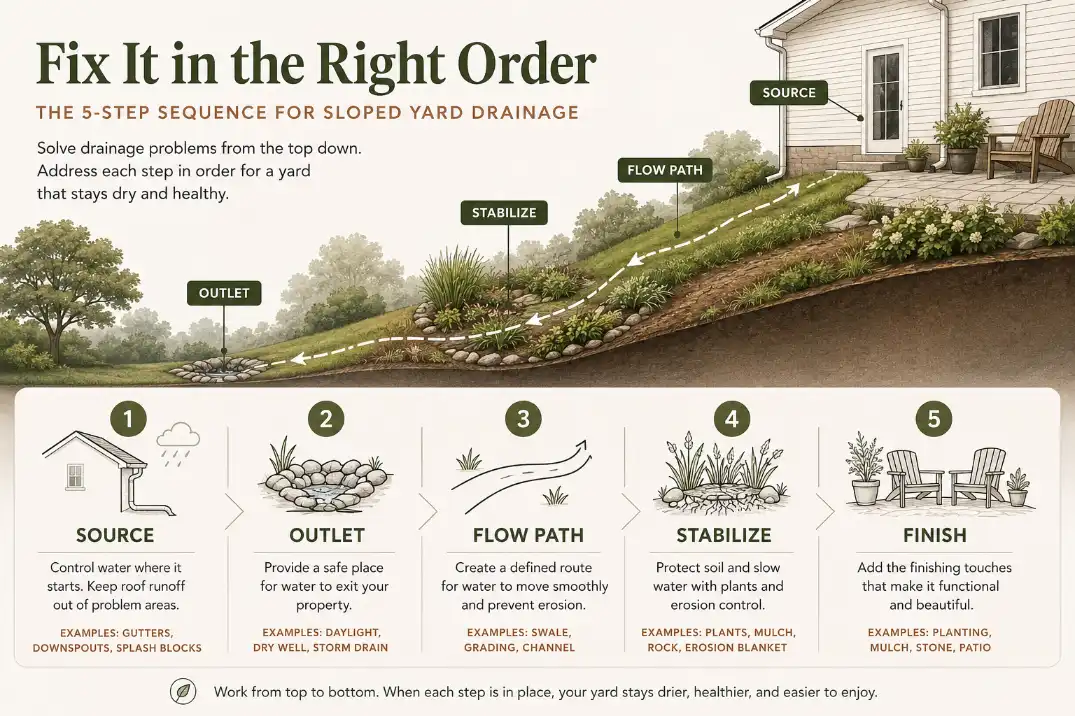
The right order is simple but often ignored: control the water source first, confirm where water can safely go, shape the flow path, stabilize the soil, then finish with grading, planting, or hardscape.
Most failed repairs happen because homeowners treat erosion as a surface problem when it is really a water movement problem.
Start by separating three issues that look similar. If water visibly moves and cuts channels, you have a runoff problem. If water sits for more than 24 to 48 hours after normal rain, you have a drainage or infiltration problem.
If the ground sends water toward a patio, fence, neighbor, or foundation, you have a slope and grading problem. A 1-inch-deep soil channel after one storm matters more than a damp patch that dries by the next afternoon.
The mistake is fixing the most visible damage first. Mulch, seed, sod, and decorative stone rarely hold until the water route is under control.
Start Here: What Kind of Failure Are You Actually Fixing?
Moving water is different from wet soil
A wet yard and an eroding yard are not the same repair. Wet soil usually means water is trapped, absorbing slowly, or has no outlet. Erosion usually means water is moving too fast, too often, or through too narrow a path.
That distinction changes the first fix. A soggy low spot may need a better outlet, soil improvement, or a rain garden. A narrow muddy line down a slope needs flow control before new plants or mulch make sense.
Use the first storm as a diagnostic test
The most useful inspection happens during steady rain or within the first hour after it stops. Look for water entering from downspouts, driveways, uphill beds, patios, or neighboring slopes. Silt fans, flattened mulch, exposed roots, and small gravel trails show where water has been moving.
If the same path appears after two or three storms, treat it as a system problem, not a one-time washout.
| What you see | Most likely problem | Fix first |
|---|---|---|
| Water cuts a visible channel | Concentrated runoff | Intercept and slow the flow |
| Lawn stays soggy for 48+ hours | Poor drainage or trapped water | Create an outlet or improve infiltration |
| Soil washes from patio edge | Hardscape discharge | Control where patio runoff exits |
| Water sits near foundation | Bad grade or roof water | Move water away from the house |
| Bottom of slope stays wet | Seepage or saturated soil | Check subsurface water before surface fixes |
The Correct Order for Fixing Slope, Drainage, and Erosion
1. Control the source before touching the surface
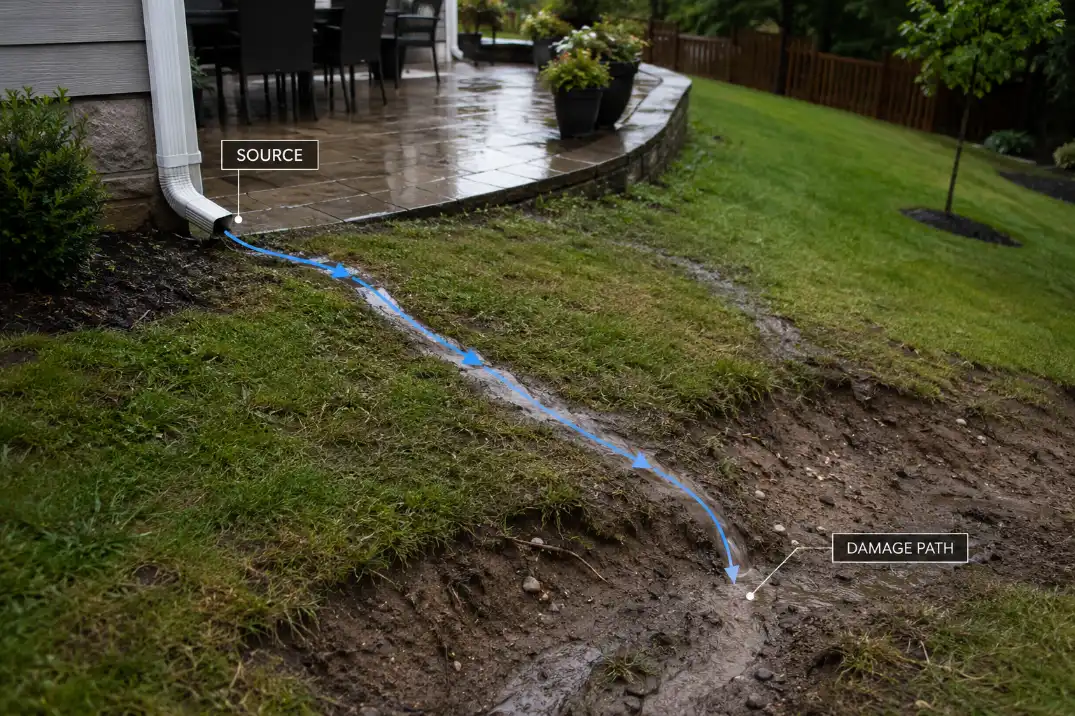
The first job is to stop extra water from entering the wrong place. Downspouts, clogged gutters, sump discharge, driveway runoff, pool overflow, and uphill slope runoff can all overload a small area.
Roof water is especially easy to underestimate. One inch of rain on 1,000 square feet of roof produces more than 600 gallons of water. If much of that exits from one downspout onto a sloped bed, no mulch layer or new grass seed will stay put for long.
Downspouts should usually discharge at least 5 to 10 feet from the foundation when the grade allows. If water still turns back toward the house, the extension is not long enough or the receiving grade is wrong.
This is also why drainage should usually be evaluated before major layout decisions. If a future patio, walkway, or planting bed crosses the natural escape route, the design may create the very problem it is supposed to fix. That same sequencing issue is central when deciding whether to fix drainage or layout first.
2. Confirm the outlet before collecting water
A French drain, catch basin, channel drain, dry creek bed, or swale is only useful if the water has somewhere safe to go. Collecting water without a legal, reliable outlet just concentrates the problem.
A surface drainage route often needs about 1% to 2% fall to move water predictably, or roughly 1 to 2 feet of drop over 100 feet. A shallow swale can work with a modest pitch, but it still needs a discharge area that will not flood a neighbor, sidewalk, driveway, or foundation.
Do not assume a buried pipe is automatically better. If the pipe collects leaves, mulch, roof grit, and sediment, it needs cleanouts. A drain that cannot be inspected or flushed can fail quietly until water resurfaces in the same bad spot.
Pro Tip: Before trenching, call 811 and check local rules if water will be discharged near a curb, storm drain, easement, property line, or public sidewalk.
3. Shape the flow path
Once the source and outlet are understood, shape the path water should follow. This may mean a shallow swale, a graded flow line, a stone-lined discharge area, a rain garden, or a drain inlet in a low spot.
The goal is not always to remove water as fast as possible. On slopes, the better goal is often to slow it, spread it, and keep it from carrying soil. A wide, shallow flow path is usually less damaging than a narrow groove that speeds downhill.
For patios, pay close attention to the edges. A common target is about 1/8 to 1/4 inch of fall per foot away from the house. Too little pitch leaves water standing. Too much pitch can push runoff aggressively into one low edge, where it starts undercutting soil or washing out joints.
If water repeatedly pools where a patio meets the house, treat it as a grading and drainage issue, not a patio-cleaning issue. The warning signs are similar to the ones homeowners face when patio water pools against the house.
4. Stabilize exposed soil
Only after the water route is controlled should the surface repair begin. Bare soil, loose mulch, and fresh seed are weak on active runoff paths. They need protection while roots establish and soil settles.
Turf can take 2 to 6 weeks to root well enough to resist light flow. Groundcovers may need a full growing season before they knit together. On an active slope, that establishment window is too long unless the soil is temporarily protected.
Erosion-control blankets, pinned jute netting, coir logs, stone aprons, check dams, and dense planting bands all help reduce water speed. The right choice depends on how steep the slope is and whether the flow is broad or concentrated. For steeper yards, the practical difference between temporary cover and real stabilization is easier to see when comparing ways to stop erosion in a sloped backyard.
5. Finish with grading, planting, or hardscape
Finish work comes last because it is the easiest part to ruin. Regrading, new sod, gravel paths, planting beds, patio extensions, and decorative stone all depend on the earlier steps.
Fresh fill can wash out in the first few strong storms if water is still entering the same place. New plants can fail before their roots matter. Gravel can migrate downhill. Pavers can settle or heave if runoff keeps softening the base.
A good finish should reinforce the water plan, not hide it.
What Usually Gets Fixed Too Early
Regrading before drainage
Regrading feels like the big fix because it changes the shape of the yard. But if uphill runoff or roof water still enters the area, new soil simply becomes new material for the water to carry away.
Regrading should refine a drainage plan. It should not be asked to solve an uncontrolled water source by itself.
Mulch before flow control
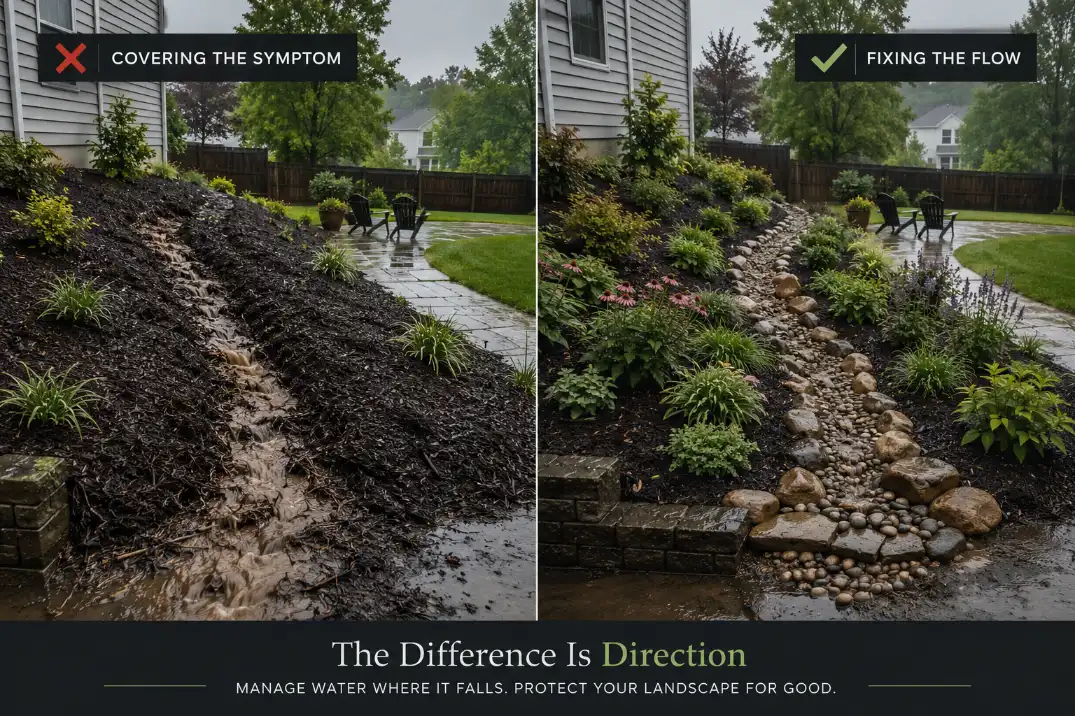
Mulch protects calm soil. It does not stop moving water. If mulch washes out more than once in a season, the problem is usually water speed, not mulch depth.
Adding another inch often just gives the runoff more loose material to move. In active channels, use stone, pinned erosion matting, dense rooted planting, or a defined drainage path instead.
Plants before roots can hold
Plants help erosion after they establish. They are not instant retaining systems.
This is where many homeowners overestimate new roots and underestimate shallow runoff. Even a half-inch sheet of fast-moving water can expose seed, loosen small plugs, and push mulch downhill. On a slope, water velocity matters more than how dramatic the slope looks.
Which Fix Belongs at Which Stage?
| Fix | Best used when | Avoid relying on it when | Best stage |
|---|---|---|---|
| Downspout extension | Roof water starts the washout | It sends water toward a neighbor or low foundation area | Source control |
| Swale | Surface runoff needs a wider path | The yard is too flat or the outlet is unclear | Flow path |
| French drain | Water is trapped or emerging below the surface | Surface runoff is the real problem | Outlet and subsurface control |
| Rain garden | Water can safely collect and soak in | Clay soil stays wet longer than 48 hours | Outlet/infiltration |
| Erosion blanket | Soil needs protection while roots establish | Water is still cutting a channel | Stabilization |
| Regrading | The land shape sends water the wrong way | Source and outlet are still unknown | Finish or correction |
The most common wasted fix is using a later-stage solution as if it were a first-stage solution. Sod, mulch, plants, and decorative gravel are finish materials unless the flow has already been controlled.
Foundation Drainage Gets Priority Over Lawn Repair
Water near the house outranks almost every other yard concern. A soggy planting bed is annoying; repeated water against a foundation, slab edge, crawlspace vent, or basement wall can become expensive.
As a practical rule, the grade near the house should move water away from the foundation, not hold it there. Be cautious when water remains within 10 feet of the house after rain, especially if the soil is still wet the next day. Also avoid solving a low spot by piling soil high against siding, brick weep holes, vents, or wood trim.
A yard can tolerate some seasonal dampness. A foundation should not be used as the outlet.
When the Problem Comes From Inside the Slope
Not all drainage starts on the surface. Sometimes water appears from within the slope itself, especially after long rain, snowmelt, irrigation leaks, or saturation in clay-heavy soil.
Signs of seepage rather than runoff
Look for wet soil at the toe of the slope after the upper slope has dried. Watch for soft ground, small springs, slumping soil, or water emerging from a slope face rather than flowing down from above.
This changes the repair. A surface swale may help runoff, but it will not fix water that is moving through the soil. Subsurface interception, drain rock, perforated pipe, or professional grading may be needed, especially near retaining walls or structures.
Why this matters on clay soil
Clay can shed water when compacted and hold water when saturated. That means the same yard can have runoff and soggy soil at the same time. In parts of the Midwest and Southeast, this combination is common after repeated storms.
If water lingers longer than 48 hours and erosion also appears nearby, do not assume one fix will solve both. You may need both an outlet for excess water and stabilization for the slope surface.
When This Stops Being a DIY Yard Fix
DIY is reasonable when the path is obvious
A homeowner can often handle small runoff corrections when the water source is visible, the outlet is safe, and no structure is involved. Extending downspouts, reshaping a shallow bed edge, adding a stone apron at a discharge point, pinning erosion blanket, or planting a mild slope can be reasonable DIY work.
The key is scale. If the erosion is shallow, the slope is safe to stand on, and the fix does not affect a neighbor, public drainage system, septic field, retaining wall, or foundation, the risk is usually manageable.
Bring in help when water threatens structures
Professional help makes sense when water reaches the foundation, enters a basement or crawlspace, undermines a patio, appears from inside a slope, or collects behind a retaining wall. The same is true when a wall bulges, leans, cracks, separates at capstones, or has sinking soil behind it after rain.
Those are not normal landscaping problems. They may be structural drainage problems. If a wall is involved, the warning signs overlap with broader retaining wall failure signs on a sloped backyard.
Also bring in help when the drainage outlet requires buried pipe across a long distance, curb discharge, storm-system connection, or work close to utilities. The cost of guessing wrong is higher than the cost of a better diagnosis.
Questions People Usually Ask
Should I regrade before installing a French drain?
Usually no. First identify the source and outlet. A French drain is useful when water is trapped below the surface or needs subsurface interception. If the main problem is visible runoff moving across the surface, a swale, grading correction, or source-control fix may matter more.
Can plants fix erosion on a slope by themselves?
Only when runoff is already slow enough for roots to establish. If water is cutting channels, plants need help from erosion blanket, coir logs, stone, terracing, or a corrected flow path. Roots are a long-term stabilizer, not an immediate brake.
Is standing water always a drainage failure?
Not always. A shallow puddle after a heavy storm may be normal if it disappears within 24 hours and is far from the house. Water that remains for more than 48 hours, returns after modest rain, or sits near a foundation is more concerning.
Final Decision Rule
If water is moving, fix the route first. If water is sitting, find out whether it needs an outlet, better soil structure, or a safe place to soak in. If soil is washing away, stabilize it only after the water has been slowed or redirected. If the ground shape sends water toward a house, patio, wall, or neighbor, correct the grading after the source and outlet are clear.
The strongest order is: source, outlet, flow path, stabilization, finish. Repairs done in that order last longer because they solve the mechanism instead of covering the visible damage.
For broader official guidance on landscape drainage problems, see Oklahoma State University Extension.