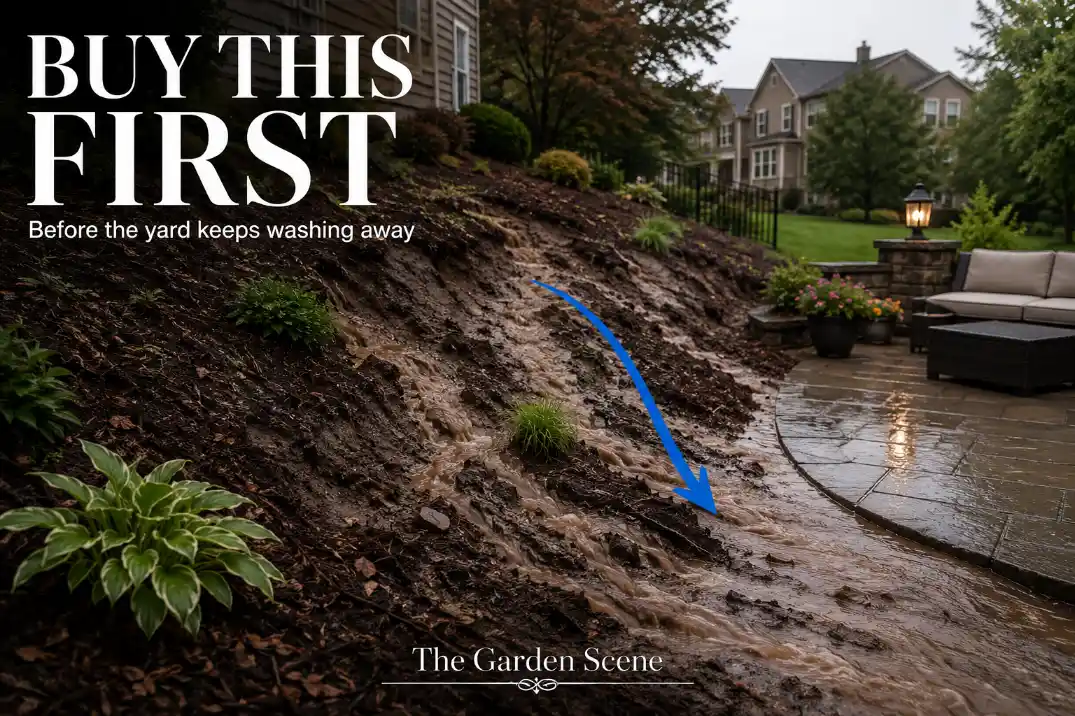
The best drainage and erosion control products to buy first are the ones that reduce water force before the yard keeps losing soil. In most problem backyards, that usually means starting with downspout extensions or solid drain pipe if roof water is involved, then using erosion control blankets where bare soil is washing. Gravel, edging, wattles, and French drain kits can help, but they are often second-step products.
A backyard that stays wet for 24–48 hours after ordinary rain is mainly showing a drainage issue. A backyard with soil channels, exposed roots, mulch pushed downhill, or sediment collecting on a patio is showing erosion. Those problems overlap, but they are not the same buying decision. Standing water needs routing, storage, or absorption. Moving water needs slowing, spreading, and surface protection.
The mistake is buying the product that looks most serious first. A French drain kit may be right later. But if a downspout is dumping roof runoff into a bed, the smarter first purchase is usually simpler, cheaper, and closer to the source.
Quick Answer: What to Buy First
Start with the water source, not the damaged spot
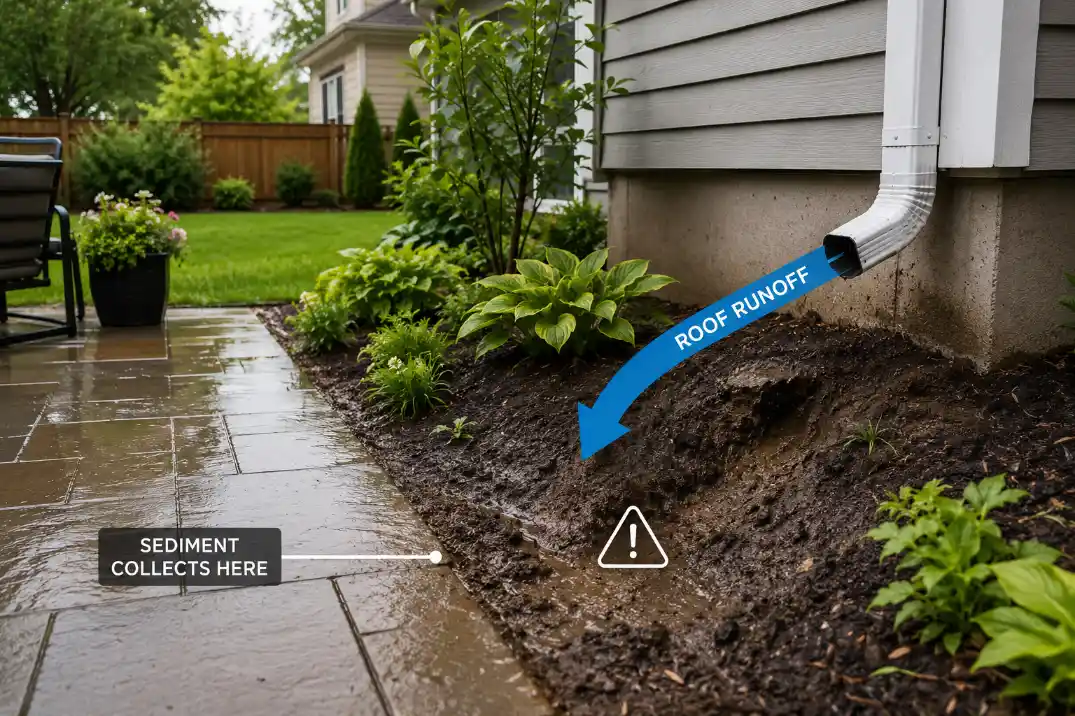
If gutter water is part of the problem, buy downspout extensions or solid drain pipe before buying erosion fabric, gravel, or mulch. Roof runoff is concentrated. During a 1-inch rain, even a modest roof section can send hundreds of gallons of water toward one low spot.
If the visible damage is bare soil washing down a slope, start with erosion control blankets or biodegradable matting. Those products protect the soil surface while grass, groundcover, or new planting roots establish.
If water is pooling at a patio edge, do not assume gravel is the fix. Gravel can hide wetness without correcting where the water enters or exits. Patio-related drainage usually needs closer diagnosis, especially in cases like backyard drainage getting worse after adding a patio or walkway.
| Backyard condition | Product to consider first | Why it belongs early | Skip it if |
|---|---|---|---|
| Downspouts dump into beds or lawn | Downspout extension or solid drain pipe | Removes concentrated roof runoff | Water comes from uphill land instead |
| Bare soil washes downhill | Erosion control blanket | Protects soil while roots establish | The slope is sliding or bulging |
| Mulch keeps moving | Straw wattles or coir logs | Slows shallow surface flow | Water is deep, fast, or concentrated |
| Muddy walking path | Geotextile fabric plus angular gravel | Stabilizes traffic areas | There is no outlet for water |
| Patio edge collects sediment | Regrading or drain interception | Stops water before it crosses hardscape | The patio pitches toward the house |
The Two Product Categories That Usually Matter Most
1. Downspout extensions and solid drain pipe
Roof runoff is the first thing to rule in or out because it can create a backyard drainage problem even when the yard itself is not badly graded. A downspout that empties into a planting bed, narrow side yard, slope, or patio edge can create erosion long before the homeowner notices the source.
Flexible downspout extensions are the lowest-cost first step when the outlet can stay visible and water only needs to move 4–10 feet to reach lawn, stone, or another stable discharge area. Buried solid pipe kits make more sense when the route crosses lawn, walkway edges, or visible patio zones.
Solid drain pipe is the stronger choice when the route needs to be longer, cleaner, buried, or less prone to crushing. Look for 4-inch solid corrugated pipe or PVC drain pipe, compatible elbows, secure adapters, and a discharge point that does not send water toward a foundation, sidewalk, neighbor’s yard, or low planting bed.
The key distinction is solid versus perforated pipe. Solid pipe carries roof water away. Perforated pipe collects or disperses water along its length. For downspout discharge, solid pipe is usually the cleaner first-buy category.
This is the category to browse first when the wettest or most eroded area sits below a gutter outlet. Surface erosion products may slow the damage, but they will not solve the source if concentrated roof water keeps hitting the same weak spot.
FIRST BUY FOR ROOF RUNOFF
Downspout Extensions or Solid Drain Pipe Kits
Best for backyards where gutter water dumps into planting beds, slopes, patio edges, or low lawn areas.
Choose a flexible extension for a short visible route; choose a buried solid pipe kit when the water needs a cleaner, longer path.
Look for 4-inch pipe compatibility, secure gutter adapters, crush-resistant pipe, cleanout access, and a clear discharge point.
🔴 SHOP downspout extension kits
2. Biodegradable erosion control blankets
Bare soil on a slope is vulnerable even before it looks dramatic. Raindrops loosen the surface, then shallow runoff carries the fine particles first. That is why the top of a slope may look only a little thin while the bottom collects muddy sediment after every storm.
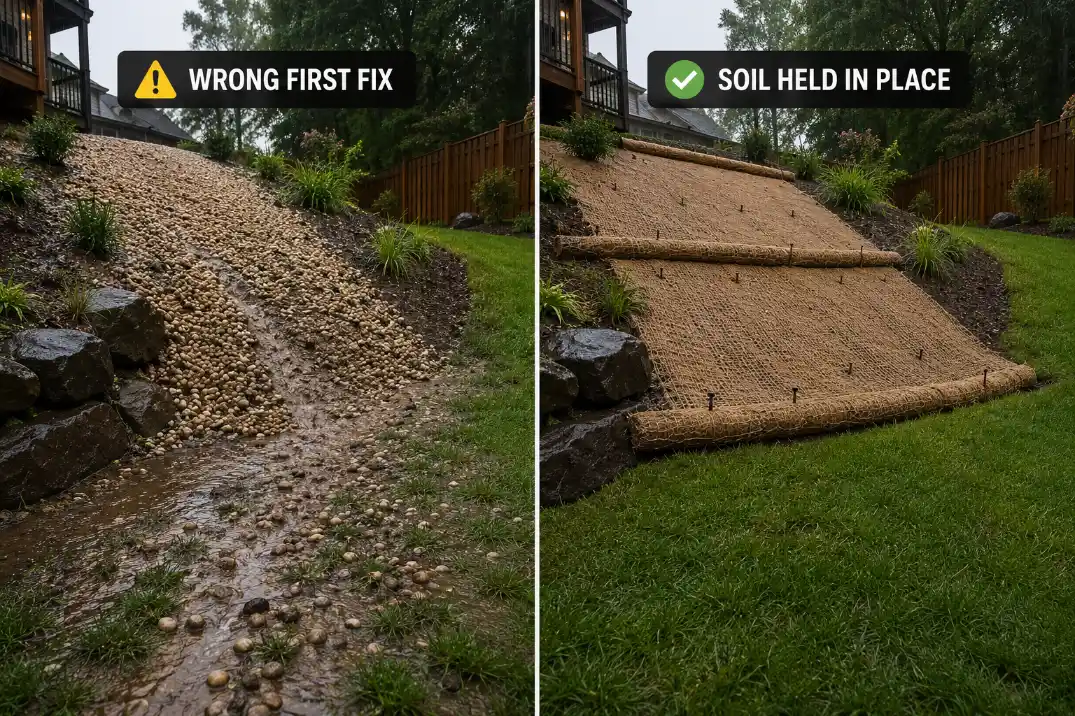
Erosion control blankets are worth buying early when the slope is still stable but exposed. For most residential backyards, biodegradable straw, coconut fiber, or wood-fiber blankets are better first choices than permanent plastic netting because they protect the surface while roots take over.
A practical limit is a mild to moderate slope up to about 3:1, meaning 3 feet of horizontal run for every 1 foot of rise. Steeper slopes, cracked soil, bulging ground, or leaning walls are not simple blanket problems. Those conditions need grading, terracing, wall repair, or professional drainage evaluation.
When choosing erosion blankets, roll size is not the main issue. Check the slope rating, fiber density, biodegradability, and staple requirements. Softer soil may hold 6-inch landscape staples; loose, sandy, or exposed slopes often need 8–12 inch staples and closer spacing. A blanket that does not stay tight against the soil lets water run underneath, which defeats the point.
This is where many homeowners waste money on mulch. Mulch helps cover soil, but it does not anchor a slope by itself. If mulch slides after the first few storms, the missing product is usually a blanket, wattle, edging, or planting strategy—not a more expensive mulch blend. That same logic applies to many cases of bare soil washout on sloped backyards.
If the soil is exposed and the slope is not structurally failing, this is the strongest erosion-control category to browse first. It protects the surface immediately while plants do the longer-term work.
BEST FIRST COVER FOR BARE SLOPES
Biodegradable Erosion Control Blankets
Best for exposed backyard slopes where soil washes away before grass, groundcover, or new planting can establish.
Choose straw blankets for mild temporary cover and coir-heavy blankets where the slope needs longer-lasting protection.
Look for excelsior, straw, jute, or coir fiber construction, biodegradable netting, slope rating, and enough 6–12 inch staples for tight soil contact.
🔴 SHOP biodegradable erosion control blankets
Useful Support Products, But Not Always First
Straw wattles and coir logs
Straw wattles and coir logs are useful when shallow sheet flow is moving across a slope. Their job is to slow water, catch sediment, and reduce cutting force. They are especially helpful while seed, groundcover, or new planting is getting established.
Use them across the slope, not straight downhill. On mild slopes, spacing every 10–20 feet may be enough. On steeper or more exposed areas, closer spacing performs better. The product needs contact with the soil; if water tunnels underneath, it can create a sharper erosion channel.
Coir logs usually last longer and look neater near visible planting beds or slope edges. Straw wattles are cheaper and often make sense as a temporary stabilizer. Both are support products. They are rarely the first purchase if the main problem is roof runoff.
Gravel, geotextile fabric, and edging
Gravel can help, but only when it has a defined job. It works better for stabilizing muddy traffic paths, lining dry creek-style swales, or protecting a discharge area than for vaguely “drying out” a wet backyard.
Geotextile fabric matters because it separates soil from stone. Without it, fine soil migrates into the gravel layer and reduces performance. A thin 1-inch layer of decorative gravel over soft soil is mostly cosmetic. A more functional surface often needs 3–4 inches of angular stone over fabric, plus edging to keep the stone from spreading.
Heavy-duty edging becomes useful when the gravel itself must stay in a channel or path. Thin plastic edging often bows, lifts, or loses its line, especially in freeze-thaw regions. In hot, dry climates, UV exposure can also make lightweight plastic brittle faster than buyers expect.
This is the product category homeowners often overestimate. Gravel looks like drainage, but it does not create an outlet. If water has nowhere to go, gravel can simply hide mud for a while.
When a Bigger Drainage Product Makes Sense
French drain kits need a clear inlet and outlet
French drains are often bought too early. They are useful when subsurface water needs to be collected and redirected, but they are not the default answer for every muddy lawn or washed-out bed.
A French drain makes sense when you know where water enters, how it will reach the trench, and where it will discharge. Without a reliable outlet, the drain can become a buried wet zone. In heavy clay soil, that mistake is common because water enters slowly and exits slowly.
If water is flowing across the surface from an uphill slope, a buried perforated pipe may miss much of the problem. If water is coming from a downspout, a solid pipe route usually makes more sense than trying to soak roof water into a gravel trench near the house.
Patio pooling also needs caution. If the hardscape pitches toward the house or traps water at the edge, the issue may be grade and interception rather than a simple drain kit. That is why water pooling against a patio near the house should be treated as a routing problem first, not just a product problem.
Channel drains are for hardscape interception
Channel drains can be useful at patio edges, driveway edges, and low hardscape transitions. They are not erosion-control products for open soil. They work when water is already crossing a hard surface and needs to be intercepted before it reaches a door, foundation edge, or seating area.
The important buying filter is capacity and outlet planning. A narrow drain with a poor outlet may clog or overflow during heavy rain. In regions with intense summer storms, such as parts of the Southeast, this matters more than appearance. A clean grate is not enough if the drain body and pipe cannot move the water volume.
What People Usually Misread Before Buying
The puddle is a symptom, not always the source
The lowest wet spot gets attention because it is visible. But the useful clue is often uphill: a downspout, compacted path, patio edge, bare slope, or fence-line channel. Buying for the puddle alone can lead to the wrong product.
Sediment is often more decision-useful than standing water. A puddle shows where water stops. Sediment shows where water moved. If the same muddy fan appears after each storm, that tells you the flow path better than the wet spot itself.
“More absorbent” is not always the answer
Many homeowners assume the yard needs to absorb more water. Sometimes it does. But compacted soil, clay, shade, and poor grading can limit absorption no matter what product goes on top.
A practical threshold: if water still sits more than 48 hours after normal rainfall, surface products alone are unlikely to solve the whole problem. If soil disappears, mulch migrates, or channels deepen after every storm, the problem is active water movement, not just slow drying.
At that point, the first purchase should reduce force or redirect volume. Decorative fixes can wait.
When Not to Buy Yet
Delay products if the slope is moving
Surface erosion removes soil from the top. Slope movement changes the shape of the ground. Cracks, bulging soil, leaning retaining walls, or shifting fence posts are not solved by blankets, wattles, or gravel.
A routine DIY product also stops making sense when water repeatedly moves toward the foundation, crosses property lines, or collects several inches deep after ordinary storms. Those situations may involve grading, retaining, discharge rules, or structural drainage decisions.
For more serious sloped-yard warning signs, sloped backyard drainage, erosion, and safety problems is a better next read than another product category.
Skip decorative fixes until the route is controlled
Fresh mulch, river rock, stepping stones, and new plants can all look like progress. They become wasteful when the water path is still uncontrolled. If a backyard loses mulch twice in one rainy season, the yard is not asking for premium mulch. It is asking for water control.
The healthier condition is quiet: water leaves without cutting channels, soil stays covered, and the surface firms up within a day or two after typical rain. The failing condition is active: the same channel deepens, sediment lands in the same place, and each storm expands the repair area.
Practical Buying Verdict
For most problem backyards, buy in this order.
Start with downspout control if roof water is involved. It is the highest-leverage first purchase because it removes concentrated water before it damages soil, beds, patios, or paths.
Next, protect exposed soil with biodegradable erosion control blankets if the slope is stable but washing. This is the strongest first erosion-control purchase because it protects the surface while vegetation establishes.
Use straw wattles, coir logs, gravel, geotextile fabric, and edging as support products once you understand the flow path. They can be useful, but they should not distract from the two core questions: where is the water coming from, and what surface is failing first?
Save French drains, channel drains, and larger drainage systems for cases where the source, collection point, and outlet are clear. They may be the right purchase, but they are often not the right first purchase. If the whole yard is hard to use because water, slope, surface, and layout problems overlap, what to fix first in a hard-to-use backyard can help keep the repair sequence realistic.
For broader official guidance, see Illinois Extension’s landscape drainage guidance.